Recognition: unknown
Ultrafast Critical Slowing of Spin Dynamics and Emergent Nonequilibrium Fano Interference in Fe3GeTe2
Pith reviewed 2026-05-14 17:46 UTC · model grok-4.3
The pith
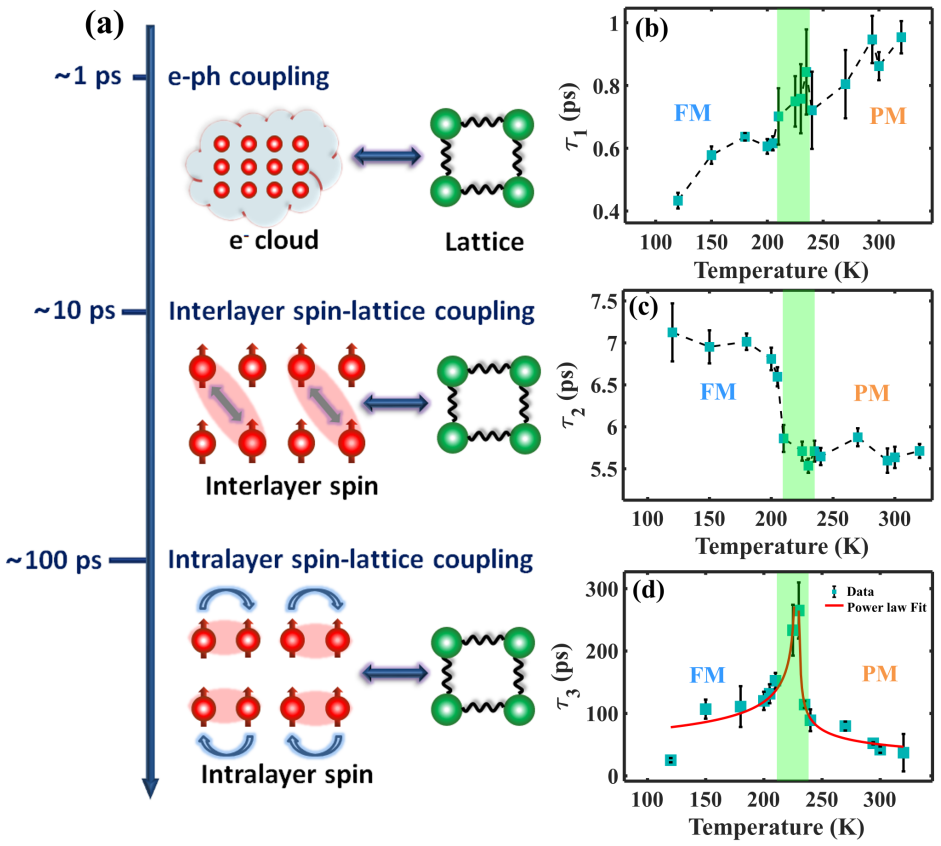
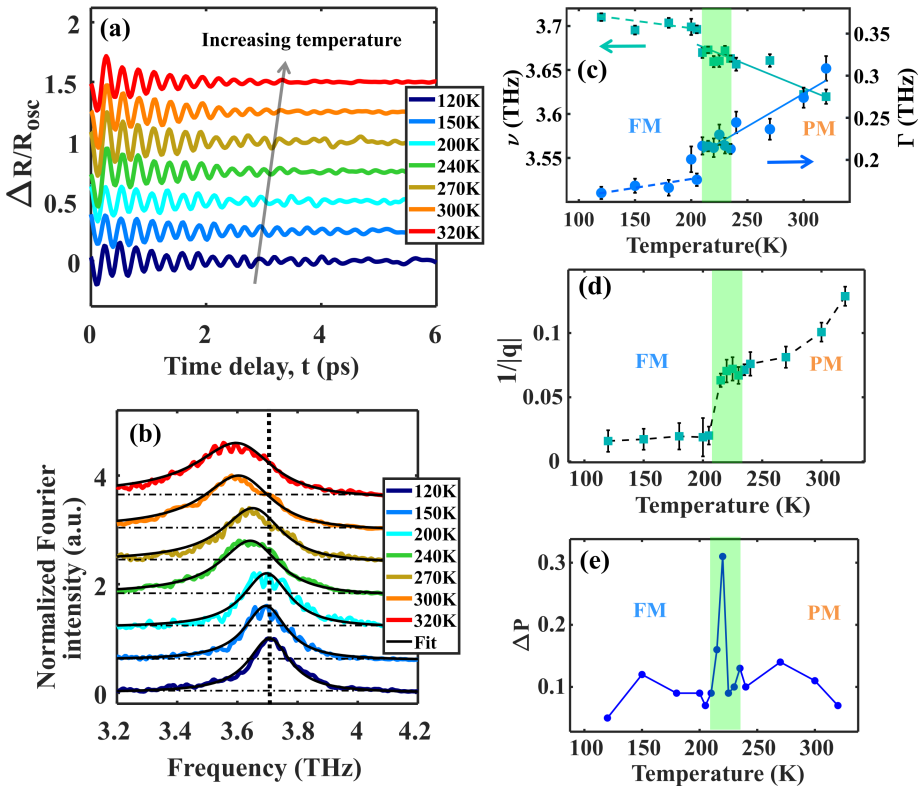
In Fe3GeTe2, time-resolved reflectivity shows spin relaxation slowing critically near the Curie temperature with an exponent near 0.3, while an A1g phonon Fano asymmetry emerges and grows in the paramagnetic phase.
A machine-rendered reading of the paper's core claim, the machinery that carries it, and where it could break.
Core claim
The time-resolved reflectivity in Fe3GeTe2 follows a tri-exponential form in which the slowest component exhibits critical slowing down with an exponent of approximately 0.3, linked to intralayer spin correlations, while the intermediate component displays an anomaly near the Curie temperature arising from enhanced interlayer spin-lattice interactions. An emergent nonequilibrium Fano asymmetry appears in the A1g phonon mode, suppressed in the ferromagnetic phase but anomalously enhanced in the paramagnetic regime through thermally activated anharmonic decay channels that connect to a hot electronic continuum. The acoustic strain pulse amplitude also increases near Tc, demonstrating robustmag
What carries the argument
tri-exponential decomposition of the two-color pump-probe reflectivity transient, whose temperature-dependent amplitudes and time constants isolate critical spin slowing, interlayer spin-lattice coupling, and the nonequilibrium A1g Fano lineshape
If this is right
- Relaxation dynamics in this material are non-universal and dominated by intralayer rather than conventional three-dimensional critical fluctuations.
- Interlayer spin-lattice coupling strengthens enough near Tc to produce a detectable anomaly in the intermediate relaxation channel.
- Magnetoelastic coupling remains strong, as evidenced by the pronounced increase in acoustic strain amplitude close to the magnetic transition.
- The nonequilibrium Fano asymmetry provides a spectroscopic signature of phonon-electron continuum coupling that is gated by magnetic order.
Where Pith is reading between the lines
- Similar critical slowing and Fano signatures may appear in other itinerant van der Waals magnets whose Curie temperatures can be tuned by gating or pressure.
- The temperature window above Tc where the Fano asymmetry grows could be exploited to control phonon lifetimes optically in magnetic 2D devices.
- Extending the same pump-probe geometry to spatially resolved or magnetic-field-dependent measurements would test whether the intralayer correlations are truly two-dimensional.
Load-bearing premise
The mechanistic links between the slowest relaxation component and intralayer spin correlations, and between the Fano enhancement and specific anharmonic decay pathways to the electronic continuum, rest solely on the quality of the tri-exponential fits and the observed temperature trends without separate verification of the decay channels.
What would settle it
If independent time-resolved measurements on Fe3GeTe2 near Tc yield a slowest relaxation time constant whose divergence is absent or follows a markedly different exponent from 0.3, or if the A1g phonon asymmetry fails to increase above Tc, the central assignments would be falsified.
Figures



read the original abstract
Fe$_3$GeTe$_2$ is a prototypical metallic van der Waals ferromagnet with itinerant magnetism and a highly tunable Curie temperature, yet how electronic excitations couple to spin and lattice degrees of freedom across its magnetic transition remains largely unexplored. Here, we use two-color pump-probe reflectivity to investigate the coupled electronic, spin, and lattice dynamics. The time-resolved reflectivity exhibits a tri-exponential relaxation, in which the intermediate component shows an anomaly near the Curie temperature due to enhanced interlayer spin-lattice interactions, while the slowest component displays pronounced critical slowing down with an exponent of ~ 0.3, revealing non-universal relaxation dynamics associated with intralayer spin correlations. Furthermore, we observe an emergent nonequilibrium A1g phonon Fano asymmetry that is suppressed in the ferromagnetic phase but anomalously enhanced in the paramagnetic regime, driven by thermally activated anharmonic decay pathways that bridge the kinematic gap to a hot electronic continuum. The pronounced enhancement of the acoustic strain pulse amplitude near T$_c$ further evidences robust magnetoelastic coupling. Overall, our results reveal how magnetic order governs the interplay among critical spin dynamics, electronic continuum excitations, and lattice response in metallic van der Waals ferromagnets
Editorial analysis
A structured set of objections, weighed in public.
Referee Report
Summary. The manuscript reports two-color pump-probe reflectivity measurements on the metallic van der Waals ferromagnet Fe3GeTe2. The time-resolved reflectivity is decomposed into a tri-exponential relaxation, with the intermediate component showing an anomaly near Tc attributed to enhanced interlayer spin-lattice interactions and the slowest component exhibiting critical slowing down with an exponent of ~0.3 linked to non-universal intralayer spin correlations. An emergent nonequilibrium A1g phonon Fano asymmetry is observed, suppressed below Tc but enhanced above Tc and ascribed to thermally activated anharmonic decay pathways coupling to a hot electronic continuum; an enhanced acoustic strain pulse amplitude near Tc is taken as evidence of robust magnetoelastic coupling.
Significance. If the central observations and mechanistic assignments hold, the work provides direct experimental access to coupled ultrafast spin, lattice, and electronic dynamics across the magnetic transition in a tunable itinerant vdW ferromagnet. The reported critical exponent, Fano asymmetry temperature dependence, and magnetoelastic signatures would constitute a useful benchmark for theories of nonequilibrium critical phenomena and phonon interference in low-dimensional magnets, with potential implications for ultrafast spintronics.
major comments (3)
- [Discussion / Fano asymmetry analysis] The central claim that the anomalous enhancement of the nonequilibrium A1g phonon Fano asymmetry in the paramagnetic regime is driven by thermally activated anharmonic decay pathways bridging the kinematic gap to a hot electronic continuum (abstract and discussion) rests on tri-exponential amplitude trends without independent verification such as temperature-dependent phonon linewidths, decay-rate measurements, or computed anharmonic matrix elements; alternative explanations (e.g., Tc-dependent changes in electronic continuum DOS) are not explicitly excluded.
- [Results / critical slowing down] The reported critical slowing-down exponent of ~0.3 for the slowest relaxation component (results on spin dynamics) is extracted from the tri-exponential fits; the manuscript should provide the explicit fitting procedure, uncertainties, and a direct comparison to theoretical expectations for 2D/3D Ising or Heisenberg universality classes to support the interpretation of non-universal intralayer spin correlations.
- [Results / tri-exponential decomposition] The attribution of the intermediate-component anomaly near Tc to enhanced interlayer spin-lattice interactions (results section) is plausible but load-bearing for the coupled-dynamics narrative; robustness against alternative functional forms (e.g., stretched-exponential or biexponential models) and exclusion of purely electronic scattering-rate changes should be demonstrated.
minor comments (3)
- [Abstract and Results] The abstract states an exponent of '~ 0.3'; the main text should report the precise fitted value with uncertainty and the temperature range used for the power-law fit.
- [Figures] Figure captions for the reflectivity traces and Fano fits would benefit from explicit mention of the pump/probe wavelengths and the fitting model employed.
- [Methods / notation] Notation for the A1g phonon mode and the Fano asymmetry parameter should be defined consistently in the text and figures.
Simulated Author's Rebuttal
We thank the referee for their careful reading and constructive comments, which have helped us improve the clarity and rigor of our analysis. We address each major comment point by point below.
read point-by-point responses
-
Referee: [Discussion / Fano asymmetry analysis] The central claim that the anomalous enhancement of the nonequilibrium A1g phonon Fano asymmetry in the paramagnetic regime is driven by thermally activated anharmonic decay pathways bridging the kinematic gap to a hot electronic continuum (abstract and discussion) rests on tri-exponential amplitude trends without independent verification such as temperature-dependent phonon linewidths, decay-rate measurements, or computed anharmonic matrix elements; alternative explanations (e.g., Tc-dependent changes in electronic continuum DOS) are not explicitly excluded.
Authors: We appreciate the referee highlighting the need for stronger support of this assignment. The interpretation relies on the pronounced temperature dependence of the extracted Fano asymmetry parameter, which increases sharply above Tc in a manner consistent with thermally activated anharmonic channels becoming available in the paramagnetic phase. While we lack direct phonon linewidth data or computed matrix elements in the present dataset, we will revise the discussion section to explicitly consider and argue against alternative scenarios such as Tc-dependent modifications to the electronic continuum DOS, drawing on established ARPES results for Fe3GeTe2. This addition will clarify the reasoning without overstating the evidence. revision: partial
-
Referee: [Results / critical slowing down] The reported critical slowing-down exponent of ~0.3 for the slowest relaxation component (results on spin dynamics) is extracted from the tri-exponential fits; the manuscript should provide the explicit fitting procedure, uncertainties, and a direct comparison to theoretical expectations for 2D/3D Ising or Heisenberg universality classes to support the interpretation of non-universal intralayer spin correlations.
Authors: We agree that these details will strengthen the presentation. In the revised manuscript we will specify the exact tri-exponential functional form, outline the fitting protocol (including initial parameter selection, constraints, and convergence), report uncertainties on the time constants and derived exponent, and add a direct comparison to expected dynamic exponents for 2D/3D Ising and Heisenberg classes. This will better justify our conclusion that the observed value reflects non-universal intralayer behavior arising from the itinerant magnetism. revision: yes
-
Referee: [Results / tri-exponential decomposition] The attribution of the intermediate-component anomaly near Tc to enhanced interlayer spin-lattice interactions (results section) is plausible but load-bearing for the coupled-dynamics narrative; robustness against alternative functional forms (e.g., stretched-exponential or biexponential models) and exclusion of purely electronic scattering-rate changes should be demonstrated.
Authors: We thank the referee for this recommendation. We have performed additional checks using stretched-exponential and biexponential models and find that the tri-exponential form yields consistently lower residuals and preserves the anomaly at Tc. The anomaly’s precise coincidence with the magnetic transition, together with its absence in the paramagnetic regime and correlation with the slowest spin-dynamics component, makes a purely electronic scattering-rate origin unlikely. We will incorporate these robustness tests and a short discussion into the supplementary information of the revised manuscript. revision: yes
Circularity Check
No circularity: experimental fits and observations are independent of any self-referential derivations
full rationale
The manuscript is a pump-probe reflectivity experiment on Fe3GeTe2. Reported quantities are directly fitted time constants from tri-exponential decomposition of measured traces, temperature-dependent amplitudes, and observed Fano lineshape parameters. The critical slowing exponent ~0.3 is extracted from a power-law fit to the slowest relaxation time versus temperature; this is a standard data reduction, not a derivation that equals its own input by construction. The Fano asymmetry attribution to anharmonic pathways is an interpretive claim based on temperature trends and phase suppression, without any equation that redefines the observed asymmetry in terms of itself. No load-bearing self-citations, uniqueness theorems, or ansatzes appear in the provided text. The work is self-contained against external benchmarks such as known critical dynamics in itinerant magnets.
Axiom & Free-Parameter Ledger
free parameters (1)
- critical slowing exponent =
~0.3
axioms (1)
- domain assumption Reflectivity signal decomposes into three independent exponential relaxation channels
Reference graph
Works this paper leans on
-
[1]
Z. Fei, B. Huang, P . Malinowski, W. Wang, T. Song, J. Sanchez, W. Y ao, D. Xiao, X. Zhu, A. F. May, et al., Two-dimensional itinerant ferromagnetism in atomically thin Fe 3GeTe2, Nat. Mater. 17, 778 (2018)
2018
-
[2]
B. Liu, S. Liu, L. Y ang, Z. Chen, E. Zhang, Z. Li, J. Wu, X. Ruan, F. Xiu, W. Liu, et al., Light-tunable ferromagnetism in atomically thin Fe 3GeTe2 driven by femtosecond laser pulse, Phys. Rev. Lett. 125, 267205 (2020)
2020
-
[4]
Roemer, C
R. Roemer, C. Liu, and K. Zou, Robust ferromagnetism in wafer-scale monolayer and multilayer Fe3GeTe2, npj 2D Mater. Appl. 4, 33 (2020)
2020
-
[5]
Y . Wu, S. Zhang, J. Zhang, W. Wang, Y . L. Zhu, J. Hu, G. Yin, K. Wong, C. Fang, C. Wan, et al., Néel- type skyrmion in WTe2/Fe3GeTe2 van der Waals heterostructure, Nat. Commun. 11, 3860 (2020)
2020
-
[6]
M. T. Birch, L. Powalla, S. Wintz, O. Hovorka, K. Litzius, J. C. Loudon, L. A. Turnbull, V . Nehruji, 12 K. Son, C. Bubeck, et al., History-dependent domain and skyrmion formation in 2D van der Waals magnet Fe3GeTe2, Nat. Commun. 13, 3035 (2022)
2022
-
[7]
Calder, A
S. Calder, A. I. Kolesnikov, and A. F. May, Magnetic excitations in the quasi-two-dimensional ferro- magnet Fe3−xGeTe2 measured with inelastic neutron scattering, Phys. Rev. B 99, 094423 (2019)
2019
-
[8]
H. J. Deiseroth, K. Aleksandrov, C. Reiner, L. Kienle, and R. K. Kremer, Fe3GeTe2 and Ni3GeTe2 two new layered transition-metal compounds: crystal structures, HRTEM investigations, and magnetic and electrical properties, Eur. J. Inorg. Chem. 2006, 1561 (2006)
2006
-
[9]
Beaurepaire, J
E. Beaurepaire, J. C. Merle, A. Daunois, and J. Y . Bigot, Ultrafast spin dynamics in ferromagnetic nickel, Phys. Rev. Lett. 76, 4250 (1996)
1996
-
[10]
Lichtenberg, C
T. Lichtenberg, C. F. Schippers, S. C. P . van Kooten, S. G. F. Evers, B. Barcones, M. H. D. Guimarães, and B. Koopmans, Anisotropic laser-pulse-induced magnetization dynamics in van der Waals magnet Fe3GeTe2, 2D Mater. 10, 015008 (2022)
2022
-
[12]
F. Zhou, K. Hwangbo, Q. Zhang, C. Wang, L. Shen, J. Zhang, Q. Jiang, A. Zong, Y . Su, M. Zajac, et al., Dynamical criticality of spin-shear coupling in van der Waals antiferromagnets, Nat. Commun. 13, 6598 (2022)
2022
-
[13]
D. J. Lovinger, M. Brahlek, P . Kissin, D. M. Kennes, A. J. Millis, R. Engel-Herbert, and R. D. Averitt, Influence of spin and orbital fluctuations on Mott-Hubbard exciton dynamics in LaVO 3 thin films, Phys. Rev. B 102, 115143 (2020)
2020
-
[14]
Zhang, S
X.-X. Zhang, S. Jiang, J. Lee, C. Lee, K. F. Mak, and J. Shan, Spin dynamics slowdown near the antiferromagnetic critical point in atomically thin FePS 3, Nano Letters 21, 50455052 (2021)
2021
- [15]
-
[16]
Adhikari, B
A. Adhikari, B. K. Mahato, S. Sahoo, S. Mukhopadhyay, M. Palit, S. Bera, S. Datta, M. Mondal, and A. Barman, Room temperature evolution of laser-induced ultrafast spin and phonon dynamics in 2D van der Waals magnets Fe xGeTe2 (x = 3, 4, 5), Adv. Funct. Mater. 35, 2418006 (2025)
2025
-
[17]
L. Hu, K. Z. Du, Y . Chen, Y . Zhai, X. Wang, and Q. Xiong, Spin-phonon coupling in two-dimensional magnetic materials, Natl. Sci. Open 2, 20230002 (2023)
2023
-
[18]
A. Zong, P . E. Dolgirev, A. Kogar, E. Ergeçen, M. B. Yilmaz, Y . Q. Bie, T. Rohwer, I.-C. Tung, J. 13 Straquadine, X. Wang et al., Dynamical slowing-down in an ultrafast photoinduced phase transition, Phys. Rev. Lett. 123, 097601 (2019)
2019
-
[19]
Fano, Effects of configuration interaction on intensities and phase shifts, Phys
U. Fano, Effects of configuration interaction on intensities and phase shifts, Phys. Rev. 124, 1866 (1961)
1961
-
[20]
M. V . Klein, in Light Scattering in Solids III, Topics in Applied Physics V ol. 51, edited by M. Cardona and G. Güntherodt (Springer-V erlag, Berlin, 1982), p. 140
1982
-
[21]
M. Hase, K. Ishioka, J. Demsar, K. Ushida, and M. Kitajima, Ultrafast dynamics of coherent optical phonons and nonequilibrium electrons in transition metals, Phys. Rev. B 71, 184301 (2005). M. Hase, J. Demsar, and M. Kitajima, Photoinduced Fano resonance of coherent phonons in zinc, Phys. Rev. B 74, 212301 (2006). R. Kumar, H. S. Mavi, A. K. Shukla, and V...
2005
-
[22]
O. V . Misochko, K. Kisoda, K. Sakai, and S. Nakashima, Dynamics of low-frequency phonons in the YBa2Cu3O7−x superconductor studied by time- and frequency-domain spectroscopies, Phys. Rev. B 61, 4305 (2000). M. Tanwar, L. Bansal, C. Rani, S. Rani, S. Kandpal, T. Ghosh, D. K. Pathak, I. Sameera, R. Bhatia, and R. Kumar, Fano-type wavelength-dependent asymm...
2000
-
[23]
[ 1, 2, 4–22, 51]
See Supplemental Material at link for sample preparation, sample characterization (XRD, Raman spectroscopy and M-T), details of experimental setup, exchange interactions in FGT, extracted decay amplitudes as a function of temperature, Ginzburg-Landau Free energy, details of data fitting, details of anharmonic decay fitting, Fano parameter with fluence, acous...
-
[24]
M. C. Jiang and G. Y . Guo, Large magneto-optical effect and magnetic anisotropy energy in two- dimensional metallic ferromagnet Fe 3GeTe2, Phys. Rev. B 105, 014437 (2022)
2022
-
[25]
H. L. Zhuang, P . R. C. Kent, and R. G. Hennig, Strong anisotropy and magnetostriction in the two- 14 dimensional Stoner ferromagnet Fe 3GeTe2, Phys. Rev. B 93, 134407 (2016)
2016
-
[26]
D. I. Badrtdinov, G. V . Pushkarev, M. I. Katsnelson et al. , Electron transport and scattering mecha- nisms in ferromagnetic monolayer Fe 3GeTe2, npj 2D Mater. Appl. 7, 52 (2023)
2023
-
[28]
Sharma, A
D. Sharma, A. Ali, N. Bhatt, R. R. Chowdhury, C. Patra, R. P . Singh, and R. S. Singh, Manifestation of incoherent-coherent crossover and non-Stoner magnetism in the electronic structure of Fe 3GeTe2, Phys. Rev. B 110, 125119 (2024)
2024
-
[29]
X. Xu, Y . W. Li, S. R. Duan, S.-L. Zhang, Y . J. Chen, L. Kang, A. J. Liang, C. Chen, W. Xia, Y . Xu, et al., Signature for non-Stoner ferromagnetism in the van der Waals ferromagnet Fe 3GeTe2, Phys. Rev. B 101, 201104 (2020)
2020
-
[30]
Eschenlohr, M
A. Eschenlohr, M. Sultan, A. Melnikov, N. Bergeard, J. Wieczorek, T. Kachel, C. Stamm, and U. Bovensiepen, Role of spin-lattice coupling in the ultrafast demagnetization of Gd 1−xTbx alloys, Phys. Rev. B 89, 214423 (2014)
2014
-
[31]
Andres, S
B. Andres, S. E. Lee, and M. Weinelt, The role of spin-lattice coupling for ultrafast changes of the magnetic order in rare earth metals, Appl. Phys. Lett. 119, 182404 (2021)
2021
-
[32]
Peczak and D
P . Peczak and D. P . Landau, Dynamical critical behavior of the three-dimensional Heisenberg model, Phys. Rev. B 47, 14260 (1993)
1993
-
[33]
Wansleben and D
S. Wansleben and D. P . Landau, Monte Carlo investigation of critical dynamics in the three- dimensional Ising model, Phys. Rev. B 43, 6006 (1991)
1991
-
[34]
H. J. Zeiger, J. Vidal, T. K. Cheng, and M. S. Dresselhaus, Theory for displacive excitation of coherent phonons, Phys. Rev. B 45, 768 (1992)
1992
-
[35]
Merlin, Generating coherent THz phonons with light pulses, Solid State Commun
R. Merlin, Generating coherent THz phonons with light pulses, Solid State Commun. 102, 207 (1997)
1997
-
[36]
N. Wu, E. Wang, D. Chen, C. Lian, Y . Wang, and S. Meng, Photoinduced femtosecond spin-flip assisted by a single-mode linear phonon, Sci. Adv. 12, eadv9616 (2026)
2026
-
[38]
Y . Tian, M. J. Gray, H. Ji, R. J. Cava, and K. S. Burch, Magneto-elastic coupling in a potential ferromagnetic 2D atomic crystal, 2D Mater. 3, 025035 (2016). 15
2016
-
[39]
Trainer, O
C. Trainer, O. R. Armitage, H. Lane, L. C. Rhodes, E. Chan, I. Bene-dii, J. A. Rodriguez-Rivera, O. Fabelo, C. Stock, and P . Wahl, Relating spin-polarized STM imaging and inelastic neutron scattering in the van der Waals ferromagnet Fe 3GeTe2, Phys. Rev. B 106, L081405 (2022)
2022
- [40]
-
[41]
D. K. Rath, S. R. Pandey, A. S. Shekhawat, L. Bansal, B. Sahu, N. Ahlawat, S. K. Saxena, S. K. Chon- dath, and R. Kumar, Resonant Fano interaction in B 1g/B3g Raman mode under off-resonant excitation in V2O5 µ-crystals: Thermal phonon as facilitator, iScience 28, 112345 (2025)
2025
-
[42]
Cheng, T
D. Cheng, T. Jiang, F. Zhang, G. Gu, L. Luo, C. Huang, B. Song, M. Mootz, A. Khatri, J.-M. Park et al., Revealing Fano resonance in the Dirac material ZrTe 5 through Raman scattering, Phys. Rev. B 112, 075108 (2025)
2025
-
[43]
D. I. Khomskii, Basic Aspects of the Quantum Theory of Solids: Order and Elementary Excitations (Cambridge University Press, Cambridge, 2010)
2010
-
[44]
D. J. Lovinger, E. Zoghlin, P . Kissin, G. Ahn, K. Ahadi, P . Kim, M. Poore, S. Stemmer, S. J. Moon, S. D. Wilson et al., Magnetoelastic coupling to coherent acoustic phonon modes in the ferrimagnetic insulator GdTiO3, Phys. Rev. B 102, 085138 (2020)
2020
-
[46]
Beaurepaire, M
E. Beaurepaire, M. Maret, V . Halt’e, J.-C. Merle, A. Daunois, and J.-Y . Bigot, Spin dynamics in CoPt3 alloy films: A magnetic phase transition in the femtosecond time scale, Phys. Rev. B 58, 12134 (1998)
1998
-
[47]
C. Gou, J. Zhang, Y . Mi, and S. N. Luo, Ultrafast carrier and coherent phonon dynamics in van der Waals ferromagnet CrI3, J. Mater. Chem. C 13, 3846 (2025)
2025
-
[52]
S. Bera, S. K. Pradhan, R. Pal, B. Pal, A. Bera, S. Kalimuddin, M. Das, D. S. Roy, H. Afzal, A. N. 16 Pal, et al., Enhanced coercivity and emergent spin-cluster-glass state in 2D ferromagnetic material Fe3GeTe2, J. Magn. Magn. Mater. 583, 171052 (2023)
2023
-
[53]
Y . Zhu, Y . F. Pan, L. Ge, J. Y . Fan, D.-N. Shi, C.-L. Ma, J. Hu, and R.-Q. Wu, Separating RKKY interaction from other exchange mechanisms in two-dimensional magnetic materials, Phys. Rev. B 108, L041401 (2023)
2023
-
[61]
D. Rana, A. R, B. G, C. Patra, S. Howlader, R. R. Chowdhury, M. Kabir, R. P . Singh, and G. Sheet, Spin-polarized supercurrent through the van der Waals Kondo-lattice ferromagnet Fe 3GeTe2, Phys. Rev. B 106, 085120 (2022). 17 APPENDIX Phenomenological Ginzberg-Landau Formalism: For a second-order phase transition, the Landau free energy can be written as ...
2022
-
[62]
L. Du, J. Tang, Y . Zhao, X. Li, R. Y ang, X. Hu, X. Bai, X. Wang, K. Watanabe, T. Taniguchi, et al., Lattice dynamics, phonon chirality, and spin-phonon coupling in 2D itinerant ferromagnet Fe 3GeTe2, Adv. Funct. Mater. 29, 1904734 (2019)
2019
-
[63]
Weerahennedige, M
H. Weerahennedige, M. Irziqat, D. Vithanage, H. Weerarathne, Z. Ronau, G. Sumanasekera, and J. B. Jasinski, The effects of thickness, polarization, and strain on vibrational modes of 2D Fe 3GeTe2, Surf. Interfaces 51, 104797 (2024)
2024
-
[64]
L. Hu, B. Y ang, Z. Hou, Y . Lu, W. Su, and L. Li, Unlocking the charge doping effect in softly interca- lated ultrathin ferromagnetic superlattice, eScience 3, 100117 (2023)
2023
-
[65]
S. Bera, S. K. Pradhan, R. Pal, B. Pal, A. Bera, S. Kalimuddin, M. Das, D. S. Roy, H. Afzal, A. N. Pal, et al., Enhanced coercivity and emergent spin-cluster-glass state in 2D ferromagnetic material S16 Fe3GeTe2, J. Magn. Magn. Mater. 583, 171052 (2023)
2023
-
[66]
Corasaniti, R
M. Corasaniti, R. Y ang, K. Sen, K. Willa, M. Merz, A. A. Haghighirad, M. Le Tacon, and L. Degiorgi, Electronic correlations in the van der Waals ferromagnet Fe 3GeTe2 revealed by its charge dynamics, Phys. Rev. B 102, 161109 (2020)
2020
-
[67]
Y . Zhu, Y . F. Pan, L. Ge, J. Y . Fan, D.-N. Shi, C.-L. Ma, J. Hu, and R. Q. Wu, Separating RKKY interaction from other exchange mechanisms in two-dimensional magnetic materials, Phys. Rev. B 108, L041401 (2023)
2023
-
[68]
Y . Deng, Y . Y u, Y . Song, J. Zhang, N. Z. Wang, Z. Sun, Y . Yi, Y . Z. Wu, S. Wu, J. Zhu, et al., Gate- tunable room-temperature ferromagnetism in two-dimensional Fe 3GeTe2, Nature 563, 94 (2018)
2018
-
[69]
H. L. Zhuang, P . R. C. Kent, and R. G. Hennig, Strong anisotropy and magnetostriction in the two- dimensional Stoner ferromagnet Fe 3GeTe2, Phys. Rev. B 93, 134407 (2016)
2016
-
[70]
P . C. Hohenberg and B. I. Halperin, Theory of dynamic critical phenomena, Rev. Mod. Phys. 49, 435 (1977)
1977
-
[71]
P . T. Boggs, J. E. Rogers, and R. B. Schnabel, Users reference guide for ODRPACK version 2.01: Software for weighted orthogonal distance regression (U.S. Dept. of Commerce, National Institute of Standards and Technology, 1992)
1992
-
[72]
Cardona, Light Scattering in Solids I , edited by M
M. Cardona, Light Scattering in Solids I , edited by M. Cardona, Topics in Applied Physics V ol. 8 (Springer, Berlin, 1983)
1983
-
[73]
P . G. Klemens, Anharmonic decay of optical phonons, Phys. Rev. 148, 845 (1966)
1966
-
[74]
Thomsen, H
C. Thomsen, H. T. Grahn, H. J. Maris, and J. Tauc, Surface generation and detection of phonons by picosecond light pulses, Phys. Rev. B 34, 4129 (1986)
1986
-
[75]
von Reppert, M
A. von Reppert, M. Mattern, J.-E. Pudell, S. P . Zeuschner, K. Dumesnil, and M. Bargheer, Unconven- tional picosecond strain pulses resulting from the saturation of magnetic stress within a photoexcited rare earth layer, Struct. Dyn. 7, 024303 (2020)
2020
-
[76]
Chauhan, S
A. Chauhan, S. Sahu, P . Ghosh, D. Singh, S. G. Nath, A. Kumar N. M., P . K. Panigrahi, C. Mitra, and N. Kamaraju, Ultrafast dynamics of carriers, coherent acoustic phonons, and strain pulses in BiSbTe1.5Se1.5 topological insulator thin films, Phys. Rev. B 112, 054311 (2025)
2025
-
[77]
A. Kumar N. M., S. Mukherjee, A. Mukherjee, A. Punjal, S. Purwar, T. Setti, S. Prabhu, S. Lal, and N. Kamaraju, Revealing the magnetic dimensional crossover in the Heisenberg ferromagnet CrSiTe 3 through picosecond strain pulses, Phys. Rev. B 111, L140414 (2025)
2025
-
[78]
D. J. Lovinger, E. Zoghlin, P . Kissin, G. Ahn, K. Ahadi, P . Kim, M. Poore, S. Stemmer, S. J. Moon, S17 S. D. Wilson et al., Magnetoelastic coupling to coherent acoustic phonon modes in the ferrimagnetic insulator GdTiO3, Phys. Rev. B 102, 085138 (2020)
2020
-
[79]
Idzuchi, A
H. Idzuchi, A. E. Llacsahuanga Allcca, A. V . Haglund, X.-C. Pan, T. Matsuda, K. Tanigaki, D. Man- drus, and Y . P . Chen, On the optical properties of Cr2Ge2Te6 and its heterostructure, Condens. Matter 8, 59 (2023)
2023
-
[80]
Wright, Z
D. Wright, Z. E. Nataj, E. Guzman, J. Polster, M. Bouman, F. Kargar, and A. A. Balandin, Acoustic and optical phonons in quasi-two-dimensional MPS 3 antiferromagnetic semiconductors, Appl. Phys. Lett. 124, 161903 (2024)
2024
-
[81]
K. Kim, J. Seo, E. Lee et al. , Large anomalous Hall current induced by topological nodal lines in a ferromagnetic van der Waals semimetal, Nat. Mater. 17, 794 (2018)
2018
-
[82]
D. Rana, A. R, B. G, C. Patra, S. Howlader, R. R. Chowdhury, M. Kabir, R. P . Singh, and G. Sheet, Spin-polarized supercurrent through the van der Waals Kondo-lattice ferromagnet Fe 3GeTe2, Phys. Rev. B 106, 085120 (2022)
2022
-
[83]
D. I. Badrtdinov, G. V . Pushkarev, M. I. Katsnelson et al. , Electron transport and scattering mecha- nisms in ferromagnetic monolayer Fe 3GeTe2, npj 2D Mater. Appl. 7, 52 (2023). S18
2023
discussion (0)
Sign in with ORCID, Apple, or X to comment. Anyone can read and Pith papers without signing in.