Recognition: 2 theorem links
· Lean TheoremThree ways to find comfort with the Bell proof and the results of the Bell experiments
Pith reviewed 2026-05-14 18:51 UTC · model grok-4.3
The pith
Bell experiment results can be accommodated without counterfactual definiteness or conspiratorial setting dependence.
A machine-rendered reading of the paper's core claim, the machinery that carries it, and where it could break.
Core claim
Bell's theorem shows that no local realistic theory without conspiracy can match quantum predictions, and experiments confirm the violation. The authors each propose a coherent worldview that drops counterfactual definiteness and conspiratorial independence violation: one by accepting irreducible non-local randomness, one by limiting observers via accessible variables, and one by dimension-dependent geometric hidden variables that achieve Tsirelson's bound in three dimensions.
What carries the argument
Rejection of counterfactual definiteness paired with either accessible variables theory, geometric dimension dependence, or acceptance of non-local randomness to explain the CHSH violation.
Load-bearing premise
The recent loophole-free Bell experiments have closed all relevant loopholes and the proposed reconstructions can be made consistent with quantum predictions.
What would settle it
Discovery of a remaining loophole in the experiments that allows a local realistic theory with conspiracy, or a quantum prediction that none of the three reconstructions can match.
Figures


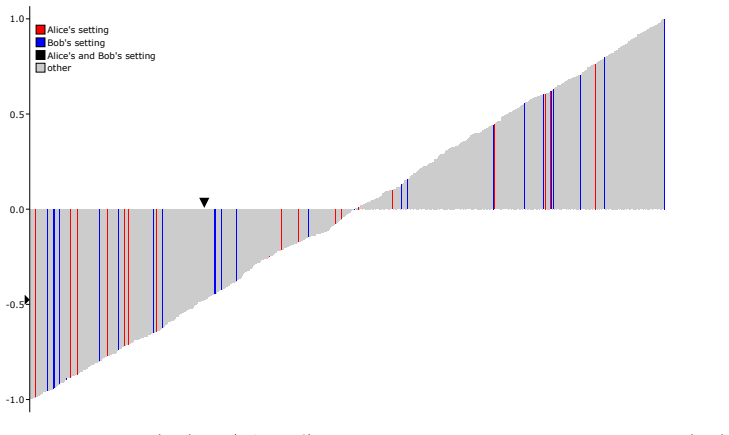


read the original abstract
Bell's theorem states that no description of a Bell experiment can be simultaneously local, realistic in the sense of counterfactual definiteness, and free of conspiracy between settings and hidden state. The recent generation of experiments has confirmed the predicted violation of the CHSH inequality, so one of the assumptions must be abandoned. Which one, and how one reconstructs a coherent worldview after doing so, is a question on which many authors disagree. This paper is written by three such authors. All three reject both counterfactual definiteness and conspiratorial violation of statistical independence of setting choices and state. After a joint exposition of the classical half of Bell's theorem in the language of Pearl-style causal graphs, a joint summary of the loophole-free experiments, and a joint survey of the recent literature, each author states where they have presently arrived. Gill accepts irreducible and non-local quantum randomness and finds the choice between locality and realism a false dichotomy. In his later works, Bell derives counterfactual definiteness from classical local causality, and that is what has to go. The metaphysical concepts "realism", "locality", "causality" need to be reconsidered. Helland reconstructs the Hilbert-space formalism from a theory of accessible variables, and from this theory he concludes that every observer must be limited in a specific sense. Jongejan proposes a geometric hidden-variable construction in which the degree of violation of the CHSH inequality depends on the number of dimensions of space, Tsirelson's bound corresponding to three dimensions. The authors conclude with a discussion.
Editorial analysis
A structured set of objections, weighed in public.
Referee Report
Summary. The manuscript presents three personal reconstructions by Gill, Helland, and Jongejan for reconciling Bell's theorem with the results of loophole-free experiments, all rejecting both counterfactual definiteness and conspiratorial violation of statistical independence. After a joint causal-graph exposition of the classical assumptions, a summary of the experimental results, and a literature survey, each author outlines their view: Gill via irreducible non-local randomness, Helland via a theory of accessible variables that reconstructs the Hilbert-space formalism, and Jongejan via a geometric hidden-variable model in which the CHSH violation depends on the dimension of space (with Tsirelson's bound at three dimensions).
Significance. If the reconstructions can be shown to reproduce the full set of quantum predictions without additional constraints, the paper would supply concrete examples of coherent worldviews that accommodate the experimental data while dropping the usual assumptions, thereby clarifying options in the foundations debate. The joint causal-graph and experimental sections are standard and accurate; the individual sections remain at a conceptual level.
major comments (3)
- [Jongejan's section] Jongejan's geometric construction: the statement that Tsirelson's bound corresponds to three dimensions requires an explicit derivation showing that the model reproduces all two-qubit marginals, the full set of quantum correlations, and higher-order inequalities without imposing extra empirical restrictions on the accessible variables or the embedding.
- [Helland's section] Helland's accessible-variables derivation: the reconstruction of the Hilbert-space formalism must demonstrate that the observer limitation does not introduce effective setting dependence or restrict the allowed observables in a manner that would violate the no-conspiracy assumption while still matching all quantum predictions.
- [Gill's section] Gill's account of irreducible non-local randomness: the view needs to be shown to remain consistent with the joint causal-graph framework without reintroducing locality or realism issues that would undermine the explicit rejection of counterfactual definiteness.
minor comments (2)
- [Literature survey] The literature survey would benefit from explicit citations to quantitative comparisons of the three reconstructions with standard quantum predictions beyond CHSH.
- [Joint exposition] Notation for the causal graphs and accessible variables could be unified across the joint and individual sections for clarity.
Simulated Author's Rebuttal
We thank the referee for the thoughtful and constructive report. The comments correctly note that the individual sections are presented at a conceptual level. We address each major comment below, clarifying the intended scope of the paper while agreeing to add explicit statements about limitations and references to fuller derivations where they exist in the authors' prior work.
read point-by-point responses
-
Referee: [Jongejan's section] Jongejan's geometric construction: the statement that Tsirelson's bound corresponds to three dimensions requires an explicit derivation showing that the model reproduces all two-qubit marginals, the full set of quantum correlations, and higher-order inequalities without imposing extra empirical restrictions on the accessible variables or the embedding.
Authors: The Jongejan section offers a geometric hidden-variable proposal in which CHSH violation strength is tied to the dimension of the embedding space, with Tsirelson's bound emerging at three dimensions. This is presented as an illustrative construction rather than a complete proof that all quantum marginals and higher-order inequalities are reproduced without further restrictions. We agree that an explicit derivation would be valuable and will revise the text to state clearly that the section outlines the geometric idea and refers to separate ongoing work for the full verification against the complete set of two-qubit predictions. revision: partial
-
Referee: [Helland's section] Helland's accessible-variables derivation: the reconstruction of the Hilbert-space formalism must demonstrate that the observer limitation does not introduce effective setting dependence or restrict the allowed observables in a manner that would violate the no-conspiracy assumption while still matching all quantum predictions.
Authors: Helland's reconstruction starts from a theory of accessible variables and derives the Hilbert-space formalism together with a specific observer limitation. The limitation is formulated to be independent of the choice of measurement settings and is therefore compatible with the no-conspiracy assumption used in the joint causal-graph section. The section summarizes the main steps; the full technical development, including verification that all quantum predictions are recovered without additional empirical constraints, appears in Helland's earlier papers. We will add a short clarifying paragraph that points to those references and reiterates the independence from setting choice. revision: partial
-
Referee: [Gill's section] Gill's account of irreducible non-local randomness: the view needs to be shown to remain consistent with the joint causal-graph framework without reintroducing locality or realism issues that would undermine the explicit rejection of counterfactual definiteness.
Authors: Gill's contribution accepts irreducible non-local randomness while rejecting both counterfactual definiteness and conspiratorial dependence, exactly as required by the joint causal-graph exposition earlier in the manuscript. The causal-graph framework already encodes the absence of local causality and the rejection of counterfactual definiteness; the non-local randomness is introduced as the remaining degree of freedom that is consistent with those graphs. We will revise the section to include an explicit cross-reference to the causal-graph diagrams, making the compatibility more transparent without altering the underlying position. revision: partial
Circularity Check
No significant circularity; arguments rest on standard QM predictions and causal modeling
full rationale
The paper is expository and philosophical rather than predictive. It begins from the established CHSH violation in loophole-free experiments and Pearl-style causal graphs, then presents three independent reconstructions (Gill on non-local randomness, Helland on accessible variables yielding Hilbert space, Jongejan on dimension-dependent geometry). No step fits a parameter to a subset of data and renames the fit as a prediction, nor does any central claim reduce by definition or self-citation chain to its own inputs. Self-references to prior technical work serve only as background; the rejection of counterfactual definiteness and conspiratorial dependence follows directly from the experimental facts and the authors' stated metaphysical choices without circular closure.
Axiom & Free-Parameter Ledger
axioms (2)
- domain assumption Quantum mechanics makes correct predictions for Bell experiments
- standard math Causal graphs correctly represent locality and statistical independence
Lean theorems connected to this paper
-
Foundation/AlexanderDuality.leanalexander_duality_circle_linking echoesJongejan proposes a geometric hidden-variable construction in which the degree of violation of the CHSH inequality depends on the number of dimensions of space, Tsirelson’s bound corresponding to three dimensions.
-
Foundation/AbsoluteFloorClosure.leanabsolute_floor_iff_bare_distinguishability echoesHelland reconstructs the Hilbert-space formalism from a theory of accessible variables... every observer must be limited in a specific sense... impossible to consider all the variables X1, X2, Y1 and Y2 at the same time
Reference graph
Works this paper leans on
-
[1]
The violation of B ell inequalities in the macroworld
Diederik Aerts, Sven Aerts, Jan Broekaert, and Liane Gabora. The violation of B ell inequalities in the macroworld. Foundations of Physics, 30 0 (9): 0 1387--1414, Sep 2000. ISSN 1572-9516. doi:10.1023/A:1026449716544
-
[2]
Towards a quantum evolutionary scheme: V iolating B ell's inequalities in language
Diederik Aerts, Marek Czachor, and Bart D'Hooghe. Towards a quantum evolutionary scheme: V iolating B ell's inequalities in language. In Nathalie Gontier, Jean Paul Van Bendegem, and Diederik Aerts, editors, Evolutionary Epistemology, Language and Culture: A Non-Adaptationist, Systems Theoretical Approach, pages 453--478. Springer Netherlands, Dordrecht, ...
-
[3]
Sven Aerts, Paul Kwiat, Jan- ke Larsson, and Marek \. Z ukowski. Two-photon F ranson-type experiments and local realism. Phys. Rev. Lett., 83: 0 2872--2875, Oct 1999. doi:10.1103/PhysRevLett.83.2872
-
[4]
Experimental test of B ell's inequalities using time-varying analyzers
Alain Aspect, Jean Dalibard, and G\'erard Roger. Experimental test of B ell's inequalities using time-varying analyzers. Phys. Rev. Lett., 49: 0 1804--1807, Dec 1982 a . doi:10.1103/PhysRevLett.49.1804
-
[5]
Alain Aspect, Philippe Grangier, and G\'erard Roger. Experimental R ealization of E instein- P odolsky- R osen- B ohm G edankenexperiment: A N ew V iolation of B ell's I nequalities. Phys. Rev. Lett., 49: 0 91--94, Jul 1982 b . doi:10.1103/PhysRevLett.49.91
-
[6]
Barr, Marco Fabbrichesi, Roberto Floreanini, Emidio Gabrielli, and Luca Marzola
Alan J. Barr, Marco Fabbrichesi, Roberto Floreanini, Emidio Gabrielli, and Luca Marzola. Quantum entanglement and B ell inequality violation at colliders. Progress in Particle and Nuclear Physics, 139: 0 104--134, 2024. ISSN 0146-6410. doi:https://doi.org/10.1016/j.ppnp.2024.104134. URL https://www.sciencedirect.com/science/article/pii/S0146641024000383
-
[7]
V. P. Belavkin. Nondemolition principle of quantum measurement theory. Foundations of Physics, 24 0 (5): 0 685--714, May 1994. ISSN 1572-9516. doi:10.1007/BF02054669. URL https://doi.org/10.1007/BF02054669
-
[8]
J. S. Bell. On the E instein P odolsky R osen paradox. Physics Physique Fizika, 1: 0 195--200, Nov 1964. doi:10.1103/PhysicsPhysiqueFizika.1.195
-
[9]
J. S. Bell. E instein- P odolsky- R osen experiments. Epistemological Lett., 9: 0 11--24, 1976. URL https://www.informationphilosopher.com/solutions/scientists/bell/EPR_Experiments.pdf
work page 1976
-
[10]
J. S. Bell. La nouvelle cuisine. In John Stewart Bell, editor, Speakable and unspeakable in quantum mechanics: collected papers on quantum philosophy, pages 232--248. Cambridge University Press, 2004 a . doi:10.1017/CBO9780511815676.026. URL https://cqi.inf.usi.ch/qic/Bell1990.pdf
-
[11]
J. S. Bell. Speakable and Unspeakable in Quantum Mechanics: Collected Papers on Quantum Philosophy. Cambridge University Press, 2 edition, 2004 b
work page 2004
-
[12]
David Bohm. Quantum theory. Journal of the Franklin Institute, 252 0 (2): 0 207, 1951. ISSN 0016-0032. doi:doi.org/10.1016/0016-0032(51)90963-5. URL https://www.sciencedirect.com/science/article/pii/0016003251909635
-
[13]
Nicolas Brunner, Daniel Cavalcanti, Stefano Pironio, Valerio Scarani, and Stephanie Wehner. Bell nonlocality. Rev. Mod. Phys., 86: 0 419--478, Apr 2014. doi:10.1103/RevModPhys.86.419
-
[14]
Jerome R. Busemeyer and Peter D. Bruza. Quantum Models of Cognition and Decision. Cambridge University Press, Cambridge, 8 2012. ISBN 9780511997716. doi:10.1017/CBO9780511997716
-
[15]
Proposed B ell experiment with genuine energy-time entanglement
Ad\'an Cabello, Alessandro Rossi, Giuseppe Vallone, Francesco De Martini, and Paolo Mataloni. Proposed B ell experiment with genuine energy-time entanglement. Phys. Rev. Lett., 102: 0 040401, Jan 2009. doi:10.1103/PhysRevLett.102.040401
-
[16]
John F. Clauser. Bell's theorem, B ell inequalities, and the ``probability normalization loophole''. In Reinhold Bertlmann and Anton Zeilinger, editors, Quantum [Un]Speakables II: Half a Century of Bell's Theorem, pages 451--484. Springer International Publishing, Cham, 11 2017. ISBN 978-3-319-38987-5. doi:10.1007/978-3-319-38987-5_28
-
[17]
John F. Clauser and Michael A. Horne. Experimental consequences of objective local theories. Phys. Rev. D, 10: 0 526--535, Jul 1974. doi:10.1103/PhysRevD.10.526
-
[18]
John F. Clauser, Michael A. Horne, Abner Shimony, and Richard A. Holt. Proposed E xperiment to T est L ocal H idden- V ariable T heories. Phys. Rev. Lett., 23: 0 880--884, Oct 1969. doi:10.1103/PhysRevLett.23.880
-
[19]
J. W. Dunne. An Experiment with Time. A . & C . B lack, 1 edition, 1927. ISBN 1-57174-234-4. URL https://archive.org/details/experimentwithti0000unse_n2w4/page/n5/mode/2up
work page 1927
-
[20]
Philippe H. Eberhard. Background level and counter efficiencies required for a loophole-free E instein- P odolsky- R osen experiment. Phys. Rev. A, 47: 0 R747--R750, Feb 1993. doi:10.1103/PhysRevA.47.R747
-
[21]
A. Einstein, B. Podolsky, and N. Rosen. Can Q uantum- M echanical D escription of P hysical R eality B e C onsidered C omplete? Phys. Rev., 47: 0 777--780, May 1935. doi:10.1103/PhysRev.47.777
-
[22]
Hidden variables, joint probability, and the bell inequalities
Arthur Fine. Hidden variables, joint probability, and the bell inequalities. Phys. Rev. Lett., 48: 0 291--295, Feb 1982. doi:10.1103/PhysRevLett.48.291
-
[23]
J. D. Franson. B ell inequality for position and time. Phys. Rev. Lett., 62: 0 2205--2208, May 1989. doi:10.1103/PhysRevLett.62.2205
-
[24]
Beyond B ell's theorem: correlation scenarios
Tobias Fritz. Beyond B ell's theorem: correlation scenarios. New Journal of Physics, 14 0 (10): 0 103001, oct 2012. doi:10.1088/1367-2630/14/10/103001
-
[25]
Beyond B ell's theorem ii: Scenarios with arbitrary causal structure
Tobias Fritz. Beyond B ell's theorem ii: Scenarios with arbitrary causal structure. Communications in Mathematical Physics, 341 0 (2): 0 391--434, Jan 2016. ISSN 1432-0916. doi:10.1007/s00220-015-2495-5
-
[26]
Richard D. Gill. Accardi contra B ell (cum mundi): T he I mpossible C oupling, 2002. URL https://arxiv.org/abs/quant-ph/0110137
work page internal anchor Pith review Pith/arXiv arXiv 2002
-
[27]
Richard D. Gill. Statistics, causality and bell’s theorem. Statistical Science, 29 0 (4), November 2014. ISSN 0883-4237. doi:10.1214/14-sts490
-
[28]
Richard D. Gill. Gull’s theorem revisited. Entropy, 24 0 (5): 0 679, May 2022 a . ISSN 1099-4300. doi:10.3390/e24050679
-
[29]
Richard D. Gill. Schr \"o dinger’s C at meets O ccam’s R azor. Entropy, 24 0 (11), 2022 b . ISSN 1099-4300. doi:10.3390/e24111586. URL https://www.mdpi.com/1099-4300/24/11/1586
- [30]
- [31]
-
[32]
Richard D. Gill and Justo Pastor Lambare. Kupczynski's contextual locally causal probabilistic models are constrained by bell's theorem, 2023. URL https://arxiv.org/abs/2208.09930
-
[33]
Marissa Giustina, Marijn A. M. Versteegh, S \"o ren Wengerowsky, Johannes Handsteiner, Armin Hochrainer, Kevin Phelan, Fabian Steinlechner, Johannes Kofler, Jan- ke Larsson, Carlos Abell \'a n, Waldimar Amaya, Valerio Pruneri, Morgan W. Mitchell, J \"o rn Beyer, Thomas Gerrits, Adriana E. Lita, Lynden K. Shalm, Sae Woo Nam, Thomas Scheidl, Rupert Ursin, B...
-
[34]
Daniel M. Greenberger, Michael A. Horne, and Anton Zeilinger. Going beyond bell's theorem. In Menas Kafatos, editor, Bell's Theorem, Quantum Theory and Conceptions of the Universe, pages 69--72. Springer Netherlands, Dordrecht, 1989. ISBN 978-94-017-0849-4. doi:10.1007/978-94-017-0849-4_10
-
[35]
I. S. Helland. Epistemic Processes. A Basis for Statistics and Quantum Theory. Springer, Cham, Switzerland, 2 edition, 2021. doi:10.1007/978-3-030-81923-1
-
[36]
I. S. Helland. The B ell experiment and the limitations of actors. Foundations of Physics, 52 0 (55): 0 1--22, 2022 a . doi:10.1007/s10701-022-00572-y
-
[37]
I. S. Helland. On constructing quantum theory from two related maximal conceptual variables. International Journal of Theoretical Physics, 61: 0 69--80, 2022 b . doi:10.1007/s10773-022-05047-4. Correction (2023). 62, 51
-
[38]
I. S. Helland. An explanation of the B ell experiment. Journal of Modern and Applied Physics, 6 0 (2): 0 1--5, 2023. URL https://www.pulsus.com/scholarly-articles/on-the-bell-experiment-and-quantum--foundation.pdf
work page 2023
-
[39]
I. S. Helland. An alternative foundation of quantum mechanics. Foundations of Physics, 54 0 (3): 0 1--45, 2024 a . doi:10.1007/s10701-023-00735-5
-
[40]
I. S. Helland. Some mathematical issues regarding a new approach towards quantum foundation. Journal of Mathematical Physics, 66, 2025. doi:10.1063/5.0251682
-
[41]
Inge S. Helland. On probabilities in quantum mechanics. APL Quantum, 1, 2024 b . doi:10.1063/5.0218982. URL https://arxiv.org/abs/2401.17717
-
[42]
Inge S. Helland. The final version of a recent approach towards quantum foundation, 2026. URL https://arxiv.org/abs/2604.05675
work page internal anchor Pith review Pith/arXiv arXiv 2026
-
[43]
B. Hensen, H. Bernien, A. E. Dr \'e au, A. Reiserer, N. Kalb, M. S. Blok, J. Ruitenberg, R. F. L. Vermeulen, R. N. Schouten, C. Abell \'a n, W. Amaya, V. Pruneri, M. W. Mitchell, M. Markham, D. J. Twitchen, D. Elkouss, S. Wehner, T. H. Taminiau, and R. Hanson. Loophole-free B ell inequality violation using electron spins separated by 1.3 kilometres. Natur...
-
[44]
Johannes Kofler, Marissa Giustina, Jan- ke Larsson, and Morgan W. Mitchell. Requirements for a loophole-free photonic B ell test using imperfect setting generators. Physical Review A, 93 0 (3), March 2016. ISSN 2469-9934. doi:10.1103/physreva.93.032115
-
[45]
Is the moon there if nobody looks: Bell inequalities and physical reality
Marian Kupczynski. Is the moon there if nobody looks: Bell inequalities and physical reality. Frontiers in Physics, 8: 0 1--13, September 2020. ISSN 2296-424X. doi:10.3389/fphy.2020.00273
-
[46]
Loopholes in B ell inequality tests of local realism
Jan- ke Larsson. Loopholes in B ell inequality tests of local realism. Journal of Physics A: Mathematical and Theoretical, 47 0 (42): 0 424003, October 2014. ISSN 1751-8121. doi:10.1088/1751-8113/47/42/424003
-
[47]
Tim Maudlin. What bell did. Journal of Physics A: Mathematical and Theoretical, 47 0 (42): 0 424010, October 2014. ISSN 1751-8121. doi:10.1088/1751-8113/47/42/424010
-
[48]
N. D. Mermin. Is the moon there when nobody looks? Physics Today, 38: 0 38--47, 1985. URL https://www.yorku.ca/koniuk/PHYS5000/mermin85.pdf
work page 1985
-
[49]
N. David Mermin. Bringing home the atomic world: Quantum mysteries for anybody. American Journal of Physics, 49: 0 940--943, 1981. URL https://api.semanticscholar.org/CorpusID:122724592
work page 1981
-
[50]
Superdeterminism without conspiracy, 2024
Tim Palmer. Superdeterminism without conspiracy, 2024. URL https://arxiv.org/abs/2308.11262
-
[51]
CAUSALITY: MODELS, REASONING, AND INFERENCE
Judea Pearl. CAUSALITY: MODELS, REASONING, AND INFERENCE. Cambridge University Press, 2009. URL https://bayes.cs.ucla.edu/BOOK-2K/
work page 2009
-
[52]
Quantum nonlocality as an axiom
Sandu Popescu and Daniel Rohrlich. Quantum nonlocality as an axiom. Foundations of Physics, 24: 0 379--385, 1994. doi:10.1007/BF02058098
-
[53]
Event-ready B ell test using entangled atoms simultaneously closing detection and locality loopholes
Wenjamin Rosenfeld, Daniel Burchardt, Robert Garthoff, Kai Redeker, Norbert Ortegel, Markus Rau, and Harald Weinfurter. Event-ready B ell test using entangled atoms simultaneously closing detection and locality loopholes. Physical Review Letters, 119 0 (1), July 2017. ISSN 1079-7114. doi:10.1103/physrevlett.119.010402
-
[54]
T. Schweder and N. L. Hjort. Confidence, Likelihood, Probability. Statistical Inference with Confidence Distributions. Cambridge University Press, Cambridge, 2016. ISBN 9780521861601. doi:10.1017/CBO9781139046671
-
[55]
Shalm, Evan Meyer-Scott, Bradley G
Lynden K. Shalm, Evan Meyer-Scott, Bradley G. Christensen, Peter Bierhorst, Michael A. Wayne, Martin J. Stevens, Thomas Gerrits, Scott Glancy, Deny R. Hamel, Michael S. Allman, Kevin J. Coakley, Shellee D. Dyer, Carson Hodge, Adriana E. Lita, Varun B. Verma, Camilla Lambrocco, Edward Tortorici, Alan L. Migdall, Yanbao Zhang, Daniel R. Kumor, William H. Fa...
-
[56]
L. Susskind and A. Friedman. Quantum Mechanics. The Theoretical Minimum. Basic Books, New York, 2014. ISBN 978-0465028115
work page 2014
-
[57]
Intuition, introspection and observation in linguistic inquiry
Klaas Willems. Intuition, introspection and observation in linguistic inquiry. Language Sciences, 34 0 (6): 0 665--681, 2012. ISSN 0388-0001. doi:10.1016/j.langsci.2012.04.008. URL https://www.sciencedirect.com/science/article/pii/S0388000112000575. Converging data sources in cognitive linguistics
-
[58]
The two bell's theorems of john bell
H M Wiseman. The two bell's theorems of john bell. Journal of Physics A: Mathematical and Theoretical, 47 0 (42): 0 424001, October 2014. ISSN 1751-8121. doi:10.1088/1751-8113/47/42/424001
-
[59]
The measurement problem: Decoherence and convivial solipsism
Herv\'e Zwirn. The measurement problem: Decoherence and convivial solipsism. Foundations of Physics, 46 0 (6): 0 635--667, 2016. doi:10.1007/s10701-016-9999-5
-
[60]
Nonlocality versus modified realism
Herv\'e Zwirn. Nonlocality versus modified realism. Foundations of Physics, 50 0 (1): 0 1--26, 2020. doi:10.1007/s10701-019-00314-7
discussion (0)
Sign in with ORCID, Apple, or X to comment. Anyone can read and Pith papers without signing in.