Recognition: 2 theorem links
· Lean TheoremHelium Bubbles in Liquid Lead Lithium Solutions: Pressure Inhomogeneities at Interfaces and Non Ideal Mixture Effects
Pith reviewed 2026-05-14 17:42 UTC · model grok-4.3
The pith
Molecular dynamics simulations characterize helium bubble interfaces in liquid lead-lithium by calculating pressure inhomogeneities.
A machine-rendered reading of the paper's core claim, the machinery that carries it, and where it could break.
Core claim
Using direct mechanical calculations of local pressure in molecular dynamics, the work determines the interfacial tension and radius of helium bubbles in lead-lithium systems, showing their dependence on thermodynamic conditions, curvature, and alloy composition.
What carries the argument
Classical molecular dynamics simulations computing local pressure changes to derive interfacial tension at helium-liquid metal interfaces.
If this is right
- Bubble stability in these alloys depends on the calculated interfacial tension values.
- Non-ideal mixture effects influence pressure inhomogeneities at the interfaces.
- Results provide data for temperatures relevant to fusion reactor breeding blankets.
Where Pith is reading between the lines
- Extending these simulations to include quantum effects could refine the tension estimates.
- The method could be applied to study bubble nucleation rates in supersaturated solutions.
- Experimental validation of the pressure inhomogeneities would strengthen the findings for reactor design.
Load-bearing premise
The interatomic potentials used in the simulations accurately represent the real helium-liquid metal interactions without significant corrections.
What would settle it
Direct experimental measurement of the interfacial tension in helium and liquid Pb-Li at a known temperature would confirm or refute the simulation results.
Figures




read the original abstract
The extremely low solubility of helium in liquid metals may lead to rapid supersaturation, promoting spontaneous formation of helium bubbles by nucleation. Once nucleated, the stability of these bubbles is governed by the properties of the helium liquid metal interface. In particular, interfacial tension between the immiscible phases controls bubble interactions and induces local pressure inhomogeneities. This work is motivated by the need of a better understanding of helium bubble formation in liquid Pb Li alloys, which are of particular relevance for the design of breeding blankets in the future nuclear fusion reactors. We employ classical molecular dynamics simulations to investigate helium segregation in a range of lead lithium systems, including the limiting cases of pure lead and pure lithium. Changes in local pressure are evaluated from direct mechanical calculations, enabling the characterization of interfacial properties. Interfacial tension and radius of the bubble are subsequently determined across multiple thermodynamic conditions, spanning temperatures starting near the melting points of the constituent metals up to 1021 K. The impact of curvature and composition of the alloy on the interfacial behaviour are also investigated.
Editorial analysis
A structured set of objections, weighed in public.
Referee Report
Summary. The manuscript uses classical molecular dynamics simulations to study helium bubble nucleation and stability in liquid Pb-Li alloys (including pure Pb and Li limits). Local pressure inhomogeneities at the He-liquid metal interfaces are computed via direct mechanical evaluation, from which interfacial tension and bubble radii are extracted over temperatures from near the constituent melting points to 1021 K; effects of curvature and alloy composition on interfacial behavior are also reported.
Significance. If the underlying potentials prove reliable, the work supplies useful interfacial data for helium management in fusion breeding blankets. The direct mechanical pressure route is a strength, as is the systematic scan of temperature, curvature, and composition without reducing quantities to fitted parameters by construction.
major comments (2)
- [Methods] Methods section: the classical interatomic potentials chosen for He-Pb and He-Li interactions receive no direct validation against DFT, ab initio MD, or experimental He-liquid-metal interfacial tension data. Because solvation and interface structure are sensitive to many-body and dispersion contributions that pair potentials commonly misrepresent, the reported pressure profiles, tension values, and radius trends could shift substantially under a different potential or with quantum corrections.
- [Results] Results / Simulation details: finite-size effects and system-size convergence for the nanoscale bubbles are not quantified. Periodic boundary conditions and box-size dependence can systematically alter the measured local pressure inhomogeneities and extracted interfacial tension for small radii.
minor comments (1)
- [Abstract] The title references 'Non Ideal Mixture Effects' but the abstract and main text emphasize curvature and composition; a short paragraph quantifying deviations from ideal mixing (e.g., via activity coefficients or excess properties) would strengthen the claim.
Simulated Author's Rebuttal
We thank the referee for the constructive comments and the positive evaluation of the significance of our work. We provide point-by-point responses below.
read point-by-point responses
-
Referee: [Methods] Methods section: the classical interatomic potentials chosen for He-Pb and He-Li interactions receive no direct validation against DFT, ab initio MD, or experimental He-liquid-metal interfacial tension data. Because solvation and interface structure are sensitive to many-body and dispersion contributions that pair potentials commonly misrepresent, the reported pressure profiles, tension values, and radius trends could shift substantially under a different potential or with quantum corrections.
Authors: We thank the referee for highlighting this important point. The interatomic potentials for He-Pb and He-Li were chosen from established literature sources that have been used in previous studies of similar systems. While we did not perform new DFT validations in this work, we will revise the Methods section to include a more detailed discussion of the potential selection criteria, their limitations regarding many-body effects, and references to any available validation data for related properties. We agree that the absolute values may depend on the potential choice, but the qualitative trends with temperature, composition, and curvature are expected to be robust. Performing comprehensive ab initio MD for the full range of conditions is beyond the current scope but could be addressed in future work. revision: partial
-
Referee: [Results] Results / Simulation details: finite-size effects and system-size convergence for the nanoscale bubbles are not quantified. Periodic boundary conditions and box-size dependence can systematically alter the measured local pressure inhomogeneities and extracted interfacial tension for small radii.
Authors: We agree that quantifying finite-size effects is important for nanoscale systems. In the revised manuscript, we will add a new subsection or appendix presenting results from simulations with varying box sizes (e.g., increasing the linear dimensions by factors of 1.5 and 2) to demonstrate that the pressure profiles and derived interfacial tensions converge within the statistical uncertainties for the system sizes used. This will confirm that the reported inhomogeneities are not artifacts of the periodic boundaries. revision: yes
Circularity Check
No significant circularity; results from direct MD simulation outputs
full rationale
The paper computes interfacial tension, bubble radius, and local pressure inhomogeneities directly from classical molecular dynamics trajectories across multiple temperatures and compositions. No analytical derivation chain, fitted parameter, or self-citation reduces these quantities to the inputs by construction. The reported values are independent simulation outputs rather than tautological re-expressions of chosen potentials or prior results.
Axiom & Free-Parameter Ledger
axioms (1)
- domain assumption Classical molecular dynamics with empirical potentials accurately models helium segregation and interfacial tension in liquid Pb-Li alloys.
Lean theorems connected to this paper
-
IndisputableMonolith/Cost/FunctionalEquation.leanwashburn_uniqueness_aczel unclear?
unclearRelation between the paper passage and the cited Recognition theorem.
We employ classical molecular dynamics simulations to investigate helium segregation... Changes in local pressure are evaluated from direct mechanical calculations... Interfacial tension and radius of the bubble are subsequently determined
What do these tags mean?
- matches
- The paper's claim is directly supported by a theorem in the formal canon.
- supports
- The theorem supports part of the paper's argument, but the paper may add assumptions or extra steps.
- extends
- The paper goes beyond the formal theorem; the theorem is a base layer rather than the whole result.
- uses
- The paper appears to rely on the theorem as machinery.
- contradicts
- The paper's claim conflicts with a theorem or certificate in the canon.
- unclear
- Pith found a possible connection, but the passage is too broad, indirect, or ambiguous to say the theorem truly supports the claim.
Reference graph
Works this paper leans on
-
[1]
∆n(ξN)β−1 +1 2 X α,i X β,j [rαβ ij ]µ[f αβ ij ]ν ∆Ωij(ξN) # ≃
Pressure tensors a. Mechanical equilibriumIn equilibrium, the pres- sure tensorΠand the hydrostatic equilibrium condition under a given orthonormal coordinate system{e 1,e 2,e 3} respectively follow as Π= 3X µ=1 3X ν=1 Πµνeµ ⊗e ν ,and (5) ∇ ·Π= 0,(6) wheree µ is the unit vector along the directionµand the vector operator nabla is defined as∇ ≡ 3X µ=1 eµ ∂...
-
[2]
These properties are studied across selected states at a specific isotherm (1021.4 K) at which all possible lead–lithium alloys are molten
Interfacial tension In this work, we explore how pressure tensors and the interfacial properties of He/LLLA mixtures (interfa- cial tension, interfacial density, adsorption, etc.) are af- fected by the composition of the LMA. These properties are studied across selected states at a specific isotherm (1021.4 K) at which all possible lead–lithium alloys are...
-
[3]
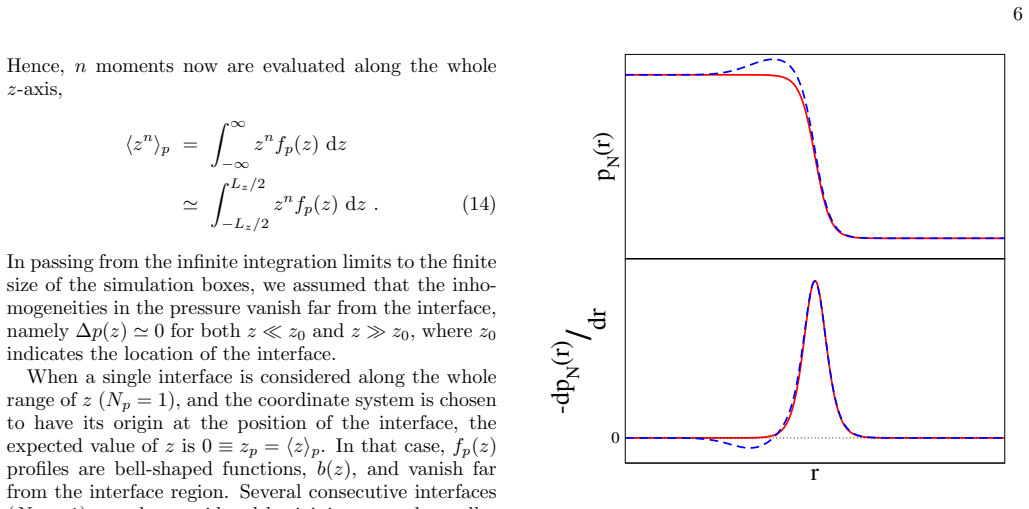
Ideal behaviour of pressure tensors in spherical geometries In the case of spherical interfaces, it seems convenient to remark that normal profiles are expected to obey the pN(r) r 0 -dpN(r) /dr FIG. 3. Ideal (red solid line) and non-ideal (blue dashed line) radial normal components of the pressure tensor (top panel) and the opposite of its derivative (bo...
-
[4]
The knowledge of experimental values of the sur- face tension of bulk lithium[68, 69], around 0.3–0.4 N/m
-
[5]
The experimental values of the surface tension of bulk LLE [70]
-
[6]
The experimental surface tension of ultracold he- lium, which ranges between 0.35 N/m at ultra-low temperatures around 1K, down to 0.1 N/m at the boiling point around 4 K[71]. In this case, no data has been found at higher temperatures, but one clearly expects surface tension values to drop for increasing temperatures. These three data sets are considered...
-
[7]
IUPAC-NIST solu- bility data series
Hans Ulrich Borgstedt, Cezary Guminski, Hans Ulrich Borgstedt, and Cezary Guminski. IUPAC-NIST solu- bility data series. 75. nonmetals in liquid alkali metals. Journal of Physical and Chemical Reference Data, 30(4): 835–1158, 2001
2001
-
[8]
Irradiation experiments on liquid tritium breeding material Pb–17Li in the HFR petten.Fusion engineering and design, 14(3-4):289–297, 1991
Rainer Conrad. Irradiation experiments on liquid tritium breeding material Pb–17Li in the HFR petten.Fusion engineering and design, 14(3-4):289–297, 1991
1991
-
[9]
Libretto-3: performance of tritium perme- ation barriers under irradiation at the hfr petten.Journal of nuclear materials, 212:998–1002, 1994
R Conrad, MA F¨ utterer, L Giancarli, R May, A Perujo, and T Sample. Libretto-3: performance of tritium perme- ation barriers under irradiation at the hfr petten.Journal of nuclear materials, 212:998–1002, 1994
1994
-
[10]
Helium bubble for- mation in Pb-16Li within the breeding blanket.Fusion Engineering and Design, 124:700–704, 2017
Michal Kordaˇ c and Luk´ aˇ s Koˇ sek. Helium bubble for- mation in Pb-16Li within the breeding blanket.Fusion Engineering and Design, 124:700–704, 2017
2017
-
[11]
Volume and pressure of helium bubbles inside liquid Pb16Li
Alberto Fraile and Tomas Polcar. Volume and pressure of helium bubbles inside liquid Pb16Li. a molecular dy- namics study.Nuclear Fusion, 60(4):046018, 2020
2020
-
[12]
A review of bubble dynamics in liquid met- als.Metals, 11(4):664, 2021
Tim Haas, Christian Schubert, Moritz Eickhoff, and Her- bert Pfeifer. A review of bubble dynamics in liquid met- als.Metals, 11(4):664, 2021
2021
-
[13]
Nucleation of helium in pure liquid lithium
Edgar ´Alvarez-Galera, Jordi Mart´ ı, Ferran Mazzanti, and Llu´ ıs Batet. Nucleation of helium in pure liquid lithium. The Journal of Chemical Physics, 159(2), 2023
2023
-
[14]
Concept design of a facility to determine helium solubility in Pb-16Li.Fusion Engineering and Design, 192:113826, 2023
Jaroslav Kekrt, Michal Kordaˇ c, Ad´ ela Gottfriedov´ a, and Ladislav V´ ala. Concept design of a facility to determine helium solubility in Pb-16Li.Fusion Engineering and Design, 192:113826, 2023
2023
-
[15]
A comprehensive review of experimental and nu- merical studies on liquid metal-gas two-phase flows and associated measurement challenges.Annals of Nuclear Energy, 213:111104, 2025
Abhishek Saraswat, Alberto Fraile, Sateesh Gedupudi, Rajendraprasad Bhattacharyay, and Paritosh Chaud- huri. A comprehensive review of experimental and nu- merical studies on liquid metal-gas two-phase flows and associated measurement challenges.Annals of Nuclear Energy, 213:111104, 2025
2025
-
[16]
Experimental facility for study of solubility of helium in liquid Pb-16Li: commissioning and first results.Available at SSRN 6232758, 2026
Ad´ ela Gottfriedov´ a, Adriana August´ ınov´ a, Jaroslav Kekrt, Roman Petr´ aˇ s, Michal Kordaˇ c, and Ladislav V´ ala. Experimental facility for study of solubility of helium in liquid Pb-16Li: commissioning and first results.Available at SSRN 6232758, 2026
2026
-
[17]
https://www.iter.org, 2023
Iter organization. https://www.iter.org, 2023
2023
-
[18]
https://demo-project.eu/, 2025
Demo project. https://demo-project.eu/, 2025
2025
-
[19]
Keimbildung in ¨ ubers¨ attigten gebilden.Zeitschrift f¨ ur physikalische Chemie, 119(1):277–301, 1926
Martin Volmer and A Weber. Keimbildung in ¨ ubers¨ attigten gebilden.Zeitschrift f¨ ur physikalische Chemie, 119(1):277–301, 1926
1926
-
[20]
Kinetische behand- lung der keimbildung in ¨ ubers¨ attigten d¨ ampfen.Annalen der physik, 416(8):719–752, 1935
Richard Becker and Werner D¨ oring. Kinetische behand- lung der keimbildung in ¨ ubers¨ attigten d¨ ampfen.Annalen der physik, 416(8):719–752, 1935
1935
-
[21]
Homogeneous nucleation.Journal of statis- tical physics, 95(5):903–923, 1999
JD Gunton. Homogeneous nucleation.Journal of statis- tical physics, 95(5):903–923, 1999
1999
-
[22]
Free-energy reconstruction from stable clusters (FRESC): A new method to evaluate nucleation barriers from simulation.The Journal of Chemical Physics, 164 (3), 2026
Adri´ an Llamas-Jaramillo, Ivan Latella, and David Reguera. Free-energy reconstruction from stable clusters (FRESC): A new method to evaluate nucleation barriers from simulation.The Journal of Chemical Physics, 164 (3), 2026
2026
-
[23]
Kinetics of droplet condensation through a double free-energy barrier.The Journal of chemical physics, 125(14), 2006
Antoni Valencia. Kinetics of droplet condensation through a double free-energy barrier.The Journal of chemical physics, 125(14), 2006
2006
-
[24]
Non-markovian dynamics in ice nu- cleation.The Journal of Chemical Physics, 164(9), 2026
Pablo Montero de Hijes, Sebastian Falkner, and Christoph Dellago. Non-markovian dynamics in ice nu- cleation.The Journal of Chemical Physics, 164(9), 2026. doi:10.1063/5.0314412
-
[25]
Dhyani Vadgama, Rohit Srivastava, and Satyam Shinde. Thermodynamical and optical properties of atmospheric pre-nucleation cluster containing sea salt, water and sul- furic acid: A density functional theory study.IEEE Jour- nal of Selected Topics in Applied Earth Observations and Remote Sensing, 2025. [20]Book of Abstracts: 22nd International Conference on...
2025
-
[26]
Cavita- tion in liquid metals under negative pressures
TT Bazhirov, GE Norman, and VV Stegailov. Cavita- tion in liquid metals under negative pressures. molecular dynamics modeling and simulation.Journal of Physics: Condensed Matter, 20(11):114113, 2008
2008
-
[27]
L Batet, Jordi Fradera, E Mas de les Valls, and LA Sedano. Numeric implementation of a nucleation, growth and transport model for helium bubbles in lead– lithium hcll breeding blanket channels: Theory and code development.Fusion engineering and design, 86(4-5): 421–428, 2011
2011
-
[28]
Nucleation of helium in liquid lithium at 843 k and high pressures.Materials, 15(8):2866, 2022
Jordi Mart´ ı, Ferran Mazzanti, Grigori E Astrakharchik, Llu´ ıs Batet, Laura Portos-Amill, and Borja Pedre˜ no. Nucleation of helium in liquid lithium at 843 k and high pressures.Materials, 15(8):2866, 2022. doi: 10.3390/ma15082866
-
[29]
Abdulrahman S Al-Awad, Lluis Batet, Ronny Rives, and Luis Sedano. Stochastic computer experiments of the thermodynamic irreversibility of bulk nanobubbles in su- persaturated and weak gas–liquid solutions.The Journal of chemical physics, 161(2), 2024
2024
-
[30]
The statistical me- chanical theory of surface tension.The Journal of Chem- ical Physics, 17(3):338–343, 1949
John G Kirkwood and Frank P Buff. The statistical me- chanical theory of surface tension.The Journal of Chem- ical Physics, 17(3):338–343, 1949
1949
-
[31]
A molecular dynamics study of liquid drops.The Journal of chemical physics, 81(1): 530–542, 1984
SM Thompson, KE Gubbins, JPRB Walton, RAR Chantry, and JS Rowlinson. A molecular dynamics study of liquid drops.The Journal of chemical physics, 81(1): 530–542, 1984
1984
-
[32]
A chemical theory analysis of the so- lution thermodynamics of oxygen, nitrogen and hydrogen in lead-rich Li–Pb mixtures.Journal of the Less Common Metals, 97:27–38, 1984
Robert E Buxbaum. A chemical theory analysis of the so- lution thermodynamics of oxygen, nitrogen and hydrogen in lead-rich Li–Pb mixtures.Journal of the Less Common Metals, 97:27–38, 1984
1984
-
[33]
Henry’s constant of he- lium in liquid lead-lithium alloys.Journal of Molecular Liquids, 432:127719, 2025
Edgar Alvarez-Galera, Daniel Laria, Ferran Mazzanti, Lluis Batet, and Jordi Marti. Henry’s constant of he- lium in liquid lead-lithium alloys.Journal of Molecular Liquids, 432:127719, 2025
2025
-
[34]
Parametrization of embedded-atom method potential for liquid lithium and lead-lithium eutectic alloy.Journal of Nuclear Materials, 587:154735, 2023
Abdulrahman S Al-Awad, Lluis Batet, and Luis Sedano. Parametrization of embedded-atom method potential for liquid lithium and lead-lithium eutectic alloy.Journal of Nuclear Materials, 587:154735, 2023
2023
-
[35]
Ab initio x 1 0+ ground state potential curves of Pb· · ·RG dimers (RG= He, Ne, Ar) including spin–orbit effects
Vladimir Sladek, Luk´ aˇ s Buˇ cinsk` y, J´ an Matuˇ ska, Michal Ilˇ cin, Vladim´ ır Lukeˇ s, and Viliam Laurinc. Ab initio x 1 0+ ground state potential curves of Pb· · ·RG dimers (RG= He, Ne, Ar) including spin–orbit effects. simula- tion of diffusion coefficients.Physical Chemistry Chemi- 13 cal Physics, 16(34):18519–18532, 2014
2014
-
[36]
The development of a full range analytical interatomic potential.Physical Chem- istry Chemical Physics, 23(13):7748–7757, 2021
XW Sheng and KT Tang. The development of a full range analytical interatomic potential.Physical Chem- istry Chemical Physics, 23(13):7748–7757, 2021
2021
-
[37]
Density and compressibility of liquid Li-Pb alloys.Z
Henner Ruppersberg and Walter Speicher. Density and compressibility of liquid Li-Pb alloys.Z. Naturforsch, 31: 47–52, 1976
1976
-
[38]
Volumetric properties of lithium–lead melts.International Journal of Thermophysics, 38(2):23, 2017
RA Khairulin, RN Abdullaev, SV Stankus, AS Agazhanov, and IV Savchenko. Volumetric properties of lithium–lead melts.International Journal of Thermophysics, 38(2):23, 2017
2017
-
[39]
Calculation of cp (t) for liquid Li/Pb alloys from experimentalρ(t) and (δp/δt) s data.Journal of Physics F: Metal Physics, 17(2):305, 1987
J Saar and H Ruppersberg. Calculation of cp (t) for liquid Li/Pb alloys from experimentalρ(t) and (δp/δt) s data.Journal of Physics F: Metal Physics, 17(2):305, 1987
1987
-
[40]
Interatomic potential for the compound-forming Li–Pb liquid alloy
Alberto Fraile, Santiago Cuesta-L´ opez, Alfredo Caro, Daniel Schwen, and J Manuel Perlado. Interatomic potential for the compound-forming Li–Pb liquid alloy. Journal of nuclear materials, 448(1-3):103–108, 2014
2014
-
[41]
Inclusion of the coulomb interaction in the embedded-atom model: Lithium–lead system.High Temperature, 57:848–858, 2019
David Kirillovich Belashchenko. Inclusion of the coulomb interaction in the embedded-atom model: Lithium–lead system.High Temperature, 57:848–858, 2019
2019
-
[42]
The embedded-atom method: a review of theory and applications.Materials Science Reports, 9(7-8):251–310, 1993
Murray S Daw, Stephen M Foiles, and Michael I Baskes. The embedded-atom method: a review of theory and applications.Materials Science Reports, 9(7-8):251–310, 1993
1993
-
[43]
Liquid metals: fundamentals and ap- plications in chemistry.Chemical Society Reviews, 47 (11):4073–4111, 2018
Torben Daeneke, Khashayar Khoshmanesh, Nasir Mah- mood, Isabela Alves De Castro, Dorna Esrafilzadeh, Steven J Barrow, Michael D Dickey, and Kourosh Kalantar-Zadeh. Liquid metals: fundamentals and ap- plications in chemistry.Chemical Society Reviews, 47 (11):4073–4111, 2018
2018
-
[44]
Li-pb (lithium-lead).Journal of phase equi- libria, 14(6):770–770, 1993
H Okamoto. Li-pb (lithium-lead).Journal of phase equi- libria, 14(6):770–770, 1993
1993
-
[45]
William C Swope, Hans C Andersen, Peter H Berens, and Kent R Wilson. A computer simulation method for the calculation of equilibrium constants for the formation of physical clusters of molecules: Application to small water clusters.The Journal of chemical physics, 76(1):637–649, 1982
1982
-
[46]
A unified formulation of the constant tem- perature molecular dynamics methods.The Journal of chemical physics, 81(1):511–519, 1984
Shuichi Nos´ e. A unified formulation of the constant tem- perature molecular dynamics methods.The Journal of chemical physics, 81(1):511–519, 1984
1984
-
[47]
Canonical dynamics: Equilibrium phase-space distributions.Physical review A, 31(3):1695, 1985
William G Hoover. Canonical dynamics: Equilibrium phase-space distributions.Physical review A, 31(3):1695, 1985
1985
-
[48]
Constant pressure molecular dynamics algorithms.J
Glenn J Martyna, Douglas J Tobias, and Michael L Klein. Constant pressure molecular dynamics algorithms.J. chem. Phys, 101(4177):10–1063, 1994
1994
-
[49]
Henry’s constant of helium in liquid alkali met- als.Journal of Molecular Liquids, 395:123853, 2024
Edgar Alvarez-Galera, Daniel Laria, L Batet, and J Mart´ ı. Henry’s constant of helium in liquid alkali met- als.Journal of Molecular Liquids, 395:123853, 2024
2024
-
[50]
Al-Awad.Multiscale Multiphysics In- vestigation of Helium Bubble Formation and Dynamics in Liquid Lead-Lithium Eutectic
Abdulrahman S. Al-Awad.Multiscale Multiphysics In- vestigation of Helium Bubble Formation and Dynamics in Liquid Lead-Lithium Eutectic. PhD thesis, DOCTORAL DEGREE IN NUCLEAR AND IONISING RADIATION ENGINEERING, Department of Physics (Universitat Polit` ecnica de Catalunya), 2025
2025
-
[51]
The statistical me- chanical theory of transport processes
JH Irving and John G Kirkwood. The statistical me- chanical theory of transport processes. iv. the equations of hydrodynamics.The Journal of chemical physics, 18 (6):817–829, 1950
1950
-
[52]
The spherical interface
Frank P Buff. The spherical interface. i. thermodynam- ics.The Journal of Chemical Physics, 19(12):1591–1594, 1951
1951
-
[53]
Spherical interface
Frank P Buff. Spherical interface. ii. molecular theory. The Journal of Chemical Physics, 23(3):419–427, 1955
1955
-
[54]
The pressure tensor at the planar surface of a liquid.Molecular physics, 48(6):1357–1368, 1983
JPRB Walton, DJ Tildesley, JS Rowlinson, and JR Hen- derson. The pressure tensor at the planar surface of a liquid.Molecular physics, 48(6):1357–1368, 1983
1983
-
[55]
The virial theorem and stress calculation in molecular dynamics.The Journal of Chemical Physics, 70(3):1375–1382, 1979
DH Tsai. The virial theorem and stress calculation in molecular dynamics.The Journal of Chemical Physics, 70(3):1375–1382, 1979
1979
-
[56]
Molecular-level calculation scheme for pressure in inho- mogeneous systems of flat and spherical layers.Molecular Simulation, 29(2):101–109, 2003
Tamio Ikeshoji, Bjørn Hafskjold, and Hilde Furuholt. Molecular-level calculation scheme for pressure in inho- mogeneous systems of flat and spherical layers.Molecular Simulation, 29(2):101–109, 2003
2003
-
[57]
Guy J Gloor, George Jackson, Felipe J Blas, and Enrique de Miguel. Test-area simulation method for the direct determination of the interfacial tension of systems with continuous or discontinuous potentials.The Journal of chemical physics, 123(13), 2005
2005
-
[58]
Molecular dynamics simulations of the surface tension of ionic liquids.The Journal of chemical physics, 122(10), 2005
Minerva Gonz´ alez-Melchor, Fernando Bresme, and Jos´ e Alejandre. Molecular dynamics simulations of the surface tension of ionic liquids.The Journal of chemical physics, 122(10), 2005
2005
-
[59]
Towards the irving- kirkwood limit of the mechanical stress tensor.The Jour- nal of chemical physics, 146(22), 2017
ER Smith, DM Heyes, and D Dini. Towards the irving- kirkwood limit of the mechanical stress tensor.The Jour- nal of chemical physics, 146(22), 2017
2017
-
[60]
A molecular dynamics study on surface tension of microbubbles.International Journal of Heat and Mass Transfer, 44(10):1849–1856,
SH Park, JG Weng, and CL Tien. A molecular dynamics study on surface tension of microbubbles.International Journal of Heat and Mass Transfer, 44(10):1849–1856,
-
[61]
doi:10.1016/S0017-9310(00)00244-1
-
[62]
Structure of nanoscale gas bubbles in metals.Applied Physics Let- ters, 103(21):213115, 2013
A Caro, D Schwen, and E Martinez. Structure of nanoscale gas bubbles in metals.Applied Physics Let- ters, 103(21):213115, 2013. doi:10.1063/1.4833775
-
[63]
The capillarity equation at the nanoscale: Gas bubbles in metals.Acta Materialia, 89:14–21, 2015
A Caro, D Schwen, J Hetherly, and E Martinez. The capillarity equation at the nanoscale: Gas bubbles in metals.Acta Materialia, 89:14–21, 2015. doi: 10.1016/j.actamat.2015.01.048
-
[64]
Molecular droplets vs bubbles: Effect of curva- ture on surface tension and tolman length.Physics of Fluids, 33(7), 2021
Jun Wen, Daniele Dini, Haibao Hu, and Edward R Smith. Molecular droplets vs bubbles: Effect of curva- ture on surface tension and tolman length.Physics of Fluids, 33(7), 2021
2021
-
[65]
Atomistic simulation study of the fcc and bcc crystal-melt interface stresses.Surfaces and Interfaces, 28:101639, 2022
Wen-Liang Lu, Hong-Tao Liang, Xiang-Ming Ma, Zi- Feng Yuan, Xin Zhang, Yang Yang, et al. Atomistic simulation study of the fcc and bcc crystal-melt interface stresses.Surfaces and Interfaces, 28:101639, 2022
2022
-
[66]
Interfacial free energy of a liquid-solid interface: Its change with curvature.The Journal of Chemical Physics, 151(14), 2019
P Montero de Hijes, Jorge R Espinosa, Eduardo Sanz, and Carlos Vega. Interfacial free energy of a liquid-solid interface: Its change with curvature.The Journal of Chemical Physics, 151(14), 2019
2019
-
[67]
Interfacial free energy and tolman length of curved liquid–solid inter- faces from equilibrium studies.The Journal of Physical Chemistry C, 124(16):8795–8805, 2020
Pablo Montero De Hijes, Jorge R Espinosa, Valentino Bianco, Eduardo Sanz, and Carlos Vega. Interfacial free energy and tolman length of curved liquid–solid inter- faces from equilibrium studies.The Journal of Physical Chemistry C, 124(16):8795–8805, 2020
2020
-
[68]
Thomas Young. Iii. an essay on the cohesion of fluids. Philosophical transactions of the royal society of London, (95):65–87, 1805
-
[69]
The effect of droplet size on surface tension.The journal of chemical physics, 17(3):333–337, 1949
Richard C Tolman. The effect of droplet size on surface tension.The journal of chemical physics, 17(3):333–337, 1949
1949
-
[70]
Jing Yang, C Calero, and J Mart´ ı. Diffusion and spectroscopy of water and lipids in fully hydrated dimyristoylphosphatidylcholine bilayer membranes.The Journal of chemical physics, 140(10), 2014. doi: 10.1063/1.4867385. 14
-
[71]
On the equilibrium of heteroge- neous substances.American journal of science, 3(96): 441–458, 1878
Josiah Willard Gibbs. On the equilibrium of heteroge- neous substances.American journal of science, 3(96): 441–458, 1878
-
[72]
Willard Gibbs, in Two Volumes, volume 1
Josiah Willard Gibbs.Scientific Papers of J. Willard Gibbs, in Two Volumes, volume 1. Longmans, Green, 1906
1906
-
[73]
The young–laplace equation for a solid–liquid interface.The Journal of Chemical Physics, 153(19), 2020
P Montero de Hijes, K Shi, Eva G Noya, EE Santiso, KE Gubbins, E Sanz, and C Vega. The young–laplace equation for a solid–liquid interface.The Journal of Chemical Physics, 153(19), 2020
2020
-
[74]
National Aeronautics and Space Administration, 1968
Harry W Davison.Compilation of thermophysical proper- ties of liquid lithium, volume 4650. National Aeronautics and Space Administration, 1968
1968
-
[75]
Summary of physical properties for lithium, Pb-17Li, and (lif) n•bef2 coolants
SJ Zinkle. Summary of physical properties for lithium, Pb-17Li, and (lif) n•bef2 coolants. InAPEX study meet- ing, pages 1–8. Sandia National Laboratories, 1998
1998
-
[76]
Mas De Les Valls, L
E. Mas De Les Valls, L. A. Sedano, L. Batet, I. Ricapito, A. Aiello, O. Gastaldi, and F. Gabriel. Lead–lithium eutectic material database for nuclear fusion technology. Journal of nuclear materials, 376(3):353–357, 2008
2008
-
[77]
Springer, 2008
Christian Wohlfarth.Surface Tension of Pure Liq- uids and Binary Liquid Mixtures:(Supplement to IV/16. Springer, 2008
2008
-
[78]
The surface tension of liquid lead.The Journal of Chemical Thermo- dynamics, 15(10):971–983, 1983
A Passerone, R Sangiorgi, and G Caracciolo. The surface tension of liquid lead.The Journal of Chemical Thermo- dynamics, 15(10):971–983, 1983
1983
-
[79]
Handbook of thermodynamic and trans- port properties of alkali metals
Roland W Ohse. Handbook of thermodynamic and trans- port properties of alkali metals. 1985
1985
-
[80]
Computer simulation of the properties of liquid metals: Gallium, lead, and bismuth.Russian Journal of Physical Chemistry A, 86(5):779–790, 2012
DK Belashchenko. Computer simulation of the properties of liquid metals: Gallium, lead, and bismuth.Russian Journal of Physical Chemistry A, 86(5):779–790, 2012
2012
discussion (0)
Sign in with ORCID, Apple, or X to comment. Anyone can read and Pith papers without signing in.