Recognition: unknown
Structural, electronic, and optical properties of hexagonal GeSn from density functional theory
Pith reviewed 2026-05-14 17:36 UTC · model grok-4.3
The pith
2H-Ge1-xSnx alloys keep a direct bandgap at the Gamma point for all dilute tin levels, with strong bowing and giant polarization anisotropy.
A machine-rendered reading of the paper's core claim, the machinery that carries it, and where it could break.
Core claim
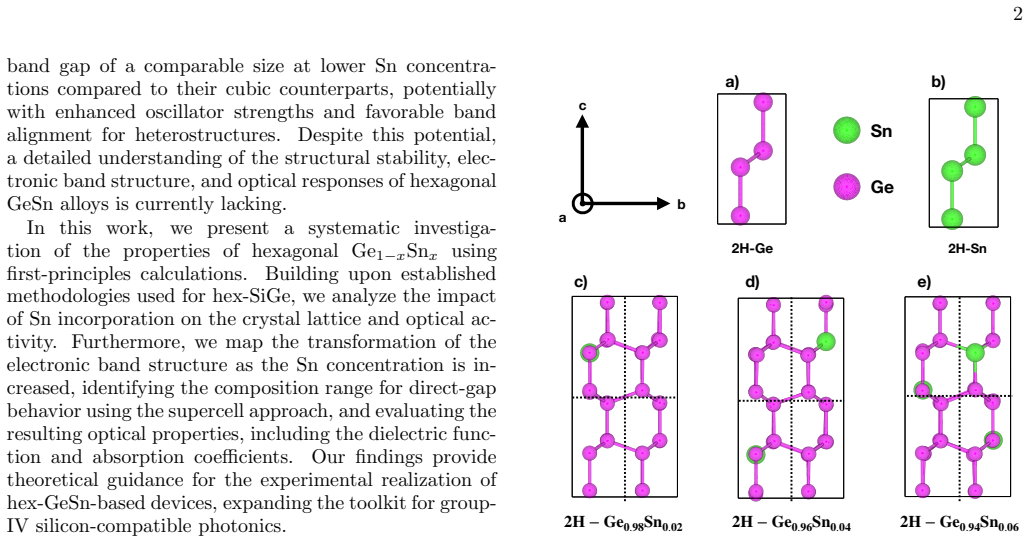
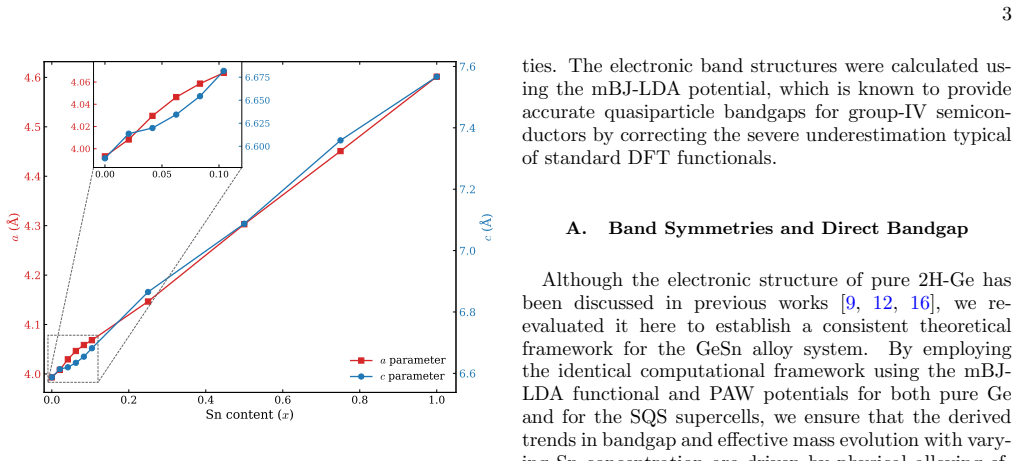
Unlike cubic GeSn, which requires a high Sn concentration to undergo an indirect-to-direct bandgap transition, lonsdaleite (2H) germanium is an intrinsic direct-gap semiconductor. We employ first-principles density functional theory to investigate the structural, electronic, and optical properties of 2H-Ge1-xSnx random alloys in the dilute Sn regime (x ≤ 0.10). The extended alloy disorder is modeled using 48-atom special quasirandom structure (SQS) supercells, and the coherent effective band structure is recovered via spectral band unfolding. We show that 2H-Ge1-xSnx maintains a direct bandgap at the Γ point across the studied composition range, exhibiting a strong bandgap bowing that shifts
What carries the argument
48-atom special quasirandom structure supercells combined with spectral band unfolding to recover effective band structure and optical transition matrix elements in the random alloy.
If this is right
- The absorption edge shifts continuously into the mid-infrared with small tin additions due to strong bowing.
- The dipole-allowed transition remains strongly polarized perpendicular to the c-axis even when random alloy disorder breaks crystal symmetry.
- Hexagonal GeSn avoids the high-tin threshold needed for direct gap in the cubic phase, allowing wider composition tuning.
- The preserved selection rule enables polarization control in potential infrared emitters or detectors.
Where Pith is reading between the lines
- Improved epitaxial growth of the 2H phase on silicon could make these alloys practical for integrated mid-infrared photonics.
- The anisotropy might be exploited in wire or nanostructure geometries to further enhance polarization selectivity.
- Extending the calculations to higher tin fractions or including strain could map the full accessible wavelength range.
Load-bearing premise
Standard density functional theory functionals and 48-atom supercells accurately capture the bandgap bowing, optical matrix elements, and disorder effects without major errors from the exchange-correlation choice or cell size.
What would settle it
Polarization-resolved optical absorption measurements on real 2H-GeSn samples that either confirm or contradict the predicted strong anisotropy between perpendicular and parallel polarization to the c-axis across the composition range.
Figures


read the original abstract
Unlike cubic GeSn, which requires a high Sn concentration to undergo an indirect-to-direct bandgap transition, lonsdaleite (2H) germanium is an intrinsic direct-gap semiconductor. We employ first-principles density functional theory to investigate the structural, electronic, and optical properties of 2H-Ge$_{1-x}$Sn$_{x}$ random alloys in the dilute Sn regime ($x \le 0.10$). The extended alloy disorder is modeled using 48-atom special quasirandom structure (SQS) supercells, and the coherent effective band structure is recovered via spectral band unfolding. We show that 2H-Ge$_{1-x}$Sn$_{x}$ maintains a direct bandgap at the $\Gamma$ point across the studied composition range, exhibiting a strong bandgap bowing that shifts the fundamental absorption edge into the mid-infrared. Evaluation of the optical transition matrix elements reveals a giant polarization anisotropy dictated by spin-orbit coupling. The fundamental transition is strongly dipole-allowed for light polarized perpendicular to the crystal $c$-axis, an optical selection rule that is robustly preserved despite the random alloy disorder breaking the symmetry. These results demonstrate that hexagonal GeSn bypasses the compositional threshold limitations of the cubic phase, providing a highly tunable direct-gap system for infrared optoelectronics.
Editorial analysis
A structured set of objections, weighed in public.
Referee Report
Summary. The paper employs first-principles DFT calculations with 48-atom special quasirandom structure (SQS) supercells and spectral band unfolding to study the structural, electronic, and optical properties of hexagonal (2H) Ge_{1-x}Sn_x random alloys for x ≤ 0.10. It claims that these alloys maintain a direct bandgap at the Γ point across the composition range, exhibit strong bandgap bowing that shifts the absorption edge into the mid-infrared, and display giant polarization anisotropy in the optical transition matrix elements dictated by spin-orbit coupling, with the fundamental transition remaining strongly dipole-allowed for light polarized perpendicular to the c-axis despite alloy disorder.
Significance. If the central claims hold, the work establishes 2H-GeSn as a direct-gap system that circumvents the high-Sn threshold of the cubic phase, offering a tunable platform for mid-infrared optoelectronics with robust polarization selection rules. The combination of SQS modeling and band unfolding provides a first-principles treatment of disorder effects, and the reported anisotropy trends constitute a concrete, falsifiable prediction for polarization-sensitive devices.
major comments (2)
- [Computational Methods] Computational Methods section: The bandgap bowing and absolute gap positions are obtained with a standard semilocal XC functional (PBE or equivalent) without reported benchmarks against hybrid functionals or GW corrections. Literature on cubic GeSn shows that the bowing parameter increases substantially under such corrections; this directly affects the quantitative claim that the absorption edge enters the mid-infrared (Results, electronic structure subsection).
- [Results] Results, alloy disorder and optical matrix elements: At x = 0.10 the 48-atom SQS contains only ~5 Sn atoms. The manuscript does not quantify finite-size effects or the number of independent SQS realizations used for configurational averaging; this limits in the assertion that the giant polarization anisotropy and dipole selection rules are robustly preserved under unfolding (see the paragraph discussing optical transition matrix elements).
minor comments (2)
- [Abstract] Abstract: The numerical value of the bowing parameter is not stated, although it is central to the mid-IR claim; adding it would improve readability.
- [Figures] Figure captions (e.g., unfolded band-structure figures): The labeling of high-symmetry points and the indication of the direct gap should be made more prominent for readers unfamiliar with the 2H Brillouin zone.
Simulated Author's Rebuttal
We thank the referee for the positive assessment and constructive comments. We address each major comment below.
read point-by-point responses
-
Referee: [Computational Methods] Computational Methods section: The bandgap bowing and absolute gap positions are obtained with a standard semilocal XC functional (PBE or equivalent) without reported benchmarks against hybrid functionals or GW corrections. Literature on cubic GeSn shows that the bowing parameter increases substantially under such corrections; this directly affects the quantitative claim that the absorption edge enters the mid-infrared (Results, electronic structure subsection).
Authors: We acknowledge that the use of a semilocal functional such as PBE limits the absolute accuracy of bandgap values and bowing parameters compared to hybrid functionals or GW, as documented for cubic GeSn. Our study focuses on compositional trends and the persistence of direct-gap character, which remain robust. In the revised manuscript we will add a dedicated paragraph in the Computational Methods section that references the cubic-GeSn literature on functional dependence and notes the expected quantitative shifts while preserving the qualitative conclusions on mid-infrared tunability. revision: partial
-
Referee: [Results] Results, alloy disorder and optical matrix elements: At x = 0.10 the 48-atom SQS contains only ~5 Sn atoms. The manuscript does not quantify finite-size effects or the number of independent SQS realizations used for configurational averaging; this limits in the assertion that the giant polarization anisotropy and dipole selection rules are robustly preserved under unfolding (see the paragraph discussing optical transition matrix elements).
Authors: The 48-atom SQS size is standard for dilute-alloy modeling at x = 0.10 and is constructed to reproduce the pair-correlation functions of a random alloy. We performed calculations on several independent SQS realizations and observed consistent anisotropy trends after unfolding. In the revised manuscript we will explicitly report the number of realizations used, add a short discussion of finite-size convergence tests, and clarify that the dipole selection rules remain robust under the unfolding procedure. revision: yes
Circularity Check
No load-bearing circularity; results from direct DFT/SQS/unfolding calculations
full rationale
The derivation consists of standard first-principles DFT computations on 48-atom SQS supercells with spectral unfolding to obtain band structures, matrix elements, and bowing. No equation reduces to a fitted parameter renamed as prediction, no self-citation supplies a uniqueness theorem or ansatz that forces the central claims, and the optical anisotropy follows from explicit dipole matrix elements evaluated on the computed wavefunctions. The only minor self-citation risk is routine benchmarking against pure-Ge properties, which does not make the alloy results tautological. The analysis is therefore self-contained against external benchmarks.
Axiom & Free-Parameter Ledger
free parameters (2)
- Sn concentration x
- Supercell size
axioms (2)
- domain assumption Density functional theory with a chosen exchange-correlation functional provides reliable trends for bandgaps and optical matrix elements in GeSn alloys.
- domain assumption Special quasirandom structures accurately represent the extended disorder in random Ge1-xSnx alloys.
Reference graph
Works this paper leans on
-
[1]
Based on this model, our calculations yield a crystal-field 4 A M L1.0 0.5 0.0 0.5 1.0 1.5 Energy (eV) 2H-Ge Ge0.9375Sn0.0625 0.0 0.2 0.4 0.6 0.8 1.0 Spectral Weight Figure 3
and third-highest (VB-2) valence bands, respectively. Based on this model, our calculations yield a crystal-field 4 A M L1.0 0.5 0.0 0.5 1.0 1.5 Energy (eV) 2H-Ge Ge0.9375Sn0.0625 0.0 0.2 0.4 0.6 0.8 1.0 Spectral Weight Figure 3. Comparison of the electronic band structures for pure 2H-Ge (gray lines) and the Ge 0.9375Sn0.0625 alloy (blue scatter points) ...
-
[2]
Soref, The past, present, and future of silicon photon- ics, IEEE Journal of Selected Topics in Quantum Elec- tronics12, 1678 (2006)
R. Soref, The past, present, and future of silicon photon- ics, IEEE Journal of Selected Topics in Quantum Elec- tronics12, 1678 (2006). 9
2006
-
[3]
D. A. Miller, Device requirements for optical intercon- nects to silicon chips, Proceedings of the IEEE97, 1166 (2009)
2009
-
[4]
A. H. Atabaki, S. Moazeni, F. Pavanello, H. Gevorgyan, J. Notaros, L. Alloatti, M. T. Wade, C. Sun, S. A. Kruger, H. Meng,et al., Integrating photonics with sil- icon nanoelectronics for the next generation of systems on a chip, Nature556, 349 (2018)
2018
-
[5]
Y. Han, H. Park, J. E. Bowers, and K. M. Lau, Recent advances in light sources on silicon, Advances in Optics and Photonics14, 404 (2022)
2022
-
[6]
P. Y. Yu and M. Cardona,Fundamentals of semiconduc- tors: Physics and materials properties(Springer, 2010)
2010
-
[7]
Wirths, R
S. Wirths, R. Geiger, N. von den Driesch, G. Mussler, T. Stoica, S. Mantl, Z. Ikonic, M. Luysberg, S. Chiussi, U. Klemradt,et al., Lasing in direct-bandgap GeSn alloy grown on Si, Nature Photonics9, 88 (2015)
2015
-
[8]
J. D. Joannopoulos and M. L. Cohen, Electronic proper- ties of complex crystalline and amorphous phases of Ge and Si. I. Density of states and band structures, Physical Review B7, 2644 (1973)
1973
-
[9]
Amato, T
M. Amato, T. Kaewmaraya, A. Zobelli, M. Palummo, and R. Rurali, Crystal phase effects in Si nanowire poly- types and their homojunctions, Nano Letters16, 5694 (2016)
2016
-
[10]
R¨ odl, J
C. R¨ odl, J. Furthm¨ uller, J. R. Suckert, V. Armuzza, F. Bechstedt, and S. Botti, Accurate electronic and op- tical properties of hexagonal germanium for optoelec- tronic applications, Physical Review Materials3, 034602 (2019)
2019
-
[11]
De and C
A. De and C. E. Pryor, Electronic structure and optical properties of Si, Ge and diamond in the lonsdaleite phase, Journal of Physics: Condensed Matter26, 045801 (2014)
2014
-
[12]
E. M. Fadaly, A. Dijkstra, J. R. Suckert, D. Ziss, M. A. van Tilburg, C. Mao, Y. Ren, V. T. van Lange, K. Ko- rzun, S. K¨ olling,et al., Direct-bandgap emission from hexagonal Ge and SiGe alloys, Nature580, 205 (2020)
2020
-
[13]
Pulcu, J
Y. Pulcu, J. Koltai, A. Korm´ anyos, and G. Burkard, Multibandk·ptheory for hexagonal germanium, Phys. Rev. B109, 205202 (2024)
2024
-
[14]
Vincent, G
L. Vincent, G. Patriarche, G. Hallais, C. Renard, C. Gard` es, D. Troadec, and D. Bouchier, Novel het- erostructured Ge nanowires based on polytype transfor- mation, Nano Letters14, 4828 (2014)
2014
-
[15]
H. I. Hauge, M. A. Verheijen, S. Conesa-Boj, T. Etzel- storfer, M. Watzinger, D. Kriegner, I. Zardo, C. Fasolato, F. Capitani, P. Postorino,et al., Hexagonal silicon real- ized, Nano Letters15, 5855 (2015)
2015
-
[16]
Cartoix` a, M
X. Cartoix` a, M. Palummo, H. I. T. Hauge, E. P. A. M. Bakkers, and R. Rurali, Optical emission in hexagonal SiGe nanowires, Nano Letters17, 4753 (2017)
2017
-
[17]
Z. Wang, Z. Zhang, S. Liu, J. Robertson, and Y. Guo, Electronic properties and tunability of the hexagonal SiGe alloys, Applied Physics Letters118, 172101 (2021)
2021
-
[18]
Borlido, F
P. Borlido, F. Bechstedt, S. Botti, and C. R¨ odl, Ensem- ble averages of ab initio optical, transport, and thermo- electric properties of hexagonal SixGe1−x alloys, Physical Review Materials7, 014602 (2023)
2023
-
[19]
Ghetmiri, W
S. Ghetmiri, W. Du, J. Margetis, A. Mosleh, L. Cousar, B. Conley, L. Domulevicz, A. Nazzal, G. Sun, R. Soref, et al., Direct-bandgap GeSn grown on silicon with 2230 nm photoluminescence, Applied Physics Letters105, 151109 (2014)
2014
-
[20]
Gupta, B
S. Gupta, B. Magyari-Kope, Y. Nishi, and K. C. Saraswat, Achieving direct band gap in germanium through integration of Sn alloying and external strain, Journal of Applied Physics113, 073707 (2013)
2013
-
[21]
C. L. Senaratne, P. M. Wallace, J. D. Gallagher, P. E. Sims, J. Kouvetakis, and J. Men´ endez, Direct gap Ge1−ySny alloys: Fabrication and design of mid-ir pho- todiodes, Journal of Applied Physics120, 025701 (2016)
2016
-
[22]
Moontragoon, Z
P. Moontragoon, Z. Ikoni´ c, and P. Harrison, Band struc- ture calculations of Si–Ge–Sn alloys: Achieving direct band gap materials, Semiconductor Science and Technol- ogy22, 742 (2007)
2007
-
[23]
H.-S. Lan, S. T. Chang, and C. W. Liu, Semiconductor, topological semimetal, indirect semimetal, and topologi- cal dirac semimetal phases of Ge 1−xSnx alloys, Physical Review B95, 201201 (2017)
2017
-
[24]
M. P. Polak, P. Scharoch, and R. Kudrawiec, The elec- tronic band structure of Ge1−xSnx in the full composition range: indirect, direct, and inverted gaps regimes, band offsets, and the Burstein-Moss effect, Journal of Physics D: Applied Physics50, 195103 (2017)
2017
-
[25]
Kouvetakis, J
J. Kouvetakis, J. Men´ endez, and A. V. Chizmeshya, Tin- based group IV semiconductors: New platforms for opto- and microelectronics on silicon, Annual Review of Mate- rials Research36, 497 (2006)
2006
-
[26]
Giunto and A
A. Giunto and A. F. i Morral, Defects in Ge and GeSn and their impact on optoelectronic properties, Applied Physics Reviews11, 041333 (2024)
2024
-
[27]
Sewell,Unveiling transport, optical and spin-scattering mechanisms in GeSn alloys through first-principles calcu- lations, Ph.D
K. Sewell,Unveiling transport, optical and spin-scattering mechanisms in GeSn alloys through first-principles calcu- lations, Ph.D. thesis, University College Cork (2025)
2025
-
[28]
Sewell and F
K. Sewell and F. Murphy-Armando, First-principles calculation of alloy scattering and n-type mobility in strained GeSn, Physical Review Applied23, 014074 (2025)
2025
-
[29]
K. Sewell and F. Murphy-Armando, First-principles calculation of spin-relaxation due to alloy scattering and electron-phonon scattering in strained GeSn, arXiv preprint arXiv:2505.10350 (2025)
-
[30]
Myronov, P
M. Myronov, P. Jahandar, S. Rossi, K. Sewell, F. Murphy-Armando, and F. Pezzoli, Efficient in situ doping of strained germanium tin epilayers at unusu- ally low temperature, Advanced Electronic Materials10, 2300811 (2024)
2024
-
[31]
M. V. Rao, First-principles calculations to investigate band structure and effective masses of direct bandgap hexagonal GeSn alloys, International Journal of Modern Physics B38, 2450171 (2024)
2024
-
[32]
N. Bao, F. Guo, D. Kang, Y. Feng, H. Wang, and J. Dai, Toward accurate electronic, optical, and vibra- tional properties of hexagonal Si, Ge, and Si 1−xGex al- loys from first-principle simulations, Journal of Applied Physics129, 145701 (2021)
2021
-
[33]
Kresse and J
G. Kresse and J. Furthm¨ uller, Efficient iterative schemes for ab initio total-energy calculations using a plane-wave basis set, Physical Review B54, 11169 (1996)
1996
-
[34]
Kresse and D
G. Kresse and D. Joubert, From ultrasoft pseudopoten- tials to the projector augmented-wave method, Physical Review B59, 1758 (1999)
1999
-
[35]
P. E. Bl¨ ochl, Projector augmented-wave method, Physi- cal Review B50, 17953 (1994)
1994
-
[36]
Zunger, S.-H
A. Zunger, S.-H. Wei, L. Ferreira, and J. E. Bernard, Special quasirandom structures, Physical Review Letters 65, 353 (1990). 10
1990
-
[37]
van de Walle, M
A. van de Walle, M. Asta, and G. Ceder, The alloy the- oretic automated toolkit: A user guide, Calphad26, 539 (2002)
2002
-
[38]
J. P. Perdew, A. Ruzsinszky, G. I. Csonka, O. A. Vydrov, G. E. Scuseria, L. A. Constantin, X. Zhou, and K. Burke, Restoring the density-gradient expansion for exchange in solids and surfaces, Physical Review Letters100, 136406 (2008)
2008
-
[39]
Tran and P
F. Tran and P. Blaha, Accurate band gaps of semiconduc- tors and insulators with a semilocal exchange-correlation potential, Physical Review Letters102, 226401 (2009)
2009
-
[40]
J. Shao, C. Beaufils, and A. N. Kolmogorov, Ab initio en- gineering of materials with stacked hexagonal tin frame- works, Scientific Reports6, 28369 (2016)
2016
-
[41]
G. Zeng, S. D. McDonald, Q. Gu, S. Matsumura, and K. Nogita, Kinetics of theβ→αtransformation of tin: Role ofα-tin nucleation, Crystal Growth & Design15, 5767 (2015)
2015
-
[42]
Vegard, Die Konstitution der Mischkristalle und die Raumf¨ ullung der Atome, Zeitschrift f¨ ur Physik5, 17 (1921)
L. Vegard, Die Konstitution der Mischkristalle und die Raumf¨ ullung der Atome, Zeitschrift f¨ ur Physik5, 17 (1921)
1921
-
[43]
J. E. Bernard and A. Zunger, Electronic structure of Zns, ZnSe, ZnTe and their pseudobinary alloys, Physical Re- view B36, 3199 (1987)
1987
-
[44]
Vurgaftman, J
I. Vurgaftman, J. Meyer, and L. Ram-Mohan, Band pa- rameters for iii–v compound semiconductors and their alloys, Journal of Applied Physics89, 5815 (2001)
2001
-
[45]
S. L. Chuang and C. Chang, k·p method for strained wurtzite semiconductors, Physical Review B54, 2491 (1996)
1996
-
[46]
Bir and G
G. Bir and G. Pikus,Symmetry and strain-induced effects in semiconductors(Wiley, New York, 1974)
1974
-
[47]
V. Wang, N. Xu, J.-C. Liu, G. Tang, and W.-T. Geng, Vaspkit: A user-friendly interface facilitating high- throughput computing and analysis using vasp code, Computer Physics Communications267, 108033 (2021)
2021
-
[48]
Popescu and A
V. Popescu and A. Zunger, Effective band structure of random alloys, Physical Review Letters104, 236403 (2010)
2010
-
[49]
The band gaps in Fig. 5 were extracted from DOS calcu- lations performed with a plane-wave cutoff energy of 400 eV, using Monkhorst–Packk-point grids and the tetrahe- dron method with Bl¨ ochl corrections. The supercell spe- cifick-point samplings were: 32 atoms (2×2×2), 7×7×4; 36 atoms (3×3×1), 5×5×8; 48 atoms (3×2×2), 6×8×4; and 72 atoms (3×3×2), 6×6×5
discussion (0)
Sign in with ORCID, Apple, or X to comment. Anyone can read and Pith papers without signing in.