Recognition: 2 theorem links
· Lean TheoremHighly Efficient Exciton Modulation in MoSe₂/PdSe₂ Heterostructures
Pith reviewed 2026-05-14 01:59 UTC · model grok-4.3
The pith
A MoSe₂/PdSe₂ van der Waals stack enhances room-temperature A-exciton emission sixfold via interlayer coupling.
A machine-rendered reading of the paper's core claim, the machinery that carries it, and where it could break.
Core claim
In a type-I MoSe₂/PdSe₂ van der Waals heterostructure, interlayer electronic coupling redistributes exciton populations, yielding a ∼6-fold enhancement of room-temperature A-exciton emission (photoluminescence quantum yield of 6 percent versus ∼1 percent for as-exfoliated monolayer MoSe₂) together with pronounced B-exciton quenching.
What carries the argument
Interlayer electronic coupling in the type-I heterostructure that shifts exciton populations toward the radiative A-exciton channel
If this is right
- Emission efficiency rises without chemical doping, defect passivation, or deliberate strain.
- Exciton-exciton annihilation is suppressed under higher excitation densities.
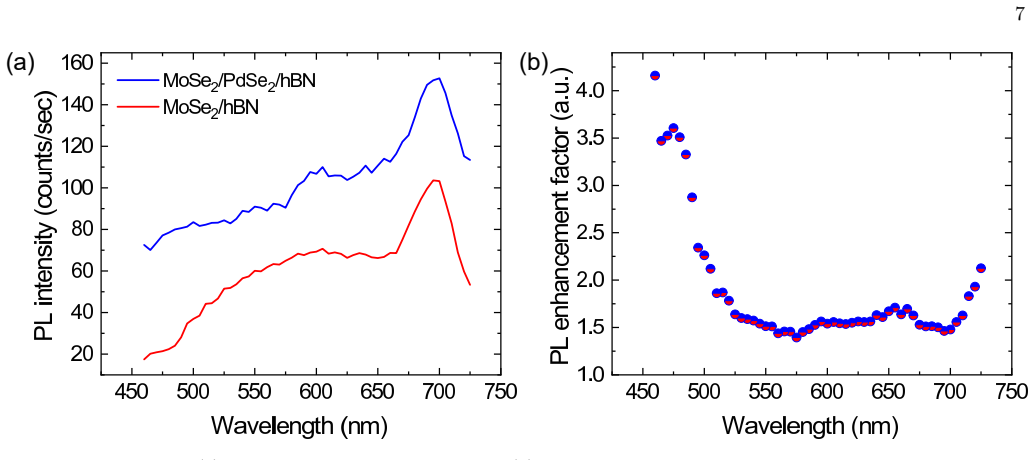
- The enhancement operates over a broad excitation window from 450 to 725 nm.
- Low-temperature measurements show a crossover to overall quenched emission, revealing altered relaxation routes.
Where Pith is reading between the lines
- The same coupling principle could be tested in other type-I pairs to map how band alignment controls exciton flow.
- Device designs might exploit this redistribution to improve brightness in 2D light-emitting structures at room temperature.
- Direct probes of interlayer charge transfer rates could quantify the population shift and predict performance in related stacks.
Load-bearing premise
The emission boost and B-exciton suppression arise from electronic coupling at the interface rather than from strain, defects, or dielectric changes caused by fabrication.
What would settle it
Fabricate a control stack with a spacer layer that blocks electronic coupling but preserves similar dielectric environment and interface strain, then measure whether the sixfold A-exciton gain disappears.
Figures


read the original abstract
Controlling exciton recombination in atomically thin semiconductors is central to their optoelectronic functionality, as the competition between radiative and non-radiative decay channels governs emission efficiency. Existing approaches, such as defect passivation, chemical doping, dielectric engineering, and strain tuning, primarily aim to suppress non-radiative losses. Here, we report a pronounced $\sim$6-fold enhancement of room-temperature A-exciton emission in a type-I MoSe$_2$/PdSe$_2$ van der Waals heterostructure, yielding a photoluminescence quantum yield of 6 %, compared to $\sim$1 % for as-exfoliated monolayer MoSe$_2$. This enhancement is accompanied by strong quenching of the B-exciton, consistent with interlayer electronic coupling that redistributes exciton populations toward the radiative A-exciton channel. Power- and temperature-dependent measurements reveal a suppression of exciton-exciton annihilation and a crossover to quenched emission at low temperature, indicating a redistribution of exciton relaxation pathways. Photoluminescence excitation spectroscopy further reveals a broadband enhancement spanning 450-725 nm, ruling out a resonance-specific mechanism. These results demonstrate that interlayer electronic coupling can be used as an efficient means to redirect exciton populations toward radiative channels, enhancing emission efficiency in two-dimensional semiconductors without chemical modification or strain.
Editorial analysis
A structured set of objections, weighed in public.
Referee Report
Summary. The manuscript reports a ~6-fold enhancement of room-temperature A-exciton photoluminescence in a type-I MoSe₂/PdSe₂ van der Waals heterostructure, achieving a PLQY of 6% compared to ~1% for as-exfoliated monolayer MoSe₂. The enhancement is accompanied by B-exciton quenching and is attributed to interlayer electronic coupling that redistributes exciton populations toward the radiative A channel. Supporting evidence includes power- and temperature-dependent PL data showing suppressed exciton-exciton annihilation and a low-temperature crossover to quenched emission, plus broadband PLE spectroscopy (450–725 nm) ruling out resonance-specific effects.
Significance. If the attribution to interlayer coupling is confirmed, the result offers a non-chemical route to enhance emission efficiency in 2D semiconductors by exploiting type-I vdW heterostructures for exciton population redistribution. This approach could complement existing strategies such as dielectric engineering or defect passivation and may inform design of more efficient TMD-based light emitters. The broadband PLE data and temperature-dependent crossover provide useful constraints on possible mechanisms.
major comments (2)
- [Abstract and Results] Abstract and Results section on PLQY: The stated PLQY values (6% vs ~1%) are presented without quantitative error bars, sample-to-sample statistics, or an explicit measurement protocol (reference standard, absorption correction, or integration method). This weakens the quantitative foundation of the central ~6-fold enhancement claim.
- [Results and Discussion] Results and Discussion on mechanism: The interpretation that A-exciton enhancement and B-exciton quenching arise specifically from type-I interlayer electronic coupling lacks controls to exclude strain, interface defects, or dielectric screening. No Raman/AFM strain maps, hBN/MoSe₂ dielectric-matched controls, or defect-density comparisons (e.g., low-T linewidths) are reported, so alternative interface artifacts remain viable explanations for the observed spectral changes.
minor comments (2)
- [Methods] Methods: Provide additional details on the dry-transfer procedure, twist-angle control, and any annealing conditions to allow reproduction of the heterostructure quality.
- [Figures] Figures: Ensure consistent normalization and labeling of intensity scales across monolayer and heterostructure PL spectra so that the enhancement factor can be directly verified from the plots.
Simulated Author's Rebuttal
We thank the referee for their constructive feedback and positive assessment of the significance of our results. We address each major comment below and will revise the manuscript to improve the quantitative rigor of the PLQY claims and to clarify the mechanistic discussion.
read point-by-point responses
-
Referee: [Abstract and Results] Abstract and Results section on PLQY: The stated PLQY values (6% vs ~1%) are presented without quantitative error bars, sample-to-sample statistics, or an explicit measurement protocol (reference standard, absorption correction, or integration method). This weakens the quantitative foundation of the central ~6-fold enhancement claim.
Authors: We agree that the PLQY values require more rigorous presentation. In the revised manuscript we will report the values with quantitative error bars obtained from repeated measurements, include sample-to-sample statistics from multiple devices, and add an explicit methods subsection detailing the protocol: use of rhodamine 6G as reference standard, absorption corrections derived from reflectance spectra, and integration over the full emission band. These additions will strengthen the quantitative foundation of the ~6-fold enhancement. revision: yes
-
Referee: [Results and Discussion] Results and Discussion on mechanism: The interpretation that A-exciton enhancement and B-exciton quenching arise specifically from type-I interlayer electronic coupling lacks controls to exclude strain, interface defects, or dielectric screening. No Raman/AFM strain maps, hBN/MoSe₂ dielectric-matched controls, or defect-density comparisons (e.g., low-T linewidths) are reported, so alternative interface artifacts remain viable explanations for the observed spectral changes.
Authors: We acknowledge that dedicated controls would further exclude alternative explanations. The existing data (power-dependent suppression of annihilation, temperature-dependent crossover, and broadband PLE) are consistent with interlayer coupling in a type-I alignment. In revision we will expand the discussion to explicitly consider strain, defects, and dielectric screening, and will add a comparison of low-temperature linewidths showing no significant broadening. However, new Raman/AFM maps or hBN control samples would require additional fabrication and measurements that are beyond the scope of the current revision cycle; we will note this limitation and the value of such controls for future studies. revision: partial
Circularity Check
No circularity: experimental observations with no derivation chain
full rationale
The paper reports direct experimental measurements of ~6-fold A-exciton PL enhancement and B-exciton quenching in a MoSe2/PdSe2 heterostructure, supported by power/temperature dependence and broadband PLE data. No mathematical derivations, first-principles predictions, fitted parameters renamed as outputs, or self-referential equations appear in the abstract or described claims. The interpretation attributing the effect to interlayer coupling is presented as a reading of the observations rather than a step that reduces to its own inputs by construction. No self-citations, ansatzes, or uniqueness theorems are invoked as load-bearing elements. This is a standard experimental report whose central claims rest on measured spectra and controls internal to the dataset.
Axiom & Free-Parameter Ledger
axioms (1)
- domain assumption Type-I band alignment exists in the MoSe2/PdSe2 heterostructure and enables interlayer exciton population transfer
Lean theorems connected to this paper
-
IndisputableMonolith/Cost/FunctionalEquation.leanwashburn_uniqueness_aczel unclearpronounced ∼6-fold enhancement of room-temperature A-exciton emission in a type-I MoSe₂/PdSe₂ van der Waals heterostructure... interlayer electronic coupling that redistributes exciton populations
-
IndisputableMonolith/Foundation/RealityFromDistinction.leanreality_from_one_distinction unclearDFT calculations... valence band alignment... hybridization... B-exciton quenching
Reference graph
Works this paper leans on
-
[1]
C. Wang, F. Yang, and Y. Gao, Nanoscale Adv.2, 4323 (2020)
work page 2020
-
[2]
O. Salehzadeh, M. Djavid, N. H. Tran, I. Shih, and Z. Mi, Nano Lett.15, 5302 (2015)
work page 2015
-
[3]
I. Aharonovich, D. Englund, and M. Toth, Nat. Photonics 10, 631 (2016)
work page 2016
-
[4]
H. Kim, S. Z. Uddin, N. Higashitarumizu, E. Rabani, and A. Javey, Science373, 448 (2021)
work page 2021
-
[5]
M. A. Reshchikov, Phys. Status Solidi A218, 2000101 (2021)
work page 2021
-
[6]
D. Valerini, A. Cret´ ı, M. Lomascolo, L. Manna, R. Cin- golani, and M. Anni, Phys. Rev. B71, 235409 (2005)
work page 2005
-
[7]
Y. C. Shen, G. O. Mueller, S. Watanabe, N. F. Gardner, A. Munkholm, and M. R. Krames, Appl. Phys. Lett.91, 141101 (2007)
work page 2007
- [8]
-
[9]
J. S. Ross, P. Klement, A. M. Jones, N. J. Ghimire, J. Yan, D. G. Mandrus, T. Taniguchi, K. Watanabe, K. Kitamura, W. Yao, D. H. Cobden, and X. Xu, Nat. Nanotechnol.9, 268 (2014)
work page 2014
-
[10]
K.Lin, J.Xing, L.N.Quan, F.P.G.DeArquer, X.Gong, J. Lu, L. Xie, W. Zhao, D. Zhang, C. Yan, W. Li, X. Liu, Y. Lu, J. Kirman, E. H. Sargent, Q. Xiong, and Z. Wei, Nature562, 245 (2018)
work page 2018
-
[11]
W. Bai, T. Xuan, H. Zhao, H. Dong, X. Cheng, L. Wang, and R. Xie, Adv. Mater.35, 2302283 (2023)
work page 2023
- [12]
-
[13]
W. Zhao, R. M. Ribeiro, and G. Eda, Acc. Chem. Res. 48, 91 (2015)
work page 2015
-
[14]
A. Splendiani, L. Sun, Y. Zhang, T. Li, J. Kim, C.-Y. Chim, G. Galli, and F. Wang, Nano Lett.10, 1271 (2010)
work page 2010
-
[15]
I. Kyl¨ anp¨ a¨ a and H.-P. Komsa, Phys. Rev. B92, 205418 (2015)
work page 2015
- [16]
-
[17]
D. Xiao, G.-B. Liu, W. Feng, X. Xu, and W. Yao, Phys. Rev. Lett.108, 196802 (2012)
work page 2012
- [18]
-
[19]
C. Li, P. Zhou, and D. W. Zhang, J. Semicond.38, 031005 (2017)
work page 2017
-
[20]
A. K. Geim and I. V. Grigorieva, Nature499, 419 (2013)
work page 2013
-
[21]
A. Raja, A. Chaves, J. Yu, G. Arefe, H. M. Hill, A. F. Rigosi, T. C. Berkelbach, P. Nagler, C. Sch¨ uller, T. Korn, C. Nuckolls, J. Hone, L. E. Brus, T. F. Heinz, D. R. Reich- man, and A. Chernikov, Nat. Commun.8, 15251 (2017)
work page 2017
-
[22]
A. Chernikov, T. C. Berkelbach, H. M. Hill, A. Rigosi, Y. Li, B. Aslan, D. R. Reichman, M. S. Hybertsen, and T. F. Heinz, Phys. Rev. Lett.113, 076802 (2014)
work page 2014
-
[23]
M. Amani, D.-H. Lien, D. Kiriya, J. Xiao, A. Azcatl, J. Noh, S. R. Madhvapathy, R. Addou, S. Kc, M. Dubey, K. Cho, R. M. Wallace, S.-C. Lee, J.-H. He, J. W. Ager, X. Zhang, E. Yablonovitch, and A. Javey, Science350, 1065 (2015)
work page 2015
- [24]
- [25]
-
[26]
J. Wierzbowski, J. Klein, F. Sigger, C. Straubinger, M. Kremser, T. Taniguchi, K. Watanabe, U. Wurstbauer, A. W. Holleitner, M. Kaniber, K. M¨ uller, and J. J. Finley, Sci. Rep.7, 12383 (2017)
work page 2017
-
[27]
H. Ryu, S. C. Hong, K. Kim, Y. Jung, Y. Lee, K. Lee, Y. Kim, H. Kim, K. Watanabe, T. Taniguchi, J. Kim, K. Kim, H. Cheong, and G.-H. Lee, Nanoscale16, 5836 (2024)
work page 2024
-
[28]
Q. Li, A. Alfrey, J. Hu, N. Lydick, E. Paik, B. Liu, H. Sun, Y. Lu, R. Wang, S. Forrest, and H. Deng, Nat. Commun.14, 1837 (2023)
work page 2023
-
[29]
A. O. A. Tanoh, J. Alexander-Webber, Y. Fan, N. Gau- riot, J. Xiao, R. Pandya, Z. Li, S. Hofmann, and A. Rao, Nanoscale Adv.3, 4216 (2021)
work page 2021
-
[30]
Z. Li, H. Bretscher, Y. Zhang, G. Delport, J. Xiao, A. Lee, S. D. Stranks, and A. Rao, Nat. Commun.12, 6044 (2021)
work page 2021
-
[31]
H. Li, A. W. Contryman, X. Qian, S. M. Ardakani, Y. Gong, X. Wang, J. M. Weisse, C. H. Lee, J. Zhao, P. M. Ajayan, J. Li, H. C. Manoharan, and X. Zheng, Nat. Commun.6, 7381 (2015)
work page 2015
-
[32]
H. Lee, Y. Koo, J. Choi, S. Kumar, H.-T. Lee, G. Ji, S. H. Choi, M. Kang, K. K. Kim, H.-R. Park, H. Choo, and K.-D. Park, Sci. Adv.8, eabm5236 (2022)
work page 2022
-
[33]
H. H. Fang, B. Han, C. Robert, M. A. Semina, D. Lagarde, E. Courtade, T. Taniguchi, K. Watanabe, T. Amand, B. Urbaszek, M. M. Glazov, and X. Marie, Phys. Rev. Lett.123, 067401 (2019)
work page 2019
-
[34]
H. J. Conley, B. Wang, J. I. Ziegler, R. F. Haglund, S. T. Pantelides, and K. I. Bolotin, Nano Lett.13, 3626 (2013)
work page 2013
-
[35]
Y. Liu, N. O. Weiss, X. Duan, H.-C. Cheng, Y. Huang, and X. Duan, Nat. Rev. Mater.1, 16042 (2016)
work page 2016
-
[36]
M. Z. Bellus, M. Li, S. D. Lane, F. Ceballos, Q. Cui, 10 X. C. Zeng, and H. Zhao, Nanoscale Horiz.2, 31 (2017)
work page 2017
-
[37]
M. A. Altvater, C. E. Stevens, N. A. Pike, J. R. Hen- drickson, R. Rao, S. Krylyuk, A. V. Davydov, D. Jariwala, R. Pachter, M. Snure, and N. R. Glavin, npj 2D Mater. Appl.9, 31 (2025)
work page 2025
-
[38]
J. Duan, P. Chava, M. Ghorbani-Asl, D. Erb, L. Hu, A. V. Krasheninnikov, H. Schneider, L. Rebohle, A. Erbe, M. Helm, Y. Zeng, S. Zhou, and S. Prucnal, Adv. Funct. Mater.31, 2104960 (2021)
work page 2021
- [39]
-
[40]
M. S. Ramzan and C. Cocchi, Nanomaterials13, 2740 (2023)
work page 2023
- [41]
-
[42]
M. Long, Y. Wang, P. Wang, X. Zhou, H. Xia, C. Luo, S. Huang, G. Zhang, H. Yan, Z. Fan, X. Wu, X. Chen, W. Lu, and W. Hu, ACS Nano13, 2511 (2019)
work page 2019
-
[43]
A. Slavich, G. Ermolaev, N. Pak, D. Grudinin, K. Kravtsov, M. Tatmyshevskiy, V. Semkin, A. Syuy, A. Mazitov, A. Minnekhanov, I. Kazantsev, D. Dyubo, A. Eghbali, D. Yakubovsky, M. Kashchenko, M. Podobrii, E. Titova, A. Melentev, E. Zhukova, G. Tselikov, I. Kruglov, D. Svintsov, S. Novikov, A. Vyshnevyy, A. Ar- senin, K. S. Novoselov, and V. Volkov, Nat. Co...
work page 2025
- [44]
-
[45]
J. S. Ross, S. Wu, H. Yu, N. J. Ghimire, A. M. Jones, G. Aivazian, J. Yan, D. G. Mandrus, D. Xiao, W. Yao, and X. Xu, Nat. Commun.4, 1474 (2013)
work page 2013
-
[46]
M. M. Ugeda, A. J. Bradley, S.-F. Shi, F. H. Da Jornada, Y. Zhang, D. Y. Qiu, W. Ruan, S.-K. Mo, Z. Hussain, Z.- X. Shen, F. Wang, S. G. Louie, and M. F. Crommie, Nat. Mater.13, 1091 (2014)
work page 2014
-
[47]
G. Wang, A. Chernikov, M. M. Glazov, T. F. Heinz, X. Marie, T. Amand, and B. Urbaszek, Rev. Mod. Phys. 90, 021001 (2018)
work page 2018
- [48]
-
[49]
A. D. Oyedele, S. Yang, L. Liang, A. A. Puretzky, K. Wang, J. Zhang, P. Yu, P. R. Pudasaini, A. W. Ghosh, Z. Liu, C. M. Rouleau, B. G. Sumpter, M. F. Chisholm, W. Zhou, P. D. Rack, D. B. Geohegan, and K. Xiao, J. Am. Chem. Soc.139, 14090 (2017)
work page 2017
- [50]
-
[51]
Y. Zhang, T.-R. Chang, B. Zhou, Y.-T. Cui, H. Yan, Z. Liu, F. Schmitt, J. Lee, R. Moore, Y. Chen, H. Lin, H.-T. Jeng, S.-K. Mo, Z. Hussain, A. Bansil, and Z.-X. Shen, Nat. Nanotechnol.9, 111 (2014)
work page 2014
- [52]
-
[53]
M. Liu, L. Qi, Y. Zou, N. Zhang, F. Zhang, H. Xiang, Z. Liu, M. Qin, X. Sun, Y. Zheng, C. Lin, D. Li, and S. Li, Nat. Commun.16, 2774 (2025)
work page 2025
- [54]
-
[55]
Y. Sun, Z. Zhou, Z. Huang, J. Wu, L. Zhou, Y. Cheng, J. Liu, C. Zhu, M. Yu, P. Yu, W. Zhu, Y. Liu, J. Zhou, B. Liu, H. Xie, Y. Cao, H. Li, X. Wang, K. Liu, X. Wang, J. Wang, L. Wang, and W. Huang, Adv. Mater.31, 1806562 (2019)
work page 2019
-
[56]
T. Yamaoka, H. E. Lim, S. Koirala, X. Wang, K. Shi- nokita, M. Maruyama, S. Okada, Y. Miyauchi, and K. Matsuda, Adv. Funct. Mater.28, 1801021 (2018)
work page 2018
-
[57]
S.-T. Varjamo, C. Edwards, Y. Zhou, R. Fang, S. H. Hosseini Shokouh, and Z. Sun, Nano Lett.25, 4379 (2025)
work page 2025
-
[58]
R. H. Lone, S. Gaonkar, B. M. Kumar, and E. S. Kannan, Nanoscale17, 1473 (2025)
work page 2025
- [59]
- [60]
- [61]
- [62]
-
[63]
A. Estrada-Real, I. Paradisanos, P. R. Wiecha, J.-M. Poumirol, A. Cuche, G. Agez, D. Lagarde, X. Marie, V. Larrey, J. M¨ uller, G. Larrieu, V. Paillard, and B. Ur- baszek, Commun. Phys.6, 102 (2023)
work page 2023
-
[64]
A. Castellanos-Gomez, M. Buscema, R. Molenaar, V. Singh, L. Janssen, H. S. J. Van Der Zant, and G. A. Steele, 2D Mater.1, 011002 (2014)
work page 2014
- [65]
- [66]
- [67]
-
[68]
P. E. Bl¨ ochl, Phys. Rev. B50, 17953–17979 (1994)
work page 1994
-
[69]
J. P. Perdew, K. Burke, and M. Ernzerhof, Phys. Rev. Lett.77, 3865–3868 (1996)
work page 1996
-
[70]
M. Dion, H. Rydberg, E. Schr¨ oder, D. C. Langreth, and B. I. Lundqvist, Phys. Rev. Lett.92, 246401 (2004)
work page 2004
-
[71]
A. D. Oyedele, S. Yang, L. Liang, A. A. Puretzky, K. Wang, J. Zhang, P. Yu, P. R. Pudasaini, A. W. Ghosh, Z. Liu, C. M. Rouleau, B. G. Sumpter, M. F. Chisholm, W. Zhou, P. D. Rack, D. B. Geohegan, and K. Xiao, J. Am. Chem. Soc.139, 14090–14097 (2017)
work page 2017
-
[72]
A. Hjorth Larsen, J. Jørgen Mortensen, J. Blomqvist, I. E. Castelli, R. Christensen, M. Du lak, J. Friis, M. N. Groves, B. Hammer, C. Hargus, E. D. Hermes, P. C. Jennings, P. Bjerre Jensen, J. Kermode, J. R. Kitchin, E. Leonhard Kolsbjerg, J. Kubal, K. Kaasb- jerg, S. Lysgaard, J. Bergmann Maronsson, T. Max- son, T. Olsen, L. Pastewka, A. Peterson, C. Ros...
work page 2017
-
[73]
A. M Ganose, A. J Jackson, and D. O Scanlon, J. Open Source Softw.3, 717 (2018). 1 SUPPOR TING INFORMA TION Raman spectroscopy Figure S1 presents the Raman spectra acquired from three regions: PdSe2 on hBN, the 1L region, and the HS region. Low-frequency Raman spectroscopy (0–100 cm−1) is a widely used, non-destructive probe of interlayer vibrational mode...
work page 2018
discussion (0)
Sign in with ORCID, Apple, or X to comment. Anyone can read and Pith papers without signing in.