Recognition: 1 theorem link
· Lean TheoremStable Charge Collection and Sub-45 ps Time Resolution in a 4H-SiC PIN Detector Irradiated With Low Fluence 16.5 MeV/u Ta Ions
Pith reviewed 2026-05-14 01:35 UTC · model grok-4.3
The pith
A 4H-SiC PIN detector maintains 99.24 percent charge collection efficiency and 45 ps time resolution after low-fluence Ta ion irradiation.
A machine-rendered reading of the paper's core claim, the machinery that carries it, and where it could break.
Core claim
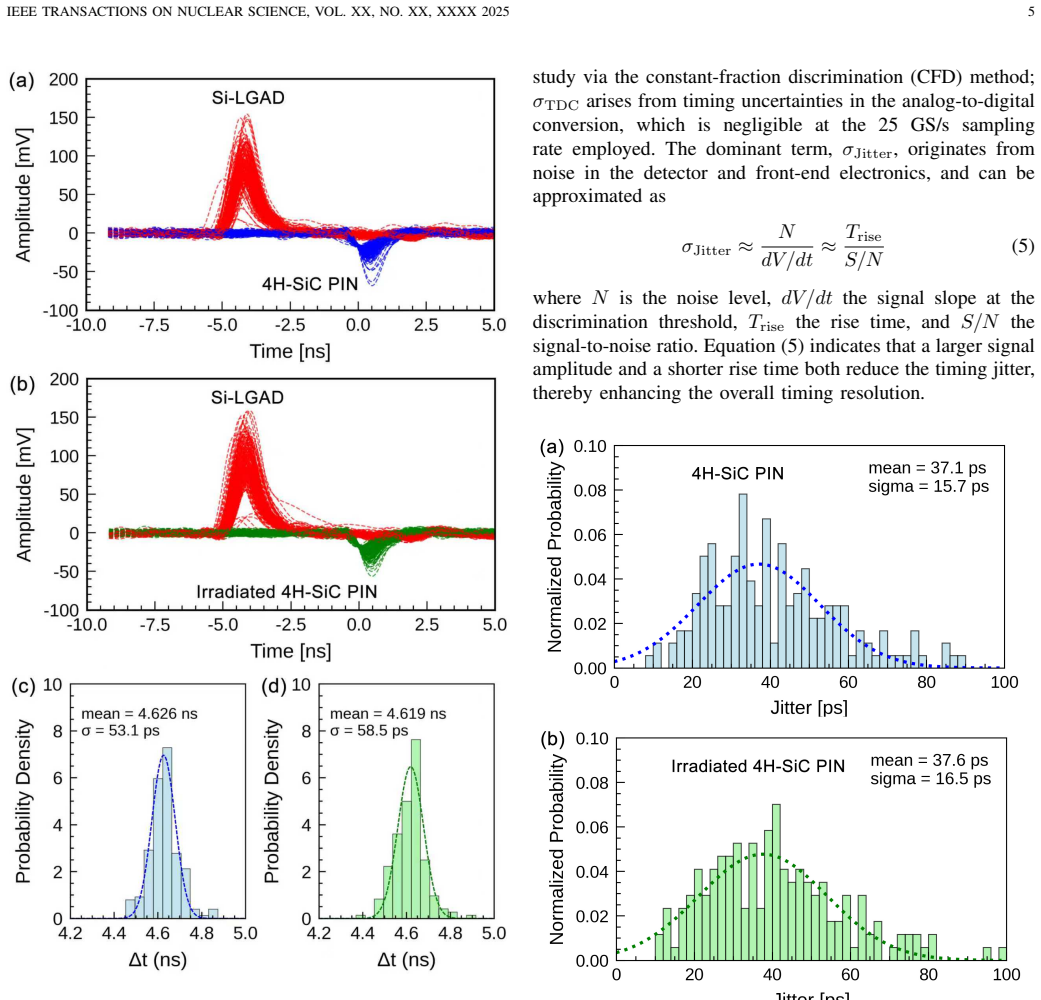
The 4H-SiC PIN detector exhibits a charge collection efficiency of 99.24 percent under Ta heavy ion irradiation. Time resolutions are 40 ps before and 45 ps after irradiation. Leakage currents and effective doping concentrations remain essentially unchanged, confirming stable device architecture.
What carries the argument
Direct comparison of leakage current, doping concentration, charge collection efficiency, and beta-particle time resolution in the 4H-SiC PIN detector before and after Ta ion exposure.
If this is right
- The detector can operate reliably in high-energy physics setups exposed to heavy ions.
- The same architecture supports use in space missions and nuclear reactor monitoring.
- Minimal change in timing performance allows continued use in fast-timing detector systems.
- The material choice reduces the need for frequent detector replacement under low-fluence heavy-ion conditions.
Where Pith is reading between the lines
- If the low-fluence regime is representative, 4H-SiC may outperform silicon detectors for timing applications in mixed radiation fields.
- Repeating the measurements at higher fluences would map the fluence threshold where degradation begins.
- The observed stability in both charge collection and timing could simplify integration into larger tracking or timing arrays.
Load-bearing premise
The low fluence of 16.5 MeV per u Ta ions together with the beta-particle test conditions represent the damage mechanisms that matter in actual high-energy physics or space applications.
What would settle it
A rise in leakage current above 10 to the minus 9 amperes at 300 volts or a charge collection efficiency falling below 90 percent under identical Ta irradiation would show the claimed stability does not hold.
Figures


read the original abstract
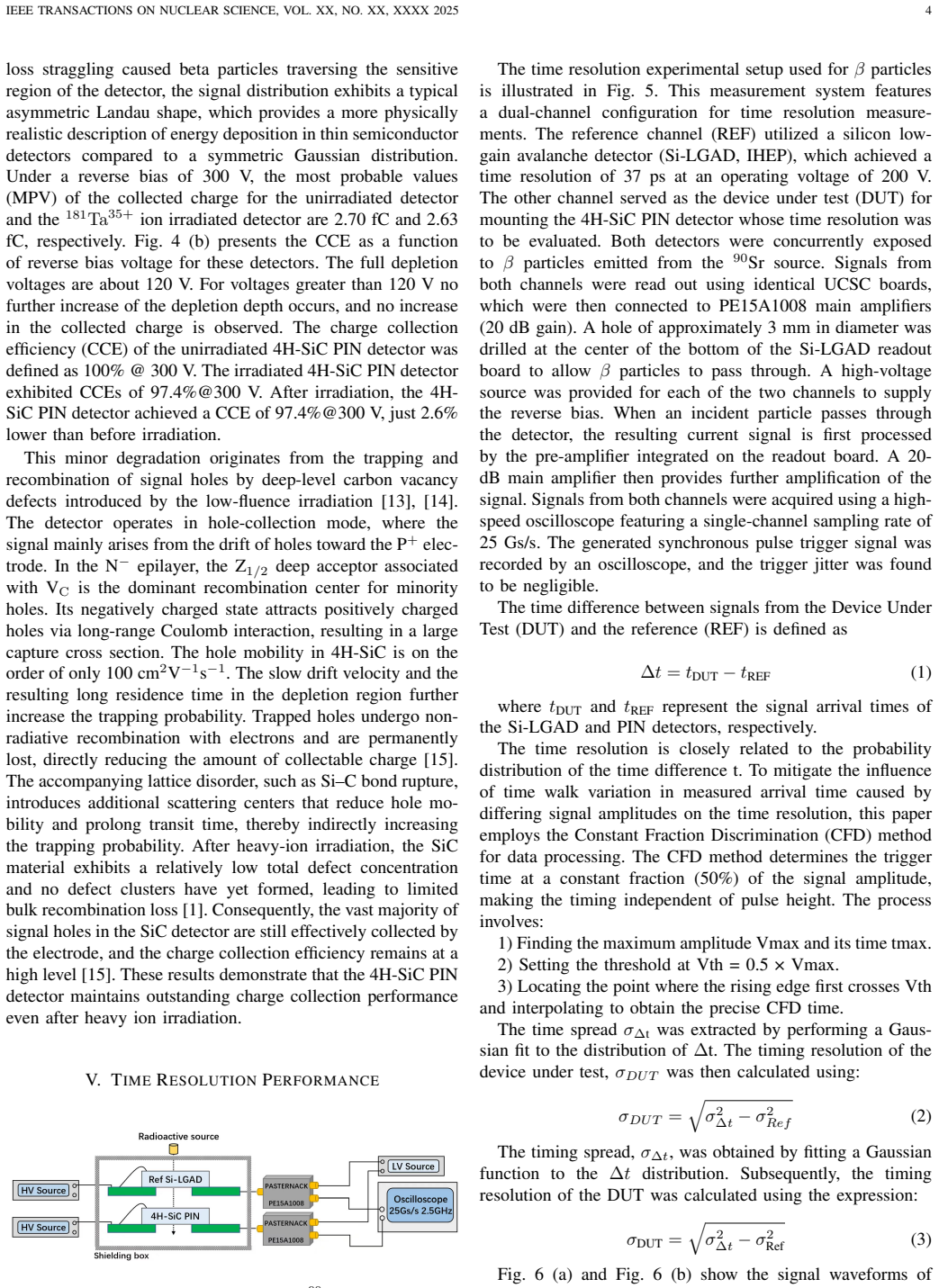
A silicon carbide PIN detector was fabricated and its radiation tolerance under Ta heavy ion irradiation of 2370 MeV was evaluated. Its electrical properties, charge collection performance and time resolution of $\beta$-particles ($^{90}$Sr) are reported. The leakage currents for unirradiated and irradiated 4H-SiC PIN detectors are $1.47 \times 10^{-10}$~A @ 300 V and 1.49~$\times$ 10$^{-10}$A@ 300 V. The effective doping concentrations for unirradiated and irradiated 4H-SiC PIN detectors are $6.23\times 10^{13}$~cm$^{-3}$ and $6.13\times 10^{13}$~cm$^{-3}$. The irradiated detector exhibits good electrical performance and stable device architecture. The 4H-SiC PIN detector exhibits a charge collection efficiency (CCE) of 99.24\% under Ta Heavy Ion Irradiation. The time resolutions of the detector before and after irradiation are 40 ps and 45 ps, respectively. Experimental results indicate that the CCE and time resolution performance exhibit good stability before and after irradiation. These results demonstrate stable performance under Ta heavy ion irradiation, highlighting the detectors potential for radiation-hard applications in high-energy physics, space missions, and nuclear reactor monitoring.
Editorial analysis
A structured set of objections, weighed in public.
Referee Report
Summary. The manuscript reports fabrication and testing of a 4H-SiC PIN detector, showing stable leakage current (1.47 to 1.49 × 10^{-10} A at 300 V), effective doping (6.23 to 6.13 × 10^{13} cm^{-3}), 99.24% charge collection efficiency under 2370 MeV Ta ion irradiation, and beta-particle time resolution of 40 ps pre-irradiation to 45 ps post-irradiation at low fluence of 16.5 MeV/u Ta ions, concluding that the detector exhibits good stability suitable for radiation-hard applications in high-energy physics, space missions, and nuclear reactor monitoring.
Significance. If the reported stability generalizes, the sub-45 ps timing performance combined with near-100% CCE would be a useful data point for SiC-based timing detectors. The work provides direct pre/post comparison measurements on electrical and timing properties under heavy-ion exposure, which is a strength for experimental validation in the field.
major comments (2)
- [Abstract] Abstract and title: The central claim that the results demonstrate suitability for 'radiation-hard applications in high-energy physics, space missions, and nuclear reactor monitoring' is not supported by the low-fluence irradiation performed. At the low fluences used, non-ionizing energy loss produces negligible defect density in 4H-SiC, so unchanged leakage, doping, CCE, and timing are expected regardless of intrinsic hardness; the extrapolation to 10^{14}–10^{16} cm^{-2} fluences typical of those applications therefore rests on an untested scaling assumption.
- [Abstract] Abstract: No numerical fluence value, error bars, sample statistics, or systematic uncertainty discussion is provided for the CCE (99.24%), time resolutions (40 ps and 45 ps), or doping concentrations, weakening the quantitative support for the stability claim.
minor comments (2)
- The beta-particle timing tests decouple the measurement from the heavy-ion damage spectrum; a discussion of how the observed timing stability relates to the actual Ta-ion interaction would strengthen the results.
- Clarify the exact fluence value (ions/cm²) and irradiation conditions in the main text, as the title refers only to 'low fluence' without a number.
Simulated Author's Rebuttal
We thank the referee for the constructive and detailed comments. We agree that the abstract overstates the implications of our low-fluence results and that quantitative details are missing. We will revise the manuscript accordingly to address these points without misrepresenting the scope of the work.
read point-by-point responses
-
Referee: [Abstract] Abstract and title: The central claim that the results demonstrate suitability for 'radiation-hard applications in high-energy physics, space missions, and nuclear reactor monitoring' is not supported by the low-fluence irradiation performed. At the low fluences used, non-ionizing energy loss produces negligible defect density in 4H-SiC, so unchanged leakage, doping, CCE, and timing are expected regardless of intrinsic hardness; the extrapolation to 10^{14}–10^{16} cm^{-2} fluences typical of those applications therefore rests on an untested scaling assumption.
Authors: We agree that the low fluence used means the observed stability is expected and does not yet demonstrate hardness at the high fluences relevant to the cited applications. In the revised version we will remove the broad suitability claims from the abstract and title, replace them with a statement that the detector shows stable performance at the tested low fluence, and add an explicit note that higher-fluence irradiation studies are required to assess suitability for high-energy physics, space, and reactor environments. revision: yes
-
Referee: [Abstract] Abstract: No numerical fluence value, error bars, sample statistics, or systematic uncertainty discussion is provided for the CCE (99.24%), time resolutions (40 ps and 45 ps), or doping concentrations, weakening the quantitative support for the stability claim.
Authors: We acknowledge this gap. The revised manuscript will report the precise fluence value (in ions cm^{-2}), include error bars and uncertainties on the CCE, time-resolution, and doping values, state the number of devices measured, and add a short paragraph discussing the main sources of systematic uncertainty in the electrical and timing measurements. revision: yes
Circularity Check
No circularity: purely experimental measurements with no derivations or self-referential predictions
full rationale
The paper consists entirely of direct experimental measurements and comparisons: leakage currents (1.47e-10 A vs 1.49e-10 A at 300 V), effective doping (6.23e13 vs 6.13e13 cm^{-3}), CCE of 99.24% under Ta irradiation, and time resolutions (40 ps before, 45 ps after) from beta-particle tests. No equations, fitted parameters, predictions, or load-bearing self-citations are present that could reduce any claim to its own inputs by construction. The central claims are empirical observations under the stated low-fluence conditions.
Axiom & Free-Parameter Ledger
axioms (1)
- domain assumption Standard semiconductor device physics governs the relationship between leakage current, effective doping concentration, charge collection efficiency, and time resolution in 4H-SiC PIN diodes.
Reference graph
Works this paper leans on
-
[1]
B. Mao, G. Zhao, X. Lv, X. Wang, W. Wei, G. Liu, J. Liu, and L. Liu, “Nondestructive spectroscopic investigation of n-type 4h-sic defects irradiated with low fluence 16.5 mev/u ta ions,”IEEE Transactions on Nuclear Science, vol. 71, no. 2, pp. 154–159, 2024
work page 2024
-
[2]
Y . Cao, Z. Zhang, L. Zhang, M. Li, S. Su, W. Zhang, Y . Xu, D. Huang, L. Liu, L. Lvet al., “Investigation on high-temperature and high-field reliability of nmos devices fabricated using 28 nm technology after heavy-ion irradiation,”Micromachines, vol. 16, no. 11, p. 1216, 2025
work page 2025
-
[3]
W. Cheng, F. Zhao, T. Zhang, Y . He, and H. Zhu, “A review of ultra-wide-bandgap semiconductor radiation detector for high-energy particles and photons,”Nanotechnology, vol. 36, no. 15, p. 152002, 2025, [Online]. Available: https://doi.org/10.1088/1361-6528/adbf2
-
[4]
Displacement damage in silicon detectors for high energy physics,
M. Moll, “Displacement damage in silicon detectors for high energy physics,”IEEE Transactions on Nuclear Science, vol. 65, no. 8, pp. 1561–1582, 2018
work page 2018
-
[5]
G. C. Messenger, “A summary review of displacement damage from high energy radiation in silicon semiconductors and semiconductor devices,” IEEE Transactions on nuclear Science, vol. 39, no. 3, pp. 468–473, 1992
work page 1992
-
[6]
Sic detectors: A review on the use of silicon carbide as radiation detection material,
M. D. Napoli, “Sic detectors: A review on the use of silicon carbide as radiation detection material,”Frontiers in Physics, vol. 10, p. 898833, 2022
work page 2022
-
[7]
Two-dimensional silicon carbide: emerging direct band gap semiconductor,
S. Chabi and K. Kadel, “Two-dimensional silicon carbide: emerging direct band gap semiconductor,”Nanomaterials, vol. 10, no. 11, p. 2226, 2020
work page 2020
-
[8]
Silicon carbide: A unique platform for metal-oxide-semiconductor physics,
G. Liu, B. R. Tuttle, and S. Dhar, “Silicon carbide: A unique platform for metal-oxide-semiconductor physics,”Applied Physics Reviews, vol. 2, no. 2, p. 15, 2015
work page 2015
-
[9]
Silicon carbide devices for radiation detection: A review of the main perfor- mances,
S. Tudisco, C. Altana, S. Amaducci, C. Ciampi, G. Cosentino, S. D. Luca, F. L. Via, G. Lanzalone, A. Muoio, G. Pasqualiet al., “Silicon carbide devices for radiation detection: A review of the main perfor- mances,”Nuclear Instruments and Methods in Physics Research Section A: Accelerators, Spectrometers, Detectors and Associated Equipment, vol. 1072, p. 1...
work page 2025
-
[10]
Consistency of bulk damage factor and niel for electrons, protons, and heavy ions in si ccds,
I. A. Slurinskayaet al., “Consistency of bulk damage factor and niel for electrons, protons, and heavy ions in si ccds,”IEEE Transactions on Nuclear Science, vol. 49, no. 6, pp. 2684–2689, 2002, nIELNIEL
work page 2002
-
[11]
Quantitative comparison between z 1/2 center and carbon vacancy in 4h-sic,
K. Kawahara, J. Suda, T. Kimoto, X. T. Trinh, N. T. Son, and E. Janz ´en, “Quantitative comparison between z 1/2 center and carbon vacancy in 4h-sic,”Journal of Applied Physics, vol. 115, no. 14, p. 143705, 2014, 4DLTSEPRZ(VC)
work page 2014
-
[12]
K. Kawahara, X. T. Trinh, N. T. Son, E. Janz ´en, J. Suda, and T. Kimoto, “Investigation on origin of z 1/2 center in sic by deep level transient spectroscopy and electron paramagnetic resonance,”Applied Physics Letters, vol. 102, p. 112106, 2013, zn4H-SiC
work page 2013
-
[13]
Carrier lifetime measurement in n − 4h-sic epilayers,
P. B. Klein, “Carrier lifetime measurement in n − 4h-sic epilayers,”J. Appl. Phys., vol. 103, no. 3, p. 033702, Feb. 2008
work page 2008
-
[14]
Elimination of the z 1/2 deep level in n- type 4h-sic by thermal oxidation,
T. Hiyoshi and T. Kimoto, “Elimination of the z 1/2 deep level in n- type 4h-sic by thermal oxidation,”Appl. Phys. Express, vol. 2, no. 9, p. 091101, Aug. 2009
work page 2009
-
[15]
G. Kramberger, V . Cindro, I. Mandi ´c, M. Miku ˇz, and M. Zavrtanik, “Effective trapping time of electrons and holes in different silicon materials irradiated with neutrons, protons and pions,”Nucl. Instrum. Methods Phys. Res. A, vol. 476, no. 3, pp. 645–651, January 2002
work page 2002
-
[16]
Lutz,Semiconductor Radiation Detectors: Device Physics
G. Lutz,Semiconductor Radiation Detectors: Device Physics. Berlin, Germany: Springer, 2007
work page 2007
-
[17]
Statistics of the recombinations of holes and electrons,
W. Shockley and W. T. R. Jr., “Statistics of the recombinations of holes and electrons,”Phys. Rev., vol. 87, no. 5, pp. 835–842, Sep. 1952
work page 1952
-
[18]
Study of silicon carbide for x-ray detectors and spectroscopy,
G. Bertuccio and R. Casiraghi, “Study of silicon carbide for x-ray detectors and spectroscopy,”IEEE Trans. Nucl. Sci., vol. 50, no. 1, pp. 175–185, Feb. 2002
work page 2002
discussion (0)
Sign in with ORCID, Apple, or X to comment. Anyone can read and Pith papers without signing in.