Recognition: 2 theorem links
· Lean TheoremFluctuation-Dissipation Framework for Size-Dependent Surface Tension
Pith reviewed 2026-05-14 18:35 UTC · model grok-4.3
The pith
The planar-limit Tolman length at liquid-vapor coexistence is a bulk fluctuation-response observable expressible through the liquid's isothermal compressibility and its pressure derivative.
A machine-rendered reading of the paper's core claim, the machinery that carries it, and where it could break.
Core claim
The central claim is that the planar-limit value of the Tolman length reduces to a combination of the liquid isothermal compressibility and its pressure derivative. It can be recast as a bulk fluctuation-response observable of the homogeneous liquid in the isothermal-isobaric ensemble, determined by second and third central moments of the volume distribution or by the pressure response of the relative fluctuation width. This representation allows the coefficient to be computed from homogeneous liquid simulations without an explicit interface, as shown for water yielding estimates near -0.7 Angstrom at 300 K.
What carries the argument
The fluctuation-dissipation relation that maps the Tolman length onto the pressure response of the relative fluctuation width of volume in the NPT ensemble.
If this is right
- The Tolman length can be obtained from standard bulk simulations or thermodynamic equations of state without modeling liquid-vapor interfaces.
- For water at coexistence the planar Tolman length is near -0.7 angstrom with weakly nonmonotonic temperature dependence.
- The framework applies directly to other one-component liquids whenever accurate bulk volume statistics or thermal equations of state are available.
- Size-dependent surface tension effects at nanoscales become predictable from macroscopic bulk properties.
Where Pith is reading between the lines
- This bulk-only route could reduce the computational effort needed to estimate curvature corrections in nanoscale phase-change processes.
- Similar fluctuation-based mappings might be developed for other interface corrections or for multicomponent systems.
- The approach highlights a direct link between interface phenomenology and equilibrium fluctuation spectra in the bulk phase.
Load-bearing premise
For weakly compressible liquids the adopted asymmetric density-based formulation is the practically relevant one, with finite-curvature effects entering through vapor supersaturation under capillary equilibrium.
What would settle it
An explicit curved-interface simulation that produces a Tolman length differing from the bulk-derived value near -0.7 angstrom for water at 300 K would falsify the relation.
Figures




read the original abstract
The size-dependent liquid-vapor surface tension controls phase change, wetting, and transport at nanoscales, yet its first curvature correction, the Tolman length, remains difficult to determine. We develop a thermodynamic and statistical-mechanical framework that relates this correction to bulk response properties of a one-component liquid near liquid-vapor coexistence. For curved interfaces, the analysis considers two local formulations of the same capillary-chemical balance, in excess pressures and in relative density deviations. For weakly compressible liquids in the regime emphasized here, the adopted asymmetric density-based formulation is the practically relevant one, with finite-curvature effects entering through vapor supersaturation under capillary equilibrium. At coexistence, the planar-limit value of the same Tolman length reduces to a combination of the liquid isothermal compressibility and its pressure derivative and can be recast as a bulk fluctuation-response observable of the homogeneous liquid in the isothermal-isobaric ensemble. In this representation, the planar-limit coefficient is determined by second and third central moments of the volume distribution, equivalently by the pressure response of the relative fluctuation width. For water, homogeneous (N,P,T) simulations of SPC/E and TIP4P/2005 sample the bulk liquid, not an explicit liquid-vapor interface, and yield estimates near -0.7 Angstrom at 300 K. An independent evaluation based on the IAPWS-IF97 industrial formulation gives -0.713 +/- 0.004 Angstrom at the same coexistence state and predicts a weakly nonmonotonic temperature dependence along coexistence. Beyond water, the framework applies to other one-component liquids in regimes where an accurate thermal equation of state or sufficiently converged bulk volume statistics are available.
Editorial analysis
A structured set of objections, weighed in public.
Referee Report
Summary. The manuscript develops a thermodynamic and statistical-mechanical framework relating the Tolman length (first curvature correction to liquid-vapor surface tension) to bulk liquid response functions near coexistence. It equates two local capillary-chemical balances (excess pressure and relative density deviation), adopts an asymmetric density-based form for weakly compressible liquids, and shows that at coexistence the planar-limit Tolman length reduces exactly to a combination of the isothermal compressibility κ_T and dκ_T/dp. This is recast as a bulk fluctuation-response observable via second and third central moments of the volume distribution in the NPT ensemble. For water, NPT simulations of SPC/E and TIP4P/2005 yield ~−0.7 Å at 300 K, consistent with an independent IAPWS-IF97 evaluation of −0.713 ± 0.004 Å that also predicts weakly nonmonotonic temperature dependence along coexistence.
Significance. If the planar-limit reduction holds without residual interface or vapor terms, the work supplies a practical route to the Tolman length from bulk equation-of-state data or NPT volume statistics alone, bypassing explicit interface simulations. The numerical agreement between two water models and the industrial formulation, together with the explicit mapping to measurable fluctuation moments, strengthens the result and extends naturally to other one-component liquids with accurate thermal equations of state.
major comments (3)
- [derivation of planar-limit Tolman length (coexistence case)] The central reduction of the planar-limit Tolman length to pure bulk NPT moments (κ_T and dκ_T/dp) is load-bearing. The derivation must explicitly demonstrate that all vapor-supersaturation and interface-specific contributions cancel identically in the density-based capillary balance at coexistence, rather than being dropped by the weak-compressibility approximation. This step is not shown in sufficient algebraic detail in the section deriving the coexistence limit.
- [local capillary-chemical balance formulations] The adopted asymmetric density formulation is stated to be the practically relevant choice for weakly compressible liquids, with curvature effects routed through vapor supersaturation. The manuscript should quantify the size of the neglected symmetric (pressure-based) corrections at coexistence to confirm they remain negligible compared with the reported −0.7 Å scale.
- [IAPWS-IF97 evaluation and temperature dependence] The IAPWS-IF97 evaluation reports ±0.004 Å uncertainty at 300 K. The propagation from the second and third volume moments (or from the pressure derivative of κ_T) to this uncertainty should be shown explicitly, including any truncation or fitting choices in the industrial formulation.
minor comments (2)
- [fluctuation-response representation] The abstract states that the planar-limit coefficient is determined by second and third central moments; the corresponding equations should be numbered and cross-referenced in the main text for clarity.
- [molecular simulations] Simulation details (system size, equilibration, block-averaging procedure for the third moment) are needed to assess convergence of the reported −0.7 Å estimates from SPC/E and TIP4P/2005.
Simulated Author's Rebuttal
We thank the referee for the careful and constructive report. The comments have prompted us to strengthen the algebraic transparency of the coexistence limit, to quantify the neglected symmetric corrections, and to document the uncertainty propagation explicitly. We address each major comment below and have revised the manuscript accordingly.
read point-by-point responses
-
Referee: [derivation of planar-limit Tolman length (coexistence case)] The central reduction of the planar-limit Tolman length to pure bulk NPT moments (κ_T and dκ_T/dp) is load-bearing. The derivation must explicitly demonstrate that all vapor-supersaturation and interface-specific contributions cancel identically in the density-based capillary balance at coexistence, rather than being dropped by the weak-compressibility approximation. This step is not shown in sufficient algebraic detail in the section deriving the coexistence limit.
Authors: We agree that the cancellation must be shown algebraically rather than asserted. In the revised manuscript we have expanded the derivation (new Eqs. (12)–(15) and accompanying text in Sec. III B) to start from the full capillary-chemical balance expressed in the asymmetric density formulation. At exact coexistence (μ = μ_sat, p = p_sat) the vapor supersaturation term vanishes identically because the chemical-potential equality forces the relative density deviation in the vapor to be zero; the interface-specific curvature corrections are absent by construction once the planar limit is taken before the curvature expansion. The weak-compressibility approximation is used only to justify retaining the density-based form; the cancellation itself is exact at coexistence and does not rely on that approximation. revision: yes
-
Referee: [local capillary-chemical balance formulations] The adopted asymmetric density formulation is stated to be the practically relevant choice for weakly compressible liquids, with curvature effects routed through vapor supersaturation. The manuscript should quantify the size of the neglected symmetric (pressure-based) corrections at coexistence to confirm they remain negligible compared with the reported −0.7 Å scale.
Authors: We have added a new paragraph (Sec. II C) that quantifies the symmetric pressure-based correction. Using the thermodynamic identity that relates pressure and density deviations through κ_T, the symmetric term contributes an additive correction of order 0.04–0.05 Å for water at 300 K (evaluated from the same IAPWS-IF97 data). This is less than 7 % of the reported Tolman length and remains negligible across the temperature range examined. The estimate is obtained by direct substitution of the coexistence values of κ_T and its pressure derivative into the symmetric balance and does not require additional simulations. revision: yes
-
Referee: [IAPWS-IF97 evaluation and temperature dependence] The IAPWS-IF97 evaluation reports ±0.004 Å uncertainty at 300 K. The propagation from the second and third volume moments (or from the pressure derivative of κ_T) to this uncertainty should be shown explicitly, including any truncation or fitting choices in the industrial formulation.
Authors: We have added Appendix B that details the uncertainty propagation. The quoted ±0.004 Å is obtained by standard first-order error propagation applied to the combination κ_T (d ln κ_T / dp) evaluated from the IAPWS-IF97 tables; the dominant contribution comes from the tabulated pressure derivative of κ_T. We specify the polynomial fitting ranges (280–320 K) and the truncation order used in the industrial formulation for the relevant derivatives, together with the numerical differentiation step size employed to extract dκ_T/dp. The resulting uncertainty band is shown as a shaded region in the revised Fig. 4. revision: yes
Circularity Check
No circularity; planar-limit reduction follows from capillary balance and fluctuation theorems without self-referential fitting or definition
full rationale
The derivation begins from two equivalent local statements of capillary-chemical equilibrium (excess pressure and relative density deviation) under the weak-compressibility approximation, then takes the planar coexistence limit where vapor supersaturation vanishes identically. The resulting expression for the Tolman length is rewritten in terms of the liquid isothermal compressibility and its pressure derivative, which are identified with second and third central moments of the NPT volume distribution via standard fluctuation-dissipation relations. This mapping is obtained directly from the thermodynamic identities and does not require any parameter fitted to interface data, nor does it invoke a self-citation chain or rename a known result; bulk simulations and independent EOS evaluations serve as external checks rather than inputs. The framework therefore remains self-contained against external benchmarks.
Axiom & Free-Parameter Ledger
axioms (2)
- domain assumption Capillary-chemical equilibrium holds for curved liquid-vapor interfaces
- domain assumption Weakly compressible liquid approximation near coexistence
Lean theorems connected to this paper
-
IndisputableMonolith/Cost/FunctionalEquation.leanwashburn_uniqueness_aczel unclear?
unclearRelation between the paper passage and the cited Recognition theorem.
δ_planar_Tolman = γ_∞/2 (β_T,l + β'_T,l / β_T,l) at coexistence; equivalently γ_∞/(2kT) (2 m2/ν1 − m3/m2) from second and third central moments of the NPT volume distribution
-
IndisputableMonolith/Foundation/RealityFromDistinction.leanreality_from_one_distinction unclear?
unclearRelation between the paper passage and the cited Recognition theorem.
At coexistence, the planar-limit value of the same Tolman length reduces to a combination of the liquid isothermal compressibility and its pressure derivative and can be recast as a bulk fluctuation-response observable
What do these tags mean?
- matches
- The paper's claim is directly supported by a theorem in the formal canon.
- supports
- The theorem supports part of the paper's argument, but the paper may add assumptions or extra steps.
- extends
- The paper goes beyond the formal theorem; the theorem is a base layer rather than the whole result.
- uses
- The paper appears to rely on the theorem as machinery.
- contradicts
- The paper's claim conflicts with a theorem or certificate in the canon.
- unclear
- Pith found a possible connection, but the passage is too broad, indirect, or ambiguous to say the theorem truly supports the claim.
Reference graph
Works this paper leans on
-
[1]
Pressure derivatives of raw and central moments It is convenient to begin with the pressure derivative of lnQ: ∂lnQ ∂P T,N = 1 Q ∂Q ∂P T,N = 1 Q Z ∞ 0 dV ∑ k (−βV)exp −β PV+E k(V;N) =−β⟨V⟩=−β ν 1. (A4) Differentiating once more yields ∂ 2 lnQ ∂P 2 T,N =−β ∂ ν1 ∂P T,N =β 2 h ⟨V2⟩ −(⟨V⟩) 2 i =β 2m2, (A5) wherem 2 is the second central moment, i.e., the vari...
-
[2]
1 ν1 ∂m 2 ∂P T,N − m2 ν2 1 ∂ ν1 ∂P T,N # = 1 (kBT) 2
Compressibility and its pressure derivative The isothermal compressibility is defined as βT (T,P) =− 1 ν1 ∂ ν1 ∂P T,N .(A13) Using Eq. (A8), we obtain the standard fluctuation formula βT (T,P) = 1 kBT m2 ν1 ,(A14) which coincides with Eq. (14) in the main text. 14 Differentiating Eq. (A14) with respect to pressure gives β ′ T (T,P) = ∂ βT ∂P T,N = 1 kBT "...
-
[3]
Fluctuation–response identity for the planar-limit relation Equations (A12) imply a compact identity for the pres- sure response of the relative width of the volume distribution. Writingσ V = √m2 and using ln(σV /ν1) = 1 2 lnm 2 −lnν 1, we obtain ∂ ∂P T,N ln σV ν1 = 1 2m2 ∂m 2 ∂P T,N − 1 ν1 ∂ ν1 ∂P T,N =β m2 ν1 − m3 2m2 .(A16) Equivalently, 1 2kBT 2 m2 ν1...
-
[4]
Coexistence reference state and local notation Throughout this Appendix, temperatureTis fixed and the reference state is the planar liquid–vapor coexistence point (T,P0), where P0 =P sat(T),µ l(T,P0) =µ v(T,P0).(B1) For each phasei∈ {l,v}, we write ρi0 ≡ρ i(T,P0),∆P i ≡Pi −P0,∆ρ i ≡ ρi −ρ i0 ρi0 .(B2) Unless stated otherwise, all pressure derivatives in t...
-
[5]
These pressure derivatives provide the local expansion co- efficients used later when the chemical-potential equality is expanded directly in excess-pressure variables
Pressure derivatives of the chemical potential Along an isotherm, the chemical potential satisfies the stan- dard relation ∂ µi ∂P T = 1 ρi .(B5) Using ∂ ρi ∂P T =β T,iρi,(B6) the second pressure derivative becomes ∂ 2µi ∂P 2 T =− βT,i ρi .(B7) Differentiating once more gives ∂ 3µi ∂P 3 T = β 2 T,i −β ′ T,i ρi .(B8) 15 Evaluated at the coexistence referen...
-
[6]
(B10) Using Eq
Local pressure expansion of the chemical potential Expandingµ i(T,P)aboutP=P 0 gives µi(P0 +∆Pi) =µ i(P0) +µ ′ i,0∆Pi + 1 2 µ ′′ i,0∆P2 i + 1 6 µ ′′′ i,0∆P3 i +O(∆P 4 i ). (B10) Using Eq. (B9), this becomes µi(P0 +∆Pi) =µ i(P0) + ∆Pi ρi0 − βT,i 2ρi0 ∆P2 i + β 2 T,i −β ′ T,i 6ρi0 ∆P3 i +O(∆P 4 i ). (B11) Equation (B11) is the local pressure expansion used ...
-
[7]
Us- ing the chain rule together with Eqs
Density derivatives of the chemical potential We next construct the local density representation ofµi. Us- ing the chain rule together with Eqs. (B5) and (B6), we obtain ∂ µi ∂ ρi T = ∂ µi ∂P T ∂ ρi ∂P T = 1 βT,iρ2 i .(B12) Differentiating with respect toρ i at fixedTgives ∂ 2µi ∂ ρ2 i T =− 2+β ′ T,i/β 2 T,i βT,iρ3 i .(B13) Equivalently, using Eq. (B4), ∂...
-
[8]
(B17) Using Eq
Local density expansion of the chemical potential Writing ρi =ρ i0(1+∆ρ i),(B16) we expandµ i(ρi;T)aboutρ i0: µi ρi0(1+∆ρ i) =µ i(ρi0) + ∂ µi ∂ ρi T ρi0 ρi0∆ρi + 1 2 ∂ 2µi ∂ ρ2 i T ρi0 ρ2 i0∆ρ2 i +O(∆ρ 3 i ). (B17) Using Eq. (B15), we obtain µi ρi0(1+∆ρ i) =µ i(ρi0) + ∆ρi βT,iρi0 − 1 2βT,iρi0 2+ β ′ T,i β 2 T,i ! ∆ρ2 i +O(∆ρ 3 i ) =µ i(ρi0) + ∆ρi βT,iρi0 ...
-
[9]
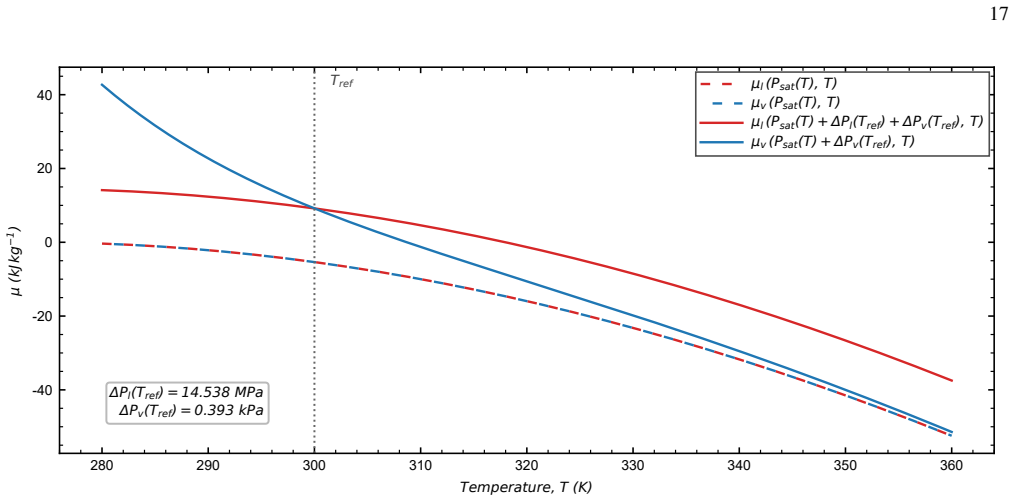
Figure 3 contrasts the planar coexistence branches with the branches evaluated at the shifted liquid and vapor pressures corresponding to a representative curved droplet
Illustrative coexistence and shifted-pressure chemical-potential branches Although the present Appendix is devoted to local one- phase expansions, it is useful to visualize the chemical- potential branches that later enter the capillary–chemical bal- ance through shifted pressure arguments. Figure 3 contrasts the planar coexistence branches with the branc...
-
[10]
Role in the later appendices The results of the present Appendix serve only as local one- phase input for the later derivations. Equation (B11) supplies the one-phase pressure expansion of the chemical potential used in Appendix D, where the same capillary–chemical bal- ance is expanded in excess-pressure variables. Equation (B18) supplies the one-phase d...
-
[11]
(C3) For later convenience, we introduce the compact combination Ai ≡1+ β ′ i β 2 i .(C4) At the present stage, all relations are purely one-phase and local
Reference state and one-phase variables Throughout this Appendix, temperatureTis fixed and the reference state is the planar liquid–vapor coexistence point (T,P0), where P0 =P sat(T),µ l(T,P0) =µ v(T,P0).(C1) For each phasei∈ {l,v}, we define ρi0 ≡ρ i(T,P0),∆P i ≡Pi −P0,∆ρ i ≡ ρi −ρ i0 ρi0 .(C2) We also write βi ≡β T,i(T,P0), β ′ i ≡ ∂ βT,i ∂P T P0 , β ′′...
-
[12]
Forward one-phase series:∆P i(∆ρi) We begin from the local thermal equation of state of phase i, written along an isotherm asP i =P i(ρ;T). The one-phase excess pressure is then ∆Pi =P i ρi0(1+∆ρ i);T −Pi(ρi0;T).(C5) Along an isotherm, the standard identities ∂ µi ∂P T = 1 ρi , ∂ ρi ∂P T =β T,i(T,P)ρ i (C6) imply ∂P ∂ ρi T = 1 βT,i(T,P)ρ i .(C7) Evaluatin...
-
[13]
(C12) to the order required later in the manuscript
Local inverse series:∆ρ i(∆Pi) We next invert Eq. (C12) to the order required later in the manuscript. We seek a local inverse relation of the form ∆ρi =a 1∆Pi +a 2∆P2 i +O(∆P 3 i ).(C13) Substituting Eq. (C13) into Eq. (C12) and matching equal powers of∆P i, we obtain a1 =β i,a 2 = 1 2 1+ β ′ i β 2 i β 2 i = 1 2 Aiβ 2 i .(C14) Therefore, ∆ρi =β i∆Pi + 1 ...
-
[14]
For the water regime emphasized in the 18 manuscript, it is therefore useful to support that these retained orders remain adequate over the interval of practical interest
Water-based support for the retained local truncation orders The one-phase local series derived above are used later only at low retained orders. For the water regime emphasized in the 18 manuscript, it is therefore useful to support that these retained orders remain adequate over the interval of practical interest. The present subsection serves exactly t...
-
[15]
Equation (C12) provides the forward one-phase thermal-equation-of-state series, whereas Eqs
Use in the later derivations The results of the present Appendix are used later only as local one-phase input. Equation (C12) provides the forward one-phase thermal-equation-of-state series, whereas Eqs. (C15) and (C17) provide the corresponding local inverse series. In the later density-based derivation, these inverse one- phase relations are combined wi...
-
[16]
II A, this corre- sponds to a liquid droplet or liquid filament surrounded by vapor, so that the liquid pressure exceeds the vapor pressure by the Laplace amount
Pressure-side setup and shifted arguments Throughout this Appendix, temperatureTis fixed and the reference state is the planar coexistence point(T,P 0), where P0 =P sat(T),µ l(T,P0) =µ v(T,P0).(D1) We define the phase excess pressures and the capillary pres- sure difference by ∆Pv ≡P v −P0,∆P l ≡P l −P0,∆P≡P l −Pv,(D2) so that ∆Pl =∆P v +∆P.(D3) With the ...
-
[17]
Local pressure-expanded capillary–chemical balance At fixedT, the pressure derivatives of the chemical poten- tial satisfy ∂ µi ∂P T = 1 ρi , ∂ 2µi ∂P 2 T =− βT,i ρi , ∂ 3µi ∂P 3 T = β 2 T,i −β ′ T,i ρi . (D8) 19 10 20 30 40 50 60 70R (nm) -1.1 -1.0 -0.9 -0.8 -0.7 -0.6 -0.5 -0.4 δ (Å) 0 5 10 15 20 25 30 35 a 10 20 30 40 50 60 70R (nm) -1.1 -1.0 -0.9 -0.8 ...
-
[18]
Accordingly, the planar-limit coefficient is not obtained from a prior separate pressure-only symbolic balance
Minimal pressure-side formulation We now combine the local pressure-expanded balance with the Tolman-corrected capillary relation ∆P=Hγ ∞ 1−Hδ Tolman .(D11) A point that matters for interpretation is that, in the actual symbolic workflow, the first retained mixed pressure-side rela- tion already contains explicitΠ v-dependence, because the liq- uid branch...
-
[19]
At this level, ex- plicit supersaturation dependence is already present, because the liquid-side bivariate expansion generates mixed terms con- taining both∆P v and∆P
First retained pressure-side Tolman-sensitive relation We next retain the first mixed pressure-side structure pro- duced directly by the symbolic workflow. At this level, ex- plicit supersaturation dependence is already present, because the liquid-side bivariate expansion generates mixed terms con- taining both∆P v and∆P. After substitution of Eq. (D11) i...
-
[20]
Including the next retained supersaturation-dependent terms If one retains the nextΠ 2 v-level contributions in the pressure-side algebra, the mixed balance acquires both quadratic vapor-response terms and higher liquid-side mixed terms. At this level, the Tolman-sensitive relation may still be written in compact form as ∆= Np(Πv) Dp(Πv) ,(D23) 21 with Np...
-
[21]
Practical scope of the pressure-side formulation The pressure-side formulation developed here is one legit- imate local formulation of the same capillary–chemical bal- ance used in the main text. Its main value is structural: it gives a direct pressure-side view of the leading supersaturation rela- tion, the planar-limit coefficient obtained within the mi...
-
[22]
II A, this corre- sponds to a liquid droplet or liquid filament surrounded by vapor, so that the liquid pressure exceeds the vapor pressure by the Laplace amount
Density-side setup and adopted retained ordering Throughout this Appendix, temperatureTis fixed and the reference state is the planar coexistence point(T,P 0), where P0 =P sat(T),µ l(T,P0) =µ v(T,P0).(E1) We use the same excess-pressure variables as in the main text and in Appendix D: ∆Pv ≡P v −P0,∆P l ≡P l −P0,∆P≡P l −Pv,(E2) so that ∆Pl =∆P v +∆P.(E3) W...
-
[23]
Leading two-phase density coupling from chemical-potential equality The local density-side expansion of the chemical potential obtained in Appendix B gives, for each phasei∈ {l,v}, µi ρi0(1+∆ρ i) =µ i(ρi0) + ∆ρi βT,iρi0 +O(∆ρ 2 i ).(E6) Imposing chemical equilibrium, µl =µ v,(E7) and using Eq. (E1), we obtain at leading order ∆ρl βT,l ρl0 − ∆ρv βT,vρv0 =0...
-
[24]
One-phase liquid and vapor re-expansions used in the adopted derivation From Appendix C, the one-phase inverse excess-pressure / relative-density series gives, for the liquid branch, ∆ρl =β T,l ∆Pl + 1 2 1+ β ′ T,l β 2 T,l ! (βT,l ∆Pl)2 +O(∆P 3 l ).(E10) For compactness, we define Al ≡1+ β ′ T,l β 2 T,l ,(E11) so that Eq. (E10) becomes ∆ρl =β T,l ∆Pl + 1 ...
-
[25]
(E12) into the leading density cou- pling (E9) gives ∆ρv = βT,vρv0 ρl0 ∆Pl + 1 2 Al βT,vβT,l ρv0 ρl0 ∆P2 l +O(∆P 3 l )
Reduced excess-pressure balance of the adopted density-based formulation Substituting Eq. (E12) into the leading density cou- pling (E9) gives ∆ρv = βT,vρv0 ρl0 ∆Pl + 1 2 Al βT,vβT,l ρv0 ρl0 ∆P2 l +O(∆P 3 l ). (E14) Equating this with the retained vapor-side relation (E13) and dividing byβ T,v, we obtain ∆Pv ρl0 ρv0 =∆P l + 1 2 Al βT,l ∆P2 l +O(∆P 3 l ,∆P...
-
[26]
Mixed finite-curvature balance in(Π v,h,∆) We now combine Eq. (E15) with the Tolman-corrected cap- illary relation ∆Pl −∆Pv =Hγ ∞ 1−Hδ Tolman .(E16) For convenience, we introduce the same dimensionless vari- ables as in Appendix D, rρ ≡ ρv0 ρl0 ,Π v ≡β T,l ∆Pv, h≡Hγ ∞βT,l ,∆≡ δTolman γ ∞βT,l . (E17) Equation (E16) then implies βT,l ∆Pl =Π v +h(1−h∆).(E18)...
-
[27]
(E19): Πv −2+2r ρ +r ρAlΠv +2hr ρ [1+A lΠv] =0.(E20) This relation is used only as an auxiliary relation controlling the supersaturation
Auxiliary supersaturation control relation The auxiliary supersaturation-control relation is built only from the explicitly retained∆-free terms of orderh 0 andh 1 in Eq. (E19): Πv −2+2r ρ +r ρAlΠv +2hr ρ [1+A lΠv] =0.(E20) This relation is used only as an auxiliary relation controlling the supersaturation. It is not itself the Tolman-sensitive rela- tion...
-
[28]
Tolman-sensitive relation and planar-limit extraction After the auxiliary supersaturation step has fixed the lead- ing scaling ofΠ v, the Tolman contribution is extracted only from the explicitly retainedh 2-sector of Eq. (E19). That sec- tor is Al −2∆−2A lΠv∆=0,(E25) which yields the Tolman-sensitive relation ∆(Πv) = Al 2(1+A lΠv) .(E26) The planar-limit...
-
[29]
Finite-curvature continuation If one keeps Eq. (E26) at finiteΠ v, rather than taking the strict planar limit immediately, one obtains the non-strict finite-curvature continuation ∆cont(Πv) = Al 2(1+A lΠv) .(E29) In dimensional form, δ cont Tolman = δ planar Tolman 1+ βT,l + β ′ T,l βT,l ∆Pv .(E30) This expression reduces to the planar-limit result as∆P v...
-
[30]
Decomposition of the quadratic liquid contribution under composition of local series To understand why comparison variants can yield differ- ent planar coefficients, it is useful to isolate the two distinct quadratic liquid contributions before they are composed. From Appendix B, the local liquid chemical-potential ex- pansion in the relative density devi...
-
[31]
Comparison variants and coefficient migration We now record three comparison variants, distinguished by which quadratic liquid contribution survives in the retained h2-sector after composition. (i) Chemical-potential quadratic contribution only.If one retains only the quadratic contribution originating from the local chemical-potential expansion, the repr...
-
[32]
Recovery of the pressure-side planar coefficient A noteworthy feature of the comparison variants is that the coefficient obtained when both quadratic liquid contributions are retained together, ∆(µ+inv) 0 =− 1 2 ,(E50) recovers the minimal pressure-side planar coefficient derived in the pressure-side formulation of Appendix D. In dimen- sional form, δ (µ+...
-
[33]
Status of the comparison variants The adopted manuscript-level derivation is the one given in Secs. E 1–E 8. Within that derivation, the reported planar-limit result is Eq. (E28). The comparison variants introduced after- ward do not modify that result and are not alternative adopted formulations. Their function is narrower. They document how different re...
-
[34]
Purpose and scope The adopted density-based derivation has already been completed in Appendix E. In particular, the auxiliary supersaturation-control relation is constructed there only from the explicitly retained∆-free terms of ordersh 0 andh 1, whereas the Tolman-sensitive relation is extracted only from the explicitly retained sector of orderh 2. The p...
-
[35]
(F1) Here rρ ≡ ρv0 ρl0 ,Π v ≡β T,l ∆Pv, h≡Hγ ∞βT,l ,∆≡ δTolman γ ∞βT,l , (F2) and Al ≡1+ β ′ T,l β 2 T,l .(F3) For the present diagnostic purpose, it is convenient to sepa- rate Eq
Diagnostic quantities inherited from Appendix E We begin from the retained mixed balance derived in Ap- pendix E, 0=Π v −2+2r ρ +r ρAlΠv +2hr ρ [1+A lΠv] +h 2rρ [Al −2∆−2A lΠv∆]. (F1) Here rρ ≡ ρv0 ρl0 ,Π v ≡β T,l ∆Pv, h≡Hγ ∞βT,l ,∆≡ δTolman γ ∞βT,l , (F2) and Al ≡1+ β ′ T,l β 2 T,l .(F3) For the present diagnostic purpose, it is convenient to sepa- rate ...
-
[36]
Throughout, the coexistence reference state is(T,P 0), withP 0 =P sat(T), and all coefficients entering Eqs
EOS-based evaluation procedure for water To evaluate the hierarchy ratio (F7) for water, we use ther- modynamic properties evaluated from the IAPWS-IF97 in- dustrial formulation as empirical input for the required liq- uid and vapor quantities near coexistence. Throughout, the coexistence reference state is(T,P 0), withP 0 =P sat(T), and all coefficients ...
-
[37]
In representative near-ambient conditions, one finds |R| ∼10 −2–10−1 (F10) for a wide range of nanometric radii and moderate choices of δTolman
Water-specific hierarchy behavior For water away from criticality, and for the nanometric regime emphasized in the manuscript, the EOS-based esti- mates show that the magnitude of the diagnostic ratio (F7) remains typically below unity and, over a broad practically relevant range, substantially below unity. In representative near-ambient conditions, one f...
-
[38]
Practical implication for the adopted density-based formulation For water under the conditions considered in the manuscript, the hierarchy condition|R| ≪1 supports the practical relevance of the adopted density-based formulation developed in Appendix E. More specifically, it supports the strategy in which the auxiliary supersaturation-control rela- tion i...
-
[39]
Interaction models for water in relation to protein hydration,
Limitations The present hierarchy support is intentionally water- specific and regime-specific. It is aimed at the weakly compressible near-coexistence regime emphasized in the manuscript, not at critical or near-spinodal conditions. Near the critical region, the coexistence density contrast de- creases, the compressibilities grow strongly, and both the l...
work page doi:10.1063/1.3376612/16122339/141101_1_online.pdf 2020
discussion (0)
Sign in with ORCID, Apple, or X to comment. Anyone can read and Pith papers without signing in.