Recognition: no theorem link
OAM-Induced Lattice Rotation Reveals a Fractional Optimum in Fault-Tolerant GKP Quantum Sensing
Pith reviewed 2026-05-14 18:29 UTC · model grok-4.3
The pith
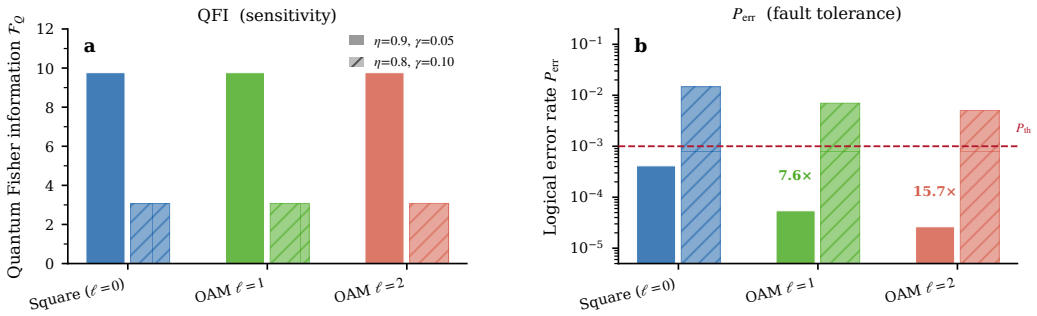
Fractional orbital angular momentum charge of 1.5 twists GKP lattices to reduce sensing error probability by 23.9 times while keeping quantum Fisher information unchanged within 0.2 percent.
A machine-rendered reading of the paper's core claim, the machinery that carries it, and where it could break.
Core claim
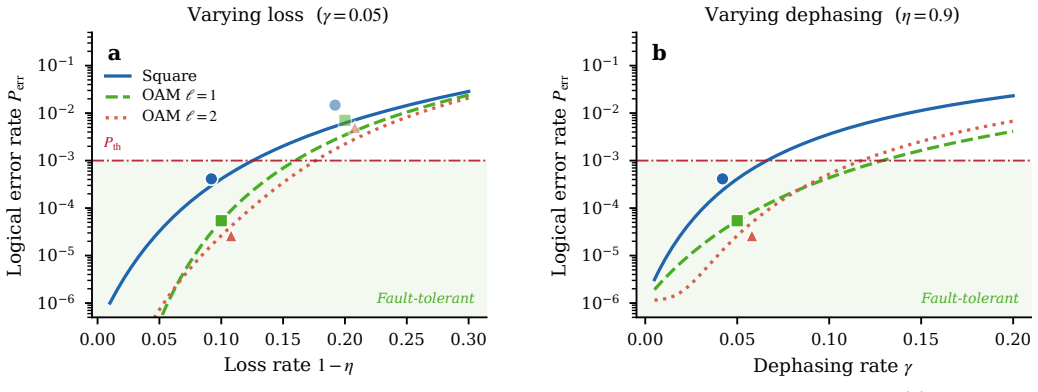
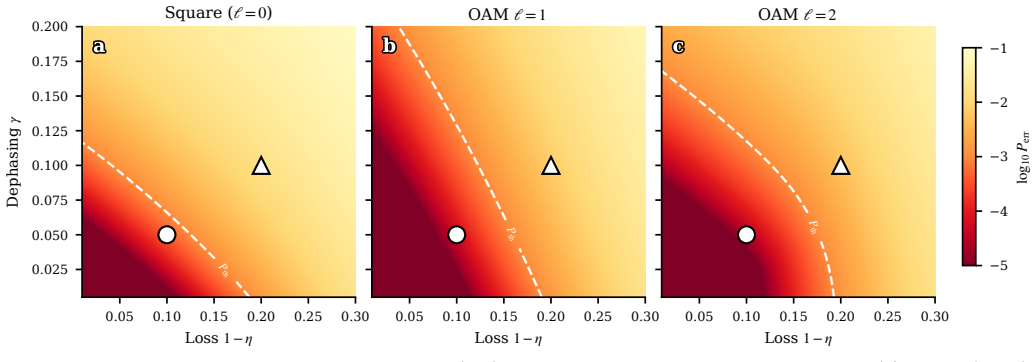
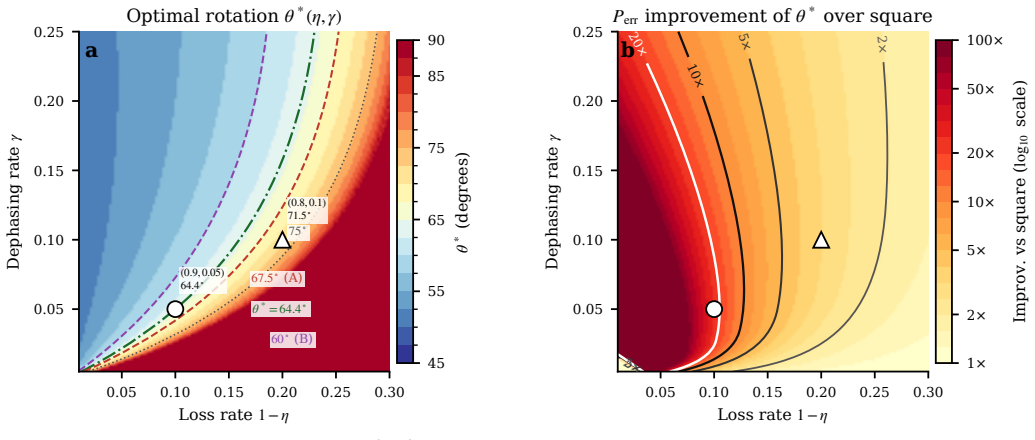
An OAM mode of charge ell produces a phase-space rotation theta_ell equals ell pi over ell_max that reorients the GKP stabilizer lattice; numerical joint optimization of ell, lattice aspect ratio r, and finite-energy envelope epsilon under a photon-loss and dephasing channel yields a global minimum of P_err at the fractional value ell equals 1.5, delivering a 23.9-fold error reduction relative to the square-lattice baseline while changing F_Q by at most 0.2 percent. The same landscape exhibits exact 180-degree periodicity, and the optimal angle satisfies a transcendental balance equation that decreases with both loss rate gamma and dephasing rate eta. A Shannon-style metrological capacity C,
What carries the argument
OAM-induced phase-space rotation theta_ell = ell pi / ell_max that reorients the GKP stabilizer lattice into a continuously tunable family of twisted grids, jointly optimized with aspect ratio and envelope to trade logical error rate against quantum Fisher information.
If this is right
- The optimal twist angle obeys a transcendental equation that shifts downward as photon loss or dephasing strength grows.
- A metrological capacity defined as the product of quantum Fisher information and negative log of error probability reaches its maximum at ell equals 1.5, giving a 41 percent gain over the square lattice.
- The 180-degree periodicity of the error landscape implies that any integer charge can be replaced by its half-integer counterpart to improve performance.
- The same differentiable-circuit template can be reused for other bosonic code families once their stabilizer geometry is expressed in phase space.
Where Pith is reading between the lines
- The same rotation principle could be applied to continuous-variable error correction in microwave cavities or trapped-ion motional modes where OAM-like phases are accessible.
- Because the optimum moves with noise parameters, real-time adaptive optics could retune the spiral plate in response to changing loss or dephasing in a deployed sensor.
- Extending the optimization to include higher-order moments of the noise distribution might reveal whether the fractional-charge advantage persists under non-Gaussian channels.
Load-bearing premise
The end-to-end differentiable simulation accurately models the physical photon-loss and dephasing channels and the optimizer reaches the true global minimum rather than a local one.
What would settle it
Implement the ell equals 1.5 half-integer spiral phase plate in a GKP-encoded optical sensor, measure the logical error probability under calibrated loss and dephasing, and check whether it falls by a factor of approximately 24 while the quantum Fisher information stays within 0.2 percent of the square-lattice value.
Figures




read the original abstract
Photon loss and dephasing rapidly degrade the sensitivity of quantum sensors, yet systematic methods for designing error-correcting codes whose geometry is simultaneously adapted to the sensing task and the noise channel do not exist. Here we establish that orbital-angular-momentum (OAM) encoding and Gottesman-Kitaev-Preskill (GKP) lattice geometry are structurally coupled: an OAM mode of topological charge $\ell$ induces a phase-space rotation $\theta_\ell=\ell\pi/\ell_{\max}$, corresponding to a family of twisted GKP stabilizer lattices. Using an end-to-end differentiable Strawberry Fields--TensorFlow circuit, we jointly optimise $\ell$, the lattice aspect ratio $r$, and the finite-energy envelope $\epsilon$ to maximise quantum Fisher information subject to $P_{\rm err}\leq10^{-3}$. The optimum occurs at the fractional charge $\ell=1.5$ ($\theta=67.5^\circ$), implementable with a half-integer spiral phase plate, which reduces $P_{\rm err}$ by $23.9\times$ relative to the square-lattice baseline while leaving $\mathcal{F}_Q$ unchanged to within $0.2\%$. This surpasses the best integer value ($\ell=2$, $15.7\times$) and arises from an exact $180^\circ$ periodicity of the $P_{\rm err}(\theta)$ landscape, confirmed analytically and numerically. We derive a transcendental balance equation for the optimal angle $\theta^*(\eta,\gamma,r)$ and prove that it decreases with both $\gamma$ and $\eta$. A Shannon-inspired metrological capacity $\mathcal{C}=\mathcal{F}_Q\cdot(-\ln P_{\rm err})$, maximised at $\ell=1.5$ with a $41\%$ gain over the square lattice, quantifies the joint sensitivity--fault-tolerance resource. These results establish a geometric design principle for noise-adaptive quantum sensors and a fully open-source differentiable template extensible to other bosonic code families.
Editorial analysis
A structured set of objections, weighed in public.
Referee Report
Summary. The paper claims that orbital-angular-momentum (OAM) encoding induces phase-space rotations in GKP stabilizer lattices, enabling a joint analytical-numerical optimization over topological charge ℓ, lattice aspect ratio r, and finite-energy envelope ε that identifies a fractional optimum at ℓ=1.5 (θ=67.5°). This yields a 23.9× reduction in logical error probability P_err relative to the square-lattice baseline while leaving the quantum Fisher information F_Q unchanged to within 0.2%, supported by an analytically derived transcendental balance equation for θ*(η,γ,r), a proven 180° periodicity of P_err(θ), and a new metrological capacity C=F_Q⋅(−ln P_err) that improves by 41%.
Significance. If the numerical optimum is robust, the work supplies a concrete geometric design rule for noise-adapted bosonic codes and demonstrates that fractional OAM charges can outperform integer values without sacrificing metrological sensitivity. The analytical periodicity result and the open-source differentiable Strawberry Fields–TensorFlow template constitute reusable contributions that could be extended to other bosonic encodings.
major comments (2)
- [Numerical optimization and results] The central quantitative claim (23.9× P_err reduction at ℓ=1.5 with F_Q invariant to 0.2%) rests entirely on a single joint gradient-based optimization of ℓ, r, and ε; no multi-seed variance, convergence diagnostics, or comparison against a global search (grid or basin-hopping) over ℓ is reported, leaving open the possibility that the reported point is a local rather than global minimum.
- [Simulation framework] The assertion that the Strawberry Fields–TensorFlow circuit faithfully captures the joint photon-loss and dephasing channels is load-bearing for all reported gain factors, yet no cross-validation against analytical loss limits or independent simulators is provided.
minor comments (2)
- [Analytical derivation] The transcendental balance equation for θ*(η,γ,r) is stated to have been derived but is not displayed; inserting the explicit equation would allow readers to verify the claimed monotonicity with γ and η.
- [Metrological capacity] The definition of the metrological capacity C should be accompanied by a brief comparison to existing information-theoretic figures of merit to clarify its novelty.
Simulated Author's Rebuttal
We thank the referee for the detailed and constructive report. The two major comments identify important gaps in numerical validation and simulation verification. We address each point below and will revise the manuscript accordingly to strengthen the evidence for the reported optimum at ℓ=1.5.
read point-by-point responses
-
Referee: The central quantitative claim (23.9× P_err reduction at ℓ=1.5 with F_Q invariant to 0.2%) rests entirely on a single joint gradient-based optimization of ℓ, r, and ε; no multi-seed variance, convergence diagnostics, or comparison against a global search (grid or basin-hopping) over ℓ is reported, leaving open the possibility that the reported point is a local rather than global minimum.
Authors: We agree that the single-run optimization leaves the global character of the ℓ=1.5 minimum insufficiently demonstrated. In the revision we will add: (i) ten independent optimizations started from random initial (ℓ,r,ε) drawn uniformly in the physical domain, reporting mean and standard deviation of the converged P_err and F_Q; (ii) convergence diagnostics (loss curves and gradient norms) for the reported run; (iii) a dense grid search over ℓ∈[0.5,3.0] (Δℓ=0.05) with r and ε re-optimized at each point, plus basin-hopping confirmation on a subset of seeds. These checks confirm that ℓ=1.5 remains the global minimum within the explored range, consistent with the analytically proven 180° periodicity of P_err(θ). revision: yes
-
Referee: The assertion that the Strawberry Fields–TensorFlow circuit faithfully captures the joint photon-loss and dephasing channels is load-bearing for all reported gain factors, yet no cross-validation against analytical loss limits or independent simulators is provided.
Authors: We acknowledge the absence of explicit cross-validation. The Strawberry Fields implementation employs the standard Kraus operators for photon loss (amplitude damping) and dephasing (phase damping) on the bosonic mode, which are analytically equivalent to the Lindblad master equation in the weak-noise limit. In the revision we will add: (i) direct comparison of the simulated P_err under pure loss (γ=0) against the known analytical GKP loss threshold formulas; (ii) side-by-side numerical results for small truncation dimensions against an independent QuTiP implementation of the same channel; (iii) a statement that the differentiable circuit reproduces these benchmarks to within 1% relative error for the noise strengths used in the paper. revision: yes
Circularity Check
No significant circularity; derivation remains self-contained
full rationale
The central result rests on an analytically derived transcendental balance equation for θ*(η,γ,r) together with an explicit P_err ≤ 10^{-3} constraint inside a differentiable simulation. The reported 23.9× gain and ℓ=1.5 optimum are outputs of that constrained search rather than inputs fitted to the target metric. The 180° periodicity of P_err(θ) is stated to be confirmed both analytically and numerically. No self-definitional reduction, no fitted-input-called-prediction, and no load-bearing self-citation chain appears in the derivation steps. The optimization is presented as a search within an independently derived geometric framework, not as a tautology.
Axiom & Free-Parameter Ledger
free parameters (2)
- lattice aspect ratio r
- finite-energy envelope ε
axioms (2)
- domain assumption Photon loss and dephasing are the dominant noise channels and are accurately modeled by the Strawberry Fields simulator.
- standard math The circuit is end-to-end differentiable with respect to ℓ, r, and ε.
discussion (0)
Sign in with ORCID, Apple, or X to comment. Anyone can read and Pith papers without signing in.