Recognition: 3 theorem links
· Lean TheoremSupervised Deep Multimodal Matrix Factorization for Interpretable Brain Network Analysis
Pith reviewed 2026-05-14 19:14 UTC · model grok-4.3
The pith
Supervised deep multimodal matrix factorization learns interpretable community structures from brain graphs for better prediction.
A machine-rendered reading of the paper's core claim, the machinery that carries it, and where it could break.
Core claim
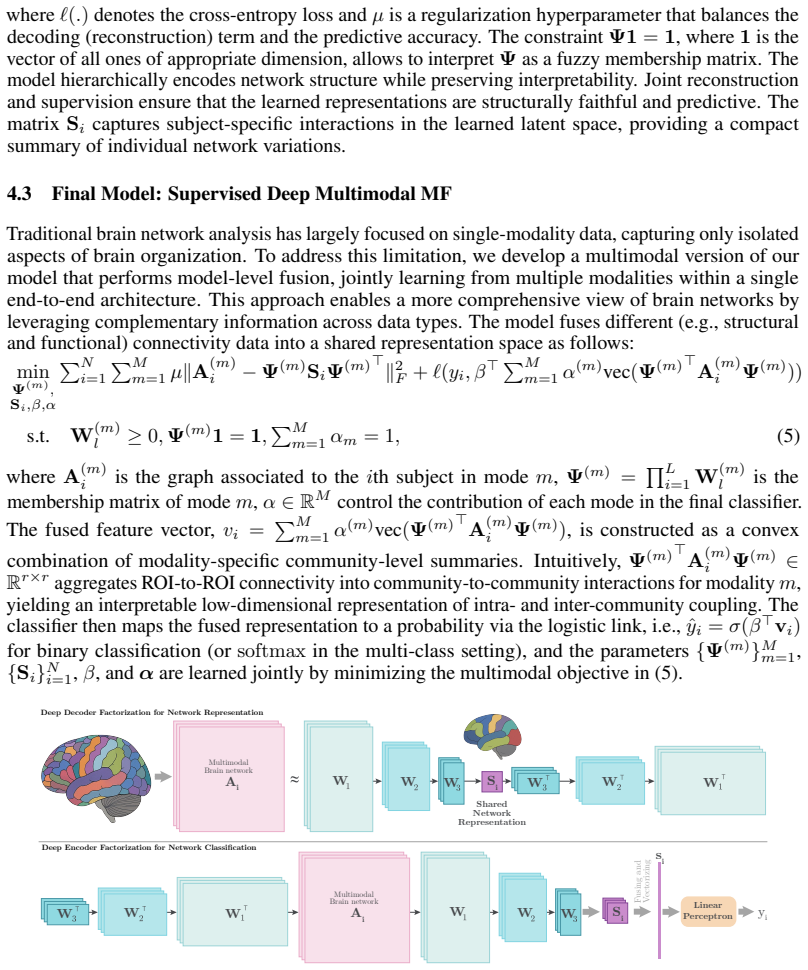
SD3MF learns deep hierarchical factorizations for each modality together with a shared latent representation that aligns subjects across views. An encoder-decoder formulation jointly optimizes graph reconstruction and supervised prediction, while adaptive weights enable data-driven multimodal fusion. By representing each subject through community-level interaction matrices, the model yields interpretable and discriminative features.
What carries the argument
SD3MF, the supervised extension of symmetric nonnegative matrix tri-factorization that produces community-level interaction matrices for each subject while aligning multimodal views through a shared latent space.
If this is right
- The model outperforms strong deep learning baselines such as CNNs and GNNs on multimodal connectome datasets.
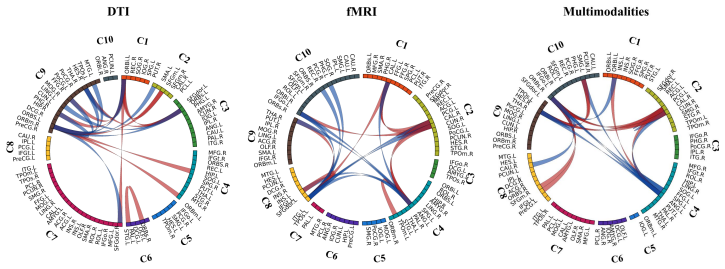
- Community interaction matrices provide both accurate predictions and biologically interpretable insights.
- Adaptive weights perform data-driven fusion across modalities without manual tuning.
- Hierarchical factorizations per modality allow the model to capture structure at multiple scales.
Where Pith is reading between the lines
- The shared latent representation could support transfer or joint modeling across additional brain imaging modalities not used in the original training.
- Community matrices might serve as compact biomarkers for tracking disease progression if applied to longitudinal connectome data.
- The same factorization approach could be tested on other multimodal graph domains such as social or transportation networks where interpretability of communities matters.
Load-bearing premise
The community-level interaction matrices are assumed to capture biologically meaningful and discriminative structure without external validation against known brain atlases or functional networks.
What would settle it
An experiment showing that the learned community matrices have no statistically significant overlap with established brain atlases or known functional networks, or that removing them does not degrade prediction performance, would falsify the interpretability and utility claims.
Figures




read the original abstract
We present Supervised Deep Multimodal Matrix Factorization (SD3MF), an interpretable framework for integrative brain network analysis that generalizes Symmetric Nonnegative Matrix Tri-Factorization (SNMTF) from unsupervised single-graph clustering to supervised prediction over populations of multimodal graphs. SD3MF learns deep hierarchical factorizations for each modality together with a shared latent representation that aligns subjects across views. An encoder-decoder formulation jointly optimizes graph reconstruction and supervised prediction, while adaptive weights enable data-driven multimodal fusion. By representing each subject through community-level interaction matrices, the model yields interpretable and discriminative features. Experiments on multimodal connectome datasets show that SD3MF consistently outperforms strong deep learning baselines such as CNNs and GNNs, while enabling biologically interpretable insights. Code for reproducibility is available at: https://github.com/amjadseyedi/SD3MF.
Editorial analysis
A structured set of objections, weighed in public.
Referee Report
Summary. The paper introduces Supervised Deep Multimodal Matrix Factorization (SD3MF), a generalization of Symmetric Nonnegative Matrix Tri-Factorization to a supervised deep hierarchical setting for multimodal brain connectome analysis. It employs an encoder-decoder architecture that jointly optimizes graph reconstruction and subject-level prediction losses, with adaptive multimodal fusion and community-level interaction matrices as the interpretable subject representations. The central claims are consistent outperformance over CNN and GNN baselines on multimodal connectome datasets together with biologically interpretable insights derived from the learned community structures.
Significance. If the empirical and interpretability claims hold, SD3MF would supply a parameter-efficient, interpretable alternative to black-box deep models for integrative neuroimaging, with the community interaction matrices offering a potential bridge to neuroscientific analysis. The public code release at https://github.com/amjadseyedi/SD3MF supports reproducibility and is a clear strength.
major comments (2)
- [Abstract] Abstract: the claim that SD3MF 'consistently outperforms strong deep learning baselines such as CNNs and GNNs' is presented without any quantitative results, statistical tests, data-split details, or baseline specifications; this absence renders the primary empirical contribution impossible to assess and is load-bearing for the paper's central claim.
- [Abstract] Abstract: the assertion that community-level interaction matrices 'yield interpretable and discriminative features' and enable 'biologically interpretable insights' rests on the unvalidated assumption that these matrices recover or align with established neuroscientific structures (e.g., AAL, Desikan-Killiany, Yeo 7/17 networks); no alignment metrics, atlas comparisons, or external validation are described, undermining the interpretability half of the contribution.
minor comments (2)
- [Abstract] The abstract states that the model 'generalizes Symmetric Nonnegative Matrix Tri-Factorization (SNMTF)' but does not specify which components of SNMTF are retained versus modified in the deep supervised extension; a brief equation-level comparison would clarify the novelty.
- [Abstract] The phrase 'adaptive weights enable data-driven multimodal fusion' is used without indicating whether these weights are learned end-to-end or set by a separate procedure; notation for the fusion mechanism should be introduced explicitly.
Simulated Author's Rebuttal
We thank the referee for their constructive feedback, which has helped clarify the presentation of our empirical and interpretability claims. We address each major comment point by point below, indicating the revisions we will make to the manuscript.
read point-by-point responses
-
Referee: [Abstract] Abstract: the claim that SD3MF 'consistently outperforms strong deep learning baselines such as CNNs and GNNs' is presented without any quantitative results, statistical tests, data-split details, or baseline specifications; this absence renders the primary empirical contribution impossible to assess and is load-bearing for the paper's central claim.
Authors: We agree that the abstract would benefit from including key quantitative support to substantiate the performance claims. In the revised manuscript, we have updated the abstract to briefly report mean classification accuracy (with standard deviation) across 5-fold cross-validation, p-values from paired statistical tests against the baselines, the exact data-split protocol, and the specific CNN and GNN architectures used (including layer counts and hyperparameters). Full experimental details and tables remain in Sections 4 and 5. revision: yes
-
Referee: [Abstract] Abstract: the assertion that community-level interaction matrices 'yield interpretable and discriminative features' and enable 'biologically interpretable insights' rests on the unvalidated assumption that these matrices recover or align with established neuroscientific structures (e.g., AAL, Desikan-Killiany, Yeo 7/17 networks); no alignment metrics, atlas comparisons, or external validation are described, undermining the interpretability half of the contribution.
Authors: We thank the referee for this observation. The current manuscript supports interpretability through qualitative visualizations of the learned community structures and their contribution to subject-level prediction. To address the lack of quantitative validation, we have added a new analysis subsection that reports alignment metrics (normalized mutual information and Dice coefficients) between the discovered communities and the Yeo 7/17 networks, along with comparisons to AAL and Desikan-Killiany parcellations. These results are now summarized in the abstract and detailed in the revised results section. revision: yes
Circularity Check
No derivation circularity; model is defined by independent optimization and experiments
full rationale
The paper presents SD3MF as a new encoder-decoder formulation that jointly optimizes graph reconstruction and supervised prediction losses, generalizing SNMTF. No equation or step reduces a claimed prediction or interpretability result to a fitted parameter by construction. The outperformance claim rests on experimental comparisons to CNNs and GNNs rather than algebraic identity. The biological interpretability of community matrices is asserted without external validation, but this is an unverified assumption, not a circular reduction in the derivation chain. No load-bearing self-citation or ansatz smuggling is exhibited in the provided text. This is the normal case of a self-contained model definition.
Axiom & Free-Parameter Ledger
free parameters (2)
- number of communities / latent factors
- depth of hierarchical factorization
axioms (2)
- domain assumption Nonnegative factors yield parts-based interpretable representations
- domain assumption Multimodal brain graphs share a common latent subject space
Lean theorems connected to this paper
-
IndisputableMonolith/Cost/FunctionalEquation.leanwashburn_uniqueness_aczel unclear?
unclearRelation between the paper passage and the cited Recognition theorem.
By representing each subject through community-level interaction matrices, the model yields interpretable and discriminative features.
-
IndisputableMonolith/Foundation/AbsoluteFloorClosure.leanabsolute_floor_iff_bare_distinguishability unclear?
unclearRelation between the paper passage and the cited Recognition theorem.
A≈WSW⊤ ... S(k,ℓ) indicates the strength between community k and ℓ
What do these tags mean?
- matches
- The paper's claim is directly supported by a theorem in the formal canon.
- supports
- The theorem supports part of the paper's argument, but the paper may add assumptions or extra steps.
- extends
- The paper goes beyond the formal theorem; the theorem is a base layer rather than the whole result.
- uses
- The paper appears to rely on the theorem as machinery.
- contradicts
- The paper's claim conflicts with a theorem or certificate in the canon.
- unclear
- Pith found a possible connection, but the passage is too broad, indirect, or ambiguous to say the theorem truly supports the claim.
Reference graph
Works this paper leans on
-
[1]
Haoteng Tang, Guixiang Ma, Yanfu Zhang, Kai Ye, Lei Guo, Guodong Liu, Qi Huang, Yalin Wang, Olusola Ajilore, Alex D. Leow, Paul M. Thompson, Heng Huang, and Liang Zhan. A comprehensive survey of complex brain network representation.Meta-Radiology, 1(3):100046, 2023
work page 2023
-
[2]
Haijing Sun, Anna Wang, and Shanshan He. Temporal and spatial analysis of Alzheimer’s disease based on an improved convolutional neural network and a resting-state FMRI brain functional network.International Journal of Environmental Research and Public Health, 19(8): 4508, 2022
work page 2022
-
[3]
Rong Zhou, Houliang Zhou, Li Shen, Brian Y . Chen, Yu Zhang, and Lifang He. Integrating multimodal contrastive learning and cross-modal attention for Alzheimer’s disease prediction in brain imaging genetics. InIEEE International Conference on Bioinformatics and Biomedicine (BIBM), pages 1806–1811, 2023
work page 2023
-
[4]
Emine Elif Tulay, Barı¸ s Metin, Nevzat Tarhan, and Mehmet Kemal Arıkan. Multimodal neuroimaging: basic concepts and classification of neuropsychiatric diseases.Clinical EEG and Neuroscience, 50(1):20–33, 2019
work page 2019
-
[5]
Sidong Liu, Weidong Cai, Siqi Liu, Fan Zhang, Michael Fulham, Dagan Feng, Sonia Pujol, and Ron Kikinis. Multimodal neuroimaging computing: a review of the applications in neuropsychiatric disorders.Brain Informatics, 2(3):167–180, 2015
work page 2015
-
[6]
Deep generalized canonical correlation analysis
Adrian Benton, Huda Khayrallah, Biman Gujral, Dee Ann Reisinger, Sheng Zhang, and Raman Arora. Deep generalized canonical correlation analysis. InWorkshop on Representation Learning for NLP, pages 1–6, 2019
work page 2019
-
[7]
Rong Zhou, Houliang Zhou, Brian Y Chen, Li Shen, Yu Zhang, and Lifang He. Attentive deep canonical correlation analysis for diagnosing Alzheimer’s disease using multimodal imaging genetics. InInternational Conference on Medical Image Computing and Computer-Assisted Intervention, pages 681–691. Springer, 2023
work page 2023
-
[8]
Asif Salim, S.S. Shiju, and S. Sumitra. Design of multi-view graph embedding using multiple kernel learning.Engineering Applications of Artificial Intelligence, 90:103534, 2020
work page 2020
-
[9]
Yipu Zhang, Li Xiao, Gemeng Zhang, Biao Cai, Julia M. Stephen, Tony W. Wilson, Vince D. Calhoun, and Yu-Ping Wang. Multi-paradigm fMRI fusion via sparse tensor decomposition in brain functional connectivity study.IEEE Journal of Biomedical and Health Informatics, 25(5): 1712–1723, 2021
work page 2021
-
[10]
Irina Belyaeva, Ben Gabrielson, Yu-Ping Wang, Tony W. Wilson, Vince D. Calhoun, Julia M. Stephen, and Tülay Adali. Learning spatiotemporal brain dynamics in adolescents via multi- modal MEG and fMRI data fusion using joint tensor/matrix decomposition.IEEE Transactions on Biomedical Engineering, 71(7):2189–2200, 2024. 10
work page 2024
-
[11]
Boosted sparse and low-rank tensor regression
Lifang He, Kun Chen, Wanwan Xu, Jiayu Zhou, and Fei Wang. Boosted sparse and low-rank tensor regression. InAdvances in Neural Information Processing Systems, volume 31, 2018
work page 2018
-
[12]
Structural deep brain network mining
Shen Wang, Lifang He, Bokai Cao, Chun-Ta Lu, Philip S Yu, and Ann B Ragin. Structural deep brain network mining. InACM SIGKDD International Conference on Knowledge Discovery and Data Mining, pages 475–484, 2017
work page 2017
-
[13]
Clustering-based deep brain multigraph integrator network for learning connectional brain templates
U˘gur Demir, Mohammed Amine Gharsallaoui, and Islem Rekik. Clustering-based deep brain multigraph integrator network for learning connectional brain templates. InInternational Workshop on Uncertainty for Safe Utilization of Machine Learning in Medical Imaging, pages 109–120, 2020
work page 2020
-
[14]
Xiaoyi Chen, Pengfei Ke, Yuanyuan Huang, Jing Zhou, Hehua Li, Runlin Peng, Jiayuan Huang, Liqin Liang, Guolin Ma, Xiaobo Li, et al. Discriminative analysis of schizophrenia patients using graph convolutional networks: A combined multimodal MRI and connectomics analysis. Frontiers in Neuroscience, 17:1140801, 2023
work page 2023
-
[15]
Kai Zhang, Rong Zhou, Eashan Adhikarla, Zhiling Yan, Yixin Liu, Jun Yu, Zhengliang Liu, Xun Chen, Brian D Davison, Hui Ren, et al. A generalist vision–language foundation model for diverse biomedical tasks.Nature Medicine, 30(11):3129–3141, 2024
work page 2024
-
[16]
Xi Zhang, Lifang He, Kun Chen, Yuan Luo, Jiayu Zhou, and Fei Wang. Multi-view graph convolutional network and its applications on neuroimage analysis for Parkinson’s disease. In AMIA annual symposium proceedings, volume 2018, page 1147, 2018
work page 2018
-
[17]
Guangqi Wen, Peng Cao, Huiwen Bao, Wenju Yang, Tong Zheng, and Osmar Zaiane. MVS- GCN: A prior brain structure learning-guided multi-view graph convolution network for autism spectrum disorder diagnosis.Computers in Biology and Medicine, 142:105239, 2022
work page 2022
-
[18]
Calhoun, Aiying Zhang, and Yu-Ping Wang
Gang Qu, Ziyu Zhou, Vince D. Calhoun, Aiying Zhang, and Yu-Ping Wang. Integrated brain connectivity analysis with fMRI, DTI, and sMRI powered by interpretable graph neural networks.Medical Image Analysis, 103:103570, 2025
work page 2025
-
[19]
Houliang Zhou, Lifang He, Brian Y . Chen, Li Shen, and Yu Zhang. Multi-modal diagnosis of Alzheimer’s disease using interpretable graph convolutional networks.IEEE Transactions on Medical Imaging, 44(1):142–153, 2025
work page 2025
-
[20]
Multi- view brain networks construction for Alzheimer’s disease diagnosis
Yuefeng Ma, Tengfei Zhang, Zeqi Wu, Xiaochen Mu, Xun Liang, and Lanzhen Guo. Multi- view brain networks construction for Alzheimer’s disease diagnosis. InIEEE International Conference on Bioinformatics and Biomedicine (BIBM), pages 889–892, 2023
work page 2023
-
[21]
Haiping Lu, Konstantinos N. Plataniotis, and Anastasios N. Venetsanopoulos. Mpca: Multilinear principal component analysis of tensor objects.IEEE Transactions on Neural Networks, 19(1): 18–39, 2008
work page 2008
-
[22]
Yanqiao Zhu, Hejie Cui, Lifang He, Lichao Sun, and Carl Yang. Joint embedding of structural and functional brain networks with graph neural networks for mental illness diagnosis. In International Conference of the IEEE Engineering in Medicine & Biology Society (EMBC), pages 272–276, 2022
work page 2022
-
[23]
Clustering on multi-source incomplete data via tensor modeling and factorization
Weixiang Shao, Lifang He, and Philip S Yu. Clustering on multi-source incomplete data via tensor modeling and factorization. InPacific-Asia Conference on Knowledge Discovery and Data Mining, pages 485–497. Springer, 2015
work page 2015
-
[24]
Ming Yin, Junbin Gao, Shengli Xie, and Yi Guo. Multiview subspace clustering via tensorial t-product representation.IEEE Transactions on Neural Networks and Learning Systems, 30(3): 851–864, 2019
work page 2019
-
[25]
Guixiang Ma, Lifang He, Chun-Ta Lu, Weixiang Shao, Philip S. Yu, Alex D. Leow, and Ann B. Ragin. Multi-view clustering with graph embedding for connectome analysis. InProceedings of the 2017 ACM on Conference on Information and Knowledge Management, page 127–136, 2017. 11
work page 2017
- [26]
-
[27]
Guanghui Li, Qinghua Huang, Chunying Liu, Guanying Wang, Lingli Guo, Ruonan Liu, and Longzhong Liu. Fully automated diagnosis of thyroid nodule ultrasound using brain-inspired inference.Neurocomputing, 582:127497, 2024
work page 2024
-
[28]
Jeremy Kawahara, Colin J. Brown, Steven P. Miller, Brian G. Booth, Vann Chau, Ruth E. Grunau, Jill G. Zwicker, and Ghassan Hamarneh. Brainnetcnn: Convolutional neural networks for brain networks; towards predicting neurodevelopment.NeuroImage, 146:1038–1049, 2017
work page 2017
-
[29]
Semi-Supervised Classification with Graph Convolutional Networks
Thomas N. Kipf and Max Welling. Semi-supervised classification with graph convolutional networks, 2017. URLhttps://arxiv.org/abs/1609.02907
work page internal anchor Pith review Pith/arXiv arXiv 2017
-
[30]
Inductive representation learning on large graphs
Will Hamilton, Zhitao Ying, and Jure Leskovec. Inductive representation learning on large graphs. InAdvances in Neural Information Processing Systems, volume 30, 2017
work page 2017
-
[31]
Graph convolution based attention model for personalized disease prediction
Anees Kazi, Shayan Shekarforoush, S Arvind Krishna, Hendrik Burwinkel, Gerome Vivar, Benedict Wiestler, Karsten Kortüm, Seyed-Ahmad Ahmadi, Shadi Albarqouni, and Nassir Navab. Graph convolution based attention model for personalized disease prediction. In International Conference on Medical Image Computing and Computer-Assisted Intervention, pages 122–130...
work page 2019
-
[32]
Yanwu Yang, Chenfei Ye, Xutao Guo, Tao Wu, Yang Xiang, and Ting Ma. Mapping multi- modal brain connectome for brain disorder diagnosis via cross-modal mutual learning.IEEE Transactions on Medical Imaging, 43(1):108–121, 2024
work page 2024
- [33]
-
[34]
Interpretable graph neural networks for connectome-based brain disorder analysis
Hejie Cui, Wei Dai, Yanqiao Zhu, Xiaoxiao Li, Lifang He, and Carl Yang. Interpretable graph neural networks for connectome-based brain disorder analysis. InInternational Conference on Medical Image Computing and Computer-Assisted Intervention, pages 375–385, 2022
work page 2022
-
[35]
Liangliang Liu, Yu-Ping Wang, Yi Wang, Pei Zhang, and Shufeng Xiong. An enhanced multi- modal brain graph network for classifying neuropsychiatric disorders.Medical Image Analysis, 81:102550, 2022
work page 2022
-
[36]
Graph neural network for interpreting task-fMRI biomarkers
Xiaoxiao Li, Nicha C Dvornek, Yuan Zhou, Juntang Zhuang, Pamela Ventola, and James S Duncan. Graph neural network for interpreting task-fMRI biomarkers. InInternational Conference on Medical Image Computing and Computer-Assisted Intervention, pages 485–493, 2019
work page 2019
-
[37]
Tensor graph convolutional neural network
Tong Zhang, Wenming Zheng, Zhen Cui, and Yang Li. Tensor graph convolutional neural network, 2018. URLhttps://arxiv.org/abs/1803.10071
work page internal anchor Pith review Pith/arXiv arXiv 2018
-
[38]
Tensor graph neural networks for learning on time varying graphs
Osman Asif Malik, Shashanka Ubaru, Lior Horesh, Misha E Kilmer, and Haim Avron. Tensor graph neural networks for learning on time varying graphs. InProceedings of NIPS Workshop, 2019
work page 2019
-
[39]
Mr-gcn: Multi-relational graph convolutional networks based on generalized tensor product
Zhichao Huang, Xutao Li, Yunming Ye, and Michael K Ng. Mr-gcn: Multi-relational graph convolutional networks based on generalized tensor product. InIJCAI, volume 20, pages 1258–1264, 2020
work page 2020
-
[40]
ALERT: Atlas-based low estimation rank tensor approach to detect Autism spectrum disorder
Ananya Samanta, Monalisa Sarma, and Debasis Samanta. ALERT: Atlas-based low estimation rank tensor approach to detect Autism spectrum disorder. InInternational Conference of the IEEE Engineering in Medicine & Biology Society (EMBC), pages 1–4, 2023
work page 2023
-
[41]
Yilin Sang and Wan Li. Classification study of Alzheimer’s disease based on self-attention mechanism and dti imaging using gcn.IEEE Access, 12:24387–24395, 2024. 12
work page 2024
-
[42]
Qiankun Zuo, Ning Zhong, Yi Pan, Huisi Wu, Baiying Lei, and Shuqiang Wang. Brain structure- function fusing representation learning using adversarial decomposed-V AE for analyzing MCI. IEEE Transactions on Neural Systems and Rehabilitation Engineering, 31:4017–4028, 2023
work page 2023
-
[43]
Tensor-based complex- valued graph neural network for dynamic coupling multimodal brain networks
Yanwu Yang, Guoqing Cai, Chenfei Ye, Yang Xiang, and Ting Ma. Tensor-based complex- valued graph neural network for dynamic coupling multimodal brain networks. InIEEE International Conference on Acoustics, Speech and Signal Processing (ICASSP), 2023
work page 2023
-
[44]
Zhaoming Kong, Rong Zhou, Xinwei Luo, Songlin Zhao, Ann B Ragin, Alex D Leow, and Lifang He. TGNet: tensor-based graph convolutional networks for multimodal brain network analysis.BioData Mining, 17(1):55, 2024
work page 2024
-
[45]
Community detection in graphs.Physics Reports, 486(3-5):75–174, 2010
Santo Fortunato. Community detection in graphs.Physics Reports, 486(3-5):75–174, 2010
work page 2010
-
[46]
Encoder-decoder symmetric nonnegative matrix tri- factorization for graph clustering
Amjad Seyedi and Nicolas Gillis. Encoder-decoder symmetric nonnegative matrix tri- factorization for graph clustering. InIEEE International Conference on Acoustics, Speech and Signal Processing (ICASSP), pages 501–505, 2026
work page 2026
-
[47]
Stochastic blockmodels and community structure in networks.Physical Review E, 83(1):016107, 2011
Brian Karrer and Mark EJ Newman. Stochastic blockmodels and community structure in networks.Physical Review E, 83(1):016107, 2011
work page 2011
-
[48]
Mixed membership stochastic blockmodels.Journal of Machine Learning Research, 9(Sep):1981–2014, 2008
Edoardo M Airoldi, David M Blei, Stephen E Fienberg, and Eric P Xing. Mixed membership stochastic blockmodels.Journal of Machine Learning Research, 9(Sep):1981–2014, 2008
work page 1981
-
[49]
Akram Hajiveiseh, Seyed Amjad Seyedi, and Fardin Akhlaghian Tab. Deep asymmetric nonnegative matrix factorization for graph clustering.Pattern Recognition, 148:110179, 2024
work page 2024
-
[50]
George Trigeorgis, Konstantinos Bousmalis, Stefanos Zafeiriou, and Björn W Schuller. A deep matrix factorization method for learning attribute representations.IEEE Transactions on Pattern Analysis and Machine Intelligence, 39(3):417–429, 2016
work page 2016
-
[51]
Learning the parts of objects by non-negative matrix factorization.Nature, 401(6755):788–791, 1999
Daniel D Lee and H Sebastian Seung. Learning the parts of objects by non-negative matrix factorization.Nature, 401(6755):788–791, 1999
work page 1999
-
[52]
Exponentially convergent algorithms for supervised matrix factorization
Joowon Lee, Hanbaek Lyu, and Weixin Yao. Exponentially convergent algorithms for supervised matrix factorization. InAdvances in Neural Information Processing Systems, volume 36, pages 76947–76959, 2023
work page 2023
-
[53]
Supervised matrix factorization: local landscape analysis and applications
Joowon Lee, Hanbaek Lyu, and Weixin Yao. Supervised matrix factorization: local landscape analysis and applications. InInternational Conference on Machine Learning, 2024
work page 2024
-
[54]
Implicit regularization in deep matrix factorization
Sanjeev Arora, Nadav Cohen, Wei Hu, and Yuping Luo. Implicit regularization in deep matrix factorization. InAdvances in Neural Information Processing Systems, volume 32, 2019
work page 2019
-
[55]
Pierre De Handschutter and Nicolas Gillis. A consistent and flexible framework for deep matrix factorizations.Pattern Recognition, 134:109102, 2023
work page 2023
-
[56]
A convergence theory for deep learning via over-parameterization
Zeyuan Allen-Zhu, Yuanzhi Li, and Zhao Song. A convergence theory for deep learning via over-parameterization. InInternational Conference on Machine Learning, pages 242–252, 2019
work page 2019
-
[57]
Stephen M Smith, Peter T Fox, Karla L Miller, David C Glahn, P Mickle Fox, Clare E Mackay, Nicola Filippini, Kate E Watkins, Roberto Toro, Angela R Laird, et al. Correspondence of the brain’s functional architecture during activation and rest.Proceedings of the National Academy of Sciences, 106(31):13040–13045, 2009
work page 2009
-
[58]
The organization of the human cerebral cortex estimated by intrinsic functional connectivity
BT Thomas Yeo, Fenna M Krienen, Jorge Sepulcre, Mert R Sabuncu, Danial Lashkari, Marisa Hollinshead, Joshua L Roffman, Jordan W Smoller, Lilla Zöllei, Jonathan R Polimeni, et al. The organization of the human cerebral cortex estimated by intrinsic functional connectivity. Journal of Neurophysiology, 2011
work page 2011
-
[59]
Sarah M Israel, Shiva Hassanzadeh-Behbahani, Peter E Turkeltaub, David J Moore, Ronald J Ellis, and Xiong Jiang. Different roles of frontal versus striatal atrophy in HIV-associated neurocognitive disorders.Human Brain Mapping, 40(10):3010–3026, 2019. 13
work page 2019
-
[60]
Paul M Thompson and Neda Jahanshad. Novel neuroimaging methods to understand how HIV affects the brain.Current HIV/AIDS Reports, 12(2):289–298, 2015
work page 2015
-
[61]
Modular brain networks.Annual Review of Psychology, 67 (1):613–640, 2016
Olaf Sporns and Richard F Betzel. Modular brain networks.Annual Review of Psychology, 67 (1):613–640, 2016
work page 2016
-
[62]
Talia R Seider, Assawin Gongvatana, Adam J Woods, Huaihou Chen, Eric C Porges, Tiffany Cummings, Stephen Correia, Karen Tashima, and Ronald A Cohen. Age exacerbates HIV- associated white matter abnormalities.Journal of Neurovirology, 22(2):201–212, 2016
work page 2016
-
[63]
Michael D Fox and Marcus E Raichle. Spontaneous fluctuations in brain activity observed with functional magnetic resonance imaging.Nature Reviews Neuroscience, 8(9):700–711, 2007
work page 2007
-
[64]
Xinhu Jin, Xinyu Liang, and Gaolang Gong. Functional integration between the two brain hemispheres: evidence from the homotopic functional connectivity under resting state.Frontiers in Neuroscience, 14:932, 2020
work page 2020
-
[65]
The influence of mild carbon dioxide on brain functional homotopy using resting-state fMRI
Olga Marshall, Jinsoo Uh, Daniel Lurie, Hanzhang Lu, Michael P Milham, and Yulin Ge. The influence of mild carbon dioxide on brain functional homotopy using resting-state fMRI. Human Brain Mapping, 36(10):3912–3921, 2015
work page 2015
-
[66]
Mingrui Xia, Jinhui Wang, and Yong He. Brainnet viewer: a network visualization tool for human brain connectomics.PloS One, 8(7):e68910, 2013
work page 2013
-
[67]
Mingxiang Xu and Xing-Da Ju. A meta-analysis of gray matter volume abnormalities in HIV patients.Psychiatry Research: Neuroimaging, 335:111722, 2023
work page 2023
-
[68]
Zhong Li, Xingxing Jin, Meng Zhang, Hongxia Wang, Wangyi Liu, Beiran Wang, Baolin Wu, and Xuekun Li. Divergent structural and functional brain alterations in HIV-infected patients: a multimodal meta-analysis.Frontiers in Neurology, 16:1618408, 2025
work page 2025
-
[69]
Ziming Liu, Yixuan Wang, Sachin Vaidya, Fabian Ruehle, James Halverson, Marin Soljacic, Thomas Y . Hou, and Max Tegmark. KAN: Kolmogorov–Arnold networks. InInternational Conference on Learning Representations, 2025
work page 2025
- [70]
-
[71]
Learning topic models–provably and efficiently.Communications of the ACM, 61(4):85–93, 2018
Sanjeev Arora, Rong Ge, Yoni Halpern, David Mimno, Ankur Moitra, David Sontag, Yichen Wu, and Michael Zhu. Learning topic models–provably and efficiently.Communications of the ACM, 61(4):85–93, 2018
work page 2018
-
[72]
Anchor-free correlated topic modeling: Identifiability and algorithm
Kejun Huang, Xiao Fu, and Nikolaos D Sidiropoulos. Anchor-free correlated topic modeling: Identifiability and algorithm. InAdvances in Neural Information Processing Systems, volume 29, 2016
work page 2016
-
[73]
Xiao Fu, Kejun Huang, Nicholas D Sidiropoulos, Qingjiang Shi, and Mingyi Hong. Anchor-free correlated topic modeling.IEEE transactions on Pattern Analysis and Machine Intelligence, 41 (5):1056–1071, 2018
work page 2018
-
[74]
Ragin, Hongyan Du, Renee Ochs, Ying Wu, Christina L
Ann B. Ragin, Hongyan Du, Renee Ochs, Ying Wu, Christina L. Sammet, Alfred Shoukry, and Leon G. Epstein. Structural brain alterations can be detected early in hiv infection.Neurology, 79(24):2328–2334, 2012
work page 2012
-
[75]
Bokai Cao, Xiangnan Kong, Jingyuan Zhang, Philip S Yu, and Ann B Ragin. Identifying HIV-induced subgraph patterns in brain networks with side information.Brain Informatics, 2 (4):211–223, 2015
work page 2015
- [76]
-
[77]
Susan Whitfield-Gabrieli and Alfonso Nieto-Castanon. Conn: a functional connectivity toolbox for correlated and anticorrelated brain networks.Brain Connectivity, 2(3):125–141, 2012. 14
work page 2012
-
[78]
Liang Zhan, Jiayu Zhou, Yalin Wang, Yan Jin, Neda Jahanshad, Gautam Prasad, Talia M Nir, Cassandra D Leonardo, Jieping Ye, Paul M Thompson, et al. Comparison of nine tractography algorithms for detecting abnormal structural brain networks in Alzheimer’s disease.Frontiers in Aging Neuroscience, 7:48, 2015. Appendix A Optimization model In this section, we ...
work page 2015
discussion (0)
Sign in with ORCID, Apple, or X to comment. Anyone can read and Pith papers without signing in.