Recognition: unknown
Shortcut Mitigation via Spurious-Positive Samples
Pith reviewed 2026-05-14 19:10 UTC · model grok-4.3
The pith
Identifying a small set of instances where models rely on spurious attributes and regularizing the associated neurons improves robustness without needing extra annotations or balanced data.
A machine-rendered reading of the paper's core claim, the machinery that carries it, and where it could break.
Core claim
The method identifies a small set of spurious-positive samples to locate highly relevant neurons in an intermediate layer, which are then regularized to prevent the model from depending on spurious attributes for predictions, ensuring reliance on core informative features and enhancing robustness.
What carries the argument
Targeted identification of spurious-positive instances followed by neuron regularization in an intermediate layer, based on reasoning that certain features should not influence predictions.
Load-bearing premise
A small set of instances can be reliably identified as those where the model relies on spurious attributes, and regularizing the corresponding neurons will reduce shortcut dependence without harming core performance.
What would settle it
Observing that regularization of the identified neurons either fails to reduce spurious dependence or decreases accuracy on the main task would falsify the central claim.
Figures


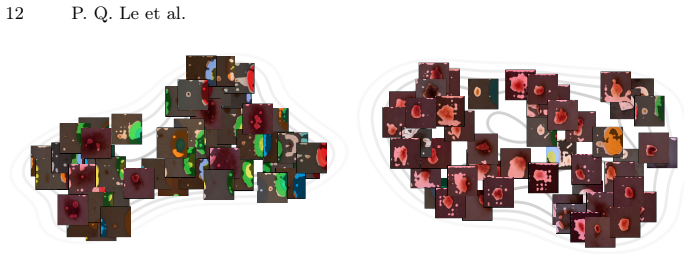
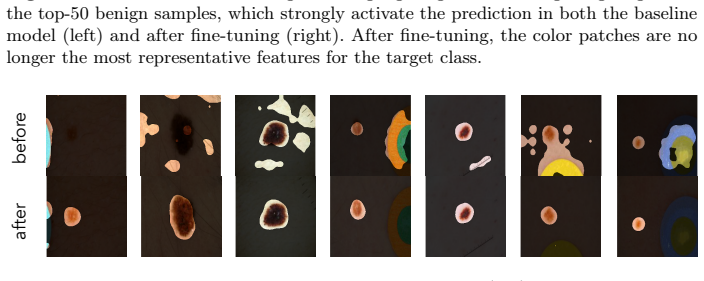


read the original abstract
Shortcut mitigation strategies commonly rely on training data annotations, group-balanced held-out data or the presence of all groups, i.e., all combinations of (spurious) attributes and classes, in the training data. However, these requirements are rarely met in practice. We instead propose a method for targeted model analysis to identify a small set of instances in which the model relies on spurious attributes. Using that set and following ``this feature should not be used for prediction'' reasoning, we identify highly relevant neurons in an intermediate layer and regularize their impact. This ensures that models learn to depend on informative features rather than being right for the wrong reasons, thereby improving robustness without requiring additional balanced held-out data or annotations.
Editorial analysis
A structured set of objections, weighed in public.
Referee Report
Summary. The paper proposes a shortcut mitigation method that uses targeted model analysis to identify a small set of spurious-positive instances, locates highly relevant neurons in an intermediate layer, and applies regularization to those neurons so that the model relies on informative rather than spurious features. The approach is presented as requiring neither annotations nor group-balanced held-out data.
Significance. If the empirical claims hold, the method would address a practical gap in shortcut mitigation, since many existing techniques depend on resources that are often unavailable. The core idea of using internal model analysis for instance selection and neuron regularization is a potentially useful direction for improving robustness in standard training pipelines.
major comments (2)
- [Abstract] Abstract: the central claim that the method 'improves robustness' is stated without any reference to datasets, baselines, or quantitative metrics; this absence is load-bearing because the soundness of the approach cannot be evaluated from the high-level pipeline alone.
- [Method] Method description: the criteria for selecting the 'small set of instances' and for identifying 'highly relevant neurons' are described only at a conceptual level; without explicit algorithms, thresholds, or ablation results, it is unclear whether the procedure is stable across random seeds or model architectures.
minor comments (1)
- [Abstract] The phrase 'this feature should not be used for prediction' is used without a formal definition or reference to prior work on feature attribution; a short clarification would improve readability.
Circularity Check
No significant circularity detected in derivation chain
full rationale
The paper's core pipeline—identifying a small set of spurious-positive instances through model-internal analysis, locating relevant neurons in an intermediate layer, and applying regularization—does not reduce to its inputs by construction. No equations, fitted parameters renamed as predictions, or self-citations are invoked in the provided text to create a self-definitional loop or load-bearing dependency. The method is framed as relying on internal model properties rather than external annotations or balanced data, and the derivation remains independent without renaming known results or smuggling ansatzes via prior work. This is the expected honest non-finding for a method whose central steps are presented as externally verifiable through model inspection.
Axiom & Free-Parameter Ledger
Reference graph
Works this paper leans on
-
[1]
In: Salakhutdinov, R., Kolter, Z., Heller, K., Weller, A., Oliver, N., Scarlett, J., Berkenkamp, F
Achtibat, R., Hatefi, S.M.V., Dreyer, M., Jain, A., Wiegand, T., Lapuschkin, S., Samek, W.: AttnLRP: Attention-aware layer-wise relevance propagation for transformers. In: Salakhutdinov, R., Kolter, Z., Heller, K., Weller, A., Oliver, N., Scarlett, J., Berkenkamp, F. (eds.) Proceedings of the 41st International Conference on Machine Learning. Proceedings ...
work page 2024
-
[2]
Advances in Neural Information Processing Systems35, 23284–23296 (2022)
Asgari, S., Khani, A., Khani, F., Gholami, A., Tran, L., Mahdavi Amiri, A., Hamarneh, G.: Masktune: Mitigating spurious correlations by forcing to explore. Advances in Neural Information Processing Systems35, 23284–23296 (2022)
work page 2022
-
[3]
Bach, S., Binder, A., Montavon, G., Klauschen, F., Müller, K.R., Samek, W.: On Pixel-Wise Explanations for Non-Linear Classifier Decisions by Layer-Wise Relevance Propagation. PLOS ONE10(7), e0130140 (Jul 2015).https://doi.org/ 10.1371/journal.pone.0130140
-
[4]
Advances in Neural Information Processing Systems37, 106383–106410 (2024)
Chakraborty, R., Wang, Y.O., Gao, J., Zheng, R., Zhang, C., De la Torre, F.D.: Visual data diagnosis and debiasing with concept graphs. Advances in Neural Information Processing Systems37, 106383–106410 (2024)
work page 2024
-
[5]
Advances in Neural Information Processing Systems35, 33618– 33632 (2022)
Chefer, H., Schwartz, I., Wolf, L.: Optimizing relevance maps of vision transformers improves robustness. Advances in Neural Information Processing Systems35, 33618– 33632 (2022)
work page 2022
-
[6]
Computerized Medical Imaging and Graphics75, 84–92 (2019)
Chen, P., Gao, L., Shi, X., Allen, K., Yang, L.: Fully automatic knee osteoarthritis severity grading using deep neural networks with a novel ordinal loss. Computerized Medical Imaging and Graphics75, 84–92 (2019)
work page 2019
-
[7]
Codella, N., Rotemberg, V., Tschandl, P., Celebi, M.E., Dusza, S., Gutman, D., Helba, B., Kalloo, A., Liopyris, K., Marchetti, M., Kittler, H., Halpern, A.: Skin Lesion Analysis Toward Melanoma Detection 2018: A Challenge Hosted by the International Skin Imaging Collaboration (ISIC) (2019)
work page 2018
-
[8]
In: Forty-second International Conference on Machine Learning (2025)
Dong, X., Zhang, M., Zhu, D., Jian, Y.J., Keli, Z., Zhou, A., Wu, F., Kuang, K.: Erict: Enhancing robustness by identifying concept tokens in zero-shot vision language models. In: Forty-second International Conference on Machine Learning (2025)
work page 2025
-
[9]
In: Proceedings of the IEEE/CVF Conference on Computer Vision and Pattern Recognition
Dreyer, M., Purelku, E., Vielhaben, J., Samek, W., Lapuschkin, S.: PURE: Turn- ing Polysemantic Neurons Into Pure Features by Identifying Relevant Circuits. In: Proceedings of the IEEE/CVF Conference on Computer Vision and Pattern Recognition. pp. 8212–8217 (2024)
work page 2024
-
[10]
In: European Conference on Computer Vision
Espinosa Zarlenga, M., Sankaranarayanan, S., Andrews, J.T., Shams, Z., Jamnik, M., Xiang, A.: Efficient bias mitigation without privileged information. In: European Conference on Computer Vision. pp. 148–166. Springer (2024)
work page 2024
-
[11]
In: International Conference on Learning Representations (Sep 2018)
Geirhos, R., Rubisch, P., Michaelis, C., Bethge, M., Wichmann, F.A., Brendel, W.: ImageNet-trained CNNs are biased towards texture; increasing shape bias improves accuracy and robustness. In: International Conference on Learning Representations (Sep 2018)
work page 2018
-
[12]
In: The Eleventh International Conference on Learning Representations (2023)
Kirichenko, P., Izmailov, P., Wilson, A.G.: Last Layer Re-Training is Sufficient for Robustness to Spurious Correlations. In: The Eleventh International Conference on Learning Representations (2023)
work page 2023
-
[13]
In: Pro- ceedings of the IEEE/CVF International Conference on Computer Vision
Kuhn, L., Sadiya, S., Schlötterer, J., Buettner, F., Seifert, C., Roig, G.: Efficient unsupervised shortcut learning detection and mitigation in transformers. In: Pro- ceedings of the IEEE/CVF International Conference on Computer Vision. pp. 2217–2226 (2025) 16 P. Q. Le et al
work page 2025
-
[14]
In: Thirty-Seventh Conference on Neural Information Processing Systems (Nov 2023)
LaBonte, T., Muthukumar, V., Kumar, A.: Towards Last-layer Retraining for Group Robustness with Fewer Annotations. In: Thirty-Seventh Conference on Neural Information Processing Systems (Nov 2023)
work page 2023
-
[15]
Transactions on Machine Learning Research (Sep 2024)
Le, P.Q., Schlötterer, J., Seifert, C.: Out of Spuriousity: Improving Robustness to Spurious Correlations without Group Annotations. Transactions on Machine Learning Research (Sep 2024)
work page 2024
-
[16]
In: World Conference on Explainable Artificial Intelligence
Le, P.Q., Schlötterer, J., Seifert, C.: An xai-based analysis of shortcut learning in neural networks. In: World Conference on Explainable Artificial Intelligence. pp. 424–445. Springer (2025)
work page 2025
-
[17]
Liu, E.Z., Haghgoo, B., Chen, A.S., Raghunathan, A., Koh, P.W., Sagawa, S., Liang, P., Finn, C.: Just Train Twice: Improving Group Robustness without Training Group Information. In: Meila, M., Zhang, T. (eds.) Proceedings of the 38th International Conference on Machine Learning. Proceedings of Machine Learning Research, vol. 139, pp. 6781–6792. PMLR (Jul 2021)
work page 2021
-
[18]
In: Proceedings of the IEEE International Conference on Computer Vision
Liu, Z., Luo, P., Wang, X., Tang, X.: Deep learning face attributes in the wild. In: Proceedings of the IEEE International Conference on Computer Vision. pp. 3730–3738 (2015)
work page 2015
-
[19]
UMAP: Uniform Manifold Approximation and Projection for Dimension Reduction
McInnes, L., Healy, J., Melville, J.: Umap: Uniform manifold approximation and projection for dimension reduction. arXiv preprint arXiv:1802.03426 (2018)
work page internal anchor Pith review Pith/arXiv arXiv 2018
-
[20]
Advances in Neural Information Processing Systems 33, 20673–20684 (2020)
Nam, J., Cha, H., Ahn, S., Lee, J., Shin, J.: Learning from failure: De-biasing classifier from biased classifier. Advances in Neural Information Processing Systems 33, 20673–20684 (2020)
work page 2020
-
[21]
Diagnostics12(1), 40 (Dec 2021).https://doi.org/10.3390/diagnostics12010040
Nauta, M., Walsh, R., Dubowski, A., Seifert, C.: Uncovering and Correcting Shortcut Learning in Machine Learning Models for Skin Cancer Diagnosis. Diagnostics12(1), 40 (Dec 2021).https://doi.org/10.3390/diagnostics12010040
-
[22]
In: Proceedings of the IEEE/CVF Conference on Computer Vision and Pattern Recognition
Park, G.Y., Lee, S., Lee, S.W., Ye, J.C.: Training debiased subnetworks with contrastive weight pruning. In: Proceedings of the IEEE/CVF Conference on Computer Vision and Pattern Recognition. pp. 7929–7938 (2023)
work page 2023
-
[23]
In: Proceedings of the IEEE/CVF Conference on Computer Vision and Pattern Recognition
Petryk, S., Dunlap, L., Nasseri, K., Gonzalez, J., Darrell, T., Rohrbach, A.: On guid- ing visual attention with language specification. In: Proceedings of the IEEE/CVF Conference on Computer Vision and Pattern Recognition. pp. 18092–18102 (2022)
work page 2022
-
[24]
In: International Conference on Machine Learning
Qiu, S., Potapczynski, A., Izmailov, P., Wilson, A.G.: Simple and fast group robust- ness by automatic feature reweighting. In: International Conference on Machine Learning. pp. 28448–28467. PMLR (2023)
work page 2023
-
[25]
In: Proceedings of the 37th International Conference on Machine Learning
Rieger, L., Singh, C., Murdoch, W.J., Yu, B.: Interpretations Are Useful: Penalizing Explanations to Align Neural Networks with Prior Knowledge. In: Proceedings of the 37th International Conference on Machine Learning. p. 11. JMLR.org (2020)
work page 2020
-
[26]
Right for the Right Reasons: Training Differentiable Models by Constraining their Explanations
Ross,A.S.,Hughes,M.C.,Doshi-Velez,F.:Rightfortherightreasons:Trainingdiffer- entiable models by constraining their explanations. arXiv preprint arXiv:1703.03717 (2017)
work page internal anchor Pith review Pith/arXiv arXiv 2017
-
[27]
In: International Conference on Learning Representations (2020)
Sagawa, S., Koh, P.W., Hashimoto, T.B., Liang, P.: Distributionally Robust Neural Networks. In: International Conference on Learning Representations (2020)
work page 2020
-
[28]
Sagawa, S., Raghunathan, A., Koh, P.W., Liang, P.: An Investigation of Why Overparameterization Exacerbates Spurious Correlations. In: III, H.D., Singh, A. (eds.) Proceedings of the 37th International Conference on Machine Learning. Proceedings of Machine Learning Research, vol. 119, pp. 8346–8356. PMLR (Jul 2020)
work page 2020
-
[29]
In: International Conference on Machine Learning
Srivastava, M., Hashimoto, T., Liang, P.: Robustness to spurious correlations via human annotations. In: International Conference on Machine Learning. pp. 9109–9119. PMLR (2020) Shortcut Mitigation via Spurious-Positive Samples 17
work page 2020
-
[30]
In: Proceedings of the IEEE/CVF Winter Conference on Applications of Computer Vision
Tiwari, R., Sivasubramanian, D., Mekala, A., Ramakrishnan, G., Shenoy, P.: Using Early Readouts to Mediate Featural Bias in Distillation. In: Proceedings of the IEEE/CVF Winter Conference on Applications of Computer Vision. pp. 2638–2647 (2024)
work page 2024
-
[31]
Wah, C., Branson, S., Welinder, P., Perona, P., Belongie, S.: The caltech-ucsd birds-200-2011 dataset. Tech. rep., California Institute of Technology (2011)
work page 2011
-
[32]
In: International Conference on Machine Learning
Wu, S., Yuksekgonul, M., Zhang, L., Zou, J.: Discover and cure: Concept-aware mitigation of spurious correlation. In: International Conference on Machine Learning. pp. 37765–37786. PMLR (2023)
work page 2023
-
[33]
PLOS Medicine15(11), e1002683 (Nov 2018).https://doi.org/10.1371/journal.pmed.1002683
Zech, J.R., Badgeley, M.A., Liu, M., Costa, A.B., Titano, J.J., Oermann, E.K.: Variable generalization performance of a deep learning model to detect pneumonia in chest radiographs: A cross-sectional study. PLOS Medicine15(11), e1002683 (Nov 2018).https://doi.org/10.1371/journal.pmed.1002683
-
[34]
Zhang, D., Ahuja, K., Xu, Y., Wang, Y., Courville, A.: Can subnetwork structure be the key to out-of-distribution generalization? In: International Conference on Machine Learning. pp. 12356–12367. PMLR (2021)
work page 2021
-
[35]
In: International Conference on Machine Learning
Zhang, M., Sohoni, N.S., Zhang, H.R., Finn, C., Re, C.: Correct-N-Contrast: A Contrastive Approach for Improving Robustness to Spurious Correlations. In: International Conference on Machine Learning. pp. 26484–26516. PMLR (2022)
work page 2022
-
[36]
Zhou, B., Lapedriza, A., Khosla, A., Oliva, A., Torralba, A.: Places: A 10 Million Image Database for Scene Recognition. IEEE Transactions on Pattern Analysis and Machine Intelligence40(6), 1452–1464 (2018).https://doi.org/10.1109/TPAMI. 2017.2723009 18 P. Q. Le et al. A Further Ablation Study A.1 Fine-tuning Dataset Construction We analyzed the effect of...
discussion (0)
Sign in with ORCID, Apple, or X to comment. Anyone can read and Pith papers without signing in.