Recognition: no theorem link
Quantitative Linear Logic
Pith reviewed 2026-05-14 18:50 UTC · model grok-4.3
The pith
Quantitative sequent calculi assign real-valued measures to proofs and sequents in linear logic.
A machine-rendered reading of the paper's core claim, the machinery that carries it, and where it could break.
Core claim
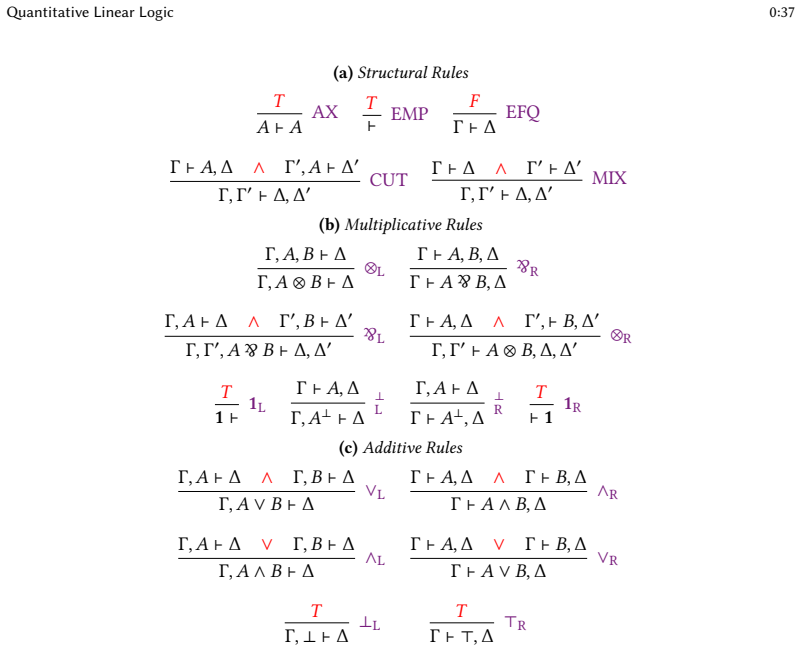
We introduce quantitative sequent calculi, which simultaneously generalize hypersequent calculi of fuzzy logics and deep inference, and in which validity of a proof and provability of a sequent are real-valued quantities. We present a family of calculi, pQLL, indexed by a hardness degree p, prove cut-elimination theorem for them, and show completeness for enriched residuated soft lattices. For p = infinity, pQLL reduces to MALL, with provability in pQLL converging to provability in MALL when p tends to infinity.
What carries the argument
The pQLL family of quantitative sequent calculi, indexed by hardness degree p, which revises sequent rules so that proof validity and sequent provability become real-valued quantities computed from sums and products.
If this is right
- Cut-elimination holds uniformly for the entire parameterized family pQLL.
- Completeness is obtained with respect to enriched residuated soft lattices.
- Provability measures converge to those of standard MALL in the limit as p tends to infinity.
- Additive connectives receive soft, real-valued semantics that remain compatible with the multiplicative fragment.
Where Pith is reading between the lines
- The real-valued provability could be inserted directly as a differentiable term inside gradient-based optimization loops for systems that must satisfy logical specifications.
- Similar quantitative revisions might be applied to other proof systems to produce graded notions of validity for uncertain or probabilistic reasoning tasks.
- The hardness parameter p offers a tunable knob that interpolates between fully soft and fully crisp logical behavior.
Load-bearing premise
That an accurate analysis of sum and product on the reals, combined with a quantitative revision of sequent rules, can preserve the logical properties of additives while making their semantics soft and differentiable.
What would settle it
A concrete sequent whose provability measure in pQLL fails to approach 1 as p grows without bound, or a cut that cannot be eliminated for some finite value of p.
Figures




read the original abstract
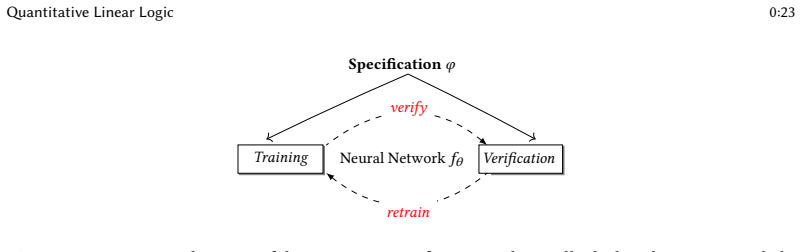
Real-valued logics have seen a renewed interest in verification for probabilistic and quantitative systems, in particular machine learning models, where they can be used to directly integrate specifications in the training objective. To do so effectively one has to strike a balance between the logical properties of the connectives and their semantics. A major hurdle in this sense is to give ``soft'' (i.e. differentiable) semantics to additive connectives -- in linear and fuzzy logics, additives are necessarily ``hard'' lattice operations. In this paper, we solve this problem by combining an accurate analysis of the properties of sum and product on the reals with a significant revision of sequent calculus. We introduce `quantitative sequent calculi', which simultaneously generalize hypersequent calculi of fuzzy logics and deep inference, and in which validity of a proof and provability of a sequent are real-valued quantities. We present a family of calculi, pQLL, indexed by a hardness degree $p$, prove cut-elimination theorem for them, and show completeness for enriched residuated `soft' lattices. For $p = \infty$, pQLL reduces to MALL, with provability in pQLL converging to provability in MALL when $p \to \infty$.
Editorial analysis
A structured set of objections, weighed in public.
Referee Report
Summary. The paper introduces quantitative sequent calculi (pQLL), a family indexed by hardness degree p, that generalize hypersequent calculi of fuzzy logics and deep inference. In these calculi, both proof validity and sequent provability are real-valued quantities obtained via sum and product operations on the reals. The authors prove cut-elimination for pQLL and completeness with respect to enriched residuated soft lattices; the p → ∞ limit recovers standard MALL.
Significance. If the cut-elimination and completeness results hold, the work provides a technically novel route to soft, differentiable semantics for additive connectives while retaining residuation and cut-elimination. This directly addresses a central obstacle in applying real-valued logics to probabilistic verification and machine-learning training objectives. The algebraic analysis of sum/product and the uniform p-parameterization that interpolates between soft and hard behavior are genuine strengths.
major comments (2)
- [Cut-elimination proof] The cut-elimination argument (stated in the abstract and presumably detailed after the definition of pQLL rules) must explicitly track how the real-valued measure is preserved or decreased under each reduction step; without this, it is unclear whether the quantitative interpretation remains compatible with the standard logical properties of additives.
- [Completeness theorem] Completeness for enriched residuated soft lattices (abstract and main completeness theorem) depends on the precise definition of the soft lattice operations and the enrichment; the manuscript should supply an explicit verification that the quantitative provability measure coincides with the lattice order without additional ad-hoc parameters beyond p.
minor comments (2)
- [Abstract] Notation for the real-valued validity measure should be introduced once and used consistently; currently the abstract mixes 'validity of a proof' and 'provability of a sequent' without a single symbol.
- [Introduction] The statement that pQLL 'simultaneously generalizes hypersequent calculi and deep inference' would benefit from a short comparative table or paragraph locating the new rules relative to existing hypersequent and deep-inference presentations.
Circularity Check
No significant circularity in derivation of quantitative sequent calculi
full rationale
The paper defines quantitative sequent calculi as a novel generalization of hypersequent calculi and deep inference, then independently proves cut-elimination for the pQLL family and completeness relative to enriched residuated soft lattices. The real-valued provability measure is introduced as part of this construction rather than fitted from data or reduced by definition to prior results. The p to infinity limit recovering MALL is presented as a convergence theorem, not a tautological equivalence. No load-bearing step relies on self-citation chains or renames known patterns; the algebraic analysis of sum/product enables the soft semantics while preserving residuation, keeping the central claims self-contained.
Axiom & Free-Parameter Ledger
free parameters (1)
- hardness degree p
axioms (1)
- domain assumption Properties of sum and product on the reals allow soft semantics for additive connectives
invented entities (1)
-
quantitative sequent calculi
no independent evidence
Reference graph
Works this paper leans on
-
[1]
Reynald Affeldt, Alessandro Bruni, Ekaterina Komendantskaya, Natalia Slusarz, and Kathrin Stark. 2024. Taming Differentiable Logics with Coq Formalisation. In15th International Conference on Interactive Theorem Proving (ITP 2024), September 9–14, 2024, Tbilisi, Georgia (LIPIcs, Vol. 309) . Schloss Dagstuhl - Leibniz-Zentrum für Informatik, 4:1–4:19. doi:1...
-
[2]
Paolo Aglianò. 2025. An algebraic investigation of linear logic. Archive for Mathematical Logic (2025), 1–23
2025
-
[3]
Arnon Avron. 1987. A Constructive Analysis of RM. The Journal of symbolic logic 52, 4 (1987), 939–
1987
-
[4]
https://www.cambridge.org/core/journals/journal-of-symbolic-logic/article/constructive-analysis-of-rm/ 342F0DE51D0878BEC48C03E65FBA03BC
-
[5]
Matthias Baaz, Agata Ciabattoni, and Christian G. Fermüller. 2003. Hypersequent Calculi for Gödel Logics - a Survey. J. Log. Comput. 13, 6 (2003), 835–861. doi:10.1093/LOGCOM/13.6.835
-
[6]
Giorgio Bacci, Radu Mardare, Prakash Panangaden, and Gordon Plotkin. 2023. Propositional Logics for the Lawvere Quantale. doi:10.48550/arXiv.2302.01224 arXiv:2302.01224 [cs]
- [7]
-
[8]
Giorgio Bacci and Rasmus Ejlers Møgelberg. 2025. Induction and Recursion Principles in a Higher-Order Quantitative Logic. CoRR abs/2501.18275 (2025). doi:10.48550/ARXIV.2501.18275 arXiv:2501.18275
-
[9]
Michał Baczyński and Balasubramaniam Jayaram. 2007. Yager’s classes of fuzzy implications: some properties and intersections. Kybernetika 43, 2 (2007), 157–182
2007
-
[10]
John C. Baez. 2024. What Is Entropy? doi:10.48550/arXiv.2409.09232 arXiv:2409.09232 [cond-mat]
-
[11]
Michael Barr. 1979. *-Autonomous Categories. Lecture Notes in Mathematics, Vol. 752. Springer, Berlin, Heidelberg. doi:10.1007/BFb0064579
-
[12]
Paola Bruscoli and Alessio Guglielmi. 2009. On the proof complexity of deep inference. ACM Trans. Comput. Log. 10, 2 (2009), 14:1–14:34. doi:10.1145/1462179.1462186
-
[13]
Samuel R. Buss. 1998. An Introduction to Proof Theory. In Handbook of Proof Theory , Samuel R. Buss (Ed.). Elsevier, 1–78
1998
-
[14]
Matteo Capucci. 2024. On Quantifiers for Quantitative Reasoning. doi:10.48550/arXiv.2406.04936 arXiv:2406.04936 [cs, math]
-
[15]
Agata Ciabattoni and Francesco A. Genco. 2018. Hypersequents and Systems of Rules: Embeddings and Applications. ACM Trans. Comput. Log. 19, 2 (2018), 11:1–11:27. doi:10.1145/3180075
-
[16]
Agata Ciabattoni, Timo Lang, and Revantha Ramanayake. 2021. Bounded-analytic Sequent Calculi and Embeddings for Hypersequent Logics. J. Symb. Log. 86, 2 (2021), 635–668. doi:10.1017/JSL.2021.42
-
[17]
Petr Cintula, Petr Hajek, and Carles Noguera. 2011. Handbook of Mathematical Fuzzy Logic . Studies in Logic, Vol. 1. College Publications, London, UK. Proc. ACM Program. Lang., Vol. 0, No. POPL, Article 0. Publication date: May 2027. 0:26 Capucci et al
2011
-
[18]
Petr Cintula, Petr Hajek, and Carles Noguera. 2011. Handbook of Mathematical Fuzzy Logic . Studies in Logic, Vol. 2. College Publications, London, UK
2011
-
[19]
J. R. B. Cockett and R. A. G. Seely. 1997. Proof Theory for Full Intuitionistic Linear Logic, Bilinear Logic, and MIX Categories. Theory and Applications of Categories 3 (1997), 85–131. http://www.tac.mta.ca/tac/volumes/1997/n5/n5.pdf
1997
-
[20]
J. R. B. Cockett and R. A. G. Seely. 1999. Linearly Distributive Functors. Journal of Pure and Applied Algebra 143, 1 (Nov. 1999), 155–203. doi:10.1016/S0022-4049(98)00110-8
-
[21]
Francesco Croce, Jonas Rauber, and Matthias Hein. 2020. Scaling up the Randomized Gradient-Free Adversarial Attack Reveals Overestimation of Robustness Using Established Attacks. International Journal of Computer Vision 128, 4 (April 2020), 1028–1046. doi:10.1007/s11263-019-01213-0
-
[22]
Daggitt, Wen Kokke, Robert Atkey, Natalia Ślusarz, Luca Arnaboldi, and Ekaterina Komendantskaya
Matthew L. Daggitt, Wen Kokke, Robert Atkey, Natalia Ślusarz, Luca Arnaboldi, and Ekaterina Komendantskaya. 2025. Vehicle: Bridging the Embedding Gap in the Verification of Neuro-Symbolic Programs. InProceedings of FSCD’2025. arXiv:2401.06379 [cs.AI]
-
[23]
Brian Day. 1970. On Closed Categories of Functors. In Reports of the Midwest Category Seminar IV , S. MacLane, H. Applegate, M. Barr, B. Day, E. Dubuc, Phreilambud, A. Pultr, R. Street, M. Tierney, and S. Swierczkowski (Eds.). Vol. 137. Springer Berlin Heidelberg, Berlin, Heidelberg, 1–38. doi:10.1007/BFb0060438
-
[24]
Arthur Azevedo de Amorim, Marco Gaboardi, Justin Hsu, Shin-ya Katsumata, and Ikram Cherigui. 2017. A semantic account of metric preservation. In Proceedings of the 44th ACM SIGPLAN Symposium on Principles of Programming Languages, POPL 2017, Paris, France, January 18-20, 2017 , Giuseppe Castagna and Andrew D. Gordon (Eds.). ACM, 545–556. doi:10.1145/30098...
-
[25]
Bruno De Finetti. 2017. Theory of Probability: A Critical Introductory Treatment . John Wiley & Sons
2017
-
[26]
Marc Fischer, Mislav Balunovic, Dana Drachsler-Cohen, Timon Gehr, Ce Zhang, and Martin T. Vechev. 2019. DL2: Training and Querying Neural Networks with Logic. In 36th International Conference on Machine Learning (ICML 2019), 9–15 June 2019, Long Beach, California, USA (Proceedings of Machine Learning Research, Vol. 97) . PMLR, 1931–1941. http://proceeding...
2019
-
[27]
Thomas Flinkow, Ekaterina Komendantskaya, Matteo Capucci, and Rosemary Monahan. 2026. Quantitative Linear Logic for Neuro-Symbolic Learning and Verification. (2026). Forthcoming preprint
2026
-
[28]
Thomas Flinkow, Barak A Pearlmutter, and Rosemary Monahan. 2025. Comparing differentiable logics for learning with logical constraints. Science of Computer Programming 244 (2025), 103280
2025
-
[29]
Nikolaos Galatos, Peter Jipsen, Tomasz Kowalski, and Hiroakira Ono. 2007. Residuated Lattices: An Algebraic Glimpse at Substructural Logics, Volume 151 . Elsevier Science
2007
-
[30]
Jean-Yves Girard. 1995. Linear logic: its syntax and semantics. In Proceedings of the Workshop on Advances in Linear Logic. Cambridge University Press, USA, 1–42
1995
-
[31]
Eleonora Giunchiglia, Mihaela Catalina Stoian, and Thomas Lukasiewicz. 2022. Deep Learning with Logical Constraints. In 31st International Joint Conference on Artificial Intelligence (IJCAI-22) . International Joint Conferences on Artificial Intelligence Organization, 5478–5485. doi:10.24963/ijcai.2022/767 Survey Track
-
[32]
Marco Grandis. 2007. Categories, Norms and Weights. Journal of Homotopy and Related Structures 2 (2007)
2007
-
[33]
J. Y. Halpern. 1999. Cox’s Theorem Revisited. Journal of Artificial Intelligence Research 11 (Dec. 1999), 429–435. doi:10.1613/jair.644
-
[34]
E. T. Jaynes. 2003. Probability Theory: The Logic of Science . Cambridge University Press, Cambridge. doi:10.1017/ CBO9780511790423
2003
-
[35]
Guy Katz, Derek A Huang, Duligur Ibeling, Kyle Julian, Christopher Lazarus, Rachel Lim, Parth Shah, Shantanu Thakoor, Haoze Wu, Aleksandar Zeljić, et al. 2019. The marabou framework for verification and analysis of deep neural networks. In Computer Aided Verification: 31st International Conference, CA V 2019, New York City, NY, USA, July 15-18, 2019, Proc...
2019
-
[36]
Max Kelly. 1982. Basic Concepts of Enriched Category Theory . Vol. 64. CUP Archive
1982
-
[37]
William Lawvere
F. William Lawvere. 1973. Metric Spaces, Generalized Logic, and Closed Categories.Rendiconti del seminario matématico e fisico di Milano 43 (1973), 135–166
1973
- [38]
-
[39]
Per Martin-Löf. 1996. On the Meanings of the Logical Constants and the Justifications of the Logical Laws. Nordic Journal of Philosophical Logic 1, 1 (1996), 11–60
1996
-
[40]
Paul-André Melliès. 2009. Categorical semantics of linear logic. In Interactive models of computation and program behaviour, panoramas et synthèses, Vol. 27. Société Mathématique de France, 1–196
2009
-
[41]
George Metcalfe, Nicola Olivetti, and Dov Gabbay. 2009. Proof Theory for Fuzzy Logics . Applied Logic Series, Vol. 36. Springer Netherlands, Dordrecht. doi:10.1007/978-1-4020-9409-5
-
[42]
D. S. Mitrinovic. 1970. Analytic Inequalities. Springer-Verlag. Proc. ACM Program. Lang., Vol. 0, No. POPL, Article 0. Publication date: May 2027. Quantitative Linear Logic 0:27
1970
-
[43]
Marius Mosbach, Maksym Andriushchenko, Thomas Trost, Matthias Hein, and Dietrich Klakow. 2019. Logit Pairing Methods Can Fool Gradient-Based Attacks. doi:10.48550/arXiv.1810.12042 arXiv:1810.12042 [cs]
work page internal anchor Pith review Pith/arXiv arXiv doi:10.48550/arxiv.1810.12042 2019
-
[44]
Hiroakira Ono. 1998. Proof-Theoretic Methods in non-classical Logic – an introduction. In Theories of Types and Proofs . 207–254
1998
- [45]
-
[46]
Garrel Pottinger. 1983. Uniform, cut-free formulations of T, S4 and S5. Journal of Symbolic Logic 48, 3 (1983), 900
1983
-
[47]
The LLHandbook project. 2023. Handbook of Linear Logic. online draft
2023
-
[48]
Jason Reed and Benjamin C. Pierce. 2010. Distance makes the types grow stronger: a calculus for differential privacy. In Proceedings of the 15th ACM SIGPLAN International Conference on Functional Programming, ICFP 2010, Baltimore, Maryland, USA, September 27-29, 2010 , Paul Hudak and Stephanie Weirich (Eds.). ACM, 157–168. doi:10.1145/1863543. 1863568
-
[49]
Natalia Slusarz. 2026. A Unifying Framework For Differentiable Logics Using Interactive Theorem Proving . PhD thesis. Heriot-Watt University, Edinburgh
2026
-
[50]
Natalia Slusarz, Ekaterina Komendantskaya, Matthew L. Daggitt, Robert J. Stewart, and Kathrin Stark. 2023. Logic of Differentiable Logics: Towards a Uniform Semantics of DL. In LPAR 2023: Proceedings of 24th International Conference on Logic for Programming, Artificial Intelligence and Reasoning, Manizales, Colombia, 4-9th June 2023 (EPiC Series in Comput...
-
[51]
Christian Szegedy, Wojciech Zaremba, Ilya Sutskever, Joan Bruna, Dumitru Erhan, Ian Goodfellow, and Rob Fergus
-
[52]
Intriguing properties of neural networks
Intriguing Properties of Neural Networks. doi:10.48550/arXiv.1312.6199 arXiv:1312.6199 [cs]
work page internal anchor Pith review Pith/arXiv arXiv doi:10.48550/arxiv.1312.6199
-
[53]
Franck van Breugel and James Worrell. 2005. A Behavioural Pseudometric for Probabilistic Transition Systems. Theoretical Computer Science 331, 1 (Feb. 2005), 115–142. doi:10.1016/j.tcs.2004.09.035
-
[55]
Emile van Krieken, Erman Acar, and Frank van Harmelen. 2022. Analyzing Differentiable Fuzzy Logic Operators. Artificial Intelligence 302 (Jan. 2022), 103602. doi:10.1016/j.artint.2021.103602 arXiv:2002.06100 [cs]
-
[56]
Peter Varnai and Dimos V. Dimarogonas. 2020. On Robustness Metrics for Learning STL Tasks. In 2020 American Control Conference (ACC). 5394–5399. doi:10.23919/ACC45564.2020.9147692
-
[57]
Joey Velez-Ginorio, Nada Amin, Konrad P. Kording, and Steve Zdancewic. 2026. Compiling to linear neurons. In POPL’26. https://arxiv.org/abs/2511.13769
-
[58]
Ronald R. Yager. 1980. On a General Class of Fuzzy Connectives. 4, 3 (1980), 235–242. doi:10.1016/0165-0114(80)90013-5
-
[59]
Lotfi Asker Zadeh. 1965. Fuzzy Sets. Information and control 8, 3 (1965), 338–353. https://www.sciencedirect.com/ science/article/pii/S001999586590241X
1965
-
[60]
Lotfi Asker Zadeh. 1988. Fuzzy Logic. Computer 21, 4 (1988), 83–93. https://ieeexplore.ieee.org/abstract/document/53/
1988
-
[61]
J Łukasiewicz. 1920. O logice trójwartościowej (in Polish). English translation: On Three-Valued Logic, in Borkowski, L.(ed.)
1920
-
[62]
Ruch Filozoficzny
Jan Łukasiewicz: Selected Works, Amsterdam: North Holland . Ruch Filozoficzny. 87—-88 pages. A ALGEBRAIC LEMMATA Lemma A.1 (Arithmetic of generalized fractions). For all 𝑎, 𝑏, 𝑐, 𝑑 ∈ [ 0, ∞]: (1) 1 ≤ 𝑎 ⊸ 𝑎, (2) (𝑏 ⊸ 𝑎) ⊗ ( 𝑐 ⊸ 𝑏) ≤ ( 𝑐 ⊸ 𝑎), (3) (𝑏 ⊸ 𝑎) ⊗ ( 𝑑 ⊸ 𝑐) ≤ ( 𝑏 ⊗ 𝑑) ⊸ (𝑎 ⊗ 𝑐), (4) 𝑎 ⊸ (𝑏 ⊸ 𝑐) = (𝑎 ⊗ 𝑏) ⊸ 𝑐. Proof. For (1), start from 1 ⊗ 𝑎 ≤ 𝑎∗∗ ...
2027
discussion (0)
Sign in with ORCID, Apple, or X to comment. Anyone can read and Pith papers without signing in.