Recognition: unknown
Distribution of GHz sequential Time-bin Entanglement in a Metropolitan Fiber Network
Pith reviewed 2026-05-14 18:19 UTC · model grok-4.3
The pith
Sequential time-bin entangled photon pairs reach 93% visibility after traveling 30 km through a real metropolitan fiber network.
A machine-rendered reading of the paper's core claim, the machinery that carries it, and where it could break.
Core claim
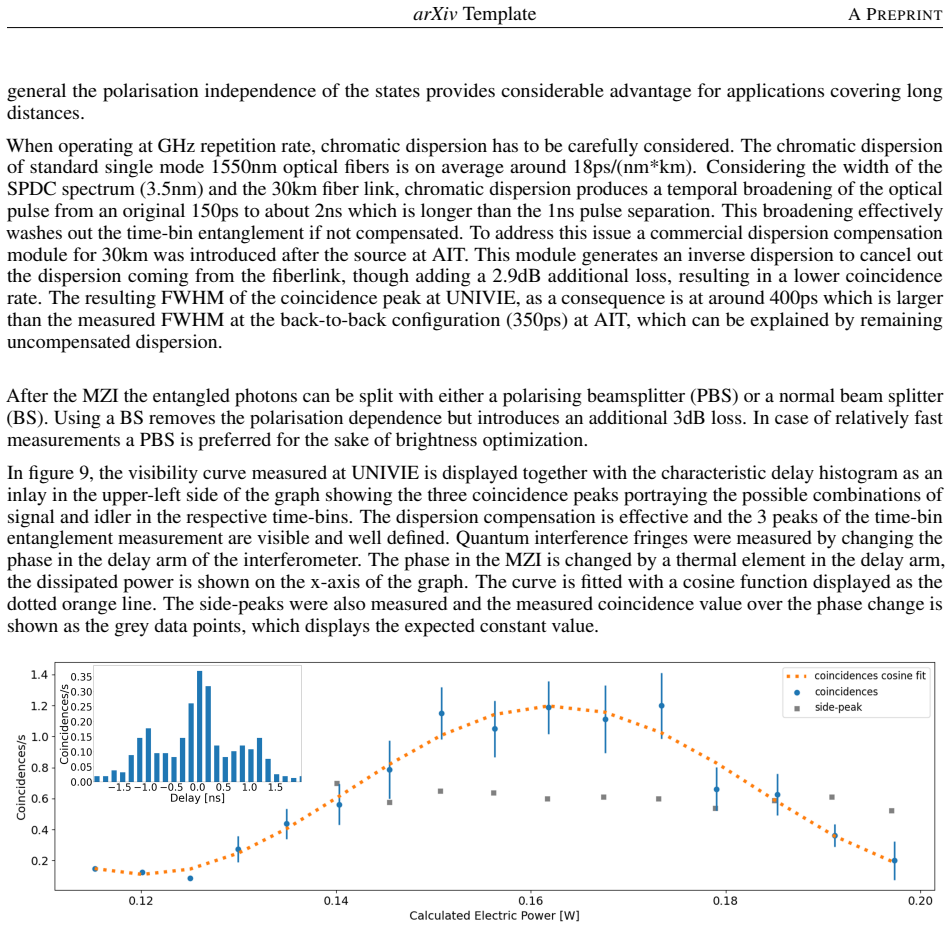
Modulated laser pulses at GHz rates produce sequential time-bin entangled photon pairs that are transmitted over an approximately 30 km fiber link with 9.5 dB loss inside the Vienna metropolitan network. The time-bin format maintains a measured quantum visibility of 93% after distribution, confirming that the encoding protects the entanglement against polarization drift that occurs in standard telecom fibers.
What carries the argument
Sequential time-bin encoding, in which entanglement is carried by the relative arrival times of photon pairs rather than polarization, allowing the state to survive random birefringence in installed fiber.
Load-bearing premise
That a measured visibility of 93% after 9.5 dB loss is high enough to support positive secret-key rates in practical metropolitan QKD protocols.
What would settle it
An experiment that measures the secret-key rate dropping to zero when the same 30 km link is used with a standard time-bin QKD protocol under the observed visibility and loss.
Figures






read the original abstract
Efficient generation and high-quality distribution of entanglement is becoming increasingly more relevant in the field of quantum technologies, with important applications such as multiparty computation as well as quantum key distribution (QKD) on the rise. Quantum communication protocols based on entanglement offer an inherent quantum based randomness for key generation and provide in general higher security compared to prepare and measure implementations. Moreover, the future quantum internet will also be based on the distribution of entanglement for securely connecting quantum computers in a network. In this work we show the feasibility of using sequential time-bin entangled states for quantum key distribution in metropolitan networks using off-the-shelf components. The time-bin encoding ensures high fidelity distribution robust against random polarisation fluctuations occuring in optical fibers. Modulated laser pulses in the GHz frequency range are used to generate time-bin entangled photon pairs. The entangled photons are then sent over an about 30km long (9.5dB loss) fiber link within the Vienna fiber network, showing high degree of distributed entanglement with a measured 93\% quantum visibility.
Editorial analysis
A structured set of objections, weighed in public.
Referee Report
Summary. The manuscript reports an experimental demonstration of generating GHz-rate sequential time-bin entangled photon pairs using modulated laser pulses and off-the-shelf components, then distributing one photon of each pair over a 30 km metropolitan fiber link (9.5 dB loss) in the Vienna network. The central result is a measured 93% quantum visibility after transmission, presented as evidence that time-bin encoding enables robust, high-fidelity entanglement distribution suitable for metropolitan QKD.
Significance. If the visibility measurement is reproducible and the missing QKD metrics are supplied, the work would provide concrete experimental support for a practical, polarization-robust entanglement source in deployed fiber infrastructure. This is relevant to metropolitan quantum networks because time-bin encoding avoids active polarization compensation; however, the current manuscript stops short of linking the visibility to a positive secret-key rate.
major comments (1)
- [Results] Results section (visibility measurement): The reported 93% visibility is given without error bars, raw coincidence counts, or integration time, and the text does not convert this visibility into the corresponding QBER = (1-V)/2 or compute an estimated secret-key rate (e.g., via the Devetak-Winter bound or a finite-size E91 analysis) that accounts for the 9.5 dB channel loss. This step is load-bearing for the claim that the scheme is suitable for practical QKD.
minor comments (2)
- [Abstract] Abstract: 'occuring' is a typographical error and should read 'occurring'.
- [Methods] The manuscript would benefit from a brief table or paragraph stating the observed coincidence rate, accidental rate, and integration time used for the visibility measurement so that the 93% figure can be independently assessed.
Simulated Author's Rebuttal
We thank the referee for the constructive feedback. We have revised the manuscript to address the visibility measurement details and to explicitly link the result to QKD performance metrics.
read point-by-point responses
-
Referee: Results section (visibility measurement): The reported 93% visibility is given without error bars, raw coincidence counts, or integration time, and the text does not convert this visibility into the corresponding QBER = (1-V)/2 or compute an estimated secret-key rate (e.g., via the Devetak-Winter bound or a finite-size E91 analysis) that accounts for the 9.5 dB channel loss. This step is load-bearing for the claim that the scheme is suitable for practical QKD.
Authors: We agree that these elements strengthen the presentation. In the revised manuscript we have added error bars to the visibility, reported the raw coincidence counts, and stated the integration time. We have also inserted the explicit conversion QBER = (1 - V)/2 = 3.5 % together with an estimated secret-key rate obtained via the Devetak-Winter bound. The calculation incorporates the measured 9.5 dB loss, the GHz source rate, and standard detector parameters, yielding a positive key rate that supports the suitability claim for metropolitan QKD. These additions appear in the Results section. revision: yes
Circularity Check
No circularity: pure experimental measurement with no derivations or self-referential predictions
full rationale
The manuscript is an experimental report on generating and distributing GHz sequential time-bin entangled photon pairs over a 30 km metropolitan fiber link. The central quantitative result is a directly measured 93% quantum visibility after 9.5 dB loss. No equations, models, or predictions are presented that reduce to fitted parameters or prior self-citations by construction. Visibility is obtained from coincidence measurements on the received photons; it is not derived from any ansatz or uniqueness theorem internal to the paper. Self-citations, if present, are not load-bearing for the reported visibility value. The paper therefore contains no circular steps of the enumerated kinds.
Axiom & Free-Parameter Ledger
axioms (1)
- standard math Quantum mechanics principles governing time-bin entanglement and photon pair generation
Reference graph
Works this paper leans on
-
[1]
Quantum cryptography without bell’s theorem,
C. H. Bennett, G. Brassard, and N. D. Mermin, “Quantum cryptography without bell’s theorem,”Physical Review Letters, vol. 68, no. 5, pp. 557–559, Feb. 3, 1992, Publisher: American Physical Society.DOI: 10.1103/ PhysRevLett.68.557 Accessed: Oct. 21, 2024. [Online]. Available: https://link.aps.org/doi/10. 1103/PhysRevLett.68.557
1992
-
[2]
Quantum cryptography: Public key distribution and coin tossing,
C. H. Bennett and G. Brassard, “Quantum cryptography: Public key distribution and coin tossing,”Theoretical Computer Science, vol. 560, pp. 7–11, Dec. 2014,ISSN: 03043975.DOI: 10.1016/j.tcs.2014.05.025 Accessed: Dec. 16, 2024. [Online]. Available: https : / / linkinghub . elsevier . com / retrieve / pii / S0304397514004241
-
[3]
Tailoring photonic entanglement in high-dimensional hilbert spaces,
H. De Riedmatten, I. Marcikic, V . Scarani, W. Tittel, H. Zbinden, and N. Gisin, “Tailoring photonic entanglement in high-dimensional hilbert spaces,”Physical Review A, vol. 69, no. 5, p. 050 304, May 18, 2004,ISSN: 1050- 2947, 1094-1622.DOI: 10 . 1103 / PhysRevA . 69 . 050304Accessed: Nov. 19, 2024. [Online]. Available: https://link.aps.org/doi/10.1103/P...
-
[4]
Time-bin entanglement at telecom wavelengths from a hybrid photonic integrated circuit,
H. Thiel et al., “Time-bin entanglement at telecom wavelengths from a hybrid photonic integrated circuit,” Scientific Reports, vol. 14, no. 1, p. 9990, May 1, 2024, Publisher: Nature Publishing Group,ISSN: 2045-2322. DOI: 10.1038/s41598-024-60758-4 Accessed: Nov. 20, 2024. [Online]. Available:https://www.nature. com/articles/s41598-024-60758-4
-
[5]
Entangled photon-pair sources based on three-wave mixing in bulk crystals,
A. Anwar, C. Perumangatt, F. Steinlechner, T. Jennewein, and A. Ling, “Entangled photon-pair sources based on three-wave mixing in bulk crystals,”Review of Scientific Instruments, vol. 92, no. 4, p. 041 101, Apr. 1, 2021,ISSN: 0034-6748, 1089-7623.DOI: 10.1063/5.0023103 Accessed: Nov. 20, 2024. [Online]. Available: https://pubs.aip.org/rsi/article/92/4/04...
-
[6]
Time-bin entangled qubits for quantum communication created by femtosecond pulses,
I. Marcikic, H. De Riedmatten, W. Tittel, V . Scarani, H. Zbinden, and N. Gisin, “Time-bin entangled qubits for quantum communication created by femtosecond pulses,”Physical Review A, vol. 66, no. 6, p. 062 308, Dec. 10, 2002,ISSN: 1050-2947, 1094-1622.DOI: 10.1103/PhysRevA.66.062308 Accessed: Nov. 20, 2024. [Online]. Available:https://link.aps.org/doi/10...
-
[7]
E. Fitzke et al., “Scalable network for simultaneous pairwise quantum key distribution via entanglement-based time-bin coding,”PRX Quantum, vol. 3, no. 2, p. 020 341, May 24, 2022, Publisher: American Physical Society.DOI: 10 . 1103 / PRXQuantum . 3 . 020341Accessed: Dec. 13, 2024. [Online]. Available: https : //link.aps.org/doi/10.1103/PRXQuantum.3.020341
-
[8]
A ps-pulse laser for ultrafast entanglement generation at 42.66 GHz repetition rate,
S. Zeiger, F. Laudenbach, B. Schrenk, M. Hentschel, and H. Hübel, “A ps-pulse laser for ultrafast entanglement generation at 42.66 GHz repetition rate,” in2019 Conference on Lasers and Electro-Optics Europe and European Quantum Electronics Conference (2019), paper eb_p_36, Optica Publishing Group, Jun. 23, 2019, eb_p_36. Accessed: Nov. 20, 2024. [Online]....
2019
-
[9]
R.-B. Jin et al., “Efficient generation of twin photons at telecom wavelengths with 2.5 GHz repetition-rate- tunable comb laser,”Scientific Reports, vol. 4, no. 1, p. 7468, Dec. 19, 2014, Publisher: Nature Publishing Group,ISSN: 2045-2322.DOI: 10.1038/srep07468 Accessed: Nov. 20, 2024. [Online]. Available: https: //www.nature.com/articles/srep07468
-
[10]
Mid-infrared coincidence measurements on twin photons at room temperature,
M. Mancinelli et al., “Mid-infrared coincidence measurements on twin photons at room temperature,”Nature Communications, vol. 8, p. 15 184, May 15, 2017,ISSN: 2041-1723.DOI: 10.1038/ncomms15184 Accessed: Nov. 20, 2024. [Online]. Available:https://www.ncbi.nlm.nih.gov/pmc/articles/PMC5440726/
-
[11]
H. d. Riedmatten, I. Marcikic, H. Zbinden, and N. Gisin,Creating high dimensional time-bin entanglement using mode-locked lasers, Apr. 29, 2002.DOI: 10.48550/arXiv.quant-ph/0204165 arXiv: quant-ph/0204165. Accessed: Dec. 4, 2024. [Online]. Available:http://arxiv.org/abs/quant-ph/0204165
work page internal anchor Pith review Pith/arXiv arXiv doi:10.48550/arxiv.quant-ph/0204165 2002
-
[12]
S. P. Neumann, A. Buchner, L. Bulla, M. Bohmann, and R. Ursin, “Continuous entanglement distribution over a transnational 248 km fiber link,”Nature Communications, vol. 13, no. 1, p. 6134, Oct. 17, 2022, Number: 1,ISSN: 2041-1723.DOI: 10.1038/s41467- 022- 33919- 0 Accessed: Jun. 15, 2023. [Online]. Available: https://www.nature.com/articles/s41467-022-33919-0
-
[13]
Estimating the intrinsic dimension of datasets by a minimal neighborhood information
F. Laudenbach, S. Kalista, M. Hentschel, P. Walther, and H. Hübel, “A novel single-crystal & single-pass source for polarisation- and colour-entangled photon pairs,”Scientific Reports, vol. 7, no. 1, p. 7235, Aug. 3, 2017, Publisher: Nature Publishing Group,ISSN: 2045-2322.DOI: 10.1038/s41598- 017- 07781- w Accessed: Nov. 20, 2024. [Online]. Available:htt...
-
[14]
Quantum key distribution using a series of quantum correlated photon pairs,
K. Inoue, “Quantum key distribution using a series of quantum correlated photon pairs,”Physical Review A, vol. 71, no. 3, p. 032 301, Mar. 3, 2005,ISSN: 1050-2947, 1094-1622.DOI: 10.1103/PhysRevA.71.032301 Accessed: Nov. 19, 2024. [Online]. Available: https://link.aps.org/doi/10.1103/PhysRevA.71. 032301
-
[15]
Quantum communication with time-bin entanglement over a wavelength-multiplexed fiber network,
J.-H. Kim, J.-W. Chae, Y .-C. Jeong, and Y .-H. Kim, “Quantum communication with time-bin entanglement over a wavelength-multiplexed fiber network,”APL Photonics, vol. 7, no. 1, p. 016 106, Jan. 1, 2022,ISSN: 2378-0967. DOI: 10.1063/5.0073040 Accessed: Nov. 20, 2024. [Online]. Available: https://pubs.aip.org/app/ article/7/1/016106/2835124/Quantum-communi...
-
[16]
Quantum cryptography using entangled photons in energy- time bell states,
W. Tittel, J. Brendel, H. Zbinden, and N. Gisin, “Quantum cryptography using entangled photons in energy- time bell states,”Physical Review Letters, vol. 84, no. 20, pp. 4737–4740, May 15, 2000,ISSN: 0031-9007, 1079-7114.DOI: 10.1103/PhysRevLett.84.4737 Accessed: Dec. 16, 2024. [Online]. Available: https: //link.aps.org/doi/10.1103/PhysRevLett.84.4737
-
[17]
Pulsed energy-time entangled twin-photon source for quantum communication,
J. Brendel, N. Gisin, W. Tittel, and H. Zbinden, “Pulsed energy-time entangled twin-photon source for quantum communication,”Physical Review Letters, vol. 82, no. 12, pp. 2594–2597, Mar. 22, 1999,ISSN: 0031-9007, 1079-7114.DOI: 10.1103/PhysRevLett.82.2594 arXiv: quant- ph/9809034. Accessed: Dec. 16, 2024. [Online]. Available:http://arxiv.org/abs/quant-ph/...
-
[18]
Feasibility of 300 km quantum key distribution with entangled states,
T. Scheidl et al., “Feasibility of 300 km quantum key distribution with entangled states,”New Journal of Physics, vol. 11, no. 8, p. 085 002, Aug. 4, 2009,ISSN: 1367-2630.DOI: 10.1088/1367-2630/11/8/085002 Accessed: Jun. 5, 2024. [Online]. Available: https://iopscience.iop.org/article/10.1088/1367- 2630/11/8/085002
-
[19]
Quantum interference of pulsed time-bin entanglement generated from silicon ring resonator,
T. Ono, Y . Tsujimoto, K. Wakui, and M. Fujiwara, “Quantum interference of pulsed time-bin entanglement generated from silicon ring resonator,”Scientific Reports, vol. 14, no. 1, p. 1051, Jan. 11, 2024, Publisher: Nature Publishing Group,ISSN: 2045-2322.DOI: 10.1038/s41598-024-51311-4 Accessed: Nov. 20, 2024. [Online]. Available:https://www.nature.com/art...
-
[20]
On-chip analysis of time-bin encoded photons,
U. Purakayastha, B. E. Nussbaum, J. C. Floyd, C. C. Evans, J. M. Hensley, and P. G. Kwiat, “On-chip analysis of time-bin encoded photons,” inQuantum Computing, Communication, and Simulation III, P. R. Hemmer and A. L. Migdall, Eds., San Francisco, United States: SPIE, Mar. 8, 2023, p. 86,ISBN: 978-1-5106-5997- 1 978-1-5106-5998-8.DOI: 10.1117/12.2649202 A...
-
[21]
High-rate photon pairs and sequential time-bin entanglement with si3 n4 microring resonators,
F. Samara et al., “High-rate photon pairs and sequential time-bin entanglement with si3 n4 microring resonators,” Optics Express, vol. 27, no. 14, p. 19 309, Jul. 8, 2019,ISSN: 1094-4087.DOI: 10.1364/OE.27.019309 Accessed: Nov. 20, 2024. [Online]. Available:https://opg.optica.org/abstract.cfm?URI=oe-27-14- 19309 12
discussion (0)
Sign in with ORCID, Apple, or X to comment. Anyone can read and Pith papers without signing in.