Recognition: unknown
Decoupled Azimuth Elevation AoA Estimation Exploiting Kronecker Separable Steering Matrices
Pith reviewed 2026-05-14 18:24 UTC · model grok-4.3
The pith
Kronecker separability of steering vectors allows decoupling of azimuth and elevation subspaces for independent 1D AoA estimation.
A machine-rendered reading of the paper's core claim, the machinery that carries it, and where it could break.
Core claim
Because the steering matrix is the Khatri-Rao product of the azimuth and elevation steering matrices, the joint signal subspace extracted from the spatial covariance matrix can be decoupled by a low-complexity scheme to recover the column spaces of the azimuth and elevation matrices separately; conventional one-dimensional algorithms can then be applied independently along each dimension, followed by pairing through a two-dimensional spectral function.
What carries the argument
The Kronecker product structure of the steering vectors, which represents the full steering matrix as the Khatri-Rao product of the azimuth and elevation steering matrices and thereby enables direct decoupling of their column spaces from the joint signal subspace.
If this is right
- Conventional one-dimensional algorithms such as MUSIC and ESPRIT can be applied independently after decoupling.
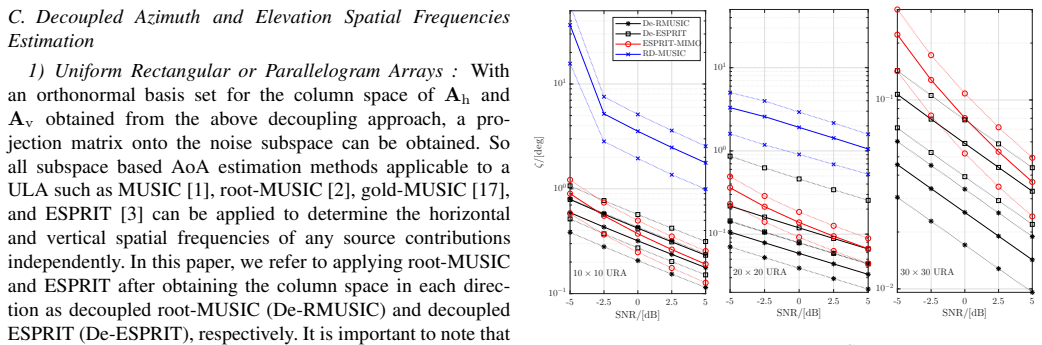
- The method achieves higher accuracy than two-dimensional MUSIC, reduced-dimension MUSIC and two-dimensional ESPRIT for medium- and large-scale arrays.
- Fewer snapshots are required, which improves spectral efficiency.
- Pairing of the separately estimated angles is performed by a final two-dimensional spectral function.
Where Pith is reading between the lines
- The decoupling step could be combined with adaptive covariance estimation to further reduce the number of required snapshots in time-varying scenarios.
- The same Kronecker separability may allow analogous dimension reduction for other array processing tasks such as beamforming or source localization in three dimensions.
- Hardware implementations could exploit the structure to perform azimuth and elevation processing on separate, lower-dimensional arrays.
Load-bearing premise
The arrays admit steering vectors that can be expressed exactly as the Kronecker product of independent azimuth and elevation steering vectors.
What would settle it
A set of Monte Carlo trials on a large uniform rectangular array in which the proposed method shows lower accuracy or requires more snapshots than two-dimensional ESPRIT would falsify the performance advantage.
Figures



read the original abstract
Uniform rectangular arrays (URA), structured non-uniform rectangular arrays (NURA), and parallelogram shaped (UPgA and NUPgA) arrays admit steering vectors that can be expressed as the Kronecker product of azimuth and elevation steering vectors. Accordingly, the full steering matrix can be represented as the Khatri Rao product of the corresponding azimuth and elevation steering matrices. This paper exploits this structure to develop an economical subspace decoupling framework for two dimensional angle of arrival (AoA) estimation. The proposed method first extracts the joint signal subspace from the spatial covariance matrix. Then it applies a low complexity decoupling scheme to recover the column spaces of the azimuth and elevation steering matrices. With the estimated decoupled subspaces, conventional one dimensional algorithms such as MUSIC, root MUSIC, and ESPRIT can be applied independently along each dimension, followed by pairing through a two dimensional spectral function. Monte Carlo simulations show that the proposed approach achieves higher accuracy than state of the art methods, i.e., two dimensional MUSIC, reduced-dimension MUSIC, and two-dimensional ESPRIT, for medium- and large scale arrays while requiring fewer snapshots, consequently with improved spectral efficiency.
Editorial analysis
A structured set of objections, weighed in public.
Referee Report
Summary. The paper presents a subspace decoupling method for two-dimensional angle-of-arrival estimation that exploits the Kronecker separability of steering vectors in uniform rectangular arrays (URA), non-uniform rectangular arrays (NURA), and parallelogram-shaped arrays (UPgA, NUPgA). The approach extracts the joint signal subspace from the sample covariance matrix, applies a low-complexity decoupling scheme to obtain separate azimuth and elevation subspaces, and then applies one-dimensional estimators such as MUSIC or ESPRIT independently, with pairing via a two-dimensional spectral function. Monte Carlo simulations are reported to demonstrate higher accuracy and reduced snapshot requirements compared to two-dimensional MUSIC, reduced-dimension MUSIC, and two-dimensional ESPRIT for medium- and large-scale arrays.
Significance. If the decoupling step remains accurate under finite-sample noise, the method offers a computationally efficient alternative for 2D AoA estimation on large arrays by reducing the problem to independent 1D searches. This structure-exploiting approach could improve spectral efficiency in radar and communications applications, provided the claimed performance gains hold beyond the reported simulations.
major comments (2)
- [Decoupling Framework] The decoupling operator is applied to the estimated joint subspace to recover the column spaces of the azimuth and elevation steering matrices via the Khatri-Rao structure. However, the manuscript provides no analytic perturbation analysis or bounds on how finite-sample errors in the joint subspace (from the sample covariance) propagate through the decoupling operator. This omission is critical because the central performance claims—superior accuracy with fewer snapshots—rely on the decoupled subspaces remaining sufficiently accurate for the subsequent 1D estimators to outperform direct 2D methods.
- [Simulation Results] The abstract states that Monte Carlo trials demonstrate superior accuracy and lower snapshot count, but the provided description lacks quantitative details such as specific array dimensions (e.g., M x N elements), SNR ranges, exact snapshot numbers, RMSE values, or comparison baselines. Without these, it is difficult to assess the magnitude and conditions of the reported improvement over 2D MUSIC, RD-MUSIC, and 2D ESPRIT.
minor comments (2)
- [Abstract] The abstract would benefit from including at least one concrete performance metric (e.g., RMSE reduction at a given SNR and snapshot count) to allow readers to immediately gauge the practical gains.
- [Method Description] Ensure that the definition of the decoupling operator and its application to the estimated subspace are presented with explicit matrix dimensions and computational complexity counts for reproducibility.
Simulated Author's Rebuttal
We thank the referee for the constructive and detailed review of our manuscript. We address each major comment below and have revised the manuscript to incorporate the suggested improvements where feasible.
read point-by-point responses
-
Referee: [Decoupling Framework] The decoupling operator is applied to the estimated joint subspace to recover the column spaces of the azimuth and elevation steering matrices via the Khatri-Rao structure. However, the manuscript provides no analytic perturbation analysis or bounds on how finite-sample errors in the joint subspace (from the sample covariance) propagate through the decoupling operator. This omission is critical because the central performance claims—superior accuracy with fewer snapshots—rely on the decoupled subspaces remaining sufficiently accurate for the subsequent 1D estimators to outperform direct 2D methods.
Authors: We thank the referee for this observation. Our claims rest on extensive Monte Carlo simulations that empirically confirm the decoupled subspaces remain accurate enough for the 1D estimators to outperform 2D methods across the tested regimes. Deriving tight closed-form bounds for the full decoupling operator under finite samples is non-trivial due to the Khatri-Rao structure and the subsequent 1D spectral searches. Nevertheless, we will add a first-order perturbation analysis in the revised manuscript that quantifies the leading-order error propagation from the sample covariance through the decoupling step, together with a discussion of the conditions under which the approximation holds. revision: yes
-
Referee: [Simulation Results] The abstract states that Monte Carlo trials demonstrate superior accuracy and lower snapshot count, but the provided description lacks quantitative details such as specific array dimensions (e.g., M x N elements), SNR ranges, exact snapshot numbers, RMSE values, or comparison baselines. Without these, it is difficult to assess the magnitude and conditions of the reported improvement over 2D MUSIC, RD-MUSIC, and 2D ESPRIT.
Authors: We agree that the abstract would benefit from concrete quantitative information. In the revised manuscript we will update the abstract to include representative simulation parameters drawn from Section IV: array sizes (e.g., 8×8 and 10×10 URAs), SNR range (−5 dB to 25 dB), snapshot counts (20 to 500), and explicit RMSE reductions (approximately 15–25 % lower than 2D ESPRIT at 50 snapshots for the tested configurations). These additions will allow readers to gauge the reported gains without altering the manuscript’s conclusions. revision: yes
Circularity Check
No circularity; derivation rests on external array manifold property
full rationale
The paper's central step extracts the joint signal subspace from the sample covariance and applies a decoupling operator derived directly from the Khatri-Rao structure that follows when steering vectors factor as Kronecker products. This structure is stated as a geometric property of the URA/NURA/UPgA/NUPgA manifolds and is not obtained by fitting parameters or by self-referential definition inside the paper. Subsequent 1D MUSIC/ESPRIT steps and the Monte-Carlo accuracy claims are therefore independent of the decoupling construction; they constitute empirical validation rather than tautological recovery of the input assumption. No self-citation chain, ansatz smuggling, or renaming of known results appears in the load-bearing equations.
Axiom & Free-Parameter Ledger
axioms (1)
- domain assumption Steering vectors of URA, NURA, UPgA and NUPgA arrays factor exactly as the Kronecker product of independent azimuth and elevation vectors.
Reference graph
Works this paper leans on
-
[1]
Multiple emitter location and signal param eter estimation,
R. Schmidt, “Multiple emitter location and signal param eter estimation,” IEEE Transactions on Antennas and Propagation , vol. 34, no. 3, pp. 276–280, Mar. 1986
work page 1986
-
[2]
Estimating the angles of ar rival of multiple plane waves,
R. Kumaresan and D. W. Tufts, “Estimating the angles of ar rival of multiple plane waves,” IEEE Transactions on Aerospace and Electronic Systems, vol. AES-19, no. 1, pp. 134–139, 1983
work page 1983
-
[3]
ESPRIT-estimation of signal para meters via ro- tational invariance techniques,
R. Roy and T. Kailath, “ESPRIT-estimation of signal para meters via ro- tational invariance techniques,” IEEE Transactions on Acoustics, Speech, and Signal Processing , vol. 37, no. 7, pp. 984–995, 1989
work page 1989
-
[4]
Gridless DOA estima tion and root- MUSIC for non-uniform linear arrays,
M. Wagner, Y . Park, and P . Gerstoft, “Gridless DOA estima tion and root- MUSIC for non-uniform linear arrays,” IEEE Transactions on Signal Processing, vol. 69, pp. 2144–2157, 2021
work page 2021
-
[5]
DOA estimatio n with non- uniform linear arrays: A phase-difference projection appr oach,
H. Chen, T. Ballal, and T. Y . Al-Naffouri, “DOA estimatio n with non- uniform linear arrays: A phase-difference projection appr oach,” IEEE Wireless Communications Letters, vol. 10, no. 11, pp. 2435–2439, 2021
work page 2021
-
[6]
Extension of ro ot-MUSIC to non-ULA array configurations,
F. Belloni, A. Richter, and V . Koivunen, “Extension of ro ot-MUSIC to non-ULA array configurations,” in 2006 IEEE International Conference on Acoustics Speech and Signal Processing Proceedings , vol. 4, 2006, pp. IV –IV
work page 2006
-
[7]
Two-Dimensional channel parameter estimation for IRS-as sisted net- works,
Fazal-E-Asim, A. L. F. de Almeida, B. Sokal, B. Makki, and G. Fodor, “Two-Dimensional channel parameter estimation for IRS-as sisted net- works,” IEEE Transactions on Communications , vol. 73, no. 8, pp. 6337–6350, 2025
work page 2025
-
[8]
A higher-order prop agator method for 2D-DOA estimation in massive MIMO systems,
T. Ahmed, X. Zhang, and W. U. Hassan, “A higher-order prop agator method for 2D-DOA estimation in massive MIMO systems,” IEEE Communications Letters , vol. 24, no. 3, pp. 543–547, 2020
work page 2020
-
[9]
Target detection and loc alization using MIMO radars and sonars,
I. Bekkerman and J. Tabrikian, “Target detection and loc alization using MIMO radars and sonars,” IEEE Transactions on Signal Processing , vol. 54, no. 10, pp. 3873–3883, 2006
work page 2006
-
[10]
X. Zhang, L. Xu, L. Xu, and D. Xu, “Direction of departure (DOD) and direction of arrival (DOA) estimation in MIMO radar with reduced- dimension MUSIC,” IEEE Communications Letters , vol. 14, no. 12, pp. 1161–1163, 2010
work page 2010
-
[11]
Compu tationally efficient 2D-DOA estimation for uniform planar arrays: RD-R oot- MUSIC algorithm,
Y . Changbo, Z. Beizuo, L. Baobao, and Z. Xiaofei, “Compu tationally efficient 2D-DOA estimation for uniform planar arrays: RD-R oot- MUSIC algorithm,” Transactions of Nanjing University of Aeronautics & Astronautics, vol. 38, no. 4, pp. 685–694, 2021
work page 2021
-
[12]
Angle estimation usin g ESPRIT without pairing in MIMO radar,
C. Jinli, G. Hong, and S. Weimin, “Angle estimation usin g ESPRIT without pairing in MIMO radar,” Electronics Letters, vol. 44, pp. 1422– 1423, 2008
work page 2008
-
[13]
Angle estimati on using ESPRIT in MIMO radar,
C. Duofang, C. Baixiao, and Q. Guodong, “Angle estimati on using ESPRIT in MIMO radar,” Electronics Letters , vol. 44, pp. 770–771, 2008
work page 2008
-
[14]
Structure d non- uniformly spaced rectangular antenna array design for FD-M IMO sys- tems,
W. Liu, Z. Wang, C. Sun, S. Chen, and L. Hanzo, “Structure d non- uniformly spaced rectangular antenna array design for FD-M IMO sys- tems,” IEEE Transactions on Wireless Communications , vol. 16, no. 5, pp. 3252–3266, 2017
work page 2017
-
[15]
S. Han, X. Lai, Y . Zhang, and X. Zhang, “A computationall y efficient and virtualization-free two-dimensional doa estimation meth od for nested planar array: Rd-root-music algorithm,” Sensors, vol. 22, no. 14, 2022
work page 2022
-
[16]
Parallel fa ctor analysis in sensor array processing,
N. Sidiropoulos, R. Bro, and G. Giannakis, “Parallel fa ctor analysis in sensor array processing,” IEEE Transactions on Signal Processing , vol. 48, no. 8, pp. 2377–2388, 2000
work page 2000
-
[17]
Gold-MUSIC: A variation on MUSIC to accurately determine peaks of the spectrum,
K. V . Rangarao and S. V enkatanarasimhan, “Gold-MUSIC: A variation on MUSIC to accurately determine peaks of the spectrum,” IEEE Transactions on Antennas and Propagation , vol. 61, no. 4, pp. 2263– 2268, 2013
work page 2013
-
[18]
M. Haardt, F. Roemer, and G. Del Galdo, “Higher-order SV D-based subspace estimation to improve the parameter estimation ac curacy in multidimensional harmonic retrieval problems,” IEEE Transactions on Signal Processing, vol. 56, no. 7, pp. 3198–3213, 2008
work page 2008
-
[19]
Two-Dimensional DoA estimation via g eneralized T-SVD and PARAFAC modeling,
Q. Liu and L. Liu, “Two-Dimensional DoA estimation via g eneralized T-SVD and PARAFAC modeling,” Signal Processing, p. 110542, 2026
work page 2026
discussion (0)
Sign in with ORCID, Apple, or X to comment. Anyone can read and Pith papers without signing in.