Recognition: unknown
Wavelength-driven photoelectron momentum tilt in XUV Ionization
Pith reviewed 2026-05-14 18:40 UTC · model grok-4.3
The pith
The radial node in argon's 3p orbital causes reversal of the photoelectron momentum tilt in XUV ionization via d-wave interference.
A machine-rendered reading of the paper's core claim, the machinery that carries it, and where it could break.
Core claim
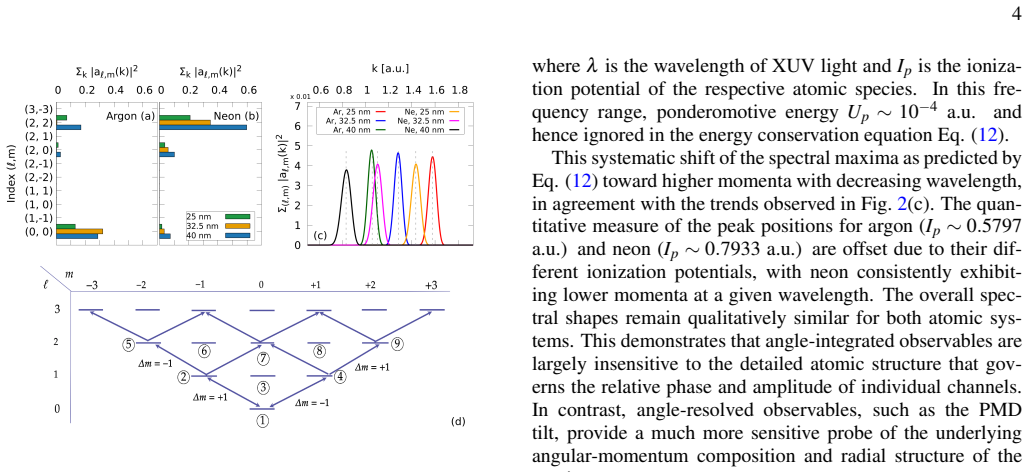
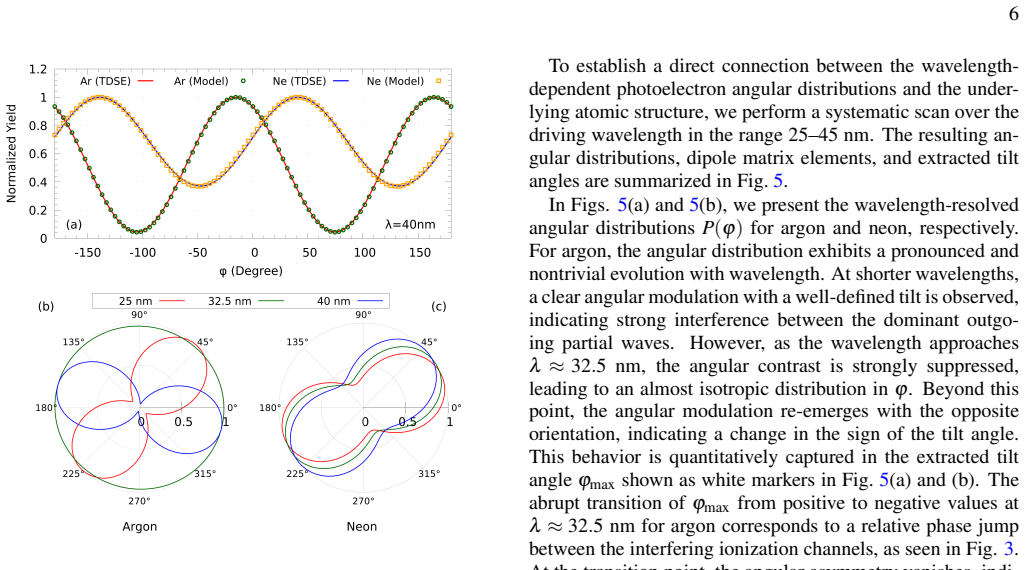
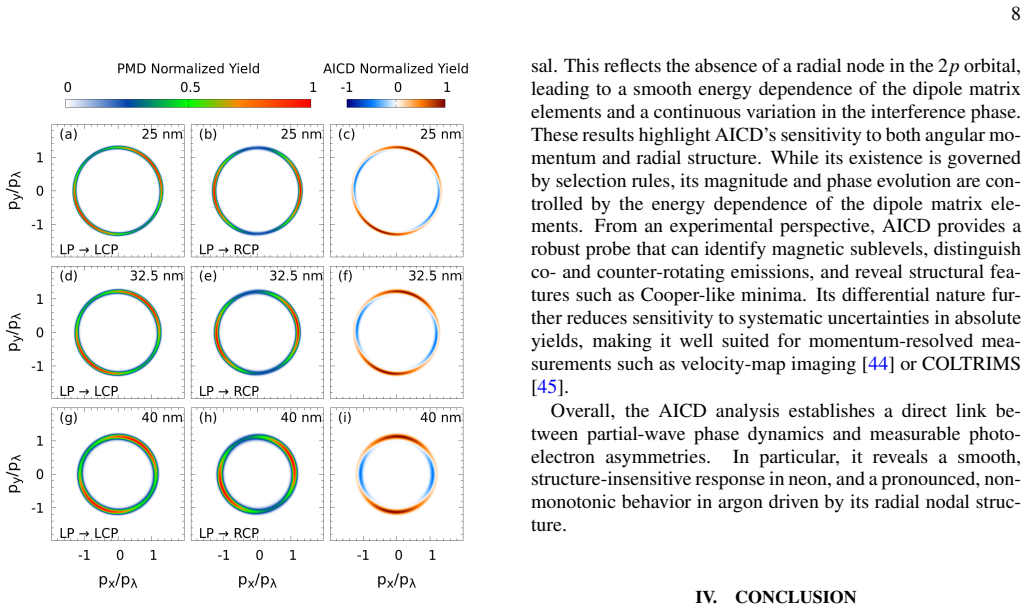
In XUV single-photon ionization, the tilt of the photoelectron momentum distribution depends on the magnetic quantum number and the radial structure of the bound orbital. For argon, the radial node in the 3p orbital induces a minimum in the d-wave radial dipole matrix element, which through interference with the s-wave channel leads to suppression and reversal of the tilt at a particular wavelength. This mechanism is absent in neon, which lacks such a node, resulting in monotonic behavior. Atomic interferometric circular dichroism serves as a probe for these effects.
What carries the argument
the minimum in the d-wave radial dipole matrix element induced by the radial node in the argon 3p orbital, which drives interference with the s-wave channel
If this is right
- Argon exhibits tilt reversal at the wavelength corresponding to the d-wave matrix element minimum, unlike the smooth dependence in neon.
- The effect provides a signature of radial-node-induced Cooper-like suppression in the d-wave channel.
- Atomic interferometric circular dichroism measurements can detect the wavelength-dependent rotation and suppression of the PMD tilt.
- These observations establish a direct link between bound-state radial wavefunction structure and momentum-space asymmetries.
Where Pith is reading between the lines
- This wavelength dependence could be used to control the direction of photoelectron emission in argon by tuning the XUV wavelength.
- Similar radial node effects may influence ionization in other atoms or molecules with nodes in their valence orbitals.
- Future experiments could test if intense fields or multi-photon processes modify this single-photon radial interference.
Load-bearing premise
The partial wave analysis and numerical computation of dipole matrix elements correctly isolate the contribution from the radial node without contamination by other atomic effects.
What would settle it
An experiment that measures the photoelectron momentum tilt in argon across a range of XUV wavelengths and checks for a reversal precisely at the wavelength where the d-wave radial dipole matrix element has a calculated minimum.
Figures





read the original abstract
We investigate how atomic structure influences photoelectron momentum distributions (PMDs) in single-photon ionization by a linearly polarized extreme-ultraviolet (XUV) pulse. We demonstrate that the PMD tilt is governed not only by the magnetic quantum number but also by the radial structure of the bound atomic orbital. While neon exhibits a smooth wavelength dependence of the PMD tilt, argon displays a non-monotonic behavior characterized by suppression and reversal of the tilt at a critical wavelength. A partial-wave analysis reveals that this behavior arises from interference between $s$- and $d$-wave channels, with the reversal originating from a minimum in the $d$-wave radial dipole matrix element induced by the radial node in the argon 3p orbital. We further show that atomic interferometric circular dichroism (AICD) serves as a sensitive probe of this effect. These findings establish a direct link between the radial wavefunction structure and observable momentum-space asymmetries, highlighting the wavelength-dependent rotation and the suppression of the PMD tilt as signatures of radial-node-induced Cooper-like suppression in the $d$-wave channel of argon.
Editorial analysis
A structured set of objections, weighed in public.
Referee Report
Summary. The paper investigates wavelength-dependent photoelectron momentum distributions (PMDs) in single-photon XUV ionization of neon and argon. It reports that neon shows smooth tilt behavior while argon exhibits non-monotonic tilt with suppression and reversal at a critical wavelength. A partial-wave analysis attributes the argon reversal to interference between s- and d-wave channels, specifically a minimum in the d-wave radial dipole matrix element induced by the radial node in the 3p orbital. Atomic interferometric circular dichroism (AICD) is identified as a sensitive probe of this radial-node effect.
Significance. If the partial-wave decomposition and matrix-element calculations hold, the work establishes a concrete connection between bound-state radial nodes and wavelength-dependent asymmetries in PMDs. This could provide a useful diagnostic for Cooper-like features in continuum channels and for interpreting momentum-resolved photoionization data. The suggestion that AICD can probe the effect offers a potential experimental handle.
major comments (2)
- [Partial-wave analysis] Partial-wave analysis section: the attribution of the PMD tilt reversal to a minimum in the d-wave radial dipole matrix element requires explicit demonstration that the computed minimum position coincides with the observed reversal wavelength; without a plot or tabulated values of the d-wave matrix element versus photon energy, it is not possible to confirm that the node-induced feature is the dominant cause rather than a shift from other partial waves or potential details.
- [Numerical results] Numerical results section: the isolation of the radial-node effect is not validated by a reference calculation on a node-free system (e.g., a different orbital or isoelectronic atom without the 3p node); if the tilt reversal persists in such a test, the claimed mechanism would be undermined.
minor comments (2)
- [Abstract] The abstract refers to 'Cooper-like suppression' but the main text should explicitly state whether the d-wave minimum is a true Cooper minimum or only analogous, with supporting references to prior work on argon photoionization.
- [Figures] Figure captions for the PMD plots should include the exact wavelengths at which the tilt reversal occurs and label the s- and d-wave contributions separately for direct comparison.
Simulated Author's Rebuttal
We thank the referee for the careful reading and positive assessment of our work. We address each major comment below and describe the revisions that will be made to the manuscript.
read point-by-point responses
-
Referee: [Partial-wave analysis] Partial-wave analysis section: the attribution of the PMD tilt reversal to a minimum in the d-wave radial dipole matrix element requires explicit demonstration that the computed minimum position coincides with the observed reversal wavelength; without a plot or tabulated values of the d-wave matrix element versus photon energy, it is not possible to confirm that the node-induced feature is the dominant cause rather than a shift from other partial waves or potential details.
Authors: We agree that explicit confirmation is required. In the revised manuscript we will add a dedicated figure displaying the d-wave radial dipole matrix element as a function of photon energy. The plot will demonstrate that the minimum occurs at the photon energy corresponding to the observed PMD tilt reversal, establishing that the radial-node feature is the dominant mechanism. revision: yes
-
Referee: [Numerical results] Numerical results section: the isolation of the radial-node effect is not validated by a reference calculation on a node-free system (e.g., a different orbital or isoelectronic atom without the 3p node); if the tilt reversal persists in such a test, the claimed mechanism would be undermined.
Authors: We acknowledge the strength of this suggestion. A full reference calculation on an isoelectronic node-free system would require substantial new computational work beyond the present study. In the revision we will expand the discussion to compare explicitly with neon (which exhibits only smooth tilt dependence) and clarify why the reversal is tied specifically to the radial node structure of the argon 3p orbital, thereby reinforcing the mechanism without the additional calculation. revision: partial
Circularity Check
No circularity: explicit partial-wave decomposition from computed matrix elements
full rationale
The paper computes photoelectron momentum distributions for neon and argon under XUV ionization, then performs a partial-wave analysis to attribute the non-monotonic tilt reversal in argon to interference between s- and d-channels, specifically a node-induced minimum in the d-wave radial dipole matrix element. This minimum is identified directly from the radial structure of the 3p orbital in the computed matrix elements rather than being fitted to the observed tilt or redefined in terms of the final observable. No equations reduce a claimed prediction to an input parameter by construction, no self-citation chain supplies the uniqueness of the mechanism, and the wavelength dependence emerges from the explicit channel decomposition. The derivation remains self-contained against the atomic wavefunctions and numerical treatment.
Axiom & Free-Parameter Ledger
axioms (1)
- standard math Single-photon ionization can be described by time-dependent or time-independent Schrödinger equation with dipole approximation
Reference graph
Works this paper leans on
-
[1]
Krausz and M
F. Krausz and M. Ivanov, Rev. Mod. Phys.81, 163 (2009)
2009
-
[2]
P. B. Corkum and F. Krausz, Nat. Phys.3, 381 (2007)
2007
-
[3]
Nisoli, P
M. Nisoli, P. Decleva, F. Calegari, A. Palacios, and F. Martín, Chem. Rev.117, 10760 (2017)
2017
-
[4]
P. B. Corkum, Phys. Rev. Lett.71, 1994 (1993)
1994
-
[5]
Lewenstein, P
M. Lewenstein, P. Balcou, M. Y . Ivanov, A. L’Huillier, and P. B. Corkum, Phys. Rev. A49, 2117 (1994)
1994
-
[6]
A. T. J. B. Eppink and D. H. Parker, Review of Scientific In- struments68, 3477–3484 (1997)
1997
-
[7]
Becker, F
W. Becker, F. Grasbon, R. Kopold, D. Miloševi´c, G. Paulus, and H. Walther (Academic Press, 2002) pp. 35–98
2002
-
[8]
Douguet and K
N. Douguet and K. Bartschat, Phys. Rev. A106, 053112 (2022)
2022
-
[9]
K.-J. Yuan, S. Chelkowski, and A. D. Bandrauk, Phys. Rev. A 93, 053425 (2016)
2016
-
[10]
Yuan and X.-B
M.-H. Yuan and X.-B. Bian, Phys. Rev. A101, 013412 (2020)
2020
-
[11]
Kerbstadt, D
S. Kerbstadt, D. Pengel, D. Johannmeyer, L. Englert, T. Bayer, and M. Wollenhaupt, New Journal of Physics19, 103017 (2017)
2017
-
[12]
Murakami and S.-I
M. Murakami and S.-I. Chu, Phys. Rev. A93, 023425 (2016)
2016
-
[13]
Murakami, G
M. Murakami, G. P. Zhang, and S.-I. Chu, Phys. Rev. A95, 053419 (2017)
2017
-
[14]
Wang and F
J.-P. Wang and F. He, Phys. Rev. A95, 043420 (2017)
2017
-
[15]
D. F. Dar and S. Fritzsche, Phys. Rev. A109, L041101 (2024)
2024
-
[16]
Bian and A
X.-B. Bian and A. D. Bandrauk, Phys. Rev. Lett.108, 263003 (2012)
2012
-
[17]
J. M. Ngoko Djiokap, S. X. Hu, L. B. Madsen, N. L. Man- akov, A. V . Meremianin, and A. F. Starace, Phys. Rev. Lett. 115, 113004 (2015)
2015
-
[18]
Böwering, T
N. Böwering, T. Lischke, B. Schmidtke, N. Müller, T. Khalil, and U. Heinzmann, Phys. Rev. Lett.86, 1187 (2001)
2001
-
[19]
G. A. Garcia, L. Nahon, M. Lebech, J.-C. Houver, D. Dowek, and I. Powis, The Journal of Chemical Physics119, 8781–8784 (2003)
2003
-
[20]
A. N. Artemyev, R. Tomar, D. Trabert, D. Kargin, E. Kutscher, M. S. Schöffler, L. P. H. Schmidt, R. Pietschnig, T. Jahnke, M. Kunitski, S. Eckart, R. Dörner, and P. V . Demekhin, Phys. Rev. Lett.132, 123202 (2024)
2024
-
[21]
Nakagawa, K
T. Nakagawa, K. Watanabe, Y . Matsumoto, and T. Yokoyama, Journal of Physics: Condensed Matter21, 314010 (2009)
2009
-
[22]
J. J. Omiste and L. B. Madsen, Journal of Physics B: Atomic, Molecular and Optical Physics54, 054001 (2021)
2021
-
[23]
Chelkowski, A
S. Chelkowski, A. D. Bandrauk, and P. B. Corkum, Phys. Rev. A95, 053402 (2017). 10
2017
-
[24]
Wang, X.-R
M.-X. Wang, X.-R. Xiao, H. Liang, S.-G. Chen, and L.-Y . Peng, Phys. Rev. A96, 043414 (2017)
2017
-
[25]
Böning and S
B. Böning and S. Fritzsche, Phys. Rev. A102, 053108 (2020)
2020
-
[26]
Kukreti and A
N. Kukreti and A. R. Holkundkar, Phys. Rev. A113, 053103 (2026)
2026
-
[27]
McKay, H
S. McKay, H. B. Ambalampitiya, D. Peng, A. Saenz, and J. M. Ngoko Djiokap, Phys. Rev. A111, 053116 (2025)
2025
-
[29]
X.-M. Tong, J. Phys. B: At. Mol. Opt. Phys.50, 144004 (2017)
2017
-
[30]
A. R. Holkundkar, R. Rajpoot, and J. N. Bandyopadhyay, Phys. Lett. A461, 128645 (2023)
2023
-
[31]
Rajpoot and A
R. Rajpoot and A. R. Holkundkar, J. Phys. B: At. Mol. Opt. Phys.56, 105402 (2023)
2023
-
[32]
X. M. Tong and C. D. Lin, J. Phys. B: At. Mol. Opt. Phys.38, 2593 (2005)
2005
-
[33]
Tong and S.-I
X.-M. Tong and S.-I. Chu, Chem. Phys.217, 119 (1997)
1997
-
[34]
Wang, S.-I
J. Wang, S.-I. Chu, and C. Laughlin, Phys. Rev. A50, 3208 (1994)
1994
-
[35]
L. B. Madsen, L. A. A. Nikolopoulos, T. K. Kjeldsen, and J. Fernández, Phys. Rev. A76, 063407 (2007)
2007
-
[36]
Murakami, O
M. Murakami, O. Korobkin, and M. Horbatsch, Phys. Rev. A 88, 063419 (2013)
2013
-
[37]
Murakami and G.-P
M. Murakami and G.-P. Zhang, Phys. Rev. A101, 053439 (2020)
2020
-
[38]
B. H. Bransden and C. J. Joachain,Physics of atoms and molecules, second edition. ed. (Prentice Hall, Harlow, 2003)
2003
-
[39]
J. W. Cooper, Phys. Rev.128, 681 (1962)
1962
-
[40]
Samson and W
J. Samson and W. Stolte, Journal of Electron Spectroscopy and Related Phenomena123, 265 (2002)
2002
-
[41]
Alexandridi, D
C. Alexandridi, D. Platzer, L. Barreau, D. Busto, S. Zhong, M. Turconi, L. Neori ˇci´c, H. Laurell, C. L. Arnold, A. Borot, J.-F. Hergott, O. Tcherbakoff, M. Lejman, M. Gisselbrecht, E. Lindroth, A. L’Huillier, J. M. Dahlström, and P. Salières, Phys. Rev. Res.3, L012012 (2021)
2021
-
[42]
Hassouneh, N
O. Hassouneh, N. B. Tyndall, J. Wragg, H. W. van der Hart, and A. C. Brown, Phys. Rev. A98, 043419 (2018)
2018
-
[43]
M. Y . Amus’ya, N. A. Cherepkov, and L. V . Chernysheva, Jour- nal of Experimental and Theoretical Physics33, 90 (1971)
1971
-
[44]
A. T. J. B. Eppink and D. H. Parker, Review of Scientific In- struments68, 3477 (1997)
1997
-
[45]
Dörner, V
R. Dörner, V . Mergel, O. Jagutzki, L. Spielberger, J. Ullrich, R. Moshammer, and H. Schmidt-Böcking, Physics Reports330, 95 (2000)
2000
discussion (0)
Sign in with ORCID, Apple, or X to comment. Anyone can read and Pith papers without signing in.