Recognition: unknown
Latent-Space Gaussian Processes for Dark-Energy Reconstruction from Observational \(H(z)\) Data
Pith reviewed 2026-05-14 18:39 UTC · model grok-4.3
The pith
Placing a Gaussian process prior directly on dark-energy density f(z) yields viable reconstructions from Hubble data consistent with Lambda CDM.
A machine-rendered reading of the paper's core claim, the machinery that carries it, and where it could break.
Core claim
The authors demonstrate that Gaussian process reconstructions of f(z), w(z), and Om(z) from observational Hubble data are consistent with Lambda CDM whether the prior is placed on f(z) or H(z). Differences between these latent constructions are small, prior-dependent, and mostly appear in the high-redshift tail where data is sparse. Cross-validation finds comparable predictive performance, while mock tests confirm the framework's ability to respond to mild dark-energy evolution when data coverage is improved.
What carries the argument
Latent-space Gaussian process prior on the normalized dark-energy density f(z) or Hubble parameter H(z), used within a Bayesian framework to reconstruct dark energy evolution.
If this is right
- Real-data reconstructions remain consistent with a cosmological constant across different external priors.
- Mock data tests show the framework detects mild evolution in w(z) and Om(z) when high-redshift coverage is sufficient.
- Improved high-redshift OHD reduces discrepancies between latent-f and latent-H methods.
- Apparent trends in Om(z) are sensitive to prior choice and do not provide robust evidence for dark energy evolution.
- The log-f branch enforces positive density without altering the primary conclusions.
Where Pith is reading between the lines
- Applying this method to larger future OHD datasets could better constrain possible deviations from Lambda CDM.
- Integrating the reconstruction with supernova or BAO data might mitigate the dependence on external priors.
- Exploring a broader set of GP kernels could test whether the current results hold under different smoothness assumptions.
- The viability of latent-f suggests similar direct priors could be tested in other cosmological inference problems.
Load-bearing premise
The Gaussian process kernel and external priors do not introduce systematic biases into the reconstruction of f(z) and Om(z) at high redshifts where data coverage is poorest.
What would settle it
High-redshift Hubble parameter observations that yield a reconstructed Om(z) deviating significantly from a constant when analyzed with this Gaussian process method, even after varying the priors.
Figures




read the original abstract
Using the 37-point cosmic-chronometer subset of observational Hubble parameter (OHD) data, we develop a Bayesian Gaussian-process framework to reconstruct the normalized dark-energy density \(f(z)\) and equation of state \(w(z)\), focusing on how the choice of latent space affects the inference. We compare a Gaussian-process prior placed directly on \(f(z)\) with the conventional latent-\(H\) formulation, and also test a log-\(f\) branch that enforces \(f(z)>0\). We further analyze OHD-like mock data generated from fiducial \(\Lambda\)CDM and mildly evolving \(w_0w_a\) models, using both the observed redshift distribution and a higher-quality high-redshift setup. For real OHD, leave-one-out cross-validation shows no strong predictive preference between latent-\(f\) and latent-\(H\) reconstructions. The inferred \(f(z)\), \(w(z)\), and \(Om(z)\) remain consistent with \(\Lambda\)CDM across the tested external priors, while apparent \(Om(z)\) trends are prior sensitive and not robust evidence for dark-energy evolution. Residual differences between the two latent constructions are small, sign mixed, prior dependent, and mainly confined to the weakly constrained high-redshift tail. We therefore interpret the real-data results primarily as a methodological assessment. In mock tests, the framework responds to injected mild evolution in the reconstructed dark-energy quantities and \(Om(z)\), with detectability depending on method and data coverage. Improved high-redshift OHD reduces the discrepancy between latent constructions and makes the \(Om(z)\) response more consistently detectable. The latent-\(f\) approach is therefore a viable alternative to latent-\(H\), while current constraints are limited mainly by sparse high-redshift OHD and dependence on external priors.
Editorial analysis
A structured set of objections, weighed in public.
Referee Report
Summary. The manuscript develops a Bayesian Gaussian-process framework to reconstruct the normalized dark-energy density f(z) and equation of state w(z) from 37 cosmic-chronometer OHD points. It compares a direct GP prior on f(z) (latent-f) to the conventional latent-H formulation, includes a log-f variant enforcing positivity, and validates via leave-one-out cross-validation on real data plus mock OHD-like catalogs generated from fiducial ΛCDM and mildly evolving w0wa models. Real-data results show no strong predictive preference between latent constructions, with f(z), w(z), and Om(z) consistent with ΛCDM but Om(z) trends prior-sensitive; mock tests indicate the framework responds to injected evolution, with detectability improving under higher-quality high-z coverage. The central conclusion is that latent-f is a viable alternative to latent-H, with current constraints limited by sparse high-redshift OHD and external-prior dependence.
Significance. If the robustness to kernel and prior choices is confirmed, the work supplies a useful methodological comparison of latent-space formulations for GP-based dark-energy reconstruction. It explicitly demonstrates the impact of prior sensitivity on Om(z) trends and the value of mock-data validation for assessing detectability of mild evolution, while the LOO CV and dual real/mock testing provide concrete evidence of the method's behavior under realistic data limitations.
major comments (2)
- [Abstract] Abstract: the claim that 'the latent-f approach is therefore a viable alternative to latent-H' is load-bearing for the central result yet rests on the untested assumption that the chosen GP kernel and external priors introduce no systematic bias in the high-redshift regime (z>1.5) where OHD coverage is poorest; no explicit variation of kernel form (squared-exponential vs. Matérn) or prior ranges is reported, even though the text itself flags prior sensitivity of Om(z) trends and sign-mixed residual differences.
- [Real-data results] Real-data results section: the statement that reconstructions 'remain consistent with ΛCDM across the tested external priors' while 'apparent Om(z) trends are prior sensitive and not robust evidence for dark-energy evolution' requires a quantitative definition of consistency (e.g., overlap of credible intervals or a specific tension metric) because the prior dependence directly affects whether the viability conclusion for latent-f holds independently of modeling choices.
minor comments (2)
- The description of the log-f branch and its positivity enforcement would benefit from an explicit equation or flowchart showing how the transformation is implemented within the GP prior.
- Figure captions for the mock-data reconstructions should include the exact redshift distribution and noise model used, to allow direct reproduction of the detectability claims.
Simulated Author's Rebuttal
We thank the referee for the constructive report and for highlighting points that improve the clarity and robustness of our claims. We respond to each major comment below and have revised the manuscript to incorporate quantitative checks and additional kernel tests where feasible.
read point-by-point responses
-
Referee: [Abstract] Abstract: the claim that 'the latent-f approach is therefore a viable alternative to latent-H' is load-bearing for the central result yet rests on the untested assumption that the chosen GP kernel and external priors introduce no systematic bias in the high-redshift regime (z>1.5) where OHD coverage is poorest; no explicit variation of kernel form (squared-exponential vs. Matérn) or prior ranges is reported, even though the text itself flags prior sensitivity of Om(z) trends and sign-mixed residual differences.
Authors: We agree that explicit kernel variation was not reported in the original submission. The squared-exponential kernel was chosen for its smoothness properties appropriate to the expected dark-energy evolution, but to address the concern we have added a comparison using the Matérn 3/2 kernel in the revised manuscript. The results show only minor differences confined to z>1.5, with the viability conclusion for latent-f unchanged. We have also expanded the description of tested prior ranges and added a supplementary table summarizing sensitivity. These additions support the abstract claim while acknowledging the prior dependence already noted in the text. revision: partial
-
Referee: [Real-data results] Real-data results section: the statement that reconstructions 'remain consistent with ΛCDM across the tested external priors' while 'apparent Om(z) trends are prior sensitive and not robust evidence for dark-energy evolution' requires a quantitative definition of consistency (e.g., overlap of credible intervals or a specific tension metric) because the prior dependence directly affects whether the viability conclusion for latent-f holds independently of modeling choices.
Authors: We accept the need for a quantitative definition. In the revised manuscript we now define consistency as the fiducial ΛCDM prediction lying inside the 68% credible interval of the reconstruction at every redshift in the data range. We additionally report a tension metric given by the maximum value of |μ_GP(z) − ΛCDM(z)| / σ_GP(z) across the redshift range, which remains below unity for all tested priors. These definitions and the associated numbers have been inserted into the real-data results section to make the consistency statement precise and independent of qualitative description. revision: yes
Circularity Check
No circularity detected; reconstructions and viability claims are data-driven with explicit prior checks.
full rationale
The paper places independent GP priors on latent f(z) or H(z), infers posteriors from the OHD likelihood, performs leave-one-out cross-validation, and tests recovery on mock data generated from fiducial models. No equation or result reduces to its inputs by construction, no fitted parameter is relabeled as a prediction, and no self-citation chain carries the central claim. The abstract explicitly flags prior sensitivity of Om(z) trends and residual latent differences, confirming the analysis remains self-contained against external benchmarks rather than tautological.
Axiom & Free-Parameter Ledger
free parameters (1)
- GP kernel hyperparameters
axioms (2)
- domain assumption FLRW metric and Friedmann equation relating H(z) to dark-energy density f(z)
- domain assumption Gaussian process prior is a reasonable non-parametric model for f(z) or H(z)
Reference graph
Works this paper leans on
-
[1]
denser high-z
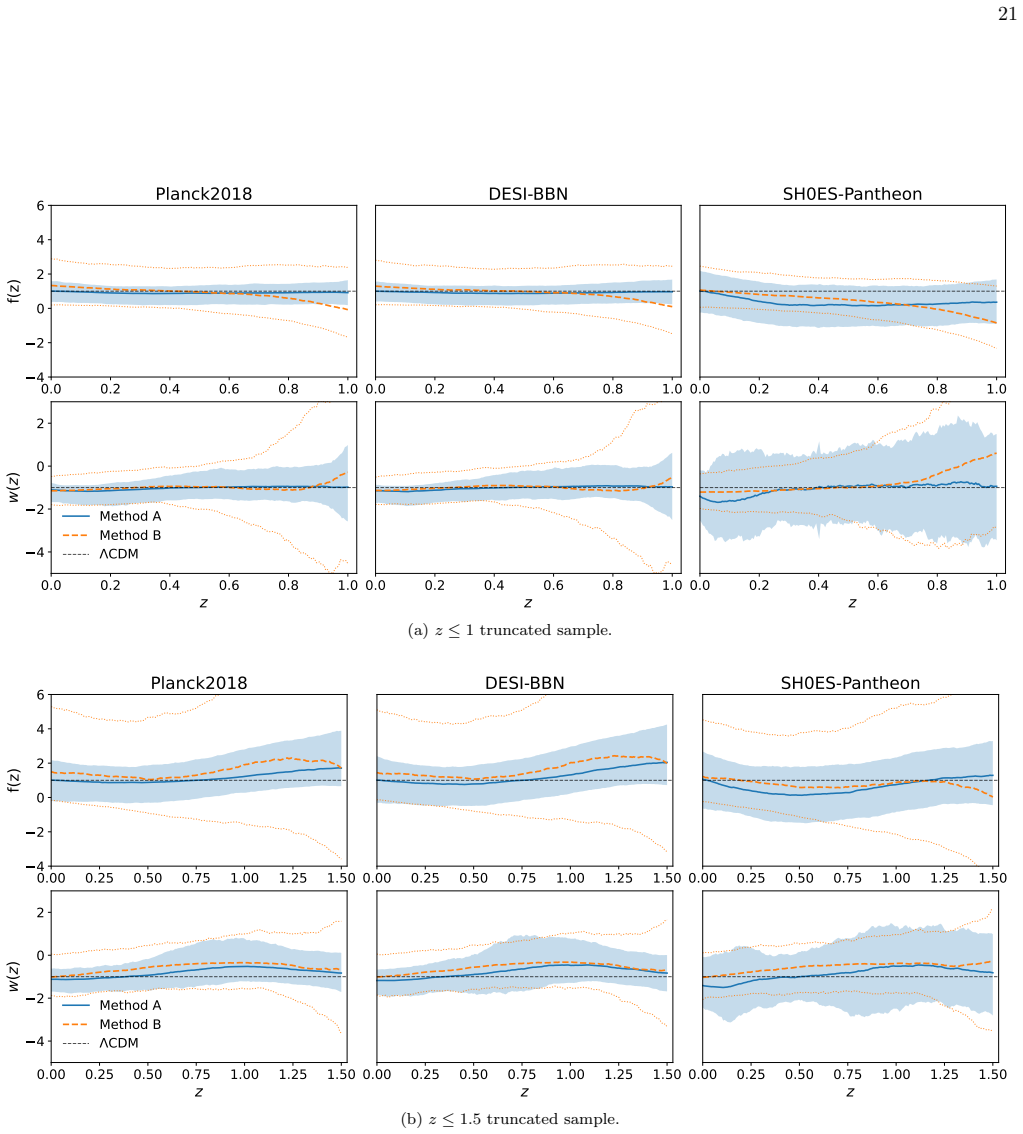
Prior dependence off(z)andw(z) The main-text figure shows the three prior sets side by side for the fullz≤2 analysis (Fig. 2), while the nested truncationsz≤1 andz≤1.5 are reported in Appendix Fig. 9. The qualitative conclusion is unchanged across these cases: the current CC OHD do not require a de- parture fromf(z) = 1 orw(z) =−1. 13 TABLE VI. Unified hi...
-
[2]
baseline
TheOm(z)diagnostic Fig. 7 provides a direct visual summary of the prior-dependentOm(z) behavior. Consistent with the real-data entries in Appendix Table X, the inferred ∆Om0.5,1.0 and ∆Om 0.5,1.5 intervals remain compati- ble with zero at 68% for all methods and priors, while SH0ES–Pantheon exhibits the largest prior-driven shift. This indicates that the ...
2025
-
[3]
Weinberg, Rev
S. Weinberg, Rev. Mod. Phys.61, 1 (1989)
1989
-
[4]
S. M. Carroll, Living reviews in relativity4, 1 (2001)
2001
-
[5]
P. Bull, Y. Akrami, J. Adamek, T. Baker, E. Bellini, J. Beltr´ an Jim´ enez, E. Bentivegna, S. Camera, S. Clesse, J. H. Davis, E. Di Dio, J. Enander, A. Heavens, L. Heisenberg, B. Hu, C. Llinares, R. Maartens, E. M¨ ortsell, S. Nadathur, J. Noller, R. Pasechnik, M. S. Pawlowski, T. S. Pereira, M. Quartin, A. Ricciardone, S. Riemer-Sørensen, M. Rinaldi, J....
work page internal anchor Pith review Pith/arXiv arXiv 2016
-
[6]
G. Efstathiou, Philosophical Transactions of the Royal Society of London Series A383, 20240022 (2025), arXiv:2406.12106 [astro-ph.CO]
-
[7]
J. Martin, Comptes Rendus Physique13, 566 (2012), arXiv:1205.3365 [astro-ph.CO]
work page internal anchor Pith review Pith/arXiv arXiv 2012
- [8]
-
[9]
F. Scali, Philosophical Transactions of the Royal So- ciety of London Series A383, 20230292 (2025), arXiv:2504.15358 [gr-qc]
-
[10]
Accelerating Universes with Scaling Dark Matter
M. Chevallier and D. Polarski, International Journal of Modern Physics D10, 213 (2001), arXiv:gr-qc/0009008 [gr-qc]
work page internal anchor Pith review Pith/arXiv arXiv 2001
-
[11]
E. V. Linder, Phys. Rev. Lett.90, 091301 (2003), arXiv:astro-ph/0208512 [astro-ph]
work page internal anchor Pith review Pith/arXiv arXiv 2003
-
[12]
Nonparametric Dark Energy Reconstruction from Supernova Data
T. Holsclaw, U. Alam, B. Sans´ o, H. Lee, K. Heitmann, S. Habib, and D. Higdon, Phys. Rev. Lett.105, 241302 (2010), arXiv:1011.3079 [astro-ph.CO]
work page internal anchor Pith review Pith/arXiv arXiv 2010
-
[13]
Nonparametric Reconstruction of the Dark Energy Equation of State
T. Holsclaw, U. Alam, B. Sans´ o, H. Lee, K. Heitmann, S. Habib, and D. Higdon, Phys. Rev. D82, 103502 (2010), arXiv:1009.5443 [astro-ph.CO]
work page internal anchor Pith review Pith/arXiv arXiv 2010
-
[14]
Reconstruction of dark energy and expansion dynamics using Gaussian processes
M. Seikel, C. Clarkson, and M. Smith, J. Cosmol. As- tropart. Phys.2012, 036 (2012), arXiv:1204.2832 [astro- ph.CO]
work page internal anchor Pith review Pith/arXiv arXiv 2012
-
[15]
A. Shafieloo, A. G. Kim, and E. V. Linder, Phys. Rev. D 85, 123530 (2012), arXiv:1204.2272 [astro-ph.CO]
work page internal anchor Pith review Pith/arXiv arXiv 2012
-
[16]
G.-B. Zhao, M. Raveri, L. Pogosian, Y. Wang, R. G. Crittenden, W. J. Handley, W. J. Percival, F. Beutler, J. Brinkmann, C.-H. Chuang, A. J. Cuesta, D. J. Eisen- stein, F.-S. Kitaura, K. Koyama, B. L’Huillier, R. C. Nichol, M. M. Pieri, S. Rodriguez-Torres, A. J. Ross, G. Rossi, A. G. S´ anchez, A. Shafieloo, J. L. Tinker, R. To- jeiro, J. A. Vazquez, and ...
work page internal anchor Pith review Pith/arXiv arXiv 2017
- [17]
- [18]
- [19]
- [20]
- [21]
-
[22]
X. Zhang, Y.-H. Xu, and Y. Sang, Communications in Theoretical Physics78, 035404 (2026), arXiv:2511.02220 [astro-ph.CO]
- [23]
-
[24]
Titsias and N
M. Titsias and N. D. Lawrence, inProceedings of the Thirteenth International Conference on Artificial Intel- ligence and Statistics, Proceedings of Machine Learning Research, Vol. 9, edited by Y. W. Teh and M. Tittering- ton (PMLR, Chia Laguna Resort, Sardinia, Italy, 2010) pp. 844–851
2010
-
[25]
C. E. Rasmussen and C. K. I. Williams,Gaussian Pro- cesses for Machine Learning(MIT Press, 2006)
2006
-
[26]
Li and S
P. Li and S. Chen, CAAI Transactions on Intelligence Technology1, 366 (2016)
2016
-
[27]
´Alvarez, D
M. ´Alvarez, D. Luengo, and N. D. Lawrence, inProceed- ings of the Twelfth International Conference on Artifi- cial Intelligence and Statistics, Proceedings of Machine Learning Research, Vol. 5, edited by D. van Dyk and M. Welling (PMLR, Hilton Clearwater Beach Resort, Clearwater Beach, Florida USA, 2009) pp. 9–16
2009
-
[28]
D. Nguyen-Tuong, M. Seeger, and J. Pe- ters, Advanced Robotics23, 2015 (2009), https://doi.org/10.1163/16918609X12529286896877
-
[29]
H.-R. Yu, S. Yuan, and T.-J. Zhang, Phys. Rev. D88, 103528 (2013), arXiv:1310.0870 [astro-ph.CO]
work page internal anchor Pith review Pith/arXiv arXiv 2013
-
[30]
L. Perenon, M. Martinelli, R. Maartens, S. Camera, and C. Clarkson, Physics of the Dark Universe37, 101119 (2022), arXiv:2206.12375 [astro-ph.CO]
-
[31]
Improved constraints on the dark energy equation of state using Gaussian processes
D. Wang and X.-H. Meng, Phys. Rev. D95, 023508 (2017), arXiv:1708.07750 [astro-ph.CO]
work page internal anchor Pith review Pith/arXiv arXiv 2017
-
[32]
Gaussian processes reconstruction of dark energy from observational data
M.-J. Zhang and H. Li, European Physical Journal C78, 460 (2018), arXiv:1806.02981 [astro-ph.CO]
work page internal anchor Pith review Pith/arXiv arXiv 2018
- [33]
-
[34]
Dutta, A
K. Dutta, A. Roy, S. Ruchika, Anjan A., and M. M. Sheikh-Jabbari, General Relativity and Gravitation52, 15 (2020)
2020
-
[35]
E. V. Linder, Phys. Rev. D70, 061302 (2004), arXiv:astro-ph/0406189 [astro-ph]
work page internal anchor Pith review Pith/arXiv arXiv 2004
-
[36]
Extended Dark Energy analysis using DESI DR2 BAO measurements
K. Lodha, R. Calderon, W. L. Matthewson, A. Shafieloo, M. Ishak, J. Pan, C. Garcia-Quintero, D. Huterer, G. Val- ogiannis, L. A. Ure˜ na-L´ opez, N. V. Kamble, D. Parkin- son, A. G. Kim, G. B. Zhao, J. L. Cervantes-Cota, J. Rohlf, F. Lozano-Rodr´ ıguez, J. O. Rom´ an-Herrera, M. Abdul-Karim, J. Aguilar, S. Ahlen, O. Alves, U. An- drade, E. Armengaud, A. A...
work page internal anchor Pith review arXiv 2025
-
[37]
Constraints on the Dark Side of the Universe and Observational Hubble Parameter Data
T.-J. Zhang, C. Ma, and T. Lan, Advances in Astronomy 2010, 184284 (2010), arXiv:1010.1307 [astro-ph.CO]
work page internal anchor Pith review Pith/arXiv arXiv 2010
-
[38]
Power of Observational Hubble Parameter Data: a Figure of Merit Exploration
C. Ma and T.-J. Zhang, Astrophys. J.730, 74 (2011), arXiv:1007.3787 [astro-ph.CO]
work page internal anchor Pith review Pith/arXiv arXiv 2011
- [39]
-
[40]
Braneworld models of dark energy
V. Sahni and Y. Shtanov, J. Cosmol. Astropart. Phys. 2003, 014 (2003), arXiv:astro-ph/0202346 [astro-ph]
work page internal anchor Pith review Pith/arXiv arXiv 2003
-
[41]
Sahni, A
V. Sahni, A. Shafieloo, and A. A. Starobinsky, Physical Review D—Particles, Fields, Gravitation, and Cosmol- ogy78, 103502 (2008)
2008
-
[42]
Constraints on scalar-tensor models of dark energy from observational and local gravity tests
S. Tsujikawa, K. Uddin, S. Mizuno, R. Tavakol, and J. Yokoyama, Phys. Rev. D77, 103009 (2008), arXiv:0803.1106 [astro-ph]
work page internal anchor Pith review Pith/arXiv arXiv 2008
-
[43]
Dynamically avoiding fine-tuning the cosmological constant: the "Relaxed Universe"
F. Bauer, J. Sol` a, and H.ˇStefanci´ c, J. Cosmol. Astropart. Phys.2010, 029 (2010), arXiv:1006.3944 [hep-th]
work page internal anchor Pith review Pith/arXiv arXiv 2010
-
[44]
Model independent evidence for dark energy evolution from Baryon Acoustic Oscillations
V. Sahni, A. Shafieloo, and A. A. Starobinsky, Astrophys. J. Lett.793, L40 (2014), arXiv:1406.2209 [astro-ph.CO]
work page internal anchor Pith review Pith/arXiv arXiv 2014
-
[45]
A. G´ omez-Valent, E. Karimkhani, and J. Sol` a, J. Cosmol. Astropart. Phys.2015, 048 (2015), arXiv:1509.03298 [gr- qc]
work page internal anchor Pith review Pith/arXiv arXiv 2015
-
[46]
J.-P. Dai, Y. Yang, and J.-Q. Xia, Astrophys. J.857, 9 (2018)
2018
- [47]
- [48]
-
[49]
S. Di Gennaro and Y. C. Ong, Universe8, 541 (2022), arXiv:2205.09311 [gr-qc]
-
[50]
H. Moshafi, H. Firouzjahi, and A. Talebian, Astrophys. J.940, 121 (2022), arXiv:2208.05583 [astro-ph.CO]
-
[51]
Ozulker, arXiv preprint arXiv:2203.04167 (2022)
E. Ozulker, arXiv preprint arXiv:2203.04167 (2022)
- [52]
- [53]
-
[54]
Bayesian leave-one-out cross-validation approximations for Gaussian latent variable models
A. Vehtari, T. Mononen, V. Tolvanen, T. Sivula, and O. Winther, arXiv e-prints , arXiv:1412.7461 (2014), arXiv:1412.7461 [stat.CO]
work page internal anchor Pith review Pith/arXiv arXiv 2014
-
[55]
Practical Bayesian model evaluation using leave-one-out cross-validation and WAIC
A. Vehtari, A. Gelman, and J. Gabry, arXiv e-prints , arXiv:1507.04544 (2015), arXiv:1507.04544 [stat.CO]
work page internal anchor Pith review Pith/arXiv arXiv 2015
-
[56]
M. Magnusson, M. Riis Andersen, J. Jonasson, and A. Vehtari, arXiv e-prints , arXiv:1904.10679 (2019), arXiv:1904.10679 [stat.ML]
-
[57]
M. Magnusson, M. Riis Andersen, J. Jonasson, and A. Vehtari, arXiv e-prints , arXiv:2001.00980 (2020), arXiv:2001.00980 [stat.ME]
-
[58]
Vehtari, D
A. Vehtari, D. Simpson, A. Gelman, Y. Yao, and J. Gabry, Journal of Machine Learning Research25, 1 (2024)
2024
-
[59]
J.-Z. Qi, S. Cao, M. Biesiada, T.-P. Xu, Y. Wu, S.-X. Zhang, and Z.-H. Zhu, Research in Astronomy and Astro- physics18, 066 (2018), arXiv:1803.04109 [astro-ph.CO]
work page internal anchor Pith review Pith/arXiv arXiv 2018
-
[60]
N. Myrzakulov, M. Koussour, and D. J. Gogoi, European Physical Journal C83, 594 (2023), arXiv:2303.04640 [gr- qc]
-
[61]
Weinberg,Cosmology(Oxford University Press, 2008)
S. Weinberg,Cosmology(Oxford University Press, 2008)
2008
-
[62]
Dodelson and F
S. Dodelson and F. Schmidt,Modern Cosmology(Aca- demic Press, 2020)
2020
-
[63]
Dodelson,Modern Cosmology(Academic Press, 2003)
S. Dodelson,Modern Cosmology(Academic Press, 2003)
2003
-
[64]
G. Efstathiou and S. Gratton, mnras496, L91 (2020), arXiv:2002.06892 [astro-ph.CO]
-
[65]
Two new diagnostics of dark energy
V. Sahni, A. Shafieloo, and A. A. Starobinsky, Phys. Rev. D78, 103502 (2008), arXiv:0807.3548 [astro-ph]
work page internal anchor Pith review Pith/arXiv arXiv 2008
-
[66]
Constraining Cosmological Parameters Based on Relative Galaxy Ages
R. Jimenez and A. Loeb, Astrophys. J.573, 37 (2002), arXiv:astro-ph/0106145 [astro-ph]
work page internal anchor Pith review Pith/arXiv arXiv 2002
-
[67]
M. Moresco, L. Amati, L. Amendola, S. Birrer, J. P. Blakeslee, M. Cantiello, A. Cimatti, J. Darling, M. Della Valle, M. Fishbach, C. Grillo, N. Hamaus, D. Holz, L. Izzo, R. Jimenez, E. Lusso, M. Meneghetti, E. Piedi- palumbo, A. Pisani, A. Pourtsidou, L. Pozzetti, M. Quar- tin, G. Risaliti, P. Rosati, and L. Verde, Living Re- views in Relativity25, 6 (202...
-
[68]
Moresco, CCcovariance: Gitlab repository,https: //gitlab.com/mmoresco/CCcovariance(2021), accessed June 11, 2025
M. Moresco, CCcovariance: Gitlab repository,https: //gitlab.com/mmoresco/CCcovariance(2021), accessed June 11, 2025
2021
-
[69]
M. Moresco, R. Jimenez, L. Verde, A. Cimatti, and L. Pozzetti, Astrophys. J.898, 82 (2020), arXiv:2003.07362 [astro-ph.GA]
-
[70]
C. Zhang, H. Zhang, S. Yuan, S. Liu, T.-J. Zhang, and Y.-C. Sun, Research in Astronomy and Astrophysics14, 1221-1233 (2014), arXiv:1207.4541 [astro-ph.CO]
work page internal anchor Pith review Pith/arXiv arXiv 2014
-
[71]
Cosmic Chronometers: Constraining the Equation of State of Dark Energy. I: H(z) Measurements
D. Stern, R. Jimenez, L. Verde, M. Kamionkowski, and S. A. Stanford, J. Cosmol. Astropart. Phys.2010, 008 (2010), arXiv:0907.3149 [astro-ph.CO]
work page internal anchor Pith review Pith/arXiv arXiv 2010
-
[72]
Jimenez, L
R. Jimenez, L. Verde, T. Treu, and D. Stern, The Astro- physical Journal593, 622 (2003)
2003
- [73]
-
[74]
M. Moresco, A. Cimatti, R. Jimenez, L. Pozzetti, G. Zamorani, M. Bolzonella, J. Dunlop, F. Lamareille, M. Mignoli, H. Pearce, P. Rosati, D. Stern, L. Verde, E. Zucca, C. M. Carollo, T. Contini, J.-P. Kneib, O. Le F` evre, S. J. Lilly, V. Mainieri, A. Renzini, M. Scodeggio, I. Balestra, R. Gobat, R. McLure, S. Bardelli, A. Bon- giorno, K. Caputi, O. Cuccia...
work page internal anchor Pith review Pith/arXiv arXiv 2012
-
[75]
Constraints on the redshift dependence of the dark energy potential
J. Simon, L. Verde, and R. Jimenez, Phys. Rev. D71, 123001 (2005), arXiv:astro-ph/0412269 [astro-ph]
work page internal anchor Pith review Pith/arXiv arXiv 2005
- [76]
-
[77]
M. Moresco, L. Pozzetti, A. Cimatti, R. Jimenez, C. Maraston, L. Verde, D. Thomas, A. Citro, R. Tojeiro, and D. Wilkinson, J. Cosmol. Astropart. Phys.2016, 014 (2016), arXiv:1601.01701 [astro-ph.CO]
work page internal anchor Pith review Pith/arXiv arXiv 2016
-
[78]
E. Tomasetti, M. Moresco, N. Borghi, K. Jiao, A. Cimatti, L. Pozzetti, A. C. Carnall, R. J. McLure, and L. Pentericci, Astron. Astrophys.679, A96 (2023), arXiv:2305.16387 [astro-ph.CO]
-
[79]
Raising the bar: new constraints on the Hubble parameter with cosmic chronometers at z$\sim$2
M. Moresco, Mon. Not. R. Astron. Soc.450, L16 (2015), arXiv:1503.01116 [astro-ph.CO]
work page internal anchor Pith review Pith/arXiv arXiv 2015
-
[80]
A. L. Ratsimbazafy, S. I. Loubser, S. M. Crawford, C. M. Cress, B. A. Bassett, R. C. Nichol, and P. V¨ ais¨ anen, Mon. Not. R. Astron. Soc.467, 3239 (2017), arXiv:1702.00418 [astro-ph.CO]
work page internal anchor Pith review Pith/arXiv arXiv 2017
discussion (0)
Sign in with ORCID, Apple, or X to comment. Anyone can read and Pith papers without signing in.