Recognition: 2 theorem links
· Lean TheoremViolations of the Leggett-Garg inequality in Hybrid Liouvillian Dynamics: The Nonlinear Role of Detector Efficiency
Pith reviewed 2026-05-14 17:55 UTC · model grok-4.3
The pith
Even an infinitesimal detector efficiency causes a rapid nonlinear suppression of Leggett-Garg inequality violations from their algebraic maximum of 3 to the classical bound.
A machine-rendered reading of the paper's core claim, the machinery that carries it, and where it could break.
Core claim
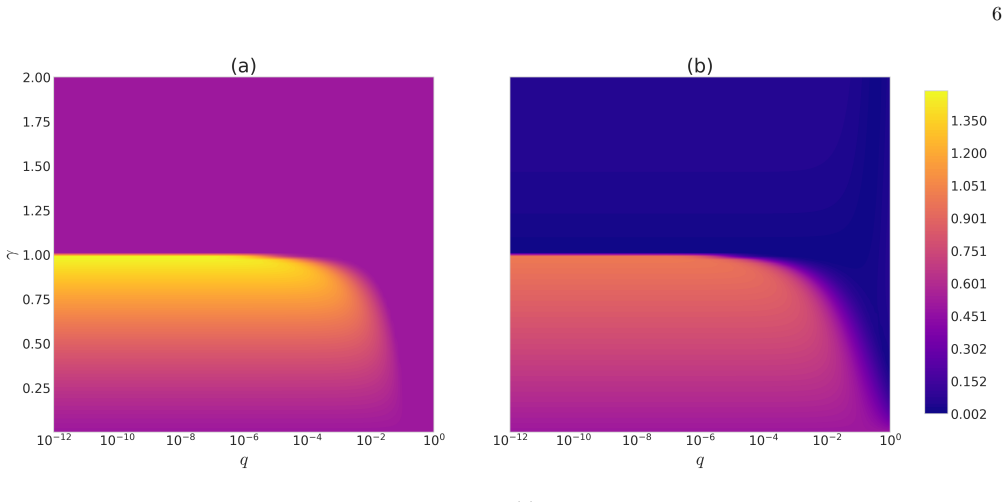
The central claim is that in the hybrid Liouvillian framework, the Leggett-Garg parameter K3 reaches its algebraic bound of 3 only in the limit of zero detector efficiency. For any finite efficiency, the dynamics incorporate enough jump trajectories to suppress the violation in a logarithmic manner back to the classical bound of 1. This fragility arises within continuous, divisible quantum trajectory evolution and contrasts with more robust violations possible in discrete protocols.
What carries the argument
The hybrid Liouvillian superoperator parameterized by detector efficiency q, which blends Lindblad jump terms with non-Hermitian evolution to model partial retention of quantum trajectories.
If this is right
- Extreme LGI violations demand near-perfect suppression of detected quantum jumps via effective post-selection.
- Detector performance must be extremely high to access the algebraic bound in continuous evolution setups.
- The nonlinear sensitivity implies that small improvements in efficiency yield large reductions in observed violations.
- Such maximal violations are singular limits rather than generic features of the open-system dynamics.
Where Pith is reading between the lines
- Similar nonlinear fragility might affect other temporal Bell inequalities under hybrid dynamics.
- Experiments could probe this by tuning effective efficiency through post-selection strength and tracking K3.
- This highlights the need for protocols that achieve strong violations without relying on idealized no-jump conditions.
Load-bearing premise
The chosen hybrid Liouvillian accurately captures how real detectors with finite efficiency affect the ensemble of quantum trajectories.
What would settle it
Perform an experiment on a two-level system with tunable detector efficiency and measure if K3 falls from near 3 to near 1 as efficiency increases from zero in the specific nonlinear way predicted by the model.
Figures

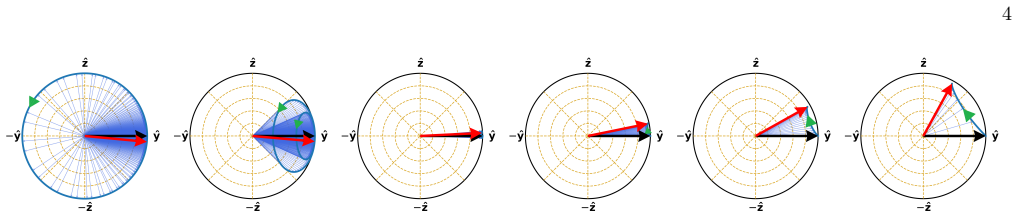

read the original abstract
Violations of the Leggett-Garg inequality (LGI) up to its algebraic bound under non-Hermitian dynamics are well established theoretically. Here, we demonstrate that such extreme violations are intrinsically fragile when realistic measurement processes are taken into account. We consider an open two-level system described by a time-local hybrid Liouvillian, with a continuous parameter $q \in [0,1]$, representing detector efficiency, i.e., the fraction of quantum jump trajectories that are retained in the ensemble. This parameter interpolates between trace-preserving Lindblad dynamics ($q=1$) and non-Hermitian ``no-jump" evolution ($q=0$). While $K_3$ approaches its algebraic maximum of 3 in the null-efficiency limit, even an infinitesimal increase in detector efficiency induces a rapid, highly nonlinear suppression toward the classical bound. This logarithmic sensitivity reveals that maximal LGI violations are not robust physical features but rather singular limits of idealized measurement conditions. Our results have direct experimental implications: achieving algebraic LGI violations in systems undergoing continuous time evolution requires near-perfect suppression of detected quantum jumps (i.e., effective post-selection), placing stringent constraints on detector performance. In contrast to discrete protocols based on time-non-divisible dynamics, our framework shows that extreme violations arising within continuous, divisible quantum trajectory evolution constitute a fundamentally fragile regime.
Editorial analysis
A structured set of objections, weighed in public.
Referee Report
Summary. The manuscript claims that extreme violations of the Leggett-Garg inequality (K3 approaching its algebraic bound of 3) under non-Hermitian dynamics are fragile when modeled with a time-local hybrid Liouvillian incorporating a continuous detector-efficiency parameter q ∈ [0,1]. This parameter interpolates between full Lindblad dynamics (q=1) and no-jump non-Hermitian evolution (q=0), with the central result being a rapid, highly nonlinear suppression of K3 toward the classical bound even for infinitesimal q > 0.
Significance. If the hybrid Liouvillian construction is accepted as a faithful model of realistic continuous measurements, the result demonstrates that algebraic LGI violations constitute a singular limit requiring near-perfect post-selection, imposing stringent experimental constraints on detector performance in continuous-time protocols. The work supplies a concrete parameterization and highlights a logarithmic sensitivity that distinguishes continuous divisible dynamics from discrete non-Markovian protocols.
major comments (1)
- [§II] §II (Hybrid Liouvillian definition): The central claim that K3 exhibits rapid nonlinear suppression for any q>0 rests on a specific interpolation in which only the jump term is scaled by q while the anticommutator term is retained in full. This construction does not reproduce the unconditional master equation of standard quantum-trajectory theory for inefficient detection (efficiency η=q), where undetected jumps still contribute to the Lindblad form and the ensemble-averaged ρ(t) remains independent of η. The reported fragility may therefore be an artifact of the chosen parameterization rather than a generic feature of realistic detector inefficiency.
minor comments (1)
- [Abstract] The abstract refers to 'logarithmic sensitivity' without specifying whether this is obtained analytically from the characteristic equation or observed numerically; the main text should clarify the derivation of the functional form of K3(q) near q=0.
Simulated Author's Rebuttal
We thank the referee for their insightful comments on our manuscript. We appreciate the opportunity to clarify the physical motivation behind our hybrid Liouvillian construction. We address the major comment in detail below.
read point-by-point responses
-
Referee: [§II] §II (Hybrid Liouvillian definition): The central claim that K3 exhibits rapid nonlinear suppression for any q>0 rests on a specific interpolation in which only the jump term is scaled by q while the anticommutator term is retained in full. This construction does not reproduce the unconditional master equation of standard quantum-trajectory theory for inefficient detection (efficiency η=q), where undetected jumps still contribute to the Lindblad form and the ensemble-averaged ρ(t) remains independent of η. The reported fragility may therefore be an artifact of the chosen parameterization rather than a generic feature of realistic detector inefficiency.
Authors: We thank the referee for this observation, which allows us to better articulate the scope of our model. Our hybrid Liouvillian is specifically designed to interpolate between the full Lindblad master equation (q = 1) and the non-Hermitian no-jump evolution (q = 0) by scaling only the jump operator term while retaining the full anticommutator. This choice is physically motivated by a continuous detector efficiency parameter q, defined as the fraction of quantum jump trajectories retained in the ensemble average. In this framework, q = 1 corresponds to including all trajectories (standard Lindblad), while q = 0 corresponds to post-selecting exclusively on no-jump trajectories, yielding the non-Hermitian dynamics. This is distinct from the unconditional master equation in standard quantum trajectory theory for inefficient detectors, where the ensemble average is indeed η-independent. However, our interest lies in the regime where partial retention of jumps (small but nonzero q) is considered, which models realistic continuous monitoring with imperfect post-selection. The rapid nonlinear suppression of K3 for q > 0 demonstrates the fragility of algebraic violations under such conditions, highlighting the need for near-perfect jump suppression. We have revised §II to include an explicit discussion of this distinction and the physical interpretation of q, ensuring the model is not misinterpreted as the unconditional case. revision: yes
Circularity Check
No significant circularity in derivation chain
full rationale
The paper introduces a hybrid Liouvillian with explicit continuous parameter q and derives the behavior of K3 by direct solution of the resulting master equation across q in [0,1]. The reported nonlinear suppression is obtained by evaluating the Leggett-Garg correlator on the interpolated dynamics; no parameter is fitted to data, no result is renamed as a prediction, and no load-bearing step reduces to a self-citation or self-definition. The derivation remains self-contained against the stated model equations.
Axiom & Free-Parameter Ledger
free parameters (1)
- q
axioms (1)
- domain assumption The hybrid Liouvillian dynamics with parameter q faithfully models open two-level systems under partial quantum-jump detection.
Lean theorems connected to this paper
-
IndisputableMonolith/Cost/FunctionalEquation.leanwashburn_uniqueness_aczel unclear?
unclearRelation between the paper passage and the cited Recognition theorem.
hybrid Liouvillian master equation with continuous parameter q ∈ [0,1] ... dρ/dt = −i[H,ρ] + 2γ (q LρL† − ½{L†L,ρ})
-
IndisputableMonolith/Foundation/AlexanderDuality.leanalexander_duality_circle_linking unclear?
unclearRelation between the paper passage and the cited Recognition theorem.
K3 approaches algebraic maximum of 3 in null-efficiency limit
What do these tags mean?
- matches
- The paper's claim is directly supported by a theorem in the formal canon.
- supports
- The theorem supports part of the paper's argument, but the paper may add assumptions or extra steps.
- extends
- The paper goes beyond the formal theorem; the theorem is a base layer rather than the whole result.
- uses
- The paper appears to rely on the theorem as machinery.
- contradicts
- The paper's claim conflicts with a theorem or certificate in the canon.
- unclear
- Pith found a possible connection, but the passage is too broad, indirect, or ambiguous to say the theorem truly supports the claim.
Reference graph
Works this paper leans on
-
[1]
A. J. Leggett, J. Phys.: Condens. Matter14, R415 (2002)
work page 2002
- [2]
-
[3]
W. H. Zurek, Rev. Mod. Phys.75, 715 (2003)
work page 2003
- [4]
-
[5]
A. J. Leggett and A. Garg, Phys. Rev. Lett.54, 857 (1985)
work page 1985
-
[6]
A. J. Leggett, Found. Phys.18, 939 (1988)
work page 1988
- [7]
-
[8]
Hensen et al., Nature526, 682-686 (2015)
B. Hensen et al., Nature526, 682-686 (2015)
2015
-
[9]
J. S. Bell, Physics1, 195 (1964)
work page 1964
-
[10]
N. Brunner, D. Cavalcanti, S. Pironio, V. Scarani, and S. Wehner, Rev. Mod. Phys.86, 419 (2014)
work page 2014
- [11]
-
[12]
A. Palacios-Laloy, A. F. Mallet, F. Nguyen, P. Bertet, D. Vion, D. Esteve, and A. N. Korotkov, Nat. Phys.6, 442 (2010)
work page 2010
-
[13]
S. Groblacher, A. Trubarov, N. Prigge, G. D. Cole, M. Aspelmeyer, and J. Eisert, Nature (London)520, 531 (2015)
work page 2015
-
[14]
H. Katiyar, A. Shukla, K. R. K. Rao, and T. S. Mahesh, Phys. Rev. A87, 052102 (2013)
work page 2013
-
[15]
K. R. K. Rao, H. Katiyar, T. S. Mahesh, A. Sen, U. Sen, and A. Kumar, Phys. Rev. A95, 022104 (2017)
work page 2017
-
[16]
G. Waldherr, P. Neumann, S. F. Huelga, F. Jelezko, and J. Wrachtrup, Phys. Rev. Lett.107, 090401 (2011)
work page 2011
- [17]
- [18]
-
[19]
O. J. E. Maroney and C. G. Timpson, arXiv:1412.6139 (2014)
work page internal anchor Pith review Pith/arXiv arXiv 2014
-
[20]
A. V. Varma, I. Mohanty, and S. Das, J. Phys. A: Math. Theor. 54, 115301 (2021)
work page 2021
-
[21]
Javid Naikoo et al 2021 J. Phys. A: Math. Theor. 54 275303
work page 2021
-
[22]
K.Pan, ANNALEN DER PHYSIK2022, 534, 2100401
A.Kumari, A. K.Pan, ANNALEN DER PHYSIK2022, 534, 2100401
-
[23]
J. Dressel, M. Malik, F. M. Miatto, A. N. Jordan, and R. W. Boyd, Rev. Mod. Phys.86, 307 (2014)
work page 2014
-
[24]
G. C. Knee, K. Kakuyanagi, M.-C. Yeh, Y. Matsuzaki, H. Toida, H. Yamaguchi, S. Saito, A. J. Leggett, and W. J. Munro, Nat. Commun.7, 13253 (2016)
work page 2016
-
[25]
A. N. Jordan, J. Tollaksen, J. E. Troupe, J. Dressel, and Y. Aharonov, Quantum Stud.: Math. Found.2, 5 (2015)
work page 2015
-
[26]
A. V. Varma et al., Phys. Rev. A 108, 032202 (2023)
work page 2023
-
[27]
S. Paul, A. V. Varma, and S. Das, Leggett–Garg inequal- ity, J. Phys. A: Math. Theor. 57, 385203 (2024)
work page 2024
-
[28]
S. Paul, A. V. Varma, Y. N. Joglekar, and S. Das, Phys. Rev. A 113, L040603 (2026)
work page 2026
-
[29]
F. Minganti, A. Miranowicz, R. W. Chhajlany, and F. Nori, Phys. Rev. A100, 062131 (2019)
work page 2019
- [30]
- [31]
- [32]
- [33]
-
[34]
H.-P. Breuer and F. Petruccione,The Theory of Open Quantum Systems(Oxford University Press, Oxford, 2002)
work page 2002
-
[35]
M. B. Plenio and P. L. Knight, Rev. Mod. Phys.70, 101 (1998)
work page 1998
-
[36]
H. J. Carmichael,An Open Systems Approach to Quan- tum Optics(Springer-Verlag, Berlin, 1993)
work page 1993
-
[37]
H. M. Wiseman and G. J. Milburn,Quantum Measure- ment and Control(Cambridge University Press, Cam- bridge, 2009)
work page 2009
-
[38]
K. Jacobs,Quantum Measurement Theory and its Appli- cations(Cambridge University Press, Cambridge, 2014)
work page 2014
-
[39]
A. Chatterjee, G.S. Karthik, T.S. Mahesh, A. R. Usha Devi, Phys. Rev. Lett.135, 220202 (2025)
work page 2025
-
[40]
A. K. Pan, Phys. Rev. A 102, 032206 (2020)
work page 2020
- [41]
- [42]
- [43]
- [44]
- [45]
- [46]
-
[47]
A. J. Daley, Adv. Phys.63, 77 (2014)
work page 2014
-
[48]
A. M. Childs and N. Wiebe, Quantum Info. Comput.12, 901 (2012)
work page 2012
-
[49]
D. W. Berry, A. M. Childs, R. Cleve, R. Kothari, and R. D. Somma, Phys. Rev. Lett.114, 090502 (2015)
work page 2015
-
[50]
C. M. Bender, Rep. Prog. Phys.70, 947 (2007)
work page 2007
-
[51]
J.-S. Tang, Y.-T. Wang, S. Yu, D.-Y. He, J.-S. Xu, B.-H. Liu, G. Chen, Y.-N. Sun, K. Sun, Y.-J. Han, et al., Nat. Photon.10, 642 (2016)
work page 2016
-
[52]
Y. Aharonov, D. Z. Albert, and L. Vaidman, Phys. Rev. Lett.60, 1351 (1988)
work page 1988
-
[53]
A. Gily´ en, Y. Su, G. H. Low, and N. Wiebe, inProceed- ings of the 51st Annual ACM SIGACT Symposium on Theory of Computing(ACM, New York, 2019), p. 193. 8 APPENDIX Appendix A: Microscopic Derivation of the Hybrid Dynamics In this appendix, we provide the microscopic foundation for the hybrid Liouvillian model utilized in the main text. We proceed by defi...
work page 2019
-
[54]
System-Detector Hamiltonian We consider a system coupled to a detector, modeled as a two-level quantum object. The system Hamiltonian is given byH s =ωˆn·σ, whereωis the Zeeman energy, and ˆnis a unit vector parametrized by spherical coordinates (θ, ϕ). The detector is prepared in the initial stateρ 0 d = 1 2(I+ ˆm·σ), where ˆmdefines the initialization d...
-
[55]
LetU(δt) = exp[−i(H s ⊗I+H s−d)δt] be the joint unitary evolution operator
Kraus Representation and Imperfect Post-Selection The reduced dynamics of the system over an infinitesimal time stepδtis obtained by tracing out the detector degrees of freedom. LetU(δt) = exp[−i(H s ⊗I+H s−d)δt] be the joint unitary evolution operator. The updated system state is ˜ρs(t+δt) = Tr d U(δt)(ρ s(t)⊗ρ 0 d)U †(δt) .(A2) Evaluating the partial tr...
-
[56]
Approx. Analytical Solution for the Coupled Spin System We rewrite the eq.(B2) with an approximation that we assumeγqS z ≃0 for the all equations and get the following form.The numerical result for these equations (B3) matches with the eqs.B2. dR dt =γS z −γ(1−q)R,(B3) dSy dt =J S z −γS y,(B4) dSz dt =−J S y −γS z +γ(1 +q)R.(B5) Below we present the analy...
work page 2005
discussion (0)
Sign in with ORCID, Apple, or X to comment. Anyone can read and Pith papers without signing in.