Recognition: unknown
Verifying Exact Samplers for Continuous Distributions with a Discrete Program Logic
Pith reviewed 2026-05-14 18:24 UTC · model grok-4.3
The pith
A higher-order separation logic proves exact samplers for continuous distributions correct.
A machine-rendered reading of the paper's core claim, the machinery that carries it, and where it could break.
Core claim
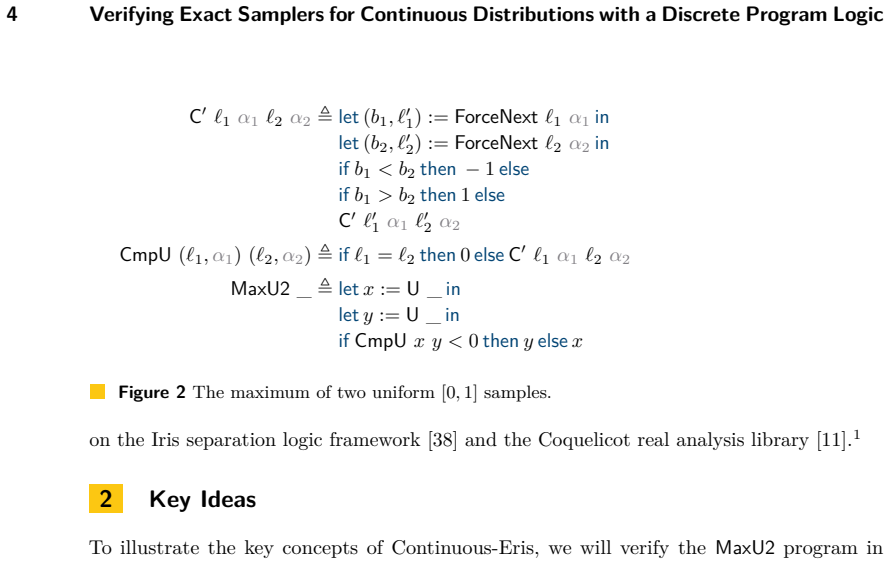
Continuous-Eris is a higher-order separation logic that allows verification of the correctness of exact sampling algorithms for computable distributions. The logic is used to establish that verified samplers for the uniform, Gaussian, and Laplace distributions generate samples according to their target distributions, along with a verified library for exact real arithmetic operations on those samples, all formalized in Rocq.
What carries the argument
Continuous-Eris, a higher-order separation logic whose rules reason about probabilistic choice, higher-order functions, and mutable state over a model of computable reals.
If this is right
- The verified uniform, Gaussian, and Laplace samplers are correct by construction.
- The exact real arithmetic library correctly supports operations on lazily generated samples.
- The same logic can be applied to other computable continuous distributions.
- Machine-checked proofs eliminate hidden approximation errors in the sampling code.
Where Pith is reading between the lines
- The verified samplers could be composed into larger differential privacy mechanisms while preserving formal guarantees against approximation-based attacks.
- The approach may extend to verifying exact sampling in other probabilistic programming languages that support lazy real generation.
- Developers could use the verified library as a trusted building block when implementing new exact samplers.
Load-bearing premise
The separation logic rules faithfully reflect the underlying language semantics for probabilistic choice, higher-order functions, and mutable state, and the computable reals model correctly captures lazy digit generation.
What would settle it
Execution of one of the Rocq-verified samplers producing a sequence of samples whose empirical distribution deviates from the claimed target distribution, or discovery of an inconsistency in the formalization of the separation logic rules.
Figures

read the original abstract
Most implementations of sampling algorithms for continuous distributions use floating-point numbers, which introduce round-off errors and approximations. These errors can be difficult to analyze, and can cause security issues when used in algorithms for differential privacy. An alternative is to use exact sampling algorithms based on computable reals, which can lazily generate the digits of a continuous sample to arbitrary precision. However, these algorithms are intricate, and implementing and using them involves a combination of semantically challenging language features, such as probabilistic choice, higher-order functions, and dynamically-allocated mutable state. In this paper we present Continuous-Eris, a higher-order separation logic for verifying the correctness of exact sampling algorithms for computable distributions. To demonstrate Continuous-Eris, we verify the correctness of computable samplers for the uniform, Gaussian, and Laplace distributions, as well as a library for exact real arithmetic for working with generated samples. All of the results in this paper have been verified in the Rocq proof assistant.
Editorial analysis
A structured set of objections, weighed in public.
Referee Report
Summary. The paper introduces Continuous-Eris, a higher-order separation logic for verifying exact sampling algorithms for computable continuous distributions. It demonstrates the logic by mechanically verifying in Rocq the correctness of samplers for the uniform, Gaussian, and Laplace distributions together with a supporting library for exact real arithmetic based on lazy digit generation.
Significance. If the result holds, the work supplies a sound, machine-checked foundation for reasoning about probabilistic programs that combine continuous sampling, higher-order functions, and mutable state. The Rocq-verified examples eliminate approximation gaps that arise in floating-point implementations and directly support applications such as differential privacy that require exact distributions.
minor comments (2)
- The abstract and introduction would benefit from a brief sentence clarifying how the lazy-digit model of computable reals interacts with the probabilistic choice rules in Continuous-Eris.
- Notation for the higher-order separation logic connectives (e.g., the precise form of the probabilistic choice rule) could be summarized in a small table for readers who are not already familiar with the Eris family of logics.
Simulated Author's Rebuttal
We thank the referee for their positive review, accurate summary of the contributions, and recommendation to accept the paper. We are pleased that the significance of Continuous-Eris as a verified foundation for exact sampling of continuous distributions is recognized.
Circularity Check
No significant circularity; formal verification is self-contained
full rationale
The paper defines Continuous-Eris as a higher-order separation logic and mechanically verifies its soundness plus the correctness of uniform/Gaussian/Laplace samplers and an exact-real library inside the Rocq proof assistant. All load-bearing steps are established by direct proof rules and semantic models (lazy-digit computable reals) rather than by fitting parameters, renaming prior results, or reducing claims to self-citations. The Rocq development supplies an independent, machine-checked foundation with no unverified semantic gaps or self-referential definitions.
Axiom & Free-Parameter Ledger
axioms (1)
- standard math Standard axioms of higher-order separation logic and the theory of computable real numbers
invented entities (1)
-
Continuous-Eris logic
no independent evidence
Reference graph
Works this paper leans on
-
[1]
1 Nathanael L. Ackerman, Cameron E. Freer, and Daniel M. Roy. On the computability of conditional probability.J. ACM, 66(3):23:1–23:40, 2019.doi:10.1145/3321699. 2 Alejandro Aguirre, Philipp G. Haselwarter, Markus de Medeiros, Kwing Hei Li, Simon Odder- shede Gregersen, Joseph Tassarotti, and Lars Birkedal. Error credits: Resourceful reasoning about error...
-
[2]
5 Kevin Batz, Joost-Pieter Katoen, Francesca Randone, and Tobias Winkler
doi:10.4230/LIPIcs.ICALP.2016.107. 5 Kevin Batz, Joost-Pieter Katoen, Francesca Randone, and Tobias Winkler. Foundations for deductive verification of continuous probabilistic programs: From lebesgue to riemann and back.Proc. ACM Program. Lang., 9(OOPSLA1):421–448, 2025.doi:10.1145/3720429. 6 Andrej Bauer and Iztok Kavkler. Implementing real numbers with ...
-
[3]
8Patrick Billingsley.Probability and Measure
doi:10.1145/3519939.3523721. 8Patrick Billingsley.Probability and Measure. Wiley, 3rd edition,
-
[4]
A domain-theoretic approach to brownian motion and general continuous stochastic processes
9 Paul Bilokon and Abbas Edalat. A domain-theoretic approach to brownian motion and general continuous stochastic processes. In Thomas A. Henzinger and Dale Miller, editors, Joint Meeting of the Twenty-Third EACSL Annual Conference on Computer Science Logic (CSL) and the Twenty-Ninth Annual ACM/IEEE Symposium on Logic in Computer Science (LICS), CSL-LICS ...
work page 2014
-
[5]
doi:10.1145/2603088.2603102. 10 Hans-Juergen Boehm. Towards an API for the real numbers. In Alastair F. Donaldson and Emina Torlak, editors,Proceedings of the 41st ACM SIGPLAN International Conference on Programming Language Design and Implementation, PLDI 2020, London, UK, June 15-20, 2020, pages 562–576. ACM, 2020.doi:10.1145/3385412.3386037. 11 Sylvie ...
-
[6]
12 Johannes Borgström, Ugo Dal Lago, Andrew D
doi:10.1007/ S11786-014-0181-1. 12 Johannes Borgström, Ugo Dal Lago, Andrew D. Gordon, and Marcin Szymczak. A lambda- calculus foundation for universal probabilistic programming. In Jacques Garrigue, Gabriele Keller, and Eijiro Sumii, editors,Proceedings of the 21st ACM SIGPLAN International Conference on Functional Programming, ICFP 2016, Nara, Japan, Se...
-
[7]
Verifying exact samplers for continuous distributions with a discrete program logic
doi:10.1145/3571239. 15 Markus de Medeiros, Puming Liu, Kwing Hei Li, Alejandro Aguirre, Lars Birkedal, and Joseph Tassarotti. Artifact for "Verifying exact samplers for continuous distributions with a discrete program logic", May 2026.doi:10.5281/zenodo.20114733. 16 Markus de Medeiros, Muhammad Naveed, Tancrède Lepoint, Temesghen Kahsai, Tristan Ravitch,...
-
[8]
26 Simon Oddershede Gregersen, Alejandro Aguirre, Philipp G
Springer Berlin Heidelberg. 26 Simon Oddershede Gregersen, Alejandro Aguirre, Philipp G. Haselwarter, Joseph Tassarotti, and Lars Birkedal. Asynchronous probabilistic couplings in higher-order separation logic.Proc. ACM Program. Lang., 8(POPL):753–784, 2024.doi:10.1145/3632868. 27 Philipp G. Haselwarter, Kwing Hei Li, Alejandro Aguirre, Simon Oddershede G...
-
[9]
33 Daniel Huang and Greg Morrisett
URL: https://www.sciencedirect.com/science/article/pii/S0890540109000170, doi:10.1016/j.ic.2008.12.009. 33 Daniel Huang and Greg Morrisett. An application of computable distributions to the semantics of probabilistic programming languages. In Peter Thiemann, editor,Programming Languages and Systems - 25th European Symposium on Programming, ESOP 2016, Held...
-
[10]
35 Mathieu Huot, Alexander K. Lew, Vikash K. Mansinghka, and Sam Staton.ωpap spaces: Rea- soning denotationally about higher-order, recursive probabilistic and differentiable programs. In 38th Annual ACM/IEEE Symposium on Logic in Computer Science, LICS 2023, Boston, MA, USA, June 26-29, 2023, pages 1–14. IEEE, 2023.doi:10.1109/LICS56636.2023.10175739. 36...
-
[11]
Association for Computing Machinery.doi:10.1145/3779031.3779109. 42 Valérie Ménissier-Morain. Arbitrary precision real arithmetic: design and algorithms. Research Report lip6.2003.003, LIP6, May
-
[12]
Springer. URL:https://hal. science/hal-02183311,doi:10.1007/978-3-030-17184-1\_1. 44 Ilya Mironov. On significance of the least significant bits for differential privacy. InProceedings of the 2012 ACM conference on Computer and communications security, pages 650–661,
-
[13]
45 NorbertTh.Müller. TheiRRAM:ExactarithmeticinC++. InJensBlanck, VascoBrattka, and Peter Hertling, editors,Computability and Complexity in Analysis, 4th International Workshop, CCA 2000, Swansea, UK, September 17-19, 2000, Selected Papers, volume 2064 ofLecture Notes in Computer Science, pages 222–252. Springer, 2000.doi:10.1007/3-540-45335-0\_14. 46 Pet...
-
[14]
doi:10.1109/LICS.1997.614952. 48 Tetsuya Sato. Approximate relational hoare logic for continuous random samplings. In Lars Birkedal, editor,The Thirty-second Conference on the Mathematical Foundations of Programming Semantics, MFPS 2016, Carnegie Mellon University, Pittsburgh, PA, USA, May 23-26, 2016, volume 325 ofElectronic Notes in Theoretical Computer...
-
[15]
49 Tetsuya Sato, Alejandro Aguirre, Gilles Barthe, Marco Gaboardi, Deepak Garg, and Justin Hsu. Formal verification of higher-order probabilistic programs: reasoning about approximation, convergence, bayesian inference, and optimization.Proc. ACM Program. Lang., 3(POPL):38:1– 38:30, 2019.doi:10.1145/3290351. 50 Alex K. Simpson. Lazy functional algorithms ...
-
[16]
Exact real computer arithmetic with continued fractions.IEEE Trans
53 Jean Vuillemin. Exact real computer arithmetic with continued fractions.IEEE Trans. Computers, 39(8):1087–1105, 1990.doi:10.1109/12.57047. 54 Mitchell Wand, Ryan Culpepper, Theophilos Giannakopoulos, and Andrew Cobb. Contextual equivalence for a probabilistic language with continuous random variables and recursion.Proc. ACM Program. Lang., 2(ICFP):87:1...
discussion (0)
Sign in with ORCID, Apple, or X to comment. Anyone can read and Pith papers without signing in.