Recognition: unknown
High-temperature behavior of amorphous alumina coatings: Insights from in-situ nanoindentation and X-ray diffraction studies
Pith reviewed 2026-05-14 18:18 UTC · model grok-4.3
The pith
Amorphous alumina coatings show gradual hardness drop with constant Young's modulus up to 650°C
A machine-rendered reading of the paper's core claim, the machinery that carries it, and where it could break.
Core claim
The hardness of the amorphous alumina coating decreases gradually and constantly with temperature up to 650°C while the Young's modulus stays constant throughout, consistent with increasing plasticity from an accelerating bond-switching mechanism; the coating remains non-crystalline in this range, and in-situ XRD shows thermally activated crystallization beginning at 700°C with intermediate alumina phases persisting until 950°C, after which only alpha-Al2O3 is observed.
What carries the argument
In-situ nanoindentation combined with in-situ X-ray diffraction, which maps the mechanical response and phase evolution in real time as temperature increases.
If this is right
- Coatings can operate without loss of stiffness up to 650°C in high-temperature applications.
- The increase in plasticity at higher temperatures may enhance resistance to brittle failure.
- Phase transitions limit long-term stability above 950°C where only alpha phase forms.
- The in-situ methods provide dynamic data on transitions that ex-situ testing would miss.
- These results help estimate performance in nuclear plant operating conditions.
Where Pith is reading between the lines
- Similar gradual softening might apply to other amorphous ceramic coatings under thermal load.
- Extending the combined techniques to irradiated samples could reveal how radiation affects the bond-switching process.
- The constant modulus suggests these coatings might resist thermal expansion mismatch stresses better than crystalline ones.
- Further modeling of bond-switching rates could predict behavior at temperatures beyond the tested range.
Load-bearing premise
The gradual hardness decrease results specifically from an accelerating bond-switching mechanism and that the laboratory in-situ conditions accurately reflect real-world nuclear power plant environments.
What would settle it
Performing nanoindentation at 650°C on a pre-annealed sample without prior loading to check if hardness drops occur without mechanical deformation, or detecting alpha-Al2O3 formation below 950°C in vacuum or different atmospheres.
Figures
read the original abstract
Further development of nuclear power plant technology relies heavily on materials durability under operating conditions. Estimating the materials performance in the operando tests is crucial. In this paper, the mechanical behavior of thin amorphous nuclear-dedicated Al2O3 coatings deposited by pulsed laser deposition was investigated by nanoindentation over the temperature range of 25-650C. Experimental nanomechanical analysis was supported by MD simulations. The results indicate that the hardness of the amorphous coating experiences a gradual, constant decrease with temperature, while the Young modulus value remains constant in the whole temperature range. Observed phenomena confirm the increasing plasticity of the material and it is postulated to be related to the bond-switching mechanism that accelerates at high temperatures. The post-mortem transmission electron microscopy characterization confirmed that the loaded material was non-crystalline over the entire range of the indentation temperatures. The thermal stability of the structure was further studied in-situ up to 1050C by X-ray diffraction. The implemented methodology allowed us to follow the dynamic process of phase transitions occurring in the material above 650C. First, thermally activated crystallization was observed at 700C. Intermediate alumina phases were present up to 950C, while above this temperature, exclusively the thermodynamically stable alpha-Al2O3 was observed. The in-situ high-temperature characterization of the evolution of thin films boosts the understanding of the application limits of the coating systems at elevated temperatures. The added value is that the paper demonstrates the potential usefulness of combining high-temperature techniques to characterize the complete behavior of thin films at elevated temperatures.
Editorial analysis
A structured set of objections, weighed in public.
Referee Report
Summary. The manuscript reports experimental results on the high-temperature mechanical properties of pulsed-laser-deposited amorphous Al2O3 coatings via in-situ nanoindentation (25–650 °C) supported by MD simulations, post-mortem TEM, and separate in-situ XRD (up to 1050 °C). It claims a gradual, constant decrease in hardness with temperature while Young’s modulus remains constant, attributes the trend to accelerating bond switching, confirms the indented material stays amorphous, and documents thermally activated crystallization beginning at 700 °C with intermediate phases persisting to 950 °C before exclusive formation of α-Al2O3.
Significance. If the reported trends hold, the work supplies direct, temperature-dependent nanomechanical data and phase-evolution observations relevant to protective coatings in nuclear environments. The combined use of in-situ nanoindentation, TEM, and XRD constitutes a practical methodology for characterizing thin-film stability at elevated temperatures, with the experimental measurements providing independent support for the hardness and modulus trends.
major comments (2)
- [Nanoindentation results] The central mechanical claim (gradual hardness decrease, constant modulus) rests on the nanoindentation data up to 650 °C, yet the manuscript does not report the number of valid indents per temperature, load-displacement curve quality metrics, or thermal-drift corrections; these details are required to assess whether the reported linear trend is statistically robust.
- [Discussion] The bond-switching interpretation of the hardness trend is presented as a postulate without quantitative comparison to the MD trajectories (e.g., no reported bond-angle or coordination-number statistics versus temperature); because this mechanism is invoked to explain the observed plasticity increase, a direct link or alternative explanation should be supplied.
minor comments (3)
- [Introduction / Experimental] The temperature range of the nanoindentation experiments (≤650 °C) versus the XRD range (up to 1050 °C) should be explicitly justified with reference to anticipated nuclear-plant service temperatures.
- [Methods] MD simulation parameters (interatomic potential, system size, equilibration protocol) are mentioned but not tabulated; adding a concise methods table would improve reproducibility.
- [XRD results] Figure captions for the XRD patterns should state the heating rate and dwell times to allow readers to assess kinetic effects on the observed phase sequence.
Simulated Author's Rebuttal
We thank the referee for the positive assessment and constructive comments. We have addressed the two major points by adding the requested experimental details and by strengthening the mechanistic discussion with quantitative MD analysis.
read point-by-point responses
-
Referee: [Nanoindentation results] The central mechanical claim (gradual hardness decrease, constant modulus) rests on the nanoindentation data up to 650 °C, yet the manuscript does not report the number of valid indents per temperature, load-displacement curve quality metrics, or thermal-drift corrections; these details are required to assess whether the reported linear trend is statistically robust.
Authors: We agree that these details are necessary to demonstrate robustness. In the revised manuscript we have added a table listing the number of valid indents at each temperature (8–12 per temperature), included representative load–displacement curves in the Supplementary Information, and expanded the Methods section with a full description of the thermal-drift correction protocol. These additions confirm that the observed linear hardness decrease is statistically supported by the data. revision: yes
-
Referee: [Discussion] The bond-switching interpretation of the hardness trend is presented as a postulate without quantitative comparison to the MD trajectories (e.g., no reported bond-angle or coordination-number statistics versus temperature); because this mechanism is invoked to explain the observed plasticity increase, a direct link or alternative explanation should be supplied.
Authors: We acknowledge that the original manuscript presented the bond-switching mechanism as a postulate. We have re-examined the MD trajectories and added quantitative statistics on the temperature dependence of Al–O coordination numbers and bond-angle distributions (new Figure and text in the revised Discussion). These metrics show a clear increase in bond-switching frequency with temperature, directly linking the simulations to the measured rise in plasticity. revision: yes
Circularity Check
No significant circularity; results from independent experiments
full rationale
The paper reports direct experimental observations from in-situ nanoindentation (hardness and modulus vs temperature), post-mortem TEM, and in-situ XRD for phase transitions up to 1050C. No derivation chain, equations, or fitted parameters are invoked that reduce to self-definition or prior self-citations. MD simulations are cited only as supporting context without load-bearing predictions that loop back to inputs. Central claims rest on raw data and standard characterization techniques, making the work self-contained against external benchmarks.
Axiom & Free-Parameter Ledger
axioms (2)
- domain assumption Standard nanoindentation analysis assumptions for extracting hardness and reduced modulus from load-displacement data remain valid at elevated temperatures up to 650C.
- domain assumption The tested thin-film samples are representative of nuclear-dedicated alumina coatings under operando conditions.
Reference graph
Works this paper leans on
-
[1]
Introduction Developing materials for extreme applications is very challenging as it requires consideration of many factors and complex relations that can affect the system's performance. This is best exemplified by nuclear materials that must retain their full functionality in the most demanding conditions, including high temperature (HT), high level s o...
-
[2]
This confirms that amorphous alumina oxide show significant potential to be used as a light, high-strength, and damage -tolerant engineering material which could be applied in Gen
are correct, and brittleness of this material could be limited furthe r at high-temperature. This confirms that amorphous alumina oxide show significant potential to be used as a light, high-strength, and damage -tolerant engineering material which could be applied in Gen. IV applications. To gain a complete picture of material behavior at high temperatur...
-
[3]
It was reported that PLD -grown coatings generally reproduce the roughness of the substrate [41]
Material and methods 2.1.Materials preparation 5 µm thick alumina coatings were deposited at RT on 0.9 mm thick AISI 316L stainless steel by PLD (Pulsed Laser Deposition). It was reported that PLD -grown coatings generally reproduce the roughness of the substrate [41]. Therefore, prior to the manufacturing process, steel samples were ground with SiC abras...
2022
-
[4]
-“ ≡ the phase is not observed; “+
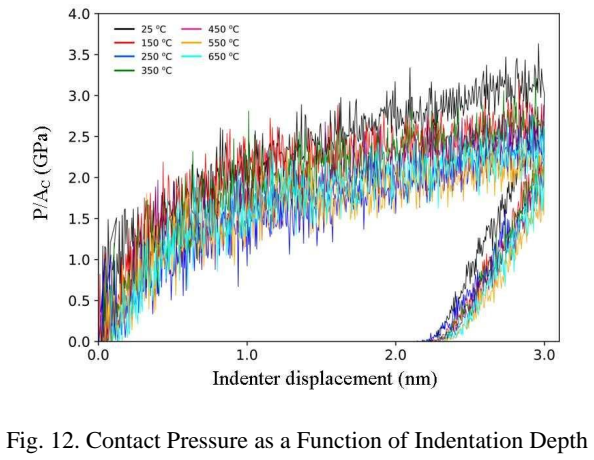
Results 3.1.High-temperature nanoindentation - experiment High-temperature nanoindentation measurements were performed to study the evolution of the mechanical properties of the investigated material over LFR foreseen operating temperatures. The l oad-displacement behavior of a -Al2O3 coating within the testing temperature range is presented in Fig. 3. It...
-
[5]
The mechanical investigation showed that the hardness of the amorphous coating decreases with the temperature
Discussion In summary, we have extensively explored the operational properties of the PLD-grown alumina coatings using in-situ high-temperature characterization techniques. The mechanical investigation showed that the hardness of the amorphous coating decreases with the temperature. The reported phenomenon is of vital importance, as from the mechanical po...
-
[6]
"Studies of the role of interfaces in multi -layered, coated and composite structures
Summary This paper reports for the first time an in situ high-temperature study of thin amorphous alumina coatings grown by PLD for nuclear applications. Implementing HT GIXRD allowed us to monitor the temporal evolution of phase transitions in the material at temperatures exceeding 650 °C. It has been shown that a thermally activated amorphous-crystallin...
2020
-
[7]
G.S. Was, D. Petti, S. Ukai, S. Zinkle, Materials for future nuclear energy systems, J. Nucl. Mater. (2019). https://doi.org/10.1016/j.jnucmat.2019.151837
-
[8]
S.J. Zinkle, G.S. Was, Materials challenges in nuclear energy, Acta Mater. 61 (2013) 735–758. https://doi.org/10.1016/j.actamat.2012.11.004
-
[9]
S.J. Zinkle, J.T. Busby, Structural materials for fission & fusion energy, Mater. Today. 12 (2009) 12–19. https://doi.org/10.1016/S1369-7021(09)70294-9
-
[11]
F. Hofmann, D.R. Mason, J.K. Eliason, A.A. Maznev, K.A. Nelson, S.L. Dudarev, Non- 29 Contact Measurement of Thermal Diffusivity in Ion -Implanted Nuclear Materials, Sci. Rep. 5 (2015) 1–7. https://doi.org/10.1038/srep16042
-
[12]
M.N. Gussev, T.S. Byun, Y. Yamamoto, S.A. Maloy, K.A. Terrani, In -situ tube burst testing and high -temperature deformation behavior of candidate materials for accident tolerant fuel cladding, J. Nucl. Mater. 466 (2015) 417 –425. https://doi.org/10.1016/j.jnucmat.2015.08.030
-
[13]
G. Guimbretière, A. Canizarès, N. Raimboux, J. Joseph, P. Desgardin, L. Desgranges, C. Jegou, P. Simon, High temperature Raman study of UO2: A possible tool for in situ estimation of irradiation -induced heating, J. Raman Spectrosc. 46 (2015) 418 –420. https://doi.org/10.1002/jrs.4661
-
[14]
G. Müller, G. Schumacher, F. Zimmermann, Investigation on oxygen controlled liquid lead corrosion of surface treated steels, J. Nucl. Mater. 278 (2000) 85 –95. https://doi.org/10.1016/S0022-3115(99)00211-1
-
[15]
P. Hosemann, Small -scale mechanical testing on nuclear materials: bridging the experimental length -scale gap, Scr. Mater. 143 (2018) 161 –168. https://doi.org/10.1016/j.scriptamat.2017.04.026
-
[16]
J.M. Wheeler, D.E.J. Armstrong, W. Heinz, R. Schwaiger, High temperature nanoindentation: The state of the art and future challenges, Curr. Opin. Solid State Mater. Sci. 19 (2015) 354–366. https://doi.org/10.1016/j.cossms.2015.02.002
-
[17]
S. Pathak, S.R. Kalidindi, Spherical nanoindentation stress -strain curves, Mater. Sci. Eng. R Reports. 91 (2015) 1–36. https://doi.org/10.1016/j.mser.2015.02.001
-
[18]
S. Schmauder, C.S.D. Chen, K.K. Chawla, N. Chawla, W. Chen, Y. Kagawa, Handbook of mechanics of materials, 2019. https://doi.org/10.1007/978-981-10-6884-3
-
[19]
B.D. Beake, Elevated temperature nanomechanics of coatings for high -temperature applications: a review, Emergent Mater. 1 (2021) 3. https://doi.org/10.1007/s42247-021- 00255-w
-
[20]
M. Frelek-Kozak, Kurpaska, K. Mulewska, M. Zieliński, R. Diduszko, A. Kosińska, D. Kalita, W. Chromiński, M. Turek, K. Kaszyca, A. Zaborowska, J. Jagielski, Mechanical behavior of ion -irradiated ODS RAF steels strengthened with different types of 30 refractory oxides, Appl. Surf. Sci. 610 (2023) 155465. https://doi.org/10.1016/J.APSUSC.2022.155465
-
[21]
L. Kurpaska, F.J. Dominguez-Gutierrez, Y. Zhang, K. Mulewska, H. Bei, W.J. Weber, A. Kosińska, W. Chr ominski, I. Jozwik, R. Alvarez -Donado, S. Papanikolaou, J. Jagielski, M. Alava, Effects of Fe atoms on hardening of a nickel matrix: Nanoindentation experiments and atom -scale numerical modeling, Mater. Des. 217 (2022). https://doi.org/10.1016/J.MATDES....
-
[22]
A. Alemberti, M. Caramello, M. Frignani, G. Grasso, F. Merli, G. Morresi, M. Tarantino, ALFRED reactor coolant system design, Nucl. Eng. Des. 370 (2020) 110884. https://doi.org/10.1016/j.nucengdes.2020.110884
-
[23]
J. Lim, H.O. Nam, I.S. Hwang, J.H. Kim, A study of early corrosion behaviors of FeCrAl alloys in liquid lead-bismuth eutectic environments, J. Nucl. Mater. 407 (2010) 205–210. https://doi.org/10.1016/j.jnucmat.2010.10.018
-
[24]
J. Ejenstam, P. Szakálos, Long term corrosion resistan ce of alumina forming austenitic stainless steels in liquid lead, J. Nucl. Mater. 461 (2015) 164 –170. https://doi.org/10.1016/j.jnucmat.2015.03.011
-
[25]
A. Weisenburger, A. Heinzel, G. Müller, H. Muscher, A. Rousanov, T91 cladding tubes with and without m odified FeCrAlY coatings exposed in LBE at different flow, stress and temperature conditions, J. Nucl. Mater. 376 (2008) 274 –281. https://doi.org/10.1016/j.jnucmat.2008.02.026
-
[26]
I. Proriol Serre, J.B. Vogt, Mechanical behavior in liquid lead of Al2O3 coated 15-15Ti steel and an Alumina-Forming Austenitic steel designed to mitigate their corrosion, Eng. Fail. Anal. 139 (2022) 106443. https://doi.org/10.1016/J.ENGFAILANAL.2022.106443
-
[27]
J.B. Vogt, I.P. Serre, A review of the surface modifications for c orrosion mitigation of steels in lead and LBE, Coatings. 11 (2021) 1 –15. https://doi.org/10.3390/coatings11010053
-
[28]
F.G. Ferré, A. Mairov, D. Iadicicco, M. Vanazzi, S. Bassini, M. Utili, M. Tarantino, M. Bragaglia, F.R. Lamastra, F. Nanni, L. Ceseracciu, Y. Serruys, P. Trocellier, L. Beck, K. Sridharan, M.G. Beghi, F. Di Fonzo, Corrosion and radiation resistant nanoceramic 31 coatings for lead fast reactors, Corros. Sci. 124 (2017) 80 –92. https://doi.org/10.1016/j.cor...
-
[29]
A. Zaborowska, Ł. Kurpaska, E. Wyszkowska, M. Clozel, M. Vanazzi, F. Di Fonzo, M. Turek, I. Jóźwik, A. Kosińska, J. Jagielski, Influence of ion irradiation on the nanomechanical properties of thin alumina coatings deposited on 316L SS by PLD, Surf. Coatings Technol. 386 (2020) 125491. https://doi.org/10.1016/j.surfcoat.2020.125491
-
[30]
F. García Ferré, A. Mairov, M. Vanazzi, Y. Serruys, F. Leprêtre, L. Beck, L. Van Brutzel, A. Chartier, M.G. Beghi, K. Sridharan, F. Di Fonzo, Extreme ion irradiation of oxide nanoceramics: Influence of the irradiation spectrum, Acta Mater. 143 (2018) 156 –165. https://doi.org/10.1016/j.actamat.2017.10.011
-
[31]
F. Garciá Ferré, A. Mairov, L. Ceseracciu, Y. Serruys, P. Trocellier, C. Baumier, O. Kaïtasov, R. Brescia, D. Gastaldi, P. Vena, M.G. Beghi, L. Beck, K. Sridharan, F. Di Fonzo, Radiation endurance in Al2O3nanoceramics, Sci. Rep. 6 (2016) 1 –9. https://doi.org/10.1038/srep33478
-
[32]
A. Zaborowska, Ł. Kurpaska, M. Clozel, E.J. Olivier, J.H. O’Connell, M. Vanazzi, F. Di Fonzo, A. Azarov, I. Jóźwik, M. Frelek-Kozak, R. Diduszko, J.H. Neethling, J. Jagielski, Absolute radiation tolerance of amorphous alumina coatings at room temperature, Ceram. Int. 47 (2021) 34740–34750. https://doi.org/10.1016/j.ceramint.2021.09.013
-
[33]
A. Barnoush, P. Hos emann, J. Molina -Aldareguia, J.M. Wheeler, In situ small -scale mechanical testing under extreme environments, MRS Bull. 44 (2019) 471 –477. https://doi.org/10.1557/mrs.2019.126
-
[34]
A.J. Harris, B.D. Beake, D.E.J. Armstrong, M.I. Davies, Development of Hig h Temperature Nanoindentation Methodology and its Application in the Nanoindentation of Polycrystalline Tungsten in Vacuum to 950 °C, Exp. Mech. 57 (2017) 1115 –1126. https://doi.org/10.1007/s11340-016-0209-3
-
[35]
B. Beake, A.J. Harris, Extreme nanomechani cs to 1000 oC for high temperature mechanical properties of bulk materials and hard coatings, Vacuum. 159 (2018) 1 –27. https://doi.org/10.1016/j.vacuum.2018.10.011
-
[36]
A. Prasitthipayong, S.J. Vachhani, S.J. Tumey, A.M. Minor, P. Hosemann, Indentation size effect in unirradiated and ion-irradiated 800H steel at high temperatures, Acta Mater. 32 144 (2018) 896–904. https://doi.org/10.1016/j.actamat.2017.11.001
-
[37]
H. Vo, A. Reichardt, C. Howard, M.D. Abad, D. Kaoumi, P. Chou, P. Hosemann, Small- Scale Mechanical Testing on Proton Beam -Irradiated 304 SS from Room Temperature to Reactor Operation Temperature, JOM 2015 6712. 67 (2015) 2959 –2964. https://doi.org/10.1007/S11837-015-1596-0
-
[38]
Z. Huang, M.D. Abad, J.K. Ramsey, M.R. de Figueiredo, D. Kaoumi, N. Li, M. Asta, N. Gronbech-Jensen, P. Hosemann, A high temperature mechanical study on PH 13 -8 Mo maraging steel, Mater. Sci. Eng. A. 651 (2016) 574 –582. https://doi.org/10.1016/j.msea.2015.10.077
-
[39]
A. Drnovšek, M. Rebelo de Figueiredo, H. Vo, A. Xia, S.J. Vachhani, S. Kolozsvári, P. Hosemann, R. Franz, Correlating high temperature mechanical and tribological properties of CrAlN and CrAlSiN hard coatings, Surf. Coatings Technol. 372 (2019) 361–368. https://doi.org/10.1016/j.surfcoat.2019.05.044
-
[40]
R.C.M.S. Al-haik, Mechanical properties of amorphous silicon carbonitride thin films at elevated temperatures, (2015) 1553–1564. https://doi.org/10.1007/s10853-014-8715-0
-
[41]
M. Rebelo De Figueiredo, M.D. Abad, A.J. Harris, C. Czettl, C. Mitterer, P. Hosemann, Nanoindentation of chemical -vapor deposited Al2O3hard coatings at elevated temperatures, Thin Solid Films. 578 (2015) 20 –24. https://doi.org/10.1016/j.tsf.2015.01.069
-
[42]
E.J. Frankberg, J. Kalikka, F.G. Ferré, L. Joly -Pottuz, T. Salminen, J. Hint ikka, M. Hokka, S. Koneti, T. Douillard, B. Le Saint, P. Kreiml, M.J. Cordill, T. Epicier, D. Stauffer, M. Vanazzi, L. Roiban, J. Akola, F. Di Fonzo, E. Levänen, K. Masenelli-Varlot, Highly ductile amorphous oxide at room temperature and high strain rate, Science (80-. ). 366 (2...
-
[43]
P. Eklund, M. Sridharan, G. Singh, J. Bøttiger, Thermal stability and phase transformations of γ -/amorphous-Al 2O3 thin films, Plasma Process. Polym. 6 (2009) 907–911. https://doi.org/10.1002/ppap.200932301
-
[44]
I. Levin, D. Brandon, Metastable Alumina Polymorphs: Crystal Structures and Transition Sequences, J. Am. Ceram. Soc. 81 (2010) 1995 –2012. https://doi.org/10.1111/j.1151-2916.1998.tb02581.x. 33
-
[45]
D.A. Yatsenko, V.P. P akharukova, S. V. Tsybulya, Low temperature transitional aluminas: Structure specifics and related x-ray diffraction features, Crystals. 11 (2021). https://doi.org/10.3390/cryst11060690
-
[46]
V. Edlmayr, M. Moser, C. Walter, C. Mitterer, Thermal stability of sputtered Al2O3 coatings, Surf. Coatings Technol. (2010). https://doi.org/10.1016/j.surfcoat.2009.10.002
-
[47]
F. García Ferré, E. Bertarelli, A. Chiodoni, D. Carnelli, D. Gastaldi, P. Vena, M.G. Beghi, F. Di Fonzo, The mechanical properties of a nanocr ystalline Al2O3/a - Al2O3composite coating measured by nanoindentation and Brillouin spectroscopy, Acta Mater. 61 (2013) 2662–2670. https://doi.org/10.1016/j.actamat.2013.01.050
-
[48]
Fischer-Cripps, Critical review of analysis and interpretation of nan oindentation test data, Surf
A.C. Fischer-Cripps, Critical review of analysis and interpretation of nan oindentation test data, Surf. Coatings Technol. 200 (2006) 4153 –4165. https://doi.org/10.1016/j.surfcoat.2005.03.018
-
[49]
W.C. Oliver, G.M. Pharr, An improved technique for determining hardness and elastic modulus using load and displacement sensing indentation experiments, J. Mater. Res. 7 (1992) 1564–1583. https://doi.org/10.1557/JMR.1992.1564
-
[50]
J.M. Wheeler, J. Michler, Invited article: Indenter materials for high temperature nanoindentation, Rev. Sci. Instrum. 84 (2013). https://doi.org/10.1063/1.4824710
-
[51]
S. Gates -Rector, T. Blanton, The Powder Diffraction File: a quality materials characterization database, Powder Diffr. 34 (2019) 352 –360. https://doi.org/10.1017/S0885715619000812
-
[52]
Plimpton, Fast Parallel Algorithms for Short-Range Molecular Dynamics, J
S. Plimpton, Fast Parallel Algorithms for Short-Range Molecular Dynamics, J. Comput. Phys. 117 (1995) 1–19. https://doi.org/https://doi.org/10.1006/jcph.1995.1039
-
[53]
P. Vashishta, R.K. Kalia, A. Nakano, J.P. Rino, Interaction potentials for alumina and molecular dynamics simulations of amorphous and liquid al umina, J. Appl. Phys. 103 (2008). https://doi.org/10.1063/1.2901171
-
[54]
H. Momida, T. Hamada, Y. Takagi, T. Yamamoto, T. Uda, T. Ohno, Theoretical study on dielectric response of amorphous alumina, Phys. Rev. B - Condens. Matter Mater. Phys. 73 (2006) 4–6. https://doi.org/10.1103/PhysRevB.73.054108. 34
-
[55]
L. Giacomazzi, N.S. Shcheblanov, M.E. Povarnitsyn, Y. Li, A. Mavrič, B. Zupančič, J. Grdadolnik, A. Pasquarello, Infrared spectra in amorphous alumina: A combined ab initio and experimental study, Phys. R ev. Mater. 7 (2023) 1 –14. https://doi.org/10.1103/PhysRevMaterials.7.045604
-
[56]
F.J. Domínguez-Gutiérrez, S. Papanikolaou, A. Esfandiarpour, P. Sobkowicz, M. Alava, Nanoindentation of single crystalline Mo: Atomistic defect nucleation and thermomechanical stability, Mater. Sci. Eng. A. 826 (2021) 141912. https://doi.org/10.1016/j.msea.2021.141912
-
[57]
Q. Xu, A. Zaborowska, K. Mulewska, W. Huo, K. Karimi, F.J. Domínguez -Gutiérrez, Ł. Kurpaska, M.J. Alava, S. Papanikolaou, Atomistic insights into nanoinden tation- induced deformation of α -Al2O3 single crystals, Vacuum. 219 (2024). https://doi.org/10.1016/j.vacuum.2023.112733
-
[58]
C.P. Alpert, H.M. Chan, S.J. Bennison, B. Lawn, Temperature Dependence of Hardness of Alumina‐Based Ceramics, J. Am. Ceram. Soc. 7 1 (1988) C‐371 -C‐373. https://doi.org/10.1111/j.1151-2916.1988.tb06394.x
-
[59]
E. Sánchez-González, J.J. Meléndez -Martínez, A. Pajares, P. Miranda, F. Guiberteau, B.R. Lawn, Application of hertzian tests to measure stress -strain characteristics of ceramics at elevated temperatures, J. Am. Ceram. Soc. 90 (2007) 149 –153. https://doi.org/10.1111/j.1551-2916.2006.01339.x
-
[60]
W. Kollenberg, Plastic deformation of Al2O3 single crystals by indentation at temperatures up to 750° C, J. Mater. Sci. 23 (1988) 3321 –3325. https://doi.org/10.1007/BF00551312
-
[61]
Munro, Evaluated Material Properties for a Sintered ␣ -Alumina, 28 (1997) 1919– 1928
R.G. Munro, Evaluated Material Properties for a Sintered ␣ -Alumina, 28 (1997) 1919– 1928
1997
-
[62]
G.S. Fox-rabinovich, B.D. Beake, J.L. Endrino, S.C. Veldhuis, R. Parkinson, Effect of mechanical properties measure d at room and elevated temperatures on the wear resistance of cutting tools with TiAlN and AlCrN coatings, 200 (2006) 5738 –5742. https://doi.org/10.1016/j.surfcoat.2005.08.132
-
[63]
G.S. Fox -Rabinovich, S.C. Veldhuis, V.N. Scvortsov, L.S. Shuster, G.K. Dos baeva, M.S. Migranov, Elastic and plastic work of indentation as a characteristic of wear 35 behavior for cutting tools with nitride PVD coatings, Thin Solid Films. 469–470 (2004) 505–512. https://doi.org/10.1016/j.tsf.2004.07.038
-
[64]
A. van der Rest, H. Idrissi, F. Henry, A. Favache, D. Schryvers, J. Proost, J.P. Raskin, Q. Van Overmeere, T. Pardoen, Mechanical behavior of ultrathin sputter deposited porous amorphous Al2O3films, Acta Mater. 125 (2017) 27 –37. https://doi.org/10.1016/j.actamat.2016.11.037
-
[65]
S.N. Black, D.A. Jefferson, P. Henderson, An electron -optical study of nickel monosulfide, J. Solid State Chem. 53 (1984) 76 –86. https://doi.org/10.1016/0022 - 4596(84)90229-9
-
[66]
Wachtman, W.E
J.B. Wachtman, W.E. Tefft, D.G. Lam, C.S. Apstein, Dependence of Young ’ s Modulus for Several Oxides, Phys. Rev. 122 (1961) 1754–1759
1961
-
[67]
SOGA, O.L
N. SOGA, O.L. ANDERSON, High -Temperature Elastic Properties of Polycrystalline MgO and Al2O3, (n.d.) 0–4
-
[68]
S. Zhang, H. Xie, X. Zeng, P. Hing, Residual stress characterization of dia mond-like carbon coatings by an X -ray diffraction method, Surf. Coatings Technol. 122 (1999) 219–224. https://doi.org/10.1016/S0257-8972(99)00298-4
-
[69]
B.K. Gupta, B. Bhushan, Micromechanical properties of amorphous carbon coatings deposited by different deposition techniques, Thin Solid Films. 270 (1995) 391 –398. https://doi.org/10.1016/0040-6090(95)06699-3
-
[70]
M. Bai, K. Kato, N. Umehara, Y. Miyake, Nanoindentation and FEM study of the effect of internal stress on micro/nano mechanical property of thi n CNx films, Thin Solid Films. 377–378 (2000) 138–147. https://doi.org/10.1016/S0040-6090(00)01314-6
-
[71]
E.J. Frankberg, A. Lambai, J. Zhang, J. Kalikka, S. Khakalo, B. Paladino, M. Cabrioli, N.G. Mathews, T. Salminen, M. Hokka, J. Akola, A. Kuronen, E. Levänen, F. Di Fonzo, G. Mohanty, Exceptional Microscale Plasticity in Amorphous AluminumOxide at Room Temperature, Adv. Mater. 35 (2023). https://doi.org/https://doi.org/10.1002/adma.202303142
-
[72]
Zhang, J
Z.F. Zhang, J. Eckert, L. Schultz, Difference in compressive and tensile fracture mechanisms of Zr59Cu20Al10Ni8Ti3 bulk metallic glass, Acta Mater. 51 (2003) 1167– 36
2003
-
[73]
https://doi.org/10.1016/S1359-6454(02)00521-9
-
[74]
R. Narasimhan, P. Tandaiya, I. Singh, R.L. Narayan, U. Ramamurty, Fracture in metallic glasses: mechanics and mechanisms, Int. J. Fract. 191 (2015) 53 –75. https://doi.org/10.1007/s10704-015-9995-3
-
[75]
J. Pokluda, M. Černý, P. Šandera, M. Šob, Calculations of theoretical strength: State of the art and history, J. Comput. Mater. Des. 11 ( 2004) 1 –28. https://doi.org/10.1007/s10820-004-4567-2
-
[76]
J. Amodeo, L. Pizzagalli, Modeling the mechanical properties of nanoparticles: A review, Comptes Rendus Phys. 22 (2021) 35–66. https://doi.org/10.5802/CRPHYS.70
-
[77]
D. Loiacono, M. Vanazzi, B. Paladino, W.-Y. Chen, M. Cabrioli, M. Li, M.G. Beghi, F. Di Fonzo, In -situ kinetic study of irradiation induced crystallization in amorphous Al2O3, J. Nucl. Mater. 588 (2023) 154805. https://doi.org/10.1016/j.jnucmat.2023.154805
-
[78]
A. Mavrič, M. Valant, C. Cui, Z.M. Wang, Advanced applications of amorphous alumina: From nano to bulk, J. Non. Cryst. Solids. (2019). https://doi.org/10.1016/j.jnoncrysol.2019.119493
-
[79]
H. Bolvardi, M. To Baben, F. Nahif, D. Music, V. Schnabel, K.P. Shaha, S. Mráz, J. Bednarcik, J. Michalikova, J.M. Schneider, Effect of Si additions on thermal stability and the phase transition sequence of sputtered amorphous alumina thin films, J. Appl. Phys. 117 (2015). https://doi.org/10.1063/1.4905296
-
[80]
D.D. Ragan, T. Mates, D.R. Clarke, Effect of yttrium and erbium ions on epitaxial phase transformations in alumina, J. Am. Ceram. Soc. 86 (2003) 541 –45. https://doi.org/10.1111/j.1151-2916.2003.tb03338.x
-
[81]
W. Gu, M. Shen, X. Chang, Y. Wang, J. Wang, Gelification process to prepare phosphate modified alumina: Study on structure and surface properties, J. Alloys Compd. 441 (2007) 311–316. https://doi.org/10.1016/j.jallcom.2006.09.102
discussion (0)
Sign in with ORCID, Apple, or X to comment. Anyone can read and Pith papers without signing in.