Recognition: unknown
UNIONS-3500 Weak Lensing: I. A Galaxy Shape Catalogue in the Northern Sky
Pith reviewed 2026-05-14 18:05 UTC · model grok-4.3
The pith
The UNIONS survey has produced a galaxy shape catalogue of 62 million objects over 3500 square degrees for weak lensing cosmology.
A machine-rendered reading of the paper's core claim, the machinery that carries it, and where it could break.
Core claim
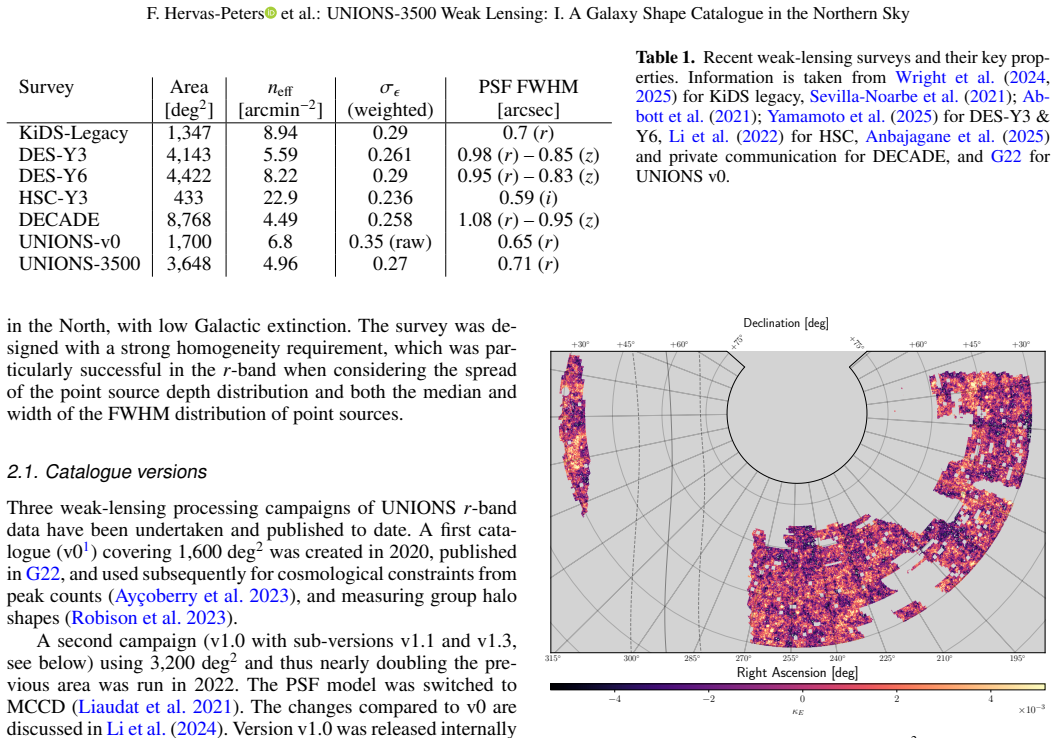
The authors establish a galaxy shape catalogue of 62 million objects over 3500 square degrees of northern sky imaging, reaching an effective source density of 4.96 arcmin^{-2} and ellipticity dispersion of 0.27 after PSF modeling and validation tests that limit contamination from instrumental effects.
What carries the argument
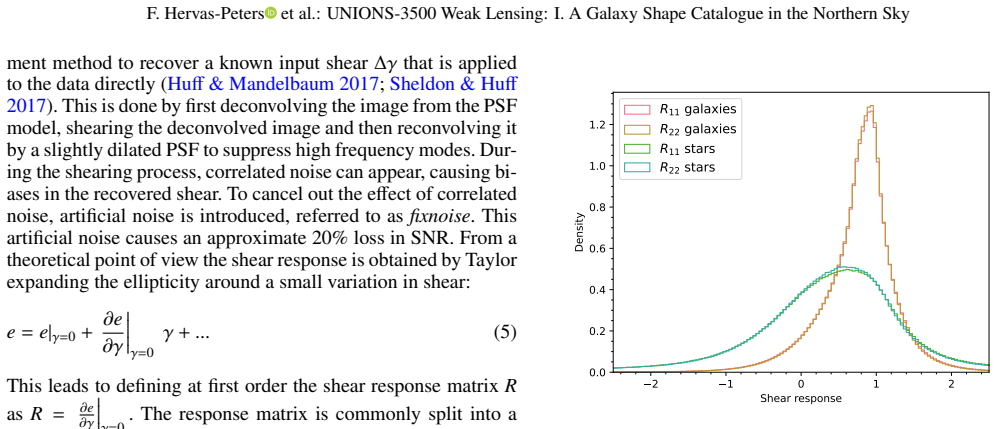
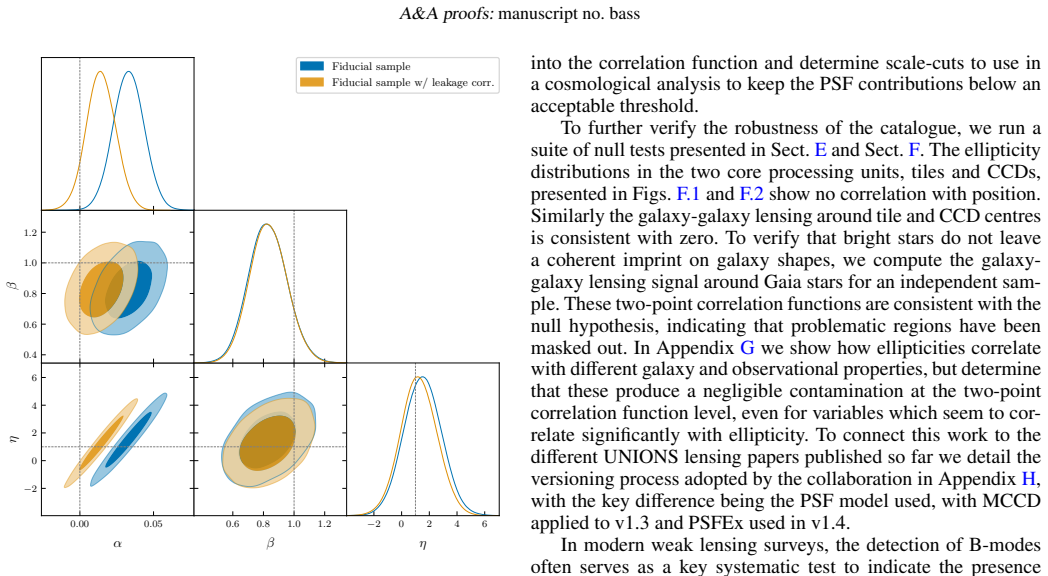
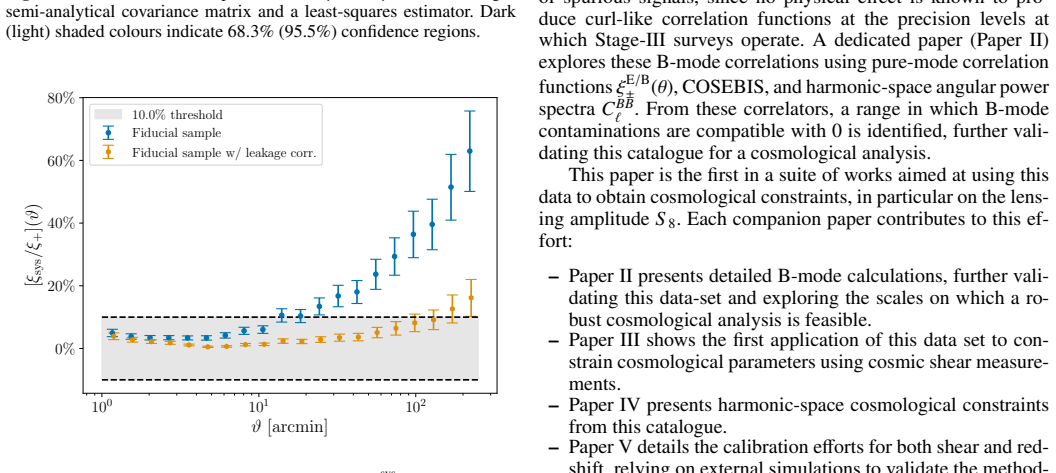
The shape measurement and PSF modeling pipeline, validated through correlation tests between galaxy ellipticities and observational variables to control systematic leakage.
If this is right
- This catalogue enables the first major cosmic shear cosmological analysis by the UNIONS collaboration.
- Companion papers can assess B-mode contamination levels and perform shear calibration using dedicated image simulations.
- Galaxy ellipticities from the catalogue can be used to measure statistical correlations that trace the dark matter distribution on large scales.
- The data set supports cosmological parameter constraints presented in both real and harmonic space.
Where Pith is reading between the lines
- The northern sky coverage could be combined with southern hemisphere lensing data to produce full-sky dark matter maps.
- The reported source density suggests the catalogue can contribute competitive constraints on cosmology if residual systematics stay below current levels.
- Future multi-band extensions of the same pipeline might refine source redshift estimates and reduce uncertainty in the lensing signal.
Load-bearing premise
The PSF modeling, shape measurement, and validation tests have successfully mitigated leakage of PSF ellipticity into galaxy shapes without introducing significant residual systematics.
What would settle it
Detection of statistically significant residual correlations between the final galaxy ellipticities and the PSF ellipticity field or other image properties such as position or proximity to bright stars.
Figures




read the original abstract
Weak gravitational lensing has become a widely used effect to characterise the dark-matter distribution on large scales in the Universe by measuring galaxy ellipticities and their statistical correlations. We present the first weak gravitational lensing catalogue for cosmic-shear cosmology of the Ultraviolet Near Infrared Optical Northern Survey (UNIONS). We analyse approximately $3\,500$ square degrees of sky area in the Northern Hemisphere, observed in the $r$-band by MegaCam on the Canada-France Hawai'i Telescope, achieving a median seeing of 0.7 arcsec. Starting from images calibrated for astrometry and photometry, we describe the steps from image processing to catalogue creation. These steps include masking, source detection and selection, star selection, point spread function (PSF) modelling, shape measurement, and calibration. We conduct extensive validation tests, particularly to assess and mitigate the leakage of PSF ellipticity into galaxy shapes. We demonstrate the robustness of the catalogue by investigating correlations between ellipticity and other observational variables as well as structural elements, such as observer-frame image positions and proximity to bright stars. The final galaxy catalogue contains $62$ million galaxies, corresponding to an effective source density of $4.96$ arcmin$^{-2}$. The ellipticity dispersion, commonly referred to as shape noise, is $\sigma_\epsilon = 0.27$. Initiating the first major cosmological analysis by the UNIONS collaboration, this is the first in a series of five papers which cover the various aspects of a robust cosmic shear analysis. Two companion papers discuss the robustness of the catalogue, one through the level of $B$-mode contamination and another by producing and analysing dedicated image simulations for shear calibration, while the other two present cosmological results in real and harmonic space.
Editorial analysis
A structured set of objections, weighed in public.
Referee Report
Summary. The paper presents the construction of the first UNIONS weak-lensing galaxy shape catalogue over ~3500 deg² in the r-band from CFHT/MegaCam imaging. It details the pipeline from calibrated images through masking, source detection, star selection, PSF modelling, shape measurement and calibration, followed by validation tests focused on mitigating PSF ellipticity leakage into galaxy shapes. The final catalogue contains 62 million galaxies at an effective source density of 4.96 arcmin^{-2} with ellipticity dispersion σ_ε = 0.27, and is positioned as the foundation for subsequent UNIONS cosmic-shear analyses in real and harmonic space.
Significance. If the PSF-leakage mitigation and other systematics controls are shown to be adequate, the catalogue supplies a large northern-sky dataset with competitive source density that can support cosmological constraints from cosmic shear. The multi-paper series structure (catalogue, B-mode tests, image simulations, and cosmology) indicates a systematic approach to the analysis.
major comments (2)
- [Validation section] Validation section (and abstract): the manuscript states that extensive correlation tests were performed against observational variables and proximity to bright stars to assess PSF leakage, yet reports no quantitative amplitudes for residual rho-statistics, no upper limits on additive or multiplicative bias, and no propagation of any residual bias into the expected shear power-spectrum uncertainty for the planned UNIONS cosmological analysis. These numbers are load-bearing for the claim that the catalogue is ready for cosmic-shear use.
- [Abstract and § on catalogue properties] The abstract and catalogue summary claim robustness after validation tests, but provide no numerical error budget, no specific metrics on residual systematics, and no direct comparison of any residual bias level against the statistical precision of the forthcoming cosmological analysis. Without these, the central usability claim cannot be evaluated from the presented material.
minor comments (2)
- [Abstract] The abstract would be strengthened by explicitly stating the quantitative catalogue properties (source density, σ_ε) in the opening summary sentence rather than only at the end.
- [Throughout] Notation for ellipticity dispersion is introduced as σ_ε but the symbol is written as σ_ε in the text; ensure consistent use of the Greek epsilon throughout.
Simulated Author's Rebuttal
We thank the referee for their careful reading of the manuscript and for highlighting the importance of quantitative validation metrics. This paper is the first in a five-paper series on the UNIONS cosmic-shear analysis, with the detailed quantitative assessments of PSF leakage, rho-statistics, bias limits, and their propagation to cosmological constraints reserved for the companion papers on B-mode tests and image simulations. We address the comments below and outline targeted revisions to improve clarity and cross-referencing without altering the paper's scope.
read point-by-point responses
-
Referee: [Validation section] Validation section (and abstract): the manuscript states that extensive correlation tests were performed against observational variables and proximity to bright stars to assess PSF leakage, yet reports no quantitative amplitudes for residual rho-statistics, no upper limits on additive or multiplicative bias, and no propagation of any residual bias into the expected shear power-spectrum uncertainty for the planned UNIONS cosmological analysis. These numbers are load-bearing for the claim that the catalogue is ready for cosmic-shear use.
Authors: We agree that quantitative amplitudes for residual rho-statistics, upper limits on additive/multiplicative bias, and their impact on the shear power spectrum are essential for assessing readiness for cosmic-shear cosmology. As this manuscript focuses on catalogue construction and the description of validation tests performed, the numerical results are presented in the companion papers (B-mode contamination and dedicated image simulations). We will revise the validation section to include explicit forward references to those papers and add a concise summary paragraph quoting the key quantitative outcomes (e.g., residual rho-statistic amplitudes below the statistical precision of the planned analysis and bias limits consistent with negligible impact on cosmological constraints). This will allow readers to evaluate the catalogue's usability directly from the series context. revision: partial
-
Referee: [Abstract and § on catalogue properties] The abstract and catalogue summary claim robustness after validation tests, but provide no numerical error budget, no specific metrics on residual systematics, and no direct comparison of any residual bias level against the statistical precision of the forthcoming cosmological analysis. Without these, the central usability claim cannot be evaluated from the presented material.
Authors: The abstract and catalogue-properties section are intentionally concise, emphasizing the pipeline and the fact that robustness is demonstrated via the full series. We will revise both to explicitly state that the numerical error budget and comparison of residual systematics to statistical precision appear in the companion papers, while adding a one-sentence summary of the main findings (residual biases well below the level that would affect the forthcoming cosmological constraints). This change preserves the paper's focus while directly addressing the referee's concern about evaluability. revision: yes
Circularity Check
No circularity: observational catalogue paper with no derivation chain
full rationale
This is a data-product paper describing image processing to produce a galaxy shape catalogue (masking, detection, PSF modelling, shape measurement, calibration, and empirical validation via correlation tests). No theoretical equations, predictions, or derivations are claimed that reduce the final catalogue statistics (62M galaxies, n_eff=4.96 arcmin^{-2}, σ_ε=0.27) to fitted inputs by construction. Validation steps are direct empirical checks on the data, not self-referential. Companion-paper citations support robustness but are not load-bearing for the catalogue creation itself. The result is the processed observations, making the chain self-contained.
Axiom & Free-Parameter Ledger
Reference graph
Works this paper leans on
-
[1]
Black-Hole-to-Halo Mass Relation From UNIONS Weak Lensing. arXiv e-prints , keywords =
-
[2]
UNIONS: The impact of systematic errors on weak-lensing peak counts. , keywords =. doi:10.1051/0004-6361/202243899 , archivePrefix =. 2204.06280 , primaryClass =
-
[3]
ShapePipe: a new shape measurement pipeline and weak-lensing application to UNIONS/CFIS data
-
[4]
The shape of dark matter haloes: results from weak lensing in the ultraviolet near-infrared optical Northern survey (UNIONS). , keywords =. doi:10.1093/mnras/stad1519 , archivePrefix =. 2209.09088 , primaryClass =
-
[5]
Multi-CCD modelling of the point spread function. , keywords =. doi:10.1051/0004-6361/202039584 , adsurl =
-
[6]
Shear measurement bias. II. A fast machine-learning calibration method. , keywords =. doi:10.1051/0004-6361/202038658 , archivePrefix =. 2006.07011 , primaryClass =
-
[7]
Weak-lensing Analysis of X-Ray-selected XXL Galaxy Groups and Clusters with Subaru HSC Data. , keywords =. doi:10.3847/1538-4357/ab6bca , archivePrefix =. 1909.10524 , primaryClass =
-
[8]
, archivePrefix = "arXiv", volume =
A highly precise shape-noise-free shear bias estimator. , archivePrefix = "arXiv", volume =
-
[9]
Shear measurement bias. I. Dependencies on methods, simulation parameters, and measured parameters. , keywords =. doi:10.1051/0004-6361/202038657 , archivePrefix =. 1707.01285 , primaryClass =
-
[10]
, archivePrefix = "arXiv", eprint =
Quantifying systematics from the shear inversion on weak-lensing peak counts. , archivePrefix = "arXiv", eprint =. doi:10.1051/0004-6361/201730872 , adsurl =
-
[11]
Astronomische Nachrichten , archivePrefix = "arXiv", eprint =
The XXL survey: First results and future. Astronomische Nachrichten , archivePrefix = "arXiv", eprint =. doi:10.1002/asna.201713352 , adsurl =
-
[12]
, archivePrefix = "arXiv", eprint =
Cosmological constraints with weak-lensing peak counts and second-order statistics in a large-field survey. , archivePrefix = "arXiv", eprint =. doi:10.1051/0004-6361/201629928 , adsurl =
-
[13]
Precision calculations of the cosmic shear power spectrum projection. , archivePrefix = "arXiv", eprint =. doi:10.1093/mnras/stx2082 , adsurl =
-
[14]
, archivePrefix = "arXiv", eprint =
Clustering-based redshift estimation: application to VIPERS/CFHTLS. , archivePrefix = "arXiv", eprint =. doi:10.1093/mnras/stw1500 , adsurl =
-
[15]
The DESI Experiment Part II: Instrument Design
The DESI Experiment Part II: Instrument Design. ArXiv:1611.00037 , archivePrefix = "arXiv", eprint =
work page internal anchor Pith review Pith/arXiv arXiv
-
[16]
The DESI Experiment Part I: Science,Targeting, and Survey Design
The DESI Experiment Part I: Science,Targeting, and Survey Design. ArXiv:1611.00036 , archivePrefix = "arXiv", eprint =
work page internal anchor Pith review Pith/arXiv arXiv
-
[17]
A new model to predict weak-lensing peak counts III. Filtering technique comparisons
A new model to predict weak-lensing peak counts III. Filtering technique comparisons. , OPTnote =. arXiv:1603.06773 , keywords =
work page internal anchor Pith review Pith/arXiv arXiv
-
[18]
The XXL Survey . IV. Mass-temperature relation of the bright cluster sample. , archivePrefix = "arXiv", eprint =
-
[19]
The XXL Survey. I. Scientific motivations - XMM-Newton observing plan - Follow-up observations and simulation programme. , archivePrefix = "arXiv", eprint =. doi:10.1051/0004-6361/201526766 , adsurl =
-
[20]
Systematic errors in shear estimation and the impact of real galaxy morphology
GREAT3 results - I. Systematic errors in shear estimation and the impact of real galaxy morphology. , archivePrefix = "arXiv", eprint =. 2015 , month = jul, volume = 450, pages =. doi:10.1093/mnras/stv781 , adsurl =
-
[21]
, archivePrefix = "arXiv", eprint =
Probing the galaxy-halo connection in UltraVISTA to z 2. , archivePrefix = "arXiv", eprint =. doi:10.1093/mnras/stv305 , adsurl =
-
[22]
Cosmology with Cosmic Shear Observations: A Review , shorttitle =
Cosmology with cosmic shear observations: a review. Reports on Progress in Physics , archivePrefix = "arXiv", eprint =. doi:10.1088/0034-4885/78/8/086901 , adsurl =
-
[23]
A new model to predict weak-lensing peak counts. II. Parameter constraint strategies. , archivePrefix = "arXiv", eprint =. doi:10.1051/0004-6361/201526659 , adsurl =
-
[24]
A new model to predict weak-lensing peak counts. I. Comparison with N-body simulations. , archivePrefix = "arXiv", eprint =. doi:10.1051/0004-6361/201425188 , adsurl =
-
[25]
, archivePrefix = "arXiv", eprint =
Clustering, host halos, and environment of z \ 2 galaxies as a function of their physical properties. , archivePrefix = "arXiv", eprint =. doi:10.1051/0004-6361/201423451 , adsurl =
-
[26]
, archivePrefix = "arXiv", eprint =
Tomography and weak lensing statistics. , archivePrefix = "arXiv", eprint =. doi:10.1088/1475-7516/2014/04/004 , adsurl =
-
[27]
, archivePrefix = "arXiv", eprint =
Measurement of the Halo Bias from Stacked Shear Profiles of Galaxy Clusters. , archivePrefix = "arXiv", eprint =. doi:10.1088/2041-8205/784/2/L25 , adsurl =
-
[28]
, archivePrefix = "arXiv", eprint =
Evolution of hierarchical clustering in the CFHTLS-Wide since z 1. , archivePrefix = "arXiv", eprint =. doi:10.1093/mnras/stt1111 , adsurl =
-
[29]
, archivePrefix = "arXiv", eprint =
Improved primordial non-Gaussianity constraints from measurements of galaxy clustering and the integrated Sachs-Wolfe effect. , archivePrefix = "arXiv", eprint =. doi:10.1103/PhysRevD.89.023511 , adsurl =
-
[30]
, archivePrefix = "arXiv", eprint =
Image Analysis for Cosmology: Results from the GREAT10 Star Challenge. , archivePrefix = "arXiv", eprint =. 2013 , month = apr, volume = 205, eid =. doi:10.1088/0067-0049/205/2/12 , adsurl =
-
[31]
, archivePrefix = "arXiv", eprint =
On the validity of cosmological Fisher matrix forecasts. , archivePrefix = "arXiv", eprint =. doi:10.1088/1475-7516/2012/09/009 , adsurl =
-
[32]
, archivePrefix = "arXiv", eprint =
Galaxy clustering in the CFHTLS-Wide: the changing relationship between galaxies and haloes since z 1.2. , archivePrefix = "arXiv", eprint =. doi:10.1051/0004-6361/201117625 , adsurl =
-
[33]
Fu, L. and Huang, Z. and Kilbinger, M. and Radovich, M. and Grado, A. and Puddu, E. and Shu, C. and Huang, J.-S. , title =. Submitted to , year =
-
[34]
2010, MNRAS, 408, 2115, doi: 10.1111/j.1365-2966.2010.17291.x
The massive galaxy cluster XMMU J1230.3+1339 at z \ 1: colour-magnitude relation, Butcher-Oemler effect, X-ray and weak lensing mass estimates. , archivePrefix = "arXiv", eprint =. doi:10.1111/j.1365-2966.2010.17874.x , adsurl =
-
[35]
, archivePrefix = "arXiv", eprint =
Fitting formulae of the reduced-shear power spectrum for weak lensing. , archivePrefix = "arXiv", eprint =. doi:10.1051/0004-6361/201014829 , adsurl =
-
[36]
2010, MNRAS, 408, 2115, doi: 10.1111/j.1365-2966.2010.17291.x
Photometric redshifts: estimating their contamination and distribution using clustering information. , archivePrefix = "arXiv", eprint =. doi:10.1111/j.1365-2966.2010.17191.x , adsurl =
-
[37]
2010, MNRAS, 408, 2115, doi: 10.1111/j.1365-2966.2010.17291.x
Bayesian model comparison in cosmology with Population Monte Carlo. , archivePrefix = "arXiv", eprint =. doi:10.1111/j.1365-2966.2010.16605.x , adsurl =
-
[38]
, archivePrefix = "arXiv", eprint =
Evidence of the accelerated expansion of the Universe from weak lensing tomography with COSMOS. , archivePrefix = "arXiv", eprint =. doi:10.1051/0004-6361/200913577 , adsurl =
-
[39]
, archivePrefix = "arXiv", keywords =
A new cosmic shear function: Optimised E-/B-mode decomposition on a finite interval. , archivePrefix = "arXiv", keywords =
-
[40]
2010, MNRAS, 408, 2115, doi: 10.1111/j.1365-2966.2010.17291.x
On the impact of intergalactic dust on cosmology with Type Ia supernovae. , archivePrefix = "arXiv", eprint =. doi:10.1111/j.1365-2966.2010.16464.x , adsurl =
- [41]
-
[42]
Estimation of cosmological parameters using adaptive importance sampling. , OPTeprint =
-
[43]
, archivePrefix = "arXiv", eprint =
Dark-energy constraints and correlations with systematics from CFHTLS weak lensing, SNLS supernovae Ia and WMAP5. , archivePrefix = "arXiv", eprint =. doi:10.1051/0004-6361/200811247 , adsurl =
-
[44]
Tereno, I. and Schimd, C. and Uzan, J.-P. and Kilbinger, M. and Vincent, F. and Fu, L. , title = ". , OPTnote =
-
[45]
Testing Gravity with the CFHTLS-Wide Cosmic Shear Survey and SDSS LRGs
Testing Gravity with the CFHTLS-Wide Cosmic Shear Survey and SDSS LRGs. Submitted to , note =. 0712.1599 , year = 2008, OPTmonth = dec, OPTvolume = 712, adsurl =
work page internal anchor Pith review Pith/arXiv arXiv 2008
-
[46]
, archivePrefix = "arXiv", eprint =
Very weak lensing in the CFHTLS wide: cosmology from cosmic shear in the linear regime. , archivePrefix = "arXiv", eprint =. doi:10.1051/0004-6361:20078522 , adsurl =
-
[47]
Optimizing the information content of cosmic shear data vectors
Comparing cosmic shear measures. Optimizing the information content of cosmic shear data vectors. , eprint =. doi:10.1051/0004-6361:20078573 , adsurl =
-
[48]
The ring statistics - how to separate E- and B-modes of cosmic shear correlation functions on a finite interval. , eprint =. doi:10.1051/0004-6361:20065532 , adsurl =
-
[49]
E- and B-mode mixing from incomplete knowledge of the shear correlation. , eprint =. doi:10.1051/0004-6361:20065495 , adsurl =
-
[50]
Principal component analysis of weak lensing surveys. , eprint =. doi:10.1051/0004-6361:20054586 , adsurl =
-
[51]
doi:10.1111/j.1365-2966.2005.09360.x , eprint =
Designing weak lensing surveys: a generalized eigenmode analysis. , eprint =. doi:10.1111/j.1365-2966.2005.09857.x , adsurl =
-
[52]
Kilbinger, M. and Schneider, P. , title =. , year = 2005, volume = 442, pages =
work page 2005
-
[53]
Schneider, P. and Kilbinger, M. and Lombardi, M. , title =. , year = 2005, volume =
work page 2005
-
[54]
, year = 2004, OPTmonth = jul, volume = 422, pages =
Stellar activity and magnetism studied by optical interferometry. , year = 2004, OPTmonth = jul, volume = 422, pages =. doi:10.1051/0004-6361:20040151 , adsurl =
-
[55]
Kilbinger, M. and Schneider, P. , title =. , year = 2004, volume = 413, pages =
work page 2004
-
[56]
Schneider, P. and Van Waerbeke, L. and Kilbinger, M. and Mellier, Y. , title =. , year = 2002, volume = 396, pages =
work page 2002
- [57]
-
[58]
Camelus: Counts of Amplified Mass Elevations from Lensing with Ultrafast Simulations. ascl:1502.015 , adsurl =
-
[59]
ascl:1402.026 , month = feb, adsurl =
athena: Tree code for second-order correlation functions. ascl:1402.026 , month = feb, adsurl =
-
[60]
ascl:1212.006 , month = dec, adsurl =
CosmoPMC: Cosmology sampling with Population Monte Carlo. ascl:1212.006 , month = dec, adsurl =
-
[61]
Modeling, Systems Engineering, and Project Management for Astronomy VI , year = 2016, series =
Mission-level performance verification approach for the Euclid space mission. Modeling, Systems Engineering, and Project Management for Astronomy VI , year = 2016, series =. doi:10.1117/12.2233015 , adsurl =
-
[62]
American Astronomical Society Meeting Abstracts , year = 2017, series =
Cosmological constraints with weak lensing peak counts and second-order statistics in a large-field survey. American Astronomical Society Meeting Abstracts , year = 2017, series =
work page 2017
-
[63]
Statistical Challenges in 21st Century Cosmology , year = 2014, series =
A New Model to Predict Weak Lensing Peak Counts. Statistical Challenges in 21st Century Cosmology , year = 2014, series =. doi:10.1017/S1743921314013477 , adsurl =
-
[64]
American Astronomical Society Meeting Abstracts , year = 2012, series =
Cosmological Constraints from Cosmic Shear in CFHTLenS. American Astronomical Society Meeting Abstracts , year = 2012, series =
work page 2012
-
[65]
Galaxy Evolution: Infrared to Millimeter Wavelength Perspective , year = 2011, series =
Decomposition of Cosmic Shear E-/B-Mode on a Finite Interval. Galaxy Evolution: Infrared to Millimeter Wavelength Perspective , year = 2011, series =
work page 2011
-
[66]
Galaxy Evolution: Infrared to Millimeter Wavelength Perspective , year = 2011, series =
The Application of the Multi-Dimensional Clustering Algorithm in the Field of Abell 383. Galaxy Evolution: Infrared to Millimeter Wavelength Perspective , year = 2011, series =
work page 2011
-
[67]
CosmoPMC: Cosmology Population Monte Carlo
CosmoPMC: Cosmology Population Monte Carlo. arXiv:1101.0950 , archivePrefix = "arXiv", eprint =
work page internal anchor Pith review Pith/arXiv arXiv
- [68]
-
[69]
Third-Order Aperture Mass Statistics of Cosmic Shear. IAU Symposium 225 -- Impact of Gravitational Lensing on Cosmology , year = 2005, OPTmonth = jun, pages =. doi:10.1017/S1743921305001845 , adsurl =
-
[70]
Interferometry for Optical Astronomy II
Mapping abundance inhomogeneities and magnetic fields of chemically peculiar (CP) stars with optical aperture synthesis arrays. Interferometry for Optical Astronomy II. Edited by Wesley A. Traub. Proceedings of the SPIE, Volume 4838 , year = 2003, OPTmonth = feb, pages =
work page 2003
-
[71]
Simulation of Interfero-Polarimetric Observations for Magnetic Stars , booktitle =
-
[72]
Kilbinger, M. and Rousselet-Perraut, K. and Stehl\'e, C. , title =
-
[73]
VizieR Online Data Catalog , keywords =
VizieR Online Data Catalog: XXL Survey: First results (Pierre+, 2016). VizieR Online Data Catalog , keywords =
work page 2016
-
[75]
Euclid: The importance of galaxy clustering and weak lensing cross-correlations within the photometric Euclid survey. , keywords =. doi:10.1051/0004-6361/202038313 , archivePrefix =. 2005.00055 , primaryClass =
-
[76]
Euclid: Forecast constraints on the cosmic distance duality relation with complementary external probes. , keywords =. doi:10.1051/0004-6361/202039078 , archivePrefix =. 2007.16153 , primaryClass =
-
[77]
Euclid: Forecasts for k -cut 3 2 Point Statistics. arXiv e-prints , keywords =
-
[78]
Euclid: The reduced shear approximation and magnification bias for Stage IV cosmic shear experiments. , keywords =. doi:10.1051/0004-6361/201937323 , archivePrefix =. 1912.07326 , primaryClass =
-
[79]
Euclid preparation. X. The Euclid photometric-redshift challenge. , keywords =. doi:10.1051/0004-6361/202039403 , archivePrefix =. 2009.12112 , primaryClass =
-
[80]
Euclid preparation. VIII. The Complete Calibration of the Colour-Redshift Relation survey: VLT/KMOS observations and data release. , keywords =. doi:10.1051/0004-6361/202038334 , archivePrefix =. 2007.02631 , primaryClass =
-
[81]
Euclid preparation. VII. Forecast validation for Euclid cosmological probes. , keywords =. doi:10.1051/0004-6361/202038071 , archivePrefix =. 1910.09273 , primaryClass =
discussion (0)
Sign in with ORCID, Apple, or X to comment. Anyone can read and Pith papers without signing in.