Recognition: unknown
Probing Floquet topological phases via non-Hermitian skin effect of reflected waves
Pith reviewed 2026-05-14 18:18 UTC · model grok-4.3
The pith
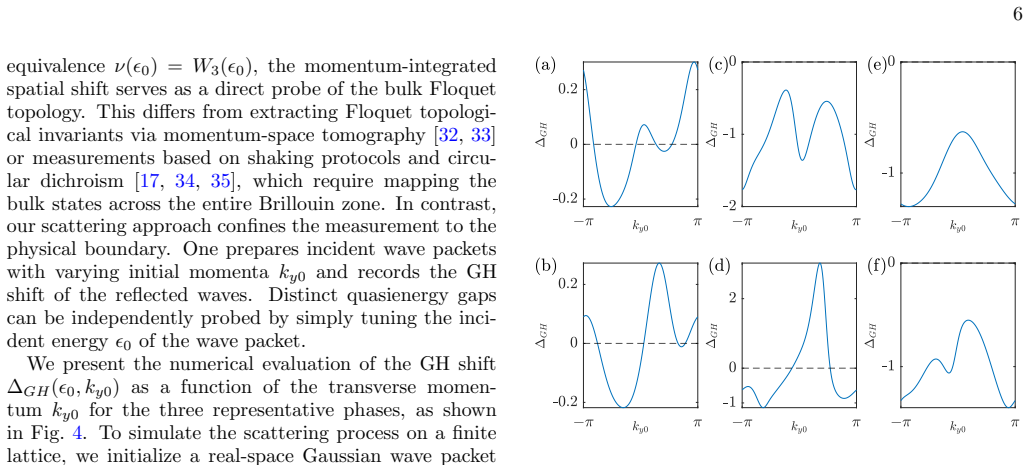
The momentum-integrated Goos-Hänchen shift of reflected waves equals the Floquet topological invariant for each quasienergy gap.
A machine-rendered reading of the paper's core claim, the machinery that carries it, and where it could break.
Core claim
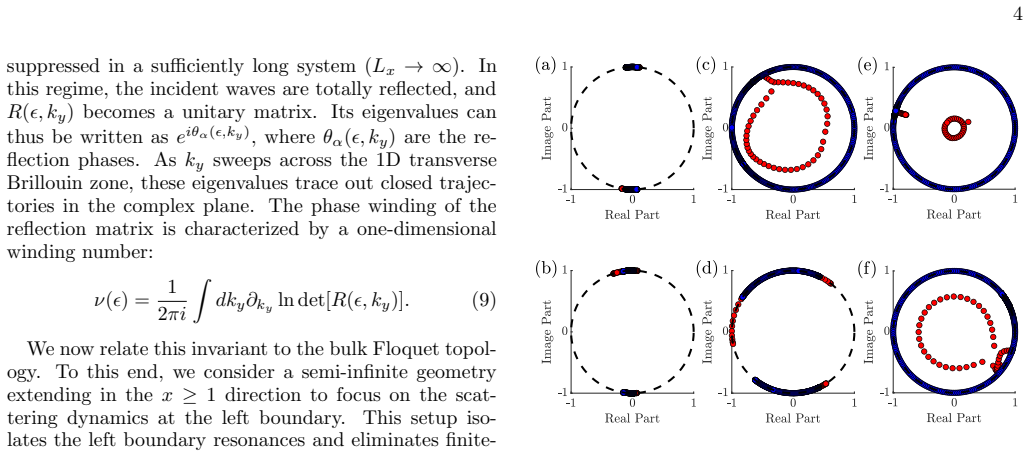
In the scattering problem of a Floquet Chern insulator, the reflection matrix acquires a non-Hermitian skin effect whose winding number is linked to the bulk Floquet invariant via boundary resonances in the discrete-time formalism. This linkage produces a gap-dependent Goos-Hänchen shift of the reflected waves, so that the momentum-integrated shift directly equals the Floquet topological invariant of the corresponding gap.
What carries the argument
The non-Hermitian winding number of the reflection matrix, which encodes the skin effect of reflected waves and connects to the bulk invariant through boundary resonances.
If this is right
- The reflected waves localize at the boundary in a manner controlled by the gap of the incident wave.
- The Goos-Hänchen shift provides a quantitative, real-space probe of the Floquet invariant without direct bulk measurement.
- The effect distinguishes anomalous Floquet phases that lack static counterparts.
- The shift is frequency-dependent, allowing separate readout for each quasienergy gap.
Where Pith is reading between the lines
- Similar scattering signatures may appear in other time-periodic systems once a discrete-time formulation is applied.
- Optical beam experiments could extract topology in driven lattices where momentum-space tomography is impractical.
- The boundary-resonance mechanism suggests testable extensions to continuous driving protocols by suitable stroboscopic sampling.
Load-bearing premise
The non-Hermitian winding number of the reflection matrix remains linked to the bulk Floquet invariant through boundary resonances in the discrete-time scattering formalism.
What would settle it
Compute the momentum-integrated Goos-Hänchen shift for a known Floquet model such as a driven honeycomb lattice and check whether it numerically equals the independently calculated bulk Floquet Chern number for each gap.
Figures


read the original abstract
Periodically driven systems host topological phases without static analogs, such as the anomalous Floquet phase characterized by trivial bulk bands yet robust boundary modes. In this work, we investigate the scattering problem of a Floquet Chern insulator and reveal the non-Hermitian skin effect (NHSE) of reflected waves. Using a discrete-time scattering formalism, we demonstrate how the non-Hermitian winding number of the reflection matrix is linked to the bulk Floquet invariant via boundary resonances. This reflected-wave NHSE relies on which quasienergy gap the incident wave resides in, leading to a gap-dependent Goos-H\"anchen (GH) shift. We further show that the momentum-integrated GH shift quantitatively yields the Floquet topological invariant of the corresponding gap. Our work highlights a frequency-dependent NHSE of reflected waves in driven systems and provides a real-space scattering approach to identify non-equilibrium topology.
Editorial analysis
A structured set of objections, weighed in public.
Referee Report
Summary. The manuscript investigates the scattering problem for a Floquet Chern insulator and reports that the non-Hermitian skin effect of reflected waves, analyzed via a discrete-time scattering formalism, links the non-Hermitian winding number of the reflection matrix to the bulk Floquet invariant through boundary resonances. It further asserts that this leads to a gap-dependent Goos-Hänchen shift whose momentum integral quantitatively equals the Floquet topological invariant of the corresponding gap, providing a real-space probe of non-equilibrium topology.
Significance. If the quantitative equality between the integrated GH shift and the Floquet invariant is rigorously established, the result supplies a concrete scattering-based diagnostic for anomalous Floquet phases that is distinct from conventional bulk or edge-state probes. The frequency dependence of the reflected-wave NHSE adds a new observable layer to studies of driven topological systems and could be relevant for microwave or optical experiments on periodically modulated lattices.
major comments (2)
- [§3] §3 (discrete-time scattering formalism): the asserted equality between the non-Hermitian winding number of the reflection matrix and the bulk Floquet invariant is presented as following directly from boundary resonances, yet the derivation does not explicitly demonstrate that each resonance pole contributes precisely one unit of winding without residual quasienergy-dependent phase factors or corrections arising from the finite driving period.
- [§4] §4 (GH shift and topological invariant): the claim that the momentum-integrated GH shift quantitatively reproduces the integer Floquet invariant rests on the winding-number link; no error analysis, finite-size scaling, or direct numerical comparison against independently computed invariants is provided to confirm exactness rather than approximate agreement.
minor comments (2)
- Notation for the reflection matrix and its winding number should be introduced with an explicit definition (e.g., Eq. (X)) before being used in the main claims.
- Figure captions for the GH-shift plots should state the system size, driving period, and quasienergy window used, to allow direct reproduction of the integrated values.
Simulated Author's Rebuttal
We thank the referee for the careful reading of our manuscript and the constructive comments. We address each major point below and have revised the manuscript to incorporate clarifications and additional evidence.
read point-by-point responses
-
Referee: §3 (discrete-time scattering formalism): the asserted equality between the non-Hermitian winding number of the reflection matrix and the bulk Floquet invariant is presented as following directly from boundary resonances, yet the derivation does not explicitly demonstrate that each resonance pole contributes precisely one unit of winding without residual quasienergy-dependent phase factors or corrections arising from the finite driving period.
Authors: We thank the referee for highlighting this point. We agree that the derivation in §3 would benefit from greater explicitness. In the revised manuscript we will expand the discussion to include a step-by-step residue calculation showing that each boundary resonance contributes exactly one unit of winding. Because the scattering matrix is defined stroboscopically, the quasienergy-dependent phase factors associated with the finite driving period cancel identically in the contour integral that defines the winding number; this cancellation follows directly from the periodicity of the Floquet operator and the topological bulk-boundary correspondence. The revised text will contain this explicit demonstration together with an appendix containing the full algebraic details. revision: yes
-
Referee: §4 (GH shift and topological invariant): the claim that the momentum-integrated GH shift quantitatively reproduces the integer Floquet invariant rests on the winding-number link; no error analysis, finite-size scaling, or direct numerical comparison against independently computed invariants is provided to confirm exactness rather than approximate agreement.
Authors: We agree that additional numerical verification strengthens the quantitative claim. In the revision we will augment §4 with (i) finite-size scaling plots of the momentum-integrated GH shift demonstrating convergence to the exact integer value of the Floquet invariant, (ii) a direct side-by-side comparison of the integrated GH shift against the bulk Floquet invariant computed independently from the quasienergy bands, and (iii) an error analysis that quantifies the effect of finite momentum sampling and system size. These additions will confirm that the equality is exact within numerical precision rather than merely approximate. revision: yes
Circularity Check
No significant circularity: derivation chain is self-contained via discrete-time scattering formalism
full rationale
The paper establishes the link between non-Hermitian winding number of the reflection matrix and bulk Floquet invariant through boundary resonances in the discrete-time scattering formalism, then derives the gap-dependent GH shift and shows that its momentum-integrated value equals the topological invariant. No quoted step reduces a prediction to a fitted input by construction, nor relies on self-citation load-bearing or ansatz smuggling; the formalism supplies independent content that is not tautological with the target result. The quantitative equality follows from the derived winding number rather than being presupposed.
Axiom & Free-Parameter Ledger
axioms (1)
- domain assumption Discrete-time scattering formalism applies to Floquet systems and correctly captures boundary resonances
Reference graph
Works this paper leans on
- [1]
-
[2]
Eckardt, Colloquium: Atomic quantum gases in pe- riodically driven optical lattices, Rev
A. Eckardt, Colloquium: Atomic quantum gases in pe- riodically driven optical lattices, Rev. Mod. Phys.89, 011004 (2017)
work page 2017
- [3]
- [4]
-
[5]
T. Kitagawa, E. Berg, M. Rudner, and E. Demler, Topo- logical phases of periodically driven systems, Phys. Rev. B82, 235114 (2010)
work page 2010
-
[6]
N. H. Lindner, G. Refael, and V. Galitski, Floquet topo- logical insulator in semiconductor quantum wells, Nat. Phys.7, 490 (2011)
work page 2011
- [7]
-
[8]
J. Cayssol, B. Dora, F. Simon, and R. Moessner, Floquet Topological Insulators, Phys. Status Solidi RRL7, 101 (2013)
work page 2013
-
[9]
N. Goldman and J. Dalibard, Periodically Driven Quan- tum Systems: Effective Hamiltonians and Engineered Gauge Fields, Phys. Rev. X4, 031027 (2014)
work page 2014
-
[10]
G. Usaj, P. M. Perez-Piskunow, L. E. F. Foa Torres, and C. A. Balseiro, Irradiated graphene as a tunable Floquet topological insulator, Phys. Rev. B90, 115423 (2014)
work page 2014
-
[11]
Y. H. Wang, H. Steinberg, P. Jarillo-Herrero, and N. Gedik, Observation of Floquet-Bloch States on the Sur- face of a Topological Insulator, Science342, 453 (2013)
work page 2013
-
[12]
J. W. McIver, B. Schulte, F.-U. Stein, T. Matsuyama, G. Jotzu, G. Meier, and A. Cavalleri, Light-induced anoma- lous Hall effect in graphene, Nat. Phys.16, 38 (2020)
work page 2020
-
[13]
P. Roushan et al., Chiral ground-state currents of inter- acting photons in a synthetic magnetic field, Nat. Phys. 13, 146 (2017)
work page 2017
-
[14]
Y.-G. Peng, C.-Z. Qin, D.-G. Zhao, Y.-X. Shen, X.-Y. Xu, M. Bao, H. Jia, and X.-F. Zhu, Experimental demon- stration of anomalous Floquet topological insulator for sound, Nat. Commun.7, 13368 (2016)
work page 2016
-
[15]
G. Jotzu et al., Experimental realization of the topologi- cal Haldane model with ultracold fermions, Nature515, 237 (2014)
work page 2014
-
[16]
M. Aidelsburger, M. Lohse, C. Schweizer, M. Atala, J. T. Barreiro, S. Nascimb` ene, N. R. Cooper, I. Bloch, and N. Goldman, Measuring the Chern number of Hofstadter bands with ultracold bosonic atoms, Nat. Phys.11, 162 (2015)
work page 2015
-
[17]
K. Wintersperger et al., Realization of an anomalous Flo- quet topological system with ultracold atoms, Nat. Phys. 16, 1058 (2020)
work page 2020
-
[18]
M. C. Rechtsman et al., Photonic Floquet topological insulators, Nature496, 196 (2013)
work page 2013
-
[19]
L. J. Maczewsky et al., Observation of photonic anoma- lous Floquet topological insulators, Nat. Commun.8, 13756 (2017)
work page 2017
-
[20]
S. Mukherjee, A. Spracklen, M. Valiente, E. Andersson, P. ¨Ohberg, N. Goldman, and R. R. Thomson, Experimen- tal observation of anomalous topological edge modes in a slowly driven photonic lattice, Nat. Commun.8, 13918 (2017)
work page 2017
-
[21]
M. S. Rudner, N. H. Lindner, G. Refael, and V. Galitski, Anomalous Edge States and the Bulk-Edge Correspon- dence for Periodically Driven 2D Systems, Phys. Rev. X 3, 031005 (2013)
work page 2013
- [22]
- [23]
-
[24]
S. Yao, Z. Yan, and Z. Wang, Topological invariants of Floquet systems: General formulation, special proper- ties, and Floquet topological defects, Phys. Rev. B96, 195303 (2017)
work page 2017
-
[25]
F. Nathan and M. S. Rudner, Topological singularities and the general classification of Floquet-Bloch systems, New J. Phys.17, 125014 (2015)
work page 2015
-
[26]
D. Carpentier, P. Delplace, M. Fruchart, and K. Gawedzki, Topological Index for Periodically Driven Time-Reversal Invariant 2D Systems, Phys. Rev. Lett. 114, 106806 (2015)
work page 2015
-
[27]
T. Morimoto, H. C. Po, and A. Vishwanath, Floquet topological phases protected by time glide symmetry, Phys. Rev. B95, 195155 (2017)
work page 2017
-
[28]
H. Hu, B. Huang, E. Zhao, and W. V. Liu, Dynamical Singularities of Floquet Higher-Order Topological Insu- lators, Phys. Rev. Lett.124, 057001 (2020)
work page 2020
-
[29]
B. Huang and W. V. Liu, Floquet Higher-Order Topolog- ical Insulators with Anomalous Dynamical Polarization, Physical Review Letters124, 216601 (2020)
work page 2020
-
[30]
J. K. Asb´ oth, B. Tarasinski, and P. Delplace, Chiral sym- metry and bulk-boundary correspondence in periodically driven one-dimensional systems, Phys. Rev. B90, 125143 (2014)
work page 2014
-
[31]
Fruchart, Complex classes of Floquet topological in- sulators, Phys
M. Fruchart, Complex classes of Floquet topological in- sulators, Phys. Rev. B93, 115429 (2016)
work page 2016
- [32]
-
[33]
N. Fl¨ aschner et al., Experimental reconstruction of the Berry curvature in a Floquet Bloch band, Science352, 1091 (2016)
work page 2016
-
[34]
F. N. ¨Unal, B. Seradjeh, and A. Eckardt, How to Di- rectly Measure Floquet Topological Invariants in Optical Lattices, Phys. Rev. Lett.122, 253601 (2019)
work page 2019
-
[35]
L. Asteria, D. T. Tran, T. Ozawa, M. Tarnowski, B. S. Rem, N. Fl¨ aschner, K. Sengstock, N. Goldman, and C. Weitenberg, Measuring quantized circular dichroism in ultracold topological matter, Nat. Phys.15, 449 (2019)
work page 2019
-
[36]
I. C. Fulga, F. Hassler, and A. R. Akhmerov, Scatter- ing theory of topological insulators and superconductors, Phys. Rev. B85, 165409 (2012)
work page 2012
- [37]
- [38]
-
[39]
V. M. Martinez Alvarez, J. E. Barrios Vargas, and L. E. F. Foa Torres, Non-Hermitian robust edge states in one dimension: Anomalous localization and eigenspace condensation at exceptional points, Phys. Rev. B97, 121401(R) (2018)
work page 2018
-
[40]
K. Yokomizo and S. Murakami, Non-Bloch Band Theory of Non-Hermitian Systems, Phys. Rev. Lett.123, 066404 (2019)
work page 2019
-
[41]
C. H. Lee and R. Thomale, Anatomy of skin modes and topology in non-Hermitian systems, Phys. Rev. B99, 201103(R) (2019)
work page 2019
- [42]
- [43]
-
[44]
F. K. Kunst, E. Edvardsson, J. C. Budich, and E. J. Bergholtz, Biorthogonal Bulk-Boundary Correspondence in Non-Hermitian Systems, Phys. Rev. Lett.121, 026808 (2018)
work page 2018
-
[45]
D. S. Borgnia, A. J. Kruchkov, and R.-J. Slager, Non- Hermitian Boundary Modes and Topology, Phys. Rev. Lett.124, 056802 (2020)
work page 2020
-
[46]
H. Hu, Topological origin of non-Hermitian skin effect in higher dimensions and uniform spectra, Science Bulletin 70, 51 (2025)
work page 2025
-
[47]
H. Ma, C. Ju, X. Xi, and R.-X. Wu, Nonreciprocal Goos- H¨ anchen shift by topological edge states of a magnetic photonic crystal, Opt. Express28, 19916 (2020)
work page 2020
-
[48]
I. C. Fulga and M. Maksymenko, Scattering matrix in- variants of Floquet topological insulators, Phys. Rev. B 93, 075405 (2016)
work page 2016
-
[49]
J. T. Chalker and P. D. Coddington, Percolation, quan- tum tunnelling and the integer Hall effect, J. Phys. C: Solid State Phys.21, 2665 (1988)
work page 1988
-
[50]
Tajic, Study of a stroboscopic model of a quantum dot, Ph.D
A. Tajic, Study of a stroboscopic model of a quantum dot, Ph.D. thesis, Leiden University (2005)
work page 2005
-
[51]
Z. Gong, Y. Ashida, K. Kawabata, K. Takasan, S. Hi- gashikawa, and M. Ueda, Topological Phases of Non- Hermitian Systems, Phys. Rev. X8, 031079 (2018)
work page 2018
-
[52]
K. Kawabata, K. Shiozaki, M. Ueda, and M. Sato, Sym- metry and Topology in Non-Hermitian Physics, Phys. Rev. X9, 041015 (2019)
work page 2019
-
[53]
C. W. J. Beenakker, R. A. Sepkhanov, A. R. Akhmerov, and J. Tworzyd lo, Quantum Goos-H¨ anchen Effect in Graphene, Phys. Rev. Lett.102, 146804 (2009)
work page 2009
-
[54]
K. Y. Bliokh and A. Aiello, Goos-H¨ anchen and Imbert- Fedorov beam shifts: An overview, J. Opt.15, 014001 (2013)
work page 2013
-
[55]
J. M. Zeuner, M. C. Rechtsman, Y. Plotnik, Y. Lumer, S. Nolte, M. S. Segev, and A. Szameit, Observation of a Topological Transition in the Bulk of a Non-Hermitian System, Phys. Rev. Lett.115, 040402 (2015)
work page 2015
- [56]
- [57]
discussion (0)
Sign in with ORCID, Apple, or X to comment. Anyone can read and Pith papers without signing in.