Recognition: unknown
Joint Segment Activation and Antenna Placement for Uplink SWAN Systems
Pith reviewed 2026-05-14 18:03 UTC · model grok-4.3
The pith
Derives an upper bound on sum-rate for uplink SWANs establishing an optimal segment activation level and shows proposed hybrid schemes outperform full-segment aggregation via numerical results.
A machine-rendered reading of the paper's core claim, the machinery that carries it, and where it could break.
Core claim
An upper bound on the achievable sum-rate is derived, based on which the existence of an optimal segment activation level is theoretically established, and the proposed HSS/A schemes outperform conventional full-segment aggregation.
Load-bearing premise
The upper bound derivation and optimality result rely on idealized channel models and interference assumptions typical for SWAN systems that may not capture real-world propagation effects or hardware imperfections.
Figures




read the original abstract
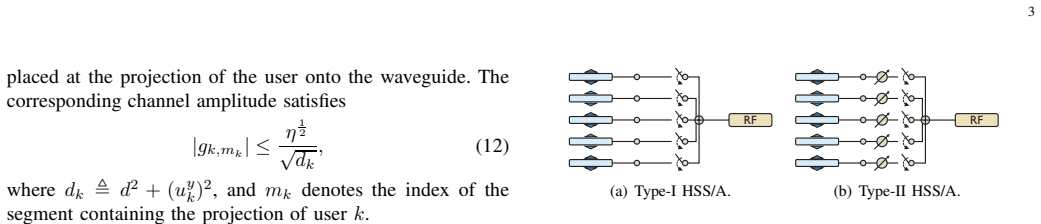
This article analyzes the achievable sum-rate of multiuser uplink segmented waveguide-enabled pinching-antenna systems (SWANs). To unveil system-design insights, an upper bound on the achievable sum-rate is derived, based on which the existence of an optimal segment activation level is theoretically established. Motivated by this result, hybrid segment selection and aggregation (HSS/A) schemes are proposed to jointly optimize segment activation and pinching-antenna (PA) placement. Correspondingly, low-complexity greedy algorithms are developed for the considered optimization problem. Numerical results validate the theoretical analysis and demonstrate that the proposed HSS/A schemes outperform conventional full-segment aggregation.
Editorial analysis
A structured set of objections, weighed in public.
Referee Report
Summary. The paper analyzes the achievable sum-rate of multiuser uplink segmented waveguide-enabled pinching-antenna systems (SWANs). It derives an upper bound on the sum-rate to establish the existence of an optimal segment activation level, proposes hybrid segment selection and aggregation (HSS/A) schemes for joint optimization of segment activation and pinching-antenna placement, develops low-complexity greedy algorithms, and shows via numerical results that the schemes outperform conventional full-segment aggregation.
Significance. If the upper bound and optimality result hold under the stated assumptions, the work supplies concrete design guidelines for segment activation in SWAN systems and practical algorithms that improve uplink sum-rate. The combination of a theoretical bound with low-complexity optimization and numerical validation strengthens the contribution for researchers working on waveguide-based antenna architectures.
major comments (2)
- [§III, Eq. (12)] §III, Eq. (12): the upper bound derivation invokes an idealized interference model that treats inter-segment leakage as negligible; this assumption is load-bearing for the subsequent optimality proof of the segment activation level, yet no sensitivity analysis is provided when leakage is non-zero.
- [§IV-B, Algorithm 1] §IV-B, Algorithm 1: the greedy HSS/A procedure selects segments and PA locations sequentially without backtracking; the claimed optimality gap relative to exhaustive search is only illustrated for N=4 users, which is insufficient to support the general performance claim.
minor comments (2)
- [Table II] Table II: the complexity order O(K M log M) is stated without specifying how M (number of candidate PA positions) scales with the waveguide length, making direct comparison to full-segment aggregation unclear.
- [Fig. 3] Fig. 3 caption: the legend labels “HSS/A-1” and “HSS/A-2” but the text does not define the difference between the two variants.
Simulated Author's Rebuttal
We thank the referee for the constructive feedback on our manuscript arXiv:2605.13580. We address each major comment point by point below, providing honest responses and indicating revisions where appropriate to strengthen the presentation.
read point-by-point responses
-
Referee: [§III, Eq. (12)] §III, Eq. (12): the upper bound derivation invokes an idealized interference model that treats inter-segment leakage as negligible; this assumption is load-bearing for the subsequent optimality proof of the segment activation level, yet no sensitivity analysis is provided when leakage is non-zero.
Authors: The upper bound in Eq. (12) is explicitly derived under the assumption of negligible inter-segment leakage, which is stated in Section III to enable a tractable analysis establishing the existence of an optimal segment activation level. This idealized model is common in initial theoretical studies of waveguide systems to isolate the core design insight. We agree that a sensitivity analysis would enhance the result's robustness. In the revised manuscript, we will add a new subsection with numerical evaluations showing how the bound and optimality conclusion degrade under increasing leakage levels (parameterized by isolation factors), thereby clarifying the assumption's practical impact. revision: yes
-
Referee: [§IV-B, Algorithm 1] §IV-B, Algorithm 1: the greedy HSS/A procedure selects segments and PA locations sequentially without backtracking; the claimed optimality gap relative to exhaustive search is only illustrated for N=4 users, which is insufficient to support the general performance claim.
Authors: The greedy algorithm is presented as a low-complexity heuristic motivated by the submodularity properties of the segment selection objective (noted in Section IV). The optimality gap is demonstrated for N=4 due to the exponential complexity of exhaustive search, which becomes prohibitive for larger N. We acknowledge that this limits the generality of the claim. In the revision, we will expand the numerical results to include comparisons for N=8 and N=16 (using Monte Carlo averaging over random user locations), providing stronger empirical support for the algorithm's near-optimality in practical regimes. revision: yes
Circularity Check
No significant circularity in derivation chain
full rationale
The upper bound on the achievable sum-rate is derived from standard information-theoretic analysis of the SWAN system model and is independent of the subsequently proposed HSS/A schemes. The existence of an optimal segment activation level follows directly from properties of this bound without reducing to a fitted parameter or self-referential definition. Performance superiority is demonstrated via separate numerical comparisons rather than by construction. No load-bearing self-citations, ansatz smuggling, or renaming of known results as new derivations are present; the central claims remain self-contained against external benchmarks.
Axiom & Free-Parameter Ledger
axioms (1)
- domain assumption Standard multiuser uplink channel model with pinching-antenna propagation
Reference graph
Works this paper leans on
-
[1]
Pinching antenna: Using a dielectric waveguide as an anten na,
A. Fukuda, H. Y amamoto, H. Okazaki, Y . Suzuki, and K. Kawa i, “Pinching antenna: Using a dielectric waveguide as an anten na,” NTT DOCOMO Technical J. , vol. 23, no. 3, pp. 5–12, Jan. 2022
work page 2022
-
[2]
Flexible-antenna sy stems: A pinching-antenna perspective,
Z. Ding, R. Schober, and H. V . Poor, “Flexible-antenna sy stems: A pinching-antenna perspective,” IEEE Trans. Commun. , vol. 73, no. 10, pp. 9236–9253, Oct. 2025
work page 2025
-
[3]
Minimum data rate maximization for uplink pinching-anten na systems,
S. A. Tegos, V . K. Papanikolaou, Z. Ding, and G. K. Karagia nnidis, “Minimum data rate maximization for uplink pinching-anten na systems,” IEEE Wireless Commun. Lett. , vol. 14, no. 5, pp. 1516–1520, May 2025
work page 2025
-
[4]
Pinching-an tenna systems (PASS) aided over-the-air computation,
Z. Lyu, H. Li, Y . Gao, M. Xiao, and H. V . Poor, “Pinching-an tenna systems (PASS) aided over-the-air computation,” IEEE Commun. Lett. , vol. 29, no. 11, pp. 2531–2535, Nov. 2025
work page 2025
-
[5]
C. Ouyang, H. Jiang, Z. Wang, Y . Liu, and Z. Ding, “Uplink a nd downlink communications in segmented waveguide-enabled p inching- antenna systems (SW ANs),” IEEE Trans. Commun. , vol. 74, pp. 3688– 3703, 2026
work page 2026
-
[6]
Sum-rate maximiza- tion for uplink segmented waveguide-enabled pinching-ant enna systems,
S. Gu, H. Jiang, C. Ouyang, Y . Liu, and D. I. Kim, “Sum-rate maximiza- tion for uplink segmented waveguide-enabled pinching-ant enna systems,” arXiv preprint arXiv:2512.20246 , 2025
-
[7]
A primer on n ear- field communications for next-generation multiple access,
C. Ouyang, Z. Wang, Y . Chen, X. Mu, and P . Zhu, “A primer on n ear- field communications for next-generation multiple access, ” Proc. IEEE , vol. 112, no. 9, pp. 1527–1565, Sep. 2024. 6
work page 2024
-
[8]
D. M. Pozar, Microwave Engineering: Theory and Techniques. Hoboken, NJ, USA: Wiley, 2021
work page 2021
discussion (0)
Sign in with ORCID, Apple, or X to comment. Anyone can read and Pith papers without signing in.