Recognition: unknown
Rethinking Generalization in Graph Neural Networks: A Structural Complexity Perspective
Pith reviewed 2026-05-14 19:40 UTC · model grok-4.3
The pith
More edges in a graph make GNN input representations overly accommodating to the model and induce overfitting.
A machine-rendered reading of the paper's core claim, the machinery that carries it, and where it could break.
Core claim
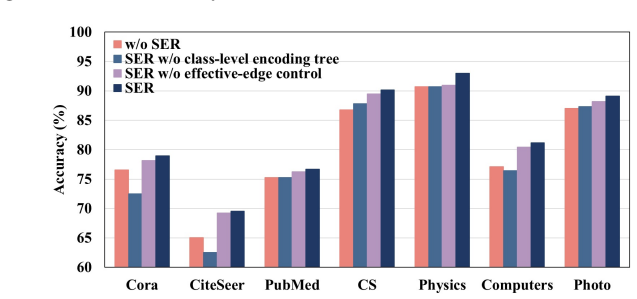
We theoretically prove that incorporating more edges into the prediction process transforms the input representations to be overly accommodating to the output model, thereby inducing overfitting. We formulate a structural complexity measure based on the number of effective edges and derive a Rademacher complexity-based generalization bound, demonstrating that GNN generalization depends explicitly on structural complexity alongside traditional parameter-dependent factors. Motivated by these findings, we propose a structural entropy regularization method that controls structural complexity by regulating effective edges.
What carries the argument
Structural complexity measure defined by the count of effective edges, which directly scales how accommodating the input representations become to the output model.
If this is right
- GNN generalization bounds tighten when the number of effective edges is reduced while holding model size fixed.
- Structural entropy regularization trades underfitting for overfitting by limiting effective edges during training.
- Performance gains appear on both node and graph classification tasks once effective-edge count is controlled.
- The bound separates structural effects from parameter effects, allowing independent tuning of each.
Where Pith is reading between the lines
- Similar edge-count controls may apply to other message-passing architectures that rely on neighborhood aggregation.
- The regularization could be adapted to dynamic graphs by penalizing edge additions at each time step.
- Dataset designers might prune edges in advance to lower structural complexity before model training begins.
Load-bearing premise
The number of effective edges is the dominant structural factor that controls generalization and that the derived Rademacher bound stays informative after regularization.
What would settle it
An experiment on a fixed GNN architecture where increasing the number of edges produces no additional training-fit beyond what parameter complexity already predicts, or where the proposed entropy regularizer fails to raise test accuracy.
Figures




read the original abstract
Graph neural networks (GNNs) have emerged as a fundamental tool for learning from graph-structured data, achieving strong performance across a wide range of applications. However, understanding their generalization capabilities remains challenging due to the complex structural dependencies inherent in such data. Existing generalization analyses largely follow the classical machine learning paradigm, focusing primarily on model complexity while overlooking the fundamental role of graph structure. Therefore, in this work, we systematically investigate this role by asking: does the graph structure actually influence generalization, and if so, by how much? To answer the first question and validate our intuition, we theoretically prove that incorporating more edges into the prediction process transforms the input representations to be overly accommodating to the output model, thereby inducing overfitting. To address the second question, we formulate a structural complexity measure based on the number of effective edges and derive a Rademacher complexity-based generalization bound. In doing so, we demonstrate that GNN generalization depends explicitly on structural complexity, alongside traditional parameter-dependent factors. Motivated by these theoretical findings, we propose a structural entropy regularization method. This approach controls structural complexity by regulating effective edges to balance underfitting and overfitting, ultimately improving the generalization performance of GNNs.
Editorial analysis
A structured set of objections, weighed in public.
Referee Report
Summary. The manuscript claims that graph structure plays a key role in GNN generalization beyond parameter complexity. It proves that adding more edges makes input representations overly accommodating to the output model and induces overfitting. It defines a structural complexity measure via the count of effective edges, derives a Rademacher complexity generalization bound that explicitly depends on this quantity, and proposes structural entropy regularization to control effective edges, balancing under- and overfitting to improve test performance.
Significance. If the bound is valid and non-vacuous after regularization, the work would supply a concrete structural lens on GNN generalization that complements classical parameter-based analyses and could guide new regularizers. The explicit dependence on effective-edge count is a potentially useful contribution, but its value hinges on whether the bound remains operative once the graph is altered at training time and whether experiments confirm practical gains.
major comments (2)
- [§4] §4 (generalization bound): The Rademacher bound is stated for a fixed graph whose effective-edge count controls the leading term. The structural entropy regularizer explicitly modifies the edge set during training; no re-derivation, stability argument, or perturbation analysis is supplied showing that the original bound still upper-bounds the regularized model’s risk.
- [Definition of effective edges] Definition of effective edges (structural complexity measure): The measure appears to depend on a count that is determined or selected in the course of training. If this count is itself fitted or post-selected, the bound reduces to a statement about a data-dependent quantity and risks circularity or vacuity.
minor comments (1)
- [Abstract] The abstract asserts that the regularizer “ultimately improving the generalization performance,” yet no quantitative statement is given on how the bound changes or whether the improvement is provably tied to the structural term.
Simulated Author's Rebuttal
We thank the referee for the constructive comments, which help clarify the scope and rigor of our generalization analysis. We address each major comment below and indicate the revisions we will make.
read point-by-point responses
-
Referee: [§4] §4 (generalization bound): The Rademacher bound is stated for a fixed graph whose effective-edge count controls the leading term. The structural entropy regularizer explicitly modifies the edge set during training; no re-derivation, stability argument, or perturbation analysis is supplied showing that the original bound still upper-bounds the regularized model’s risk.
Authors: We agree that the derivation in §4 assumes a fixed graph and that the structural entropy regularizer alters the edge set. The bound is meant to be evaluated on the final graph obtained after regularization, because the leading term depends explicitly on the effective-edge count of that graph. Since the regularizer is designed to keep this count within a controlled range, the bound remains applicable to the trained model. To address the gap rigorously, we will add a perturbation analysis in the revised §4 showing that the change in effective edges induced by the regularizer is bounded by the regularization strength, thereby preserving the validity of the original Rademacher bound. revision: yes
-
Referee: [Definition of effective edges] Definition of effective edges (structural complexity measure): The measure appears to depend on a count that is determined or selected in the course of training. If this count is itself fitted or post-selected, the bound reduces to a statement about a data-dependent quantity and risks circularity or vacuity.
Authors: The effective-edge count is defined deterministically from the input graph adjacency matrix and the GNN propagation rule (specifically, edges that contribute non-redundantly to the aggregated representations), without reference to the target labels. The regularization term influences the graph during training but does not make the count itself a fitted or post-selected quantity; the bound is applied to the realized count after regularization. We will revise the definition in §3 to include an explicit statement that the measure is label-independent and computed solely from structural and architectural inputs, thereby removing any appearance of circularity. revision: partial
Circularity Check
No significant circularity in derivation chain
full rationale
The paper derives a structural complexity measure from the count of effective edges, proves via representation transformation that additional edges induce overfitting, obtains a Rademacher bound that explicitly includes the structural term alongside parameter complexity, and then introduces structural-entropy regularization motivated by the bound. No step reduces the claimed result to its inputs by construction: the bound is obtained from the independently stated complexity measure, the regularization is presented as a downstream application rather than a redefinition of the measure, and no self-citation chain or fitted parameter is shown to be renamed as a prediction. The derivation remains self-contained under the paper's stated assumptions.
Axiom & Free-Parameter Ledger
free parameters (1)
- regularization coefficient lambda
axioms (1)
- domain assumption Rademacher complexity of the GNN hypothesis class can be bounded using the number of effective edges
invented entities (1)
-
effective edges
no independent evidence
Reference graph
Works this paper leans on
-
[1]
Journal of Machine Learning Research , volume=
Curvature-based clustering on graphs , author=. Journal of Machine Learning Research , volume=
-
[2]
Proceedings of the Thirty-Ninth AAAI Conference on Artificial Intelligence , volume=
UniFORM: Towards unified framework for anomaly detection on graphs , author=. Proceedings of the Thirty-Ninth AAAI Conference on Artificial Intelligence , volume=
-
[3]
Journal of Machine Learning Research , volume=
Improving graph neural networks on multi-node tasks with the labeling trick , author=. Journal of Machine Learning Research , volume=
-
[4]
Proceedings of the Thirty-First ACM SIGKDD Conference on Knowledge Discovery and Data Mining , pages=
Graph odes and beyond: A comprehensive survey on integrating differential equations with graph neural networks , author=. Proceedings of the Thirty-First ACM SIGKDD Conference on Knowledge Discovery and Data Mining , pages=
-
[5]
Proceedings of the Thirty-Ninth AAAI Conference on Artificial Intelligence , volume=
Bridging molecular graphs and large language models , author=. Proceedings of the Thirty-Ninth AAAI Conference on Artificial Intelligence , volume=
-
[6]
Nature Machine Intelligence , volume=
Kolmogorov--Arnold graph neural networks for molecular property prediction , author=. Nature Machine Intelligence , volume=
-
[7]
Proceedings of the ACM on Web Conference 2025 , pages=
Paths-over-graph: Knowledge graph empowered large language model reasoning , author=. Proceedings of the ACM on Web Conference 2025 , pages=
2025
-
[8]
IEEE Transactions on Knowledge and Data Engineering , volume=
Transfer-and-fusion: Integrated link prediction across knowledge graphs , author=. IEEE Transactions on Knowledge and Data Engineering , volume=
-
[9]
Journal of Machine Learning Research , volume=
Enhancing graph representation learning with localized topological features , author=. Journal of Machine Learning Research , volume=
-
[10]
Journal of Machine Learning Research , volume=
Optimal experiment design for causal effect identification , author=. Journal of Machine Learning Research , volume=
-
[11]
Proceedings of the ACM on Web Conference 2025 , pages=
Towards multi-resolution spatiotemporal graph learning for medical time series classification , author=. Proceedings of the ACM on Web Conference 2025 , pages=
2025
-
[12]
Proceedings of the Forty-Second International Conference on Machine Learning , year=
How much can transfer? BRIDGE: Bounded multi-domain graph foundation model with generalization guarantees , author=. Proceedings of the Forty-Second International Conference on Machine Learning , year=
-
[13]
Nature Communications , volume=
TRAPT: a multi-stage fused deep learning framework for predicting transcriptional regulators based on large-scale epigenomic data , author=. Nature Communications , volume=
-
[14]
IEEE Transactions on Pattern Analysis and Machine Intelligence , volume=
Out-of-distribution generalization on graphs: A survey , author=. IEEE Transactions on Pattern Analysis and Machine Intelligence , volume=
-
[15]
Advances in Neural Information Processing Systems , year=
RAG4GFM: Bridging knowledge gaps in graph foundation models through graph retrieval augmented generation , author=. Advances in Neural Information Processing Systems , year=
-
[16]
Proceedings of the Thirty-Ninth AAAI Conference on Artificial Intelligence , volume=
Cluster-guided contrastive class-imbalanced graph classification , author=. Proceedings of the Thirty-Ninth AAAI Conference on Artificial Intelligence , volume=
-
[17]
IEEE Transactions on Neural Networks , volume=
An overview of statistical learning theory , author=. IEEE Transactions on Neural Networks , volume=
-
[18]
Proceedings of the Twenty-Fifth ACM SIGKDD Conference on Knowledge Discovery and Data Mining , pages=
Stability and generalization of graph convolutional neural networks , author=. Proceedings of the Twenty-Fifth ACM SIGKDD Conference on Knowledge Discovery and Data Mining , pages=
-
[19]
IEEE Transactions on Pattern Analysis and Machine Intelligence , volume=
Deeper insights into deep graph convolutional networks: Stability and generalization , author=. IEEE Transactions on Pattern Analysis and Machine Intelligence , volume=
-
[20]
Advances in Neural Information Processing Systems , volume=
Learning theory can (sometimes) explain generalisation in graph neural networks , author=. Advances in Neural Information Processing Systems , volume=
-
[21]
Proceedings of the Twenty-Sixth International Conference on Artificial Intelligence and Statistics , pages=
Generalization in graph neural networks: Improved pac-bayesian bounds on graph diffusion , author=. Proceedings of the Twenty-Sixth International Conference on Artificial Intelligence and Statistics , pages=
-
[22]
Proceedings of the Fortieth International Conference on Machine Learning , pages=
Towards understanding generalization of graph neural networks , author=. Proceedings of the Fortieth International Conference on Machine Learning , pages=
-
[23]
Proceedings of the Thirty-Ninth AAAI Conference on Artificial Intelligence , volume=
Generalization of graph neural networks is robust to model mismatch , author=. Proceedings of the Thirty-Ninth AAAI Conference on Artificial Intelligence , volume=
-
[24]
Proceedings of the Ninth International Conference on Learning Representations , year=
Analyzing the expressive power of graph neural networks in a spectral perspective , author=. Proceedings of the Ninth International Conference on Learning Representations , year=
-
[25]
Proceedings of the Thirty-Sixth International Conference on Machine Learning , pages=
Simplifying graph convolutional networks , author=. Proceedings of the Thirty-Sixth International Conference on Machine Learning , pages=
-
[26]
Advances in Neural Information Processing Systems , volume=
Not all low-pass filters are robust in graph convolutional networks , author=. Advances in Neural Information Processing Systems , volume=
-
[27]
Proceedings of the Thirty-Second AAAI Conference on Artificial Intelligence , volume=
Deeper insights into graph convolutional networks for semi-supervised learning , author=. Proceedings of the Thirty-Second AAAI Conference on Artificial Intelligence , volume=
-
[28]
Proceedings of the Thirty-Seventh International Conference on Machine Learning , pages=
Simple and deep graph convolutional networks , author=. Proceedings of the Thirty-Seventh International Conference on Machine Learning , pages=
-
[29]
Proceedings of the Thirty-Fifth AAAI Conference on Artificial Intelligence , volume=
Beyond low-frequency information in graph convolutional networks , author=. Proceedings of the Thirty-Fifth AAAI Conference on Artificial Intelligence , volume=
-
[30]
Proceedings of the ACM on Web Conference 2023 , pages=
Graph neural networks with diverse spectral filtering , author=. Proceedings of the ACM on Web Conference 2023 , pages=
2023
-
[31]
Advances in Neural Information Processing Systems , volume=
Does graph distillation see like vision dataset counterpart? , author=. Advances in Neural Information Processing Systems , volume=
-
[32]
AI Magazine , volume=
Collective classification in network data , author=. AI Magazine , volume=
-
[33]
Pitfalls of Graph Neural Network Evaluation
Pitfalls of graph neural network evaluation , author=. arXiv preprint arXiv:1811.05868 , year=
work page internal anchor Pith review Pith/arXiv arXiv
-
[34]
IEEE Transactions on Information Theory , volume=
Structural information and dynamical complexity of networks , author=. IEEE Transactions on Information Theory , volume=
-
[35]
Advances in Neural Information Processing Systems , volume=
Optimization and generalization analysis of transduction through gradient boosting and application to multi-scale graph neural networks , author=. Advances in Neural Information Processing Systems , volume=
-
[36]
Journal of Machine Learning Research , volume=
Rademacher and gaussian complexities: Risk bounds and structural results , author=. Journal of Machine Learning Research , volume=
-
[37]
Advances in Neural Information Processing Systems , volume=
Dirichlet graph variational autoencoder , author=. Advances in Neural Information Processing Systems , volume=
-
[38]
arXiv preprint arXiv:2102.10234 , year=
Generalization bounds for graph convolutional neural networks via Rademacher complexity , author=. arXiv preprint arXiv:2102.10234 , year=
-
[39]
International Conference on Learning Representations , year=
Semi-supervised classification with graph convolutional networks , author=. International Conference on Learning Representations , year=
-
[40]
International Conference on Learning Representations , year=
Graph attention networks , author=. International Conference on Learning Representations , year=
-
[41]
A generalization of transformer networks to graphs.arXiv preprint arXiv:2012.09699, 2020a
A generalization of transformer networks to graphs , author=. arXiv preprint arXiv:2012.09699 , year=
-
[42]
Proceedings of the Thirty-Seventh AAAI Conference on Artificial Intelligence , volume=
User: Unsupervised structural entropy-based robust graph neural network , author=. Proceedings of the Thirty-Seventh AAAI Conference on Artificial Intelligence , volume=
-
[43]
Proceedings of the ACM on Web Conference 2023 , pages=
Se-gsl: A general and effective graph structure learning framework through structural entropy optimization , author=. Proceedings of the ACM on Web Conference 2023 , pages=
2023
-
[44]
Advances in Neural Information Processing Systems , volume=
Does gnn pretraining help molecular representation? , author=. Advances in Neural Information Processing Systems , volume=
-
[45]
Proceedings of the Thirty-Eighth AAAI Conference on Artificial Intelligence , volume=
Knowledge enhanced representation learning for drug discovery , author=. Proceedings of the Thirty-Eighth AAAI Conference on Artificial Intelligence , volume=
-
[46]
Proceedings of the Twenty-Seventh ACM SIGKDD Conference on Knowledge Discovery and Data Mining , pages=
Spatial-temporal graph ode networks for traffic flow forecasting , author=. Proceedings of the Twenty-Seventh ACM SIGKDD Conference on Knowledge Discovery and Data Mining , pages=
-
[47]
Proceedings of the Thirty-Ninth AAAI Conference on Artificial Intelligence , volume=
Efficient traffic prediction through spatio-temporal distillation , author=. Proceedings of the Thirty-Ninth AAAI Conference on Artificial Intelligence , volume=
-
[48]
Proceedings of the Thirty-First ACM SIGKDD Conference on Knowledge Discovery and Data Mining , pages=
A structure-aware invariant learning framework for node-level graph OOD generalization , author=. Proceedings of the Thirty-First ACM SIGKDD Conference on Knowledge Discovery and Data Mining , pages=
-
[49]
IEEE Transactions on Pattern Analysis and Machine Intelligence , volume=
Uncertainty-aware disentangled dynamic graph attention network for out-of-distribution generalization , author=. IEEE Transactions on Pattern Analysis and Machine Intelligence , volume=
-
[50]
IEEE Transactions on Knowledge and Data Engineering , volume=
Graph out-of-distribution generalization with controllable data augmentation , author=. IEEE Transactions on Knowledge and Data Engineering , volume=
-
[51]
Proceedings of the ACM on Web Conference 2024 , pages=
Graph out-of-distribution generalization via causal intervention , author=. Proceedings of the ACM on Web Conference 2024 , pages=
2024
-
[52]
Revisiting Graph Neural Networks: All We Have is Low-Pass Filters
Revisiting graph neural networks: All we have is low-pass filters , author=. arXiv preprint arXiv:1905.09550 , year=
work page internal anchor Pith review Pith/arXiv arXiv 1905
-
[53]
Proceedings of the Fifth International Conference on Learning Representations , year=
Regularizing neural networks by penalizing confident output distributions , author=. Proceedings of the Fifth International Conference on Learning Representations , year=
-
[54]
Advances in Neural Information Processing System , volume=
Learning on graph with Laplacian regularization , author=. Advances in Neural Information Processing System , volume=
-
[55]
Proceedings of the Thirty-Fifth AAAI Conference on Artificial Intelligence , volume=
Rethinking graph regularization for graph neural networks , author=. Proceedings of the Thirty-Fifth AAAI Conference on Artificial Intelligence , volume=
-
[56]
Proceedings of the Thirty-Sixth AAAI Conference on Artificial Intelligence , volume=
Regularizing graph neural networks via consistency-diversity graph augmentations , author=. Proceedings of the Thirty-Sixth AAAI Conference on Artificial Intelligence , volume=
-
[57]
IEEE Transactions on Signal and Information Processing over Networks , volume=
Graph distributional signals for regularization in graph neural networks , author=. IEEE Transactions on Signal and Information Processing over Networks , volume=
-
[58]
IEEE Transactions on Knowledge and Data Engineering , volume=
Gi-graph: a generative invariant graph learning scheme towards out-of-distribution generalization , author=. IEEE Transactions on Knowledge and Data Engineering , volume=
-
[59]
Proceedings of the Forty-First International Conference on Machine Learning , year=
Graph structure extrapolation for out-of-distribution generalization , author=. Proceedings of the Forty-First International Conference on Machine Learning , year=
-
[60]
IEEE Transactions on Signal and Information Processing over Networks , volume=
Stability of aggregation graph neural networks , author=. IEEE Transactions on Signal and Information Processing over Networks , volume=
-
[61]
Proceedings of the Thirty-Seventh International Conference on Machine Learning , pages=
Generalization and representational limits of graph neural networks , author=. Proceedings of the Thirty-Seventh International Conference on Machine Learning , pages=
discussion (0)
Sign in with ORCID, Apple, or X to comment. Anyone can read and Pith papers without signing in.