Recognition: unknown
Volumetric Growth in Linear Elasticity Driven by an Optimality Criterion
Pith reviewed 2026-05-14 17:47 UTC · model grok-4.3
The pith
Volumetric growth in linear elasticity is determined implicitly by constrained optimization rather than by prescribed evolution laws.
A machine-rendered reading of the paper's core claim, the machinery that carries it, and where it could break.
Core claim
Using linearized elasticity as a convenient mechanical framework, volumetric growth is formulated as an optimization-driven process in which the growth tensor is determined implicitly by constrained optimization rather than prescribed through phenomenological evolution laws. At each incremental step the displacement and growth fields satisfy equilibrium, mass-balance constraints, and an irreversibility condition enforcing accretive growth, while an objective functional encodes the driving mechanism of the process. Finite element discretization leads to a finite-dimensional constrained minimization problem in the growth variables alone and makes explicit the interpretation of the evolution as
What carries the argument
The constrained minimization problem whose objective functional encodes the driving mechanism of growth and whose variables are subject to equilibrium, mass-balance, and irreversibility constraints.
If this is right
- The growth tensor is found implicitly by solving the constrained minimization at each step rather than being prescribed in advance.
- Finite-element discretization converts the problem into a finite-dimensional minimization over growth variables only.
- The incremental evolution is equivalent to a projected gradient flow on the admissible growth set.
- Irreversibility is enforced directly by the constraint that growth cannot decrease.
- Numerical examples can be generated by solving the discrete minimization problem under chosen objective functionals.
Where Pith is reading between the lines
- Different choices of the objective functional could be tested to match observed growth in specific biological or material systems.
- The same optimization structure might be applied to growth problems outside linear elasticity once the corresponding well-posedness is established.
- The projected-gradient-flow view opens the possibility of using accelerated optimization algorithms for large-scale growth simulations.
- Coupling this growth model with other physics (e.g., diffusion or chemical reactions) would require extending the objective functional and constraint set accordingly.
Load-bearing premise
A suitable objective functional exists that encodes the physical driving mechanism of growth and the resulting incremental constrained minimization problem remains well-posed under the stated equilibrium, mass-balance, and irreversibility constraints.
What would settle it
Direct comparison of the growth patterns predicted by the optimization against measured volumetric growth in a laboratory specimen under controlled loading would confirm or refute whether the implicit growth tensor matches experiment.
Figures



read the original abstract
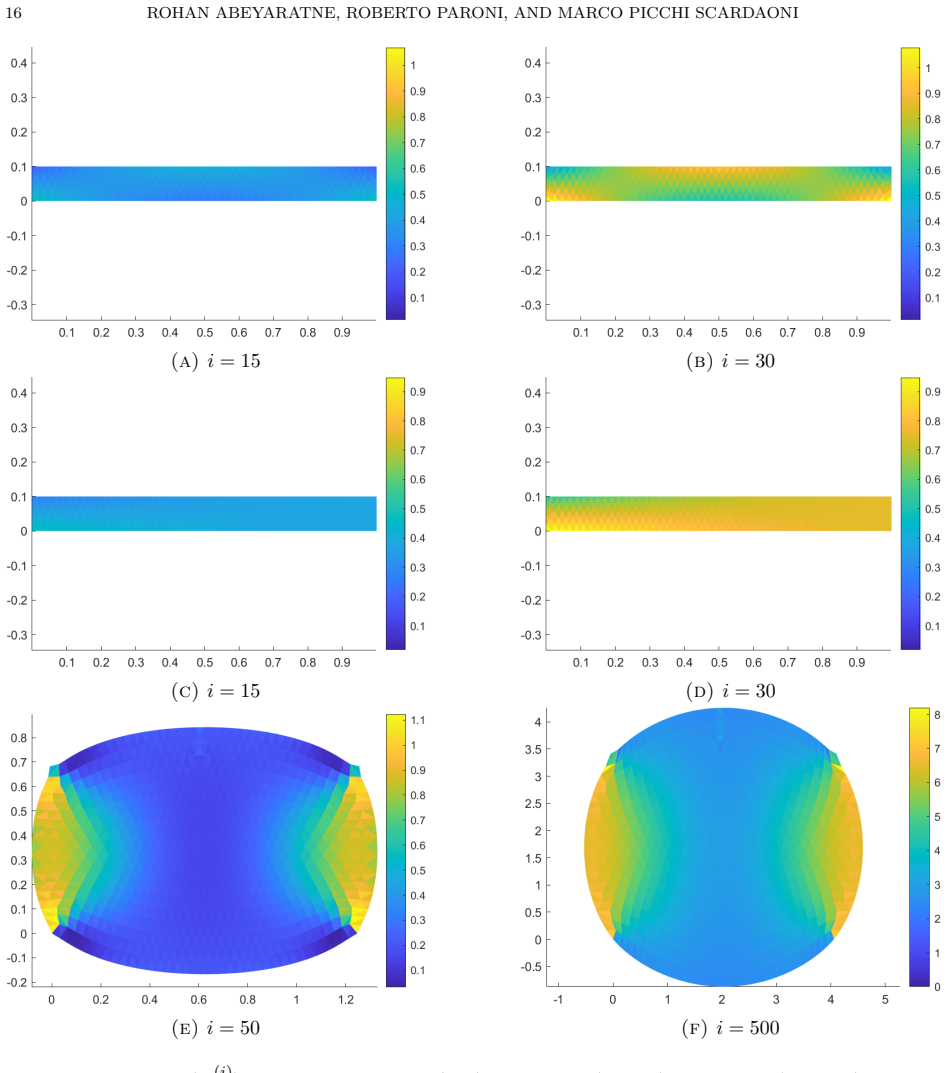
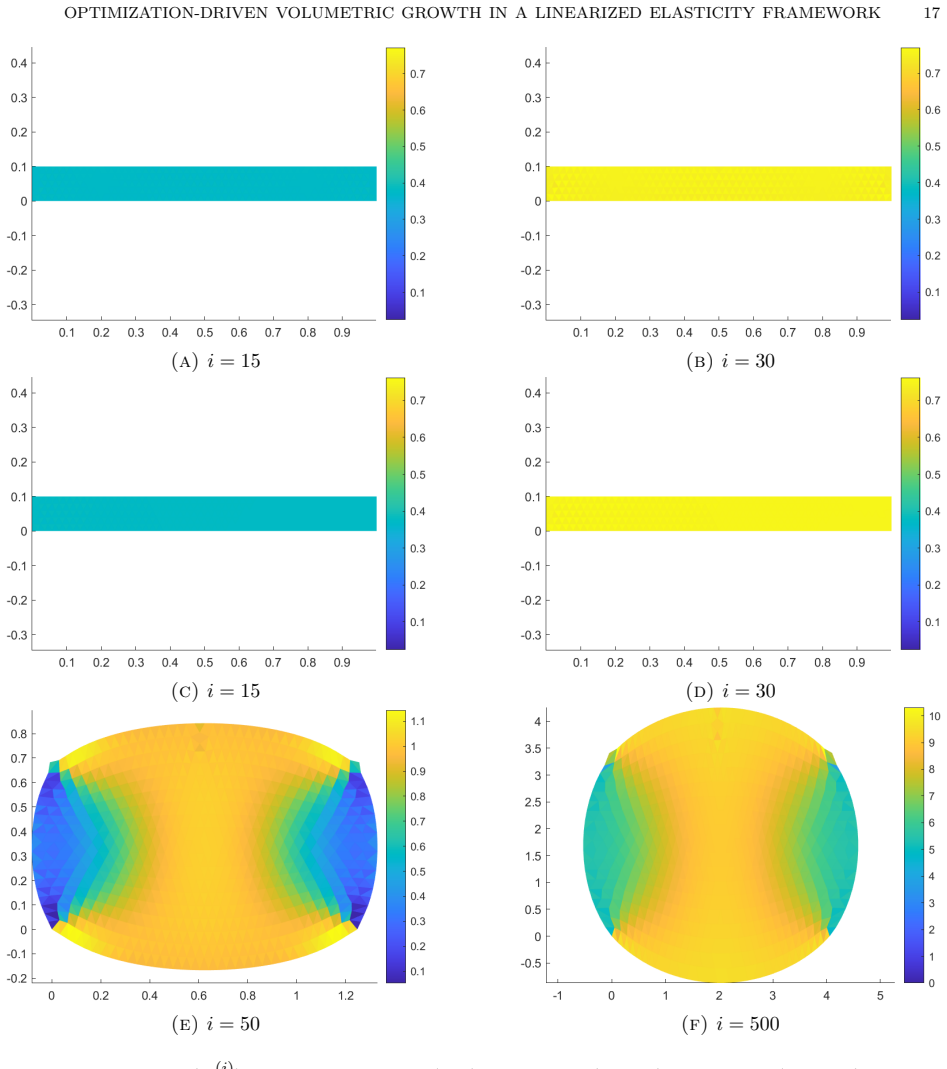
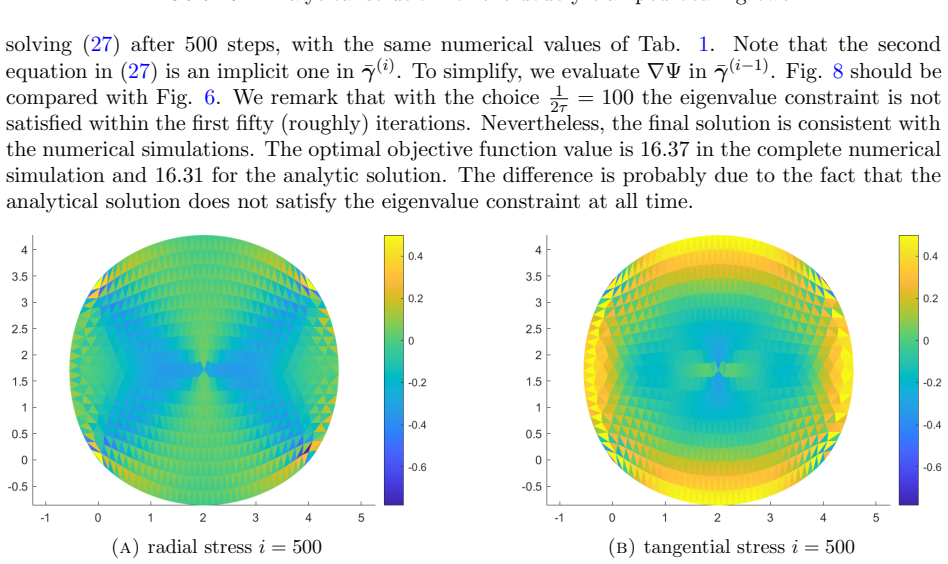
Using linearized elasticity as a convenient mechanical framework, we show that volumetric growth can be formulated as an optimization-driven process in which the growth tensor is determined implicitly by constrained optimization rather than prescribed through phenomenological evolution laws. At each incremental step, the displacement and growth fields satisfy equilibrium, mass-balance constraints, and an irreversibility condition enforcing accretive growth, while an objective functional encodes the driving mechanism of the process. Finite element discretization leads to a finite-dimensional constrained minimization problem in the growth variables alone and makes explicit the interpretation of the evolution as a projected gradient flow. Numerical examples illustrate the proposed framework.
Editorial analysis
A structured set of objections, weighed in public.
Referee Report
Summary. The paper claims that volumetric growth in linearized elasticity can be modeled as an optimization-driven process in which the growth tensor is determined implicitly at each incremental step by solving a constrained minimization problem. The displacement and growth fields are required to satisfy equilibrium, mass-balance, and an irreversibility condition for accretive growth, while an objective functional encodes the physical driving mechanism. Finite-element discretization reduces the problem to a finite-dimensional constrained minimization over growth variables alone, which is interpreted as a projected gradient flow, and the framework is illustrated with numerical examples.
Significance. If the well-posedness of the incremental minimization can be established, the work would offer a principled alternative to phenomenological evolution laws for growth by deriving the growth tensor from an optimality criterion. This could enable more systematic investigation of growth mechanisms within a standard mechanical setting and might facilitate reproducible simulations of accretive processes in biological or engineered materials. The explicit reduction to a projected gradient flow after discretization is a conceptually clean contribution.
major comments (1)
- The central construction reduces growth evolution to a finite-dimensional constrained minimization over growth variables at each time step (after FEM discretization), subject to equilibrium, mass balance, and irreversibility. No proof of existence of a minimizer is supplied, nor is coercivity, convexity, or lower semicontinuity of the objective established in the space of admissible growth tensors. Without these, the implicit definition of the growth tensor via optimization may fail to yield a well-defined evolution even when the abstract states that the problem is solved numerically.
minor comments (1)
- The abstract states the modeling strategy and discretization route but supplies no derivations, error estimates, or numerical verification details; these should be added to allow assessment of the practical performance of the scheme.
Simulated Author's Rebuttal
We thank the referee for the careful reading and for highlighting the need for a well-posedness discussion. We address the single major comment below and will incorporate a clarifying remark in the revised version.
read point-by-point responses
-
Referee: The central construction reduces growth evolution to a finite-dimensional constrained minimization over growth variables at each time step (after FEM discretization), subject to equilibrium, mass balance, and irreversibility. No proof of existence of a minimizer is supplied, nor is coercivity, convexity, or lower semicontinuity of the objective established in the space of admissible growth tensors. Without these, the implicit definition of the growth tensor via optimization may fail to yield a well-defined evolution even when the abstract states that the problem is solved numerically.
Authors: We agree that the manuscript does not supply a rigorous existence proof for the discrete minimizer. After FEM discretization the problem is finite-dimensional, the admissible set defined by the linear equilibrium, mass-balance, and irreversibility constraints is closed and convex, and the objective is quadratic (hence continuous and convex) in the growth variables. Standard Weierstrass-type arguments would therefore guarantee existence once coercivity on this set is verified. The present work focuses on the modeling framework and its numerical realization rather than on the full functional-analytic theory; consequently no such coercivity analysis appears. In the revision we will add a short paragraph after the discretization section stating that existence follows from convexity and coercivity of the objective on the compact level sets observed in the numerical examples, and that the projected-gradient solver used in practice converges reliably. This addition clarifies the mathematical status without altering the core contribution or requiring new theorems. revision: partial
Circularity Check
No significant circularity in the optimization-driven growth formulation
full rationale
The paper introduces an objective functional to encode the driving mechanism of volumetric growth and defines the growth tensor implicitly via constrained minimization at each step, subject to equilibrium, mass balance, and irreversibility. This construction is presented as an alternative modeling choice rather than a derivation that reduces by the paper's own equations to a pre-fitted quantity, self-citation chain, or renamed input. No load-bearing step equates the output growth evolution to its inputs by construction; the framework remains self-contained as a proposed formulation.
Axiom & Free-Parameter Ledger
axioms (2)
- domain assumption Linearized elasticity provides a valid mechanical framework for the growth process.
- ad hoc to paper An objective functional exists that encodes the physical driving mechanism of growth.
Reference graph
Works this paper leans on
-
[1]
Abeyaratne, R., Paroni, R., Picchi Scardaoni, M. (2026). Surface growth driven by an opti- mality criterion. Submitted
2026
-
[2]
Ambrosi, D., Guana, F. (2007). Stress-modulated growth.Mathematics and Mechanics of Solids, 12(3), 319–342. doi:10.1177/1081286505059739
-
[3]
Ambrosi, D., Mollica, F. (2002). On the mechanics of a growing tumor.International Journal of Engineering Science, 40(12), 1297–1316
2002
-
[4]
Ambrosi, D., Pezzuto, S., Riccobelli, D., Stylianopoulos, T., Ciarletta, P. (2017). Solid tumors are poroelastic solids with a chemo-mechanical feedback on growth.Journal of Elasticity, 129(1–2), 107–124. doi:10.1007/s10659-016-9619-9
-
[5]
(2005).Gradient Flows in Metric Spaces and in the Space of Probability Measures
Ambrosio, L., Gigli, N., Savar´ e, G. (2005).Gradient Flows in Metric Spaces and in the Space of Probability Measures. Birkh¨ auser, Basel. doi:10.1007/978-3-7643-8722-8
-
[6]
P., McElwain, D
Araujo, R. P., McElwain, D. L. S. (2004). A linear-elastic model of anisotropic tumour growth. Journal of Mathematical Biology, 49, 56–74
2004
-
[7]
Barton, D. L., Henkes, S., Weijer, C. J., Sknepnek, R. (2017). Active Vertex Model for cell- resolution description of epithelial tissue mechanics.PLoS Computational Biology, 13(6), 1–34. doi:10.1371/journal.pcbi.1005569
-
[8]
Chen, Y.-C., Hoger, A. (2000). Constitutive functions of elastic materials in finite growth and deformation.Journal of Elasticity, 59, 175–193. doi:10.1023/A:1011061400438
-
[9]
Davoli, E., Nik, K., Stefanelli, U., Tomassetti, G. (2024). An existence result for accre- tive growth in elastic solids.Mathematical Models and Methods in Applied Sciences, 34(11). doi:10.1142/S0218202524500465
-
[10]
De Giorgi, E. (1993). New problems on minimizing movements. In:Boundary Value Problems for PDEs and Applications, 81–98. Masson
1993
-
[11]
Del Piero, G. (2018). On the decomposition of the deformation gradient in plasticity.Journal of Elasticity, 131(1), 111–124. doi:10.1007/s10659-017-9648-z. OPTIMIZATION-DRIVEN VOLUMETRIC GROWTH IN A LINEARIZED ELASTICITY FRAMEWORK 23
-
[12]
Di Carlo, A., Quiligotti, S. (2002). Growth and balance.Mechanics Research Communications, 29, 449–456
2002
-
[13]
Epstein, M., Maugin, G.A. (2000). Thermomechanics of volumetric growth in uniform bodies.Journal of the Mechanics and Physics of Solids, 48, 149–166. doi:10.1016/S0022- 5096(99)00021-9
-
[14]
Erlich, A., Zurlo, G. (2024). Incompatibility-driven growth and size control during develop- ment.Journal of the Mechanics and Physics of Solids, 188, 105660
2024
-
[15]
Erlich, A., Zurlo, G. (2025). The geometric nature of homeostatic stress in biological growth. Journal of the Mechanics and Physics of Solids, 201, 106155
2025
-
[16]
Fletcher, A. G., Osborne, J. M., Maini, P. K., Gavaghan, D. J. (2013). Implement- ing vertex dynamics models of cell populations in biology within a consistent compu- tational framework.Progress in Biophysics and Molecular Biology, 113(2), 299–326. doi:10.1016/j.pbiomolbio.2013.09.003
-
[17]
(2017).The Mathematics and Mechanics of Biological Growth
Goriely, A. (2017).The Mathematics and Mechanics of Biological Growth. Springer, New York
2017
-
[18]
Goriely, A., Ben Amar, M. (2005). Differential growth and instability in elastic shells.Journal of the Mechanics and Physics of Solids, 53, 2284–2319. doi:10.1016/j.jmps.2005.04.004
-
[19]
Hoger, A. (1986). On the determination of residual stress in an elastic body.Journal of Elasticity, 16, 303–324. doi:10.1007/BF00040812
-
[20]
L., Byrne, H
Jones, E. L., Byrne, H. M. (1995). A mathematical model of stress-induced inhibition of avascular tumour growth.Mathematical and Computer Modelling, 22(5), 1–14
1995
-
[21]
Moulton, D. E., Lessinnes, T., Goriely, A. (2013). Morphoelastic rods. Part I: A sin- gle growing elastic rod.Journal of the Mechanics and Physics of Solids, 61, 398–427. doi:10.1016/j.jmps.2012.09.017
-
[22]
Persson, P.-O., Strang, G. (2004). A simple mesh generator in MATLAB.SIAM Review, 46(2), 329–345
2004
-
[23]
Picchi Scardaoni, M. (2022). Energetic convenience of cell division in biological tissues.Physical Review E, 106(5), 054405
2022
-
[24]
K., Hoger, A., McCulloch, A
Rodriguez, E. K., Hoger, A., McCulloch, A. D. (1994). Stress-dependent finite growth in soft elastic tissues.Journal of Biomechanics, 27(4), 455–467
1994
-
[25]
Skalak, R., Dasgupta, G., Moss, M., Otten, M., Dullumeijer, P., Vilmann, H. (1982). Ana- lytical description of growth.Journal of Theoretical Biology, 94, 555–577. doi:10.1016/0022- 5193(82)90301-0
-
[26]
Sozio, F., and Yavari, A. (2019). Nonlinear mechanics of accretion.Journal of Nonlinear Science, 29(4), 1813–1863. doi: 10.1007/s00332-019-09531-w
-
[27]
D., Chauhan, V
Stylianopoulos, T., Martin, J. D., Chauhan, V. P., Jain, S. R., Diop-Frimpong, B., Bardeesy, N., Smith, L. L., Ferrone, C. B., Jain, R. K. (2012). Causes, consequences, and remedies for growth-induced solid stress in murine and human tumors.Proceedings of the National Academy of Sciences, 109(38), 15101–15108
2012
-
[28]
Taber, L. A. (2020).Continuum Modeling in Mechanobiology. Springer, Cham, Switzerland
2020
-
[29]
Yavari, A. (2010). A geometric theory of growth mechanics.Journal of Nonlinear Science, 20(6), 781–830. doi: 10.1007/s00332-010-9073-y. 24 ROHAN ABEYARATNE, ROBERTO PARONI, AND MARCO PICCHI SCARDAONI (R. Abeyaratne)Department of Mechanical Engineering, Massachusetts Institute of Technology, Cambridge, MA, USA Email address:rohan@mit.edu (R. Paroni)Departm...
discussion (0)
Sign in with ORCID, Apple, or X to comment. Anyone can read and Pith papers without signing in.