Recognition: unknown
Magnetocaloric Effect in Nanostructured La_{0.6}Sr_{0.4}Fe_{1-x}Co_{x}O₃
Pith reviewed 2026-05-14 18:03 UTC · model grok-4.3
The pith
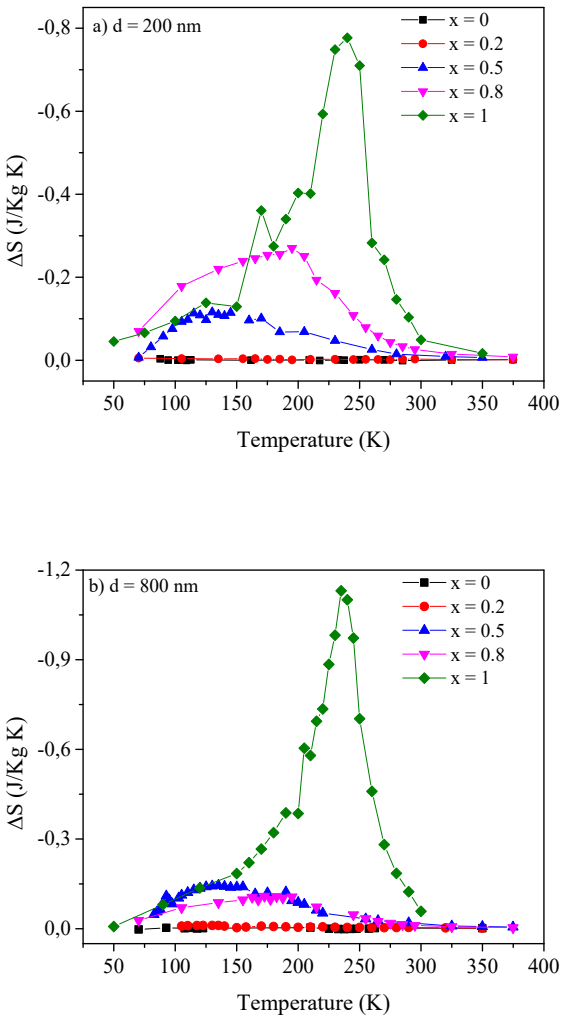
Cobalt substitution combined with nanostructuring maximizes magnetocaloric entropy change to 1.13 J/kg K under 3 T in La0.6Sr0.4Fe1-xCoxO3.
A machine-rendered reading of the paper's core claim, the machinery that carries it, and where it could break.
Core claim
In the nanostructured La0.6Sr0.4Fe1-xCoxO3 series synthesized by pore-wetting, Co substitution enhances ferromagnetic order and increases both saturation magnetization and Curie temperature; the magnetic entropy change calculated via Maxwell relations from isothermal magnetization curves reaches a maximum of 1.13 J/(kg K) under 3 T precisely when x equals 1.
What carries the argument
Magnetic entropy change obtained from Maxwell relations applied to field-dependent magnetization isotherms in Co-doped nanostructured perovskites.
If this is right
- Higher cobalt content steadily increases saturation magnetization and Curie temperature.
- Morphology shifts from thinner nanotubes and smaller particles at low cobalt to thicker nanotubes and larger particles at high cobalt.
- The peak magnetocaloric entropy change occurs at full cobalt substitution (x=1).
- Single-phase perovskite structure is preserved across the entire doping series after 1000 °C calcination.
- Combined cobalt doping and pore-controlled nanostructuring produces the largest observed magnetocaloric response in the series.
Where Pith is reading between the lines
- The same synthesis route could be tested on related cobalt-rich perovskites to check whether the entropy-change gain generalizes beyond this specific La-Sr composition.
- Varying the template pore diameter more widely might reveal an optimal particle size that further improves the entropy change or reduces magnetic hysteresis.
- Comparing these nanotube samples directly with bulk powders of identical composition would isolate the nanostructuring contribution from the doping effect.
- If the entropy change remains linear with applied field beyond 3 T, the material could become competitive for higher-field magnetic cooling prototypes.
Load-bearing premise
Maxwell relations applied to the measured magnetization curves accurately yield the entropy change without significant distortions from particle-size effects or undetected secondary phases.
What would settle it
Direct measurement of adiabatic temperature change on the x=1 sample under a 3 T field swing and comparison against the temperature span predicted from the reported 1.13 J/kg K entropy change.
Figures


read the original abstract
This work presents a systematic study of the magnetocaloric effect in the nanostructured perovskite series $La_{0.6}Sr_{0.4}Fe_{1-x}Co_{x}O_3$ (x = 0, 0.2, 0.5, 0.8, and 1.0), synthesized by a pore-wetting method using polymeric membranes with pore diameters of 200 nm and 800 nm. All samples were calcined at 1000{\deg}C. Structural characterization was made by X-ray diffraction and confirmed the formation of a single-phase perovskite with distorted rhombohedral symmetry, without detectable secondary phases. We observed significant influence of substitution of Fe by Co on the morphology, as the analysis by scanning electron microscopy revealed a clear evolution from smaller to larger particles and from thin to thicker nanotubes, as the Co content increased. Magnetic measurements showed that the cationic substitution enhances ferromagnetic coupling, increasing both the saturation magnetization (MS) and the Curie temperature (TC). The magnetocaloric properties, determined through the Maxwell relations, exhibit a maximum entropy change of 1.13 J/(kg K) under an applied field of 3 T for the sample with x = 1. These results demonstrate that the combination of Co doping and controlled nanostructuring effectively optimizes the magnetocaloric response.
Editorial analysis
A structured set of objections, weighed in public.
Axiom & Free-Parameter Ledger
axioms (1)
- domain assumption XRD patterns confirm single-phase distorted rhombohedral perovskite with no detectable secondary phases
Reference graph
Works this paper leans on
-
[1]
Introduction The study of the magnetocaloric effect (MCE) in materials has gained increasing attention over the last decades due to its potential application in magnetic refrigeration technologies[1]. The MCE is defined as the isothermal change in magnetic entropy (−ΔS) that occurs when a magnetic field is applied to a material. [2] This quantity can be d...
-
[2]
Experimental Nanostructured La0.6Sr0.4Fe1-xCoxO3 (x = 0, 0.2, 0.5, 0.8 and 1) samples were prepared by the pore-wetting technique, following the methodology previously reported for La0.6Sr0.4CoO3 perovskite tubes [12]. High-purity precursor salts La(NO3)3∙6H2O, Sr(NO3)2, Fe(NO3)3∙9H2O, and Co(NO3)2∙6H2O (Merck, 99.99%) were dissolved in distilled water to...
-
[3]
Results and discussion 40 60 80 30 40 50 60 70 80 90 x = 0 2 1 40 2 42 0 2 1 1 0 1 0 4 d = 800 nm x = 0 d = 200 nm x = 0.2 x = 0.2 Intensity (a.u) x = 0.5 x = 0.5 x = 0.8 x = 0.8 x = 1 2(°) x = 1 Fig. 1. X-ray diffraction patterns of all La0.6Sr0.4Fe1-XCoxO3 samples. Fig. 1 shows the X-ray diffraction (XRD) patterns obtained for the complete series of L...
-
[4]
A clear dependence of magnetization on cobalt content is observed
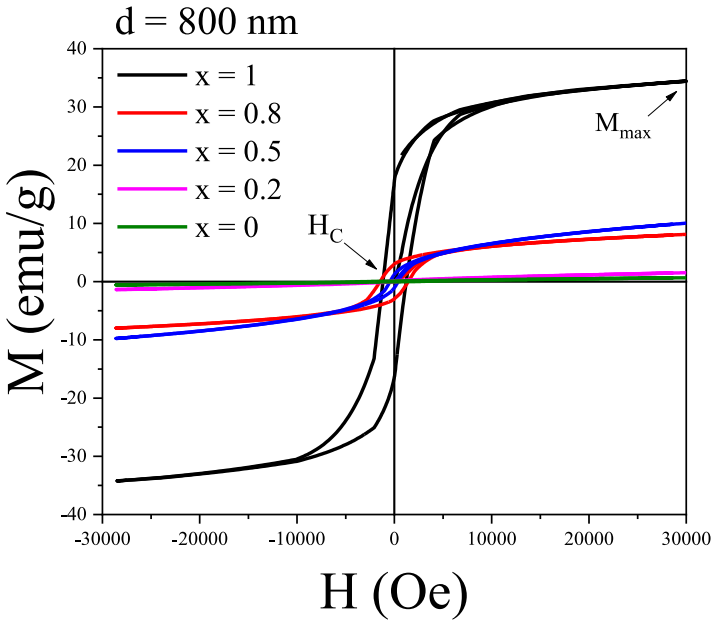
Magnetic and Magnetocaloric Properties Figure 3 shows the magnetization versus temperature (M(T)) curves for the La0.6Sr0.4Fe1- xCoxO3 series, measured under an applied magnetic field of 1000 Oe. A clear dependence of magnetization on cobalt content is observed. The samples with x = 1 exhibit the highest low-temperature magnetization (≈ 29–33 emu g-1 at 1...
-
[5]
exhibit smaller slopes (on the order of 10-8–10-10 emu g⁻¹ Oe-1), consistent with a more ideal mean-field-like behavior. In contrast, compositions with lower Co content (x = 0.2 – 0.5) show larger slopes (10-2 – 10-3 emu g-1 Oe-1), indicative of increased magnetic disorder and less homogeneous ferromagnetic coupling. Figure 6. Arrott plots for La0.6Sr0.4F...
work page 2000
-
[6]
Conclusions A comprehensive study of the La0.6Sr0.4Fe1-xCoxO3 (x = 0, 0.2, 0.5, 0.8, and 1.0) nanostructured perovskite series synthesized by the pore-wetting method has been presented. Structural, morphological, and magnetic analyses demonstrate the close relationship between composition, morphology, and magnetocaloric performance. X-ray diffraction conf...
work page 2021
-
[7]
A. Greco, C. Aprea, A. Maiorino, C. Masselli, A review of the state of the art of solid-state caloric cooling processes at room-temperature before 2019, Int. J. Refrig. 106 (2019) 66–88. https://doi.org/10.1016/j.ijrefrig.2019.06.034
-
[8]
P.Z.Z. Nehan, O. Vitayaya, D.R. Munazat, M.T.E. Manawan, D. Darminto, B. Kurniawan, The magnetocaloric effect properties for potential applications of magnetic refrigerator technology: a review, Phys. Chem. Chem. Phys. 26 (2024) 14476–14504. https://doi.org/10.1039/D4CP01077A
-
[9]
H. Biswal, T.R. Senapati, A. Haque, J.R. Sahu, Beneficial effect of Mn- substitution on magnetic and magnetocaloric properties of La0.5Sr0.5CoO3 ceramics, Ceram. Int. 46 (2020) 11828–11834. https://doi.org/10.1016/j.ceramint.2020.01.217
- [11]
-
[12]
P.T. Long, T. V. Manh, T.A. Ho, V. Dongquoc, P. Zhang, S.C. Yu, Magnetocaloric effect in La1-xSrxCoO3 undergoing a second-order phase transition, Ceram. Int. 44 (2018) 15542–15549. https://doi.org/10.1016/j.ceramint.2018.05.216
-
[13]
M. Itoh, I. Natori, S. Kubota, K. Motoya, Spin-Glass Behavior and Magnetic Phase Diagram of La1-xSrxCoO3 ( 0 ≤x ≤0.5) Studied by Magnetization Measurements, J. Phys. Soc. Japan. 63 (1994) 1486–1493. https://doi.org/10.1143/JPSJ.63.1486
-
[14]
L. Joshi, S. Keshri, Magneto-transport properties of Fe-doped LSMO manganites, (n.d.). https://doi.org/10.1016/j.measurement.2011.02.005
-
[15]
A. Kumar, D. Sivaprahsam, A.D. Thakur, Improvement of thermoelectric properties of lanthanum cobaltate by Sr and Mn co-substitution, J. Alloys Compd. 735 (2018) 1787–1791. https://doi.org/10.1016/J.JALLCOM.2017.11.334
-
[16]
N. Raghu Ram, M. Prakash, U. Naresh, N. Suresh Kumar, T. Sofi Sarmash, T. Subbarao, R. Jeevan Kumar, G. Ranjith Kumar, K. Chandra Babu Naidu, Review on Magnetocaloric Effect and Materials, J. Supercond. Nov. Magn. 31 (2018) 1971–1979. https://doi.org/10.1007/s10948-018-4666-z
-
[17]
Predictions for bottomonium from a relativistic screened potential model,
W. Zhong, C.T. Au, Y.W. Du, Review of magnetocaloric effect in perovskite- type oxides, Chinese Phys. B. 22 (2013). https://doi.org/10.1088/1674- 1056/22/5/057501
-
[18]
F.M. Alvarez, M.B. Vigna, M. Quintero, D.G. Lamas, J. Sacanell, Magnetocaloric effect of nanostructured La0.6Sr0.4CoO3, J. Alloys Compd. 970 (2024). https://doi.org/10.1016/j.jallcom.2023.172507
-
[19]
J. Sacanell, M.G. Bellino, D.G. Lamas, A.G. Leyva, Synthesis and characterization La0.6Sr0.4CoO3 and La0.6Sr0.4Co0.2Fe0.8O 3 nanotubes for cathode of solid-oxide fuel cells, Phys. B Condens. Matter. 398 (2007) 341–343. https://doi.org/10.1016/j.physb.2007.04.039
-
[20]
A. Mejía Gómez, J. Sacanell, A.G. Leyva, D.G. Lamas, Performance of La0.6Sr0.4Co1−yFeyO3 (y=0.2, 0.5 and 0.8) nanostructured cathodes for intermediate-temperature solid-oxide fuel cells: Influence of microstructure and composition, Ceram. Int. 42 (2015) 3145–3153. https://doi.org/10.1016/j.ceramint.2015.10.104
-
[21]
J. Sacanell, A.G. Leyva, M.G. Bellino, D.G. Lamas, Nanotubes of rare earth cobalt oxides for cathodes of intermediate-temperature solid oxide fuel cells, J. Power Sources. 195 (2010) 1786–1792. https://doi.org/10.1016/j.jpowsour.2009.10.049
-
[22]
J. Rodríguez-Carvajal, Recent advances in magnetic structure determination by neutron powder diffraction, Phys. B Phys. Condens. Matter. 192 (1993) 55–69. https://doi.org/10.1016/0921-4526(93)90108-I
-
[23]
A.S. Khan, M.F. Nasir, M.T. Khan, A. Murtaza, M.A. Hamayun, Study of structural, magnetic and radio frequency heating aptitudes of pure and (Fe-III) doped manganite (La1-x SrxMnO3) and their incorporation with Sodium Poly- Styrene Sulfonate (PSS) for magnetic hyperthermia applications, Phys. B Condens. Matter. 600 (2021) 412627. https://doi.org/10.1016/j....
-
[24]
V.S. Pokatilov, V.S. Rusakov, A.O. Makarova, V. V. Pokatilov, M.E. Matsnev, Specific features of magnetic states of impurity iron ions in the perovskite La0.75Sr0.25Co0.9857Fe0.02O3, Phys. Solid State. 58 (2016) 315–318. https://doi.org/10.1134/S1063783416020220
-
[25]
H. El Shinawi, J.F. Marco, F.J. Berry, C. Greaves, LaSrCoFeO5, LaSrCoFeO5F and LaSrCoFeO5.5: New La-Sr-Co-Fe perovskites, J. Mater. Chem. 20 (2010) 3253–3259. https://doi.org/10.1039/b927141d
-
[26]
M.A. Señarı́s-Rodrı́guez, J.B. Goodenough, Magnetic and Transport Properties of the System La1-xSrxCoO3-δ (0 < x ≤ 0.50), J. Solid State Chem. 118 (1995) 323–336. https://doi.org/10.1006/jssc.1995.1351
-
[27]
Banerjee, On a generalised approach to first and second order magnetic transitions, Phys
B.K. Banerjee, On a generalised approach to first and second order magnetic transitions, Phys. Lett. 12 (1964) 16–17. https://doi.org/10.1016/0031- 9163(64)91158-8
discussion (0)
Sign in with ORCID, Apple, or X to comment. Anyone can read and Pith papers without signing in.