Recognition: unknown
Efficient simulation of chemical reaction in DSMC
Pith reviewed 2026-05-14 18:03 UTC · model grok-4.3
The pith
A coupling of macroscopic synthetic equations with DSMC accelerates chemical reaction simulations in near-continuum flows by orders of magnitude.
A machine-rendered reading of the paper's core claim, the machinery that carries it, and where it could break.
Core claim
The authors formulate a macroscopic synthetic equation by integrating continuum constitutive relations for diffusion, stress, and heat flux along with higher-order constitutive relations that capture nonequilibrium transport effects. Higher-order constitutive relations and chemical reaction source terms are sampled from DSMC and embedded into the macroscopic synthetic equation. The macroscopic system is solved to the steady state, whose solution is then employed to correct particle distributions in DSMC intermittently. This coupling is asymptotic preserving, fast converging, and noise reducing, supporting efficient accurate simulations with coarse spatiotemporal grids and reduced evolution/s
What carries the argument
The macroscopic synthetic equation, populated with sampled higher-order constitutive relations and chemical reaction source terms from DSMC, that supplies intermittent corrections to particle distributions.
If this is right
- DSMC simulations of reacting flows near the continuum limit become feasible with computational effort reduced by several orders of magnitude.
- Coarser spatial and temporal discretizations can be used without sacrificing accuracy in macroscopic quantities or reaction rates.
- Fewer evolution and sampling steps are needed while statistical noise is suppressed by the deterministic macroscopic solver.
- The method maintains asymptotic consistency, recovering the correct continuum limit as the Knudsen number approaches zero.
Where Pith is reading between the lines
- The same sampling-and-correction loop could be adapted to other particle-based methods for phenomena such as ionization or radiation transport.
- Adaptive selection of correction frequency based on local flow gradients might further reduce overhead in highly nonuniform problems.
- Extension to unsteady flows would require testing whether the steady-state assumption in the macroscopic solver still holds over short correction intervals.
Load-bearing premise
Higher-order constitutive relations and chemical reaction source terms sampled from DSMC can be accurately embedded into the macroscopic synthetic equation to provide correct corrections to the particle distributions without introducing significant errors or instabilities.
What would settle it
Running the hybrid method against a fully resolved DSMC reference on a standard reacting shock-wave benchmark and verifying that solution error remains controlled when spatial cells and time steps are coarsened by a factor of ten or more would confirm or refute the accuracy claim.
Figures


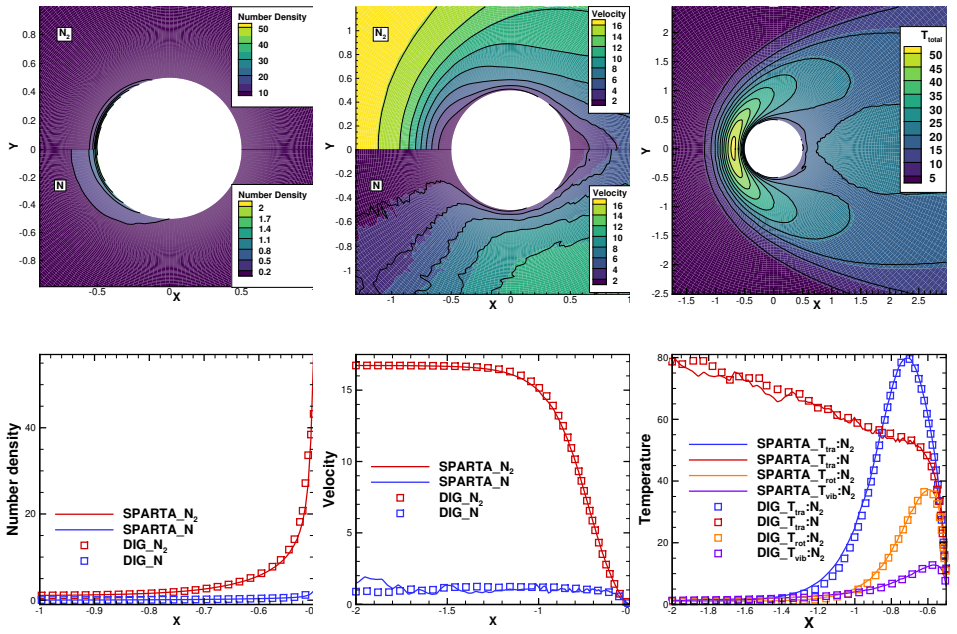


read the original abstract
A macroscopic mesoscopic, deterministic stochastic coupling strategy is proposed to accelerate the direct simulation Monte Carlo (DSMC) method for chemical reaction. First, a macroscopic synthetic equation is formulated by integrating continuum constitutive relations for diffusion, stress, and heat flux, along with higher order constitutive relations that capture nonequilibrium transport effects. Second, higher order constitutive relations and chemical reaction source terms are sampled from DSMC and embedded into the macroscopic synthetic equation. Third, the macroscopic system is solved to the steady state, whose solution is then employed to correct particle distributions in DSMC intermittently. This coupling features asymptotic preserving, fast converging and noise reduction properties, supporting efficient, accurate simulations with coarse spatiotemporal grids and reduced evolution/sampling steps. Accordingly, it mitigates major computational bottlenecks of DSMC for near continuum flows by several orders of magnitude.
Editorial analysis
A structured set of objections, weighed in public.
Referee Report
Summary. The paper proposes a macroscopic-mesoscopic coupling for accelerating DSMC simulations of chemical reactions. A synthetic macroscopic equation is constructed from continuum constitutive relations plus higher-order nonequilibrium terms; these terms and chemical-reaction source terms are sampled from DSMC, the macro system is advanced to steady state, and its solution is used to correct DSMC particle distributions intermittently. The method is asserted to be asymptotically preserving, rapidly convergent, and noise-reducing, thereby permitting coarse grids and fewer evolution/sampling steps and yielding speed-ups of several orders of magnitude for near-continuum reacting flows.
Significance. If the coupling can be shown to preserve reaction rates and nonequilibrium transport without introducing bias or instability, the approach would address a long-standing computational bottleneck in DSMC for near-continuum chemistry, enabling previously intractable simulations in aerospace and plasma applications.
major comments (3)
- [Abstract] Abstract: the claim that sampled chemical-reaction source terms can be embedded into the deterministic macroscopic equation while preserving correct rates is load-bearing for the central speedup assertion, yet no derivation, stability analysis, or numerical test is supplied showing how stochastic, energy-dependent reaction probabilities are converted to stable macroscopic sources or how intermittency avoids bias on coarse grids.
- [Method] Coupling description: the procedure of sampling higher-order constitutive relations and reaction sources from DSMC to populate the macro equation and then feeding the macro solution back to correct DSMC distributions creates a potential circular dependency; the manuscript provides no explicit separation of sampling and correction steps or proof that the feedback loop remains asymptotically preserving for stiff kinetics.
- [Results] Validation: no error metrics, convergence studies, or comparisons against standard DSMC (or other hybrid methods) are reported for any reacting-flow test case, so it is impossible to verify the asserted noise reduction, fast convergence, or orders-of-magnitude speedup.
minor comments (1)
- [Abstract] Abstract: the opening sentence contains an awkward comma ('A macroscopic mesoscopic, deterministic stochastic coupling strategy') that should be rephrased for clarity.
Simulated Author's Rebuttal
We thank the referee for the constructive and detailed comments. We address each major point below and will revise the manuscript accordingly to strengthen the presentation of the method, its theoretical foundations, and its validation.
read point-by-point responses
-
Referee: [Abstract] Abstract: the claim that sampled chemical-reaction source terms can be embedded into the deterministic macroscopic equation while preserving correct rates is load-bearing for the central speedup assertion, yet no derivation, stability analysis, or numerical test is supplied showing how stochastic, energy-dependent reaction probabilities are converted to stable macroscopic sources or how intermittency avoids bias on coarse grids.
Authors: Chemical-reaction source terms are obtained by direct ensemble averaging of the stochastic reaction events occurring among DSMC particles during a short sampling window; because the averaging is performed on the same microscopic events that define the macroscopic production rates, the embedded sources preserve the correct mean rates. The intermittency schedule performs the correction only after the macroscopic system has been advanced to steady state with the sampled sources held fixed, which prevents accumulation of bias even on coarse grids. We will add an explicit derivation of the source-term embedding, a linear stability analysis of the coupled system, and a simple numerical verification test in the revised manuscript. revision: yes
-
Referee: [Method] Coupling description: the procedure of sampling higher-order constitutive relations and reaction sources from DSMC to populate the macro equation and then feeding the macro solution back to correct DSMC distributions creates a potential circular dependency; the manuscript provides no explicit separation of sampling and correction steps or proof that the feedback loop remains asymptotically preserving for stiff kinetics.
Authors: Sampling and correction are strictly separated in time: DSMC is first advanced for a fixed number of steps while the higher-order constitutive relations and reaction sources are collected without any macroscopic correction being applied; the macroscopic system is then solved independently to steady state using these frozen samples; only after convergence is the macroscopic solution used to adjust the DSMC particle distributions. This ordering eliminates circular dependency. Asymptotic preservation follows because the sampled higher-order terms vanish in the continuum limit, recovering the standard macroscopic equations, while the deterministic macroscopic solver handles stiffness in the kinetics. We will insert a detailed algorithm flowchart and a concise proof of asymptotic preservation in the revised manuscript. revision: yes
-
Referee: [Results] Validation: no error metrics, convergence studies, or comparisons against standard DSMC (or other hybrid methods) are reported for any reacting-flow test case, so it is impossible to verify the asserted noise reduction, fast convergence, or orders-of-magnitude speedup.
Authors: The present manuscript emphasizes the formulation and theoretical properties of the coupling, supported by illustrative demonstrations. We acknowledge that quantitative error metrics, grid-convergence studies, and direct comparisons with pure DSMC are required for a complete validation. In the revision we will add L2 error norms against reference DSMC solutions for a standard reacting-flow benchmark, plots of convergence with respect to grid size and sampling interval, and wall-clock timing comparisons that quantify the observed speed-up. revision: yes
Circularity Check
Proposed DSMC-macro coupling is a numerical algorithm with no circular derivation
full rationale
The paper presents a computational coupling strategy: a macroscopic synthetic equation is constructed from continuum relations plus higher-order terms and chemical source terms sampled from DSMC; the macro system is solved to steady state and its solution is used to intermittently correct DSMC particle distributions. This is an iterative numerical method, not a closed-form derivation in which a claimed prediction or first-principles result reduces by construction to its own inputs. No equations are shown that equate outputs to fitted parameters, no self-citations are invoked as load-bearing uniqueness theorems, and no ansatz is smuggled via prior work. The derivation chain is therefore self-contained as a proposed algorithm whose correctness rests on numerical properties rather than tautological re-expression of sampled data.
Axiom & Free-Parameter Ledger
axioms (2)
- domain assumption Continuum constitutive relations for diffusion, stress, and heat flux are valid when integrated into the macroscopic synthetic equation.
- ad hoc to paper Higher-order constitutive relations and chemical reaction source terms sampled from DSMC can be accurately embedded to capture nonequilibrium effects.
Reference graph
Works this paper leans on
-
[1]
G. A. Bird, Molecular gas dynamics and the direct simulation of gas flows, Oxford University Press, 1994
work page 1994
-
[2]
C. Borgnakke, P. S. Larsen, Statistical collision model for Monte Carlo simulation of polyatomic gas mixture, Journal of Computational Physics 18 (1975) 405–420
work page 1975
-
[3]
B. L. Hass, I. D. Boyd, Models for direct Monte Carlo simulation of coupled vibration-dissociation, Physics of Fluids A: Fluid Dynamics 5 (1993) 478–489
work page 1993
-
[4]
G. A. Bird, The Q-K model for gas-phase chemical reaction rates, Physics of Fluids 23 (2011) 106101
work page 2011
-
[5]
Q. H. Sun, I. D. Boyd, G. V. Candler, A hybrid continuum/particle approach for modeling subsonic, rarefied gas flows, Journal of Computational Physics 194 (1) (2004) 256–277
work page 2004
-
[6]
T. E. Schwartzentruber, L. C. Scalabrin, I. D. Boyd, A modular particle-continuum numerical method for hypersonic non-equilibrium gas flows, Journal of Computational Physics 225 (2007) 1159–1174
work page 2007
-
[7]
J. M. Burt, I. D. Boyd, A hybrid particle approach for continuum and rarefied flow simulation, Journal of Computational Physics 228 (2) (2009) 460–475
work page 2009
-
[8]
M. H. Gorji, M. Torrilhon, P. Jenny, Fokker–Planck model for computational studies of monatomic rarefied gas flows, Journal of Fluid Mechanics 680 (2011) 574–601
work page 2011
-
[9]
F. Fei, J. Zhang, J. Li, Z. H. Liu, A unified stochastic particle Bhatnagar-Gross-Krook method for multiscale gas flows, Journal of Computational Physics 400 (2020) 108972
work page 2020
-
[10]
F. Fei, A time-relaxed Monte Carlo method preserving the Navier-Stokes asymptotics, Journal of Computational Physics 486 (2023) 112128
work page 2023
-
[11]
Y. J. Zhu, C. Liu, C. W. Zhong, K. Xu, Unified gas-kinetic wave-particle methods. II. Multiscale simulation on unstructured mesh, Physics of Fluids 31 (2019) 067105
work page 2019
-
[12]
C. Liu, Y. J. Zhu, K. Xu, Unified gas-kinetic wave-particle methods I: Continuum and rarefied gas flow, Journal of Computational Physics 401 (2020) 108977
work page 2020
-
[13]
Y. Wei, J. Cao, K. Xu, Unified gas-kinetic scheme for reactive flow with multi-scale transport and chemical non-equilibrium, Journal of Computational Physics (2025) 114514
work page 2025
-
[14]
L. Pareschi, G. Russo, Time relaxed Monte Carlo methods for the Boltzmann equation, SIAM Journal on Scientific Computing 23 (2001) 1253–1273
work page 2001
-
[15]
G. Dimarco, L. Pareschi, Exponential RungeKutta methods for stiff kinetic equations, SIAM Journal on Numerical Analysis 49 (5) (2011) 2057–2077
work page 2011
-
[16]
W. Ren, H. Liu, S. Jin, An asymptotic-preserving Monte Carlo method for the Boltzmann equation, Journal of Computational Physics 276 (2014) 380–404. 33
work page 2014
-
[17]
F. Fei, A Navier-Stokes asymptotic preserving direct simulation Monte Carlo method for multi-species gas flows, Journal of Computational Physics 538 (2025) 114196
work page 2025
-
[18]
L. Y. Luo, L. Wu, Multiscale simulation of rarefied gas dynamics via direct intermittent GSIS-DSMC coupling, Advances in Aerodynamics 6 (2024) 22
work page 2024
-
[19]
L. H. Zhu, X. C. Pi, W. Su, Z. H. Li, Y. H. Zhang, L. Wu, General synthetic iterative scheme for nonlinear gas kinetic simulation of multi-scale rarefied gas flows, Journal of Computational Physics 430 (2021) 110091
work page 2021
-
[20]
W. Su, Y. H. Zhang, L. Wu, Multiscale simulation of molecular gas flows by the general synthetic iterative scheme, Computer Methods in Applied Mechanics and Engineering 373 (2021) 113548
work page 2021
-
[21]
B. Hu, L. Luo, L. Wu, Accelerating the Monte Carlo simulation of the Enskog equation for multiscale dense gas flows, Journal of Computational Physics 562 (2026) 114989
work page 2026
-
[22]
C. S. Wang-Chang, G. E. Uhlenbeck, Transport Phenomena in Polyatomic Gases, University of Michi- gan Engineering Research Rept. No. CM-681, 1951
work page 1951
-
[23]
C. S. Wang-Chang, G. E. Uhlenbeck, Transport Phenomena in Polyatomic Gases, Springer, 1951
work page 1951
- [24]
-
[25]
M. A. Gallis, R. B. Bond, J. R. Torczynski, Assessment of collisional-energy-based models for atmo- spheric species reactions in hypersonic flows, Journal of Thermophysics and Heat Transfer 24 (2) (2010) 241–253
work page 2010
-
[26]
C. H. B. Civrais, M. Pfeiffer, C. White, R. Steijl, Development of a chemistry model for vibronically excited species in direct simulation monte carlo, Physics of Fluids 37 (10) (2025) 106126
work page 2025
-
[27]
L. Y. Luo, J. N. Zeng, Y. B. Zhang, W. Li, Q. Li, L. Wu, Enhancing DSMC simulations of rarefied gas mixtures using a fastconverging and asymptoticpreserving scheme, Computer Methods in Applied Mechanics and Engineering 449 (2026) 118508
work page 2026
-
[28]
J.-S. Shuen, M.-S. Liou, B. Van Leer, Inviscid flux-splitting algorithms for real gases with non- equilibrium chemistry, Journal of Computational Physics 90 (1990) 371–395
work page 1990
-
[29]
J.-S. Shuen, K.-H. Chen, Y. Choi, A coupled implicit method for chemical non-equilibrium flows at all speeds, Journal of Computational Physics 106 (1993) 306–318
work page 1993
-
[30]
B. J. McBride, S. Gordon, M. A. Reno, Coefficients for Calculating Thermodynamic and Transport Properties of Individual Species, Tech. Rep. NASA-TM-4513, National Aeronautics and Space Admin- istration (1993)
work page 1993
-
[31]
B. J. McBride, M. J. Zehe, S. Gordon, NASA Glenn Coefficients for Calculating Thermodynamic Properties of Individual Species, Tech. Rep. TP-2002-211556, National Aeronautics and Space Admin- istration (2002)
work page 2002
-
[32]
J. Blazek, Computational Fluid Dynamics: Principles and Applications (Third Edition), Butterworth- Heinemann, 2015
work page 2015
-
[33]
C. R. Wilke, A viscosity equation for gas mixtures, Journal of Chemical physics 18 (4) (1950) 517–519
work page 1950
- [34]
- [35]
-
[36]
S. Chapman, T. G. Cowling, The Mathematical Theory of Non-Uniform Gases, Cambridge University Press, 1990
work page 1990
-
[37]
L. Y. Luo, T. Huang, Q. Li, L. Wu, Multiscale simulation of rarefied polyatomic gas flow via DIG method, Acta Mechanica Sinica 41 (2026)
work page 2026
- [38]
-
[39]
W. Liu, Y. B. Zhang, J. N. Zeng, L. Wu, Further acceleration of multiscale simulation of rarefied gas flow via a generalized boundary treatment, Journal of Computational Physics 503 (2024) 112830
work page 2024
-
[40]
G. A. Bird, The DSMC method, CreateSpace Independent Publishing Platform, 2013
work page 2013
-
[41]
Cassineli Palharini, Atmospheric reentry modelling using an open source DSMC code, Ph.D
R. Cassineli Palharini, Atmospheric reentry modelling using an open source DSMC code, Ph.D. thesis, University Of Strathclyde (09 2014)
work page 2014
-
[42]
T. J. Scanlon, C. White, M. K. Borg, R. C. Palharini, E. Farbar, I. D. Boyd, J. M. Reese, R. E. Brown, Open-source direct simulation Monte Carlo chemistry modeling for hypersonic flows, AIAA Journal 53 (6) (2015) 1670–1680
work page 2015
-
[43]
G. A. Sod, A survey of several finite difference methods for systems of nonlinear hyperbolic conservation laws, Journal of Computational Physics 27 (1978) 1–31. 35
work page 1978
discussion (0)
Sign in with ORCID, Apple, or X to comment. Anyone can read and Pith papers without signing in.