Recognition: unknown
Calorimetric approach to paleo-detection of dark matter
Pith reviewed 2026-05-14 17:54 UTC · model grok-4.3
The pith
Combining track lengths with lattice vacancy counts in mineral samples lets paleo-detectors distinguish dark matter recoils from neutron backgrounds and reach cross-section sensitivities of order 10^{-48} cm^{2}.
A machine-rendered reading of the paper's core claim, the machinery that carries it, and where it could break.
Core claim
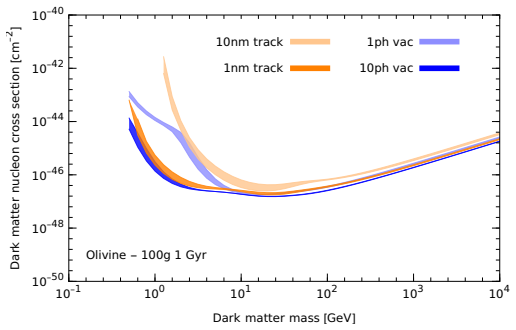
Using full-cascade SRIM simulations the authors show that a vacancy-only readout already reaches sensitivities similar to track-only analyses; combining the two observables supplies a proxy for |dE/dx| and therefore for the recoiling nuclear species, suppressing the neutron background by more than an order of magnitude and yielding spin-independent dark-matter–nucleon cross sections of order 10^{-48} cm^{2} at WIMP masses of a few tens of GeV for a 100 gGyr exposure.
What carries the argument
Dual readout of track length plus number of stable lattice vacancies, serving as a per-event proxy for |dE/dx| to identify the recoiling nucleus.
Load-bearing premise
Full-cascade SRIM simulations correctly predict the number of stable lattice vacancies created by each recoil and these vacancies remain measurable as a reliable per-event observable in olivine.
What would settle it
An experimental calibration showing that the measured vacancy count in olivine does not scale with |dE/dx| as predicted by SRIM, or that the combined observables fail to suppress the neutron background in a controlled sample.
Figures




read the original abstract
We present the first paleo-detector dark matter sensitivity analysis based on a calorimetric readout, in which the number of stable lattice vacancies produced by each nuclear recoil is used as a per-event observable complementary to the track length. Using full-cascade SRIM simulations in olivine, we compute the expected sensitivity for a 100 gGyr exposure. We find that a vacancy-only readout reaches a sensitivity envelope very similar to that of state-of-the-art track-only analyses. The combination of the two observables provides an event-by-event proxy for |dE/dx| and hence for the recoiling nuclear species. Since the neutron-nucleus cross section is approximately flat in nuclear mass while the dark-matter--nucleus cross section scales as $A^2$, this discrimination suppresses the dominant neutron background by more than an order of magnitude at moderate dark matter masses. The combined-analysis sensitivity reaches spin-independent dark-matter--nucleon cross sections of order $10^{-48}\,\mathrm{cm}^2$ at WIMP masses of a few tens of GeV, comparable to future direct detection experiments. A two-stage readout combining selective-plane illumination microscopy with scanning electron microscopy is identified as a path to making a 100 g-scale analysis plausible.
Editorial analysis
A structured set of objections, weighed in public.
Referee Report
Summary. The paper proposes a calorimetric paleo-detection approach for dark matter in which the number of stable lattice vacancies produced by nuclear recoils in olivine serves as a per-event observable complementary to track length. Using full-cascade SRIM simulations, the authors compute sensitivities for a 100 gGyr exposure and show that combining the two observables provides an event-by-event proxy for dE/dx (and thus recoiling nuclear species), enabling neutron background suppression via the differing A-dependence of DM-nucleus versus neutron-nucleus cross sections. They project spin-independent DM-nucleon cross-section sensitivities of order 10^{-48} cm² at WIMP masses of a few tens of GeV, comparable to future direct-detection experiments, and identify a two-stage microscopy readout as a practical path forward.
Significance. If the SRIM-based vacancy predictions prove accurate, the combined observable would constitute a genuine advance in paleo-detection by adding background discrimination power without requiring larger exposures. The explicit identification of a feasible readout technology strengthens the practical relevance of the projected reach.
major comments (2)
- [SRIM simulation description and sensitivity calculation] The central sensitivity projections rest on SRIM predictions of stable lattice vacancy counts in olivine; no experimental calibration, cross-check, or uncertainty band for vacancy production is presented, leaving the calorimetric observable unvalidated at the level required for the claimed background rejection.
- [Background discrimination and combined-analysis results] The order-of-magnitude neutron suppression is derived from the A² scaling of the DM cross section versus the flatter neutron cross section, but the paper does not quantify the overlap between signal and background distributions in the combined (vacancy, track-length) plane or the resulting signal efficiency after cuts.
minor comments (2)
- [Results section] The abstract states that the vacancy-only readout reaches sensitivities 'very similar' to track-only analyses; the main text should include a direct side-by-side comparison plot or table with numerical values.
- [Method section] Notation for the vacancy observable (e.g., whether it is total vacancies or vacancies per unit track length) should be defined explicitly at first use and used consistently.
Simulated Author's Rebuttal
We thank the referee for their careful review and constructive feedback. We address each major comment below and have revised the manuscript to strengthen the presentation of the SRIM-based results and the background discrimination analysis.
read point-by-point responses
-
Referee: The central sensitivity projections rest on SRIM predictions of stable lattice vacancies in olivine; no experimental calibration, cross-check, or uncertainty band for vacancy production is presented, leaving the calorimetric observable unvalidated at the level required for the claimed background rejection.
Authors: We agree that experimental calibration would provide the strongest validation of the vacancy observable. As this work is a theoretical sensitivity study, we have added a new subsection reviewing existing SRIM validation benchmarks for similar mineral targets in the literature, together with conservative uncertainty bands obtained by varying key simulation parameters such as displacement threshold energies. Within these bands the projected neutron suppression and sensitivity reach remain stable, although we explicitly note that dedicated experimental calibration would be a valuable next step. revision: partial
-
Referee: The order-of-magnitude neutron suppression is derived from the A² scaling of the DM cross section versus the flatter neutron cross section, but the paper does not quantify the overlap between signal and background distributions in the combined (vacancy, track-length) plane or the resulting signal efficiency after cuts.
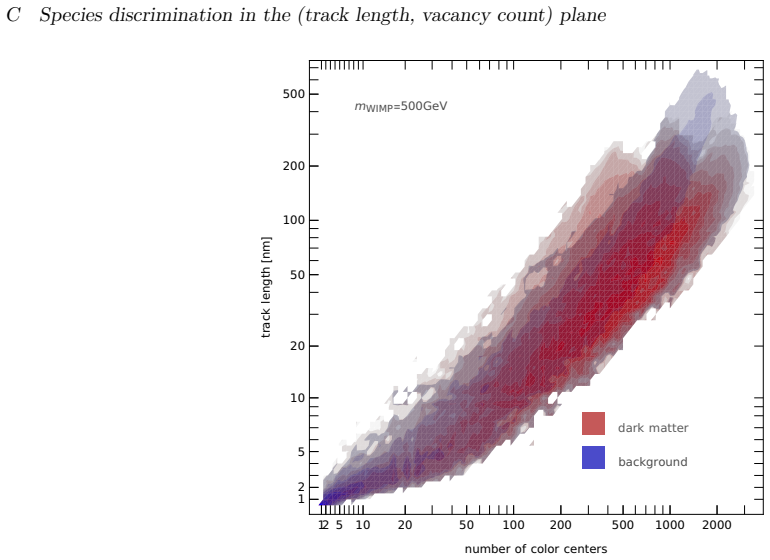
Authors: We have performed the requested quantification and added new figures and text to the revised manuscript. The two-dimensional distributions of signal and neutron background events in the (vacancy count, track length) plane are now shown explicitly, together with the optimized cut contours. The resulting signal efficiency after cuts is 65–80 % across the relevant WIMP mass range while preserving the order-of-magnitude neutron suppression, confirming that the quoted sensitivity is achievable with realistic selection efficiencies. revision: yes
Circularity Check
No significant circularity; relies on external SRIM simulations
full rationale
The paper computes sensitivity using full-cascade SRIM simulations (external code) to predict stable lattice vacancies in olivine as a per-event observable, combined with standard nuclear recoil cross-section scalings (A^2 for DM-nucleus, approximately flat for neutrons). No derivation step reduces by the paper's own equations to a quantity fitted from its own data, and no self-citation is load-bearing for the central sensitivity claim. The result is self-contained against external benchmarks.
Axiom & Free-Parameter Ledger
axioms (2)
- domain assumption SRIM simulations accurately model the production of stable lattice vacancies by nuclear recoils in olivine
- domain assumption Neutron-nucleus cross section is approximately flat in nuclear mass while dark-matter--nucleus cross section scales as A²
Reference graph
Works this paper leans on
-
[2]
Fossil tracks of charged particles in mica and the age of minerals,
P. B. Price and R. M. Walker, “Fossil tracks of charged particles in mica and the age of minerals,” Journal of Geophysical Research68, 4847–4862 (1963)
work page 1963
-
[3]
G. A. Wagner and P. Van den haute,Fission Track Dating(Ferdinand Enke Verlag, Stuttgart, 1992)
work page 1992
-
[4]
Fission track dating of phosphate minerals and the thermochronology of apatite,
A. J. W. Gleadow, D. X. Belton, B. P. Kohn, and R. W. Brown, “Fission track dating of phosphate minerals and the thermochronology of apatite,” Reviews in Mineralogy and Geochemistry48, 579–630 (2002)
work page 2002
-
[5]
Search for magnetic monopoles in deep ocean deposits,
R. L. Fleischer, Jr. Hart, H. R., I. S. Jacobs, P. B. Price, W. M. Schwarz, and F. Aumento, “Search for magnetic monopoles in deep ocean deposits,” Physical Review184, 1393–1397 (1969)
work page 1969
-
[6]
Search for supermassive magnetic monopoles using mica crystals,
P. B. Price and M. H. Salamon, “Search for supermassive magnetic monopoles using mica crystals,” Physical Review Letters56, 1226–1229 (1986)
work page 1986
-
[7]
Compositional dependence of the formation of nuclear tracks in muscovite mica,
D. P. Snowden-Ifft, M. K. Y. Chan, and R. Frenkel, “Compositional dependence of the formation of nuclear tracks in muscovite mica,” Phys. Rev. Lett.74, 4133–4136 (1995)
work page 1995
-
[8]
Paleo-detectors: Searching for Dark Matter with Ancient Minerals
Andrzej K. Drukier, Sebastian Baum, Katherine Freese, Maciej G´ orski, and Patrick Stengel, “Paleo-detectors: Searching for Dark Matter with Ancient Minerals,” Phys. Rev. D99, 043014 (2019), arXiv:1811.06844 [astro-ph.CO]
work page internal anchor Pith review Pith/arXiv arXiv 2019
-
[9]
Searching for Dark Matter with Paleo-Detectors,
Sebastian Baum, Andrzej K. Drukier, Katherine Freese, Maciej G´ orski, and Patrick Stengel, “Searching for Dark Matter with Paleo-Detectors,” Phys. Lett. B803, 135325 (2020), arXiv:1806.05991 [astro-ph.CO]
-
[10]
Mineral detection of neutrinos and dark matter. A whitepaper,
Sebastian Baumet al., “Mineral detection of neutrinos and dark matter. A whitepaper,” Phys. Dark Univ.41, 101245 (2023), arXiv:2301.07118 [astro-ph.IM]
-
[11]
DARWIN: towards the ultimate dark matter detector,
J. Aalberset al.(DARWIN), “DARWIN: towards the ultimate dark matter detector,” JCAP11, 017 (2016)
work page 2016
-
[12]
The XLZD Design Book: Towards the Next-Generation Dark Matter Observatory,
J. Aalberset al.(XLZD), “The XLZD Design Book: Towards the Next-Generation Dark Matter Observatory,” (2024)
work page 2024
-
[13]
Measuring Changes in the Atmospheric Neutrino Rate Over Gigayear Timescales,
Johnathon R. Jordan, Sebastian Baum, Patrick Stengel, Alfredo Ferrari, Maria Cristina Morone, Paola Sala, and Joshua Spitz, “Measuring Changes in the Atmospheric Neutrino Rate Over Gigayear Timescales,” Phys. Rev. Lett.125, 231802 (2020), arXiv:2004.08394 [hep-ph]
-
[14]
Measuring solar neutrinos over gigayear timescales with paleo detectors,
Natalia Tapia-Arellano and Shunsaku Horiuchi, “Measuring solar neutrinos over gigayear timescales with paleo detectors,” Phys. Rev. D103, 123016 (2021), arXiv:2102.01755 [hep-ph]
-
[15]
Rocks, water, and noble liquids: Unfolding the flavor contents of supernova neutrinos,
Sebastian Baum, Francesco Capozzi, and Shunsaku Horiuchi, “Rocks, water, and noble liquids: Unfolding the flavor contents of supernova neutrinos,” Phys. Rev. D106, 123008 (2022), arXiv:2203.12696 [hep-ph]
-
[16]
Lorenzo Caccianiga, Lorenzo Apollonio, Federico Maria Mariani, Paolo Magnani, Claudio Galelli, and Alessandro Veutro, “Sedimentary rocks from Mediterranean drought in the Messinian age as a probe of the past cosmic ray flux,” Phys. Rev. D110, L121301 (2024), arXiv:2405.04908 [astro-ph.HE]
-
[17]
Claudio Galelli, Lorenzo Caccianiga, Lorenzo Apollonio, Paolo Magnani, and Vincent Breton, “A volcanic chronosequence as a time-resolved paleo-detector array to study the cosmic-ray flux in the late Pleistocene and Holocene,” JCAP04, 023 (2026), arXiv:2510.23126 [astro-ph.HE]
-
[18]
New Projections for Dark Matter Searches with Paleo-Detectors,
S. Baum, T. D. P. Edwards, K. Freese, and P. Stengel, “New Projections for Dark Matter Searches with Paleo-Detectors,” Instruments5, 21 (2021), arXiv:2106.06559 [astro-ph.CO]
-
[19]
Refining the sensitivity of new physics searches with ancient minerals,
A. Fung, T. Lucas, L. Balogh, M. Leybourne, and A. C. Vincent, “Refining the sensitivity of new physics searches with ancient minerals,” Phys. Rev. D112, 043040 (2025), arXiv:2504.08885 [hep-ph]
-
[20]
Passive Low-Energy Nuclear-Recoil Detection with Color Centers,
B. K. Cogswell, A. Goel, and P. Huber, “Passive Low-Energy Nuclear-Recoil Detection with Color Centers,” Phys. Rev. Applied16, 064060 (2021), arXiv:2104.13926 [physics.ins-det]
-
[21]
Nuclear recoil detection with color centers in bulk lithium fluoride,
G. R. Araujoet al.(PALEOCCENE), “Nuclear recoil detection with color centers in bulk lithium fluoride,” (2025), arXiv:2503.20732 [physics.ins-det]
-
[22]
Benchtop mesoSPIM: a next-generation open-source light-sheet microscope for cleared samples,
N. Vladimirovet al., “Benchtop mesoSPIM: a next-generation open-source light-sheet microscope for cleared samples,” Nature Communications (2024), 10.1038/s41467-024-46770-2
-
[23]
The CMS experiment at the CERN LHC,
S. Chatrchyanet al.(CMS), “The CMS experiment at the CERN LHC,” JINST3, S08004 (2008)
work page 2008
-
[24]
The ATLAS Experiment at the CERN Large Hadron Collider,
G. Aadet al.(ATLAS), “The ATLAS Experiment at the CERN Large Hadron Collider,” JINST3, S08003 (2008)
work page 2008
-
[25]
SRIM – The Stopping and Range of Ions in Matter (2010),
J. F. Ziegler, M. D. Ziegler, and J. P. Biersack, “SRIM – The Stopping and Range of Ions in Matter (2010),” Nucl. Instrum. Meth. B268, 1818–1823 (2010). 13
work page 2010
-
[26]
On the use of SRIM for computing radiation damage exposure,
S. Agarwal, Y. Lin, C. Li, R. E. Stoller, and S. J. Zinkle, “On the use of SRIM for computing radiation damage exposure,” Nucl. Instrum. Meth. B503, 11–29 (2021)
work page 2021
-
[27]
J. Billard, L. Strigari, and E. Figueroa-Feliciano, “Implication of neutrino backgrounds on the reach of next generation dark matter direct detection experiments,” Phys. Rev. D89, 023524 (2014), arXiv:1307.5458 [hep-ph]
work page internal anchor Pith review Pith/arXiv arXiv 2014
-
[28]
O’Hare,New Definition of the Neutrino Floor for Direct Dark Matter Searches,Phys
Ciaran A. J. O’Hare, “New definition of the neutrino floor for direct dark matter searches,” Phys. Rev. Lett.127, 251802 (2021), arXiv:2109.03116 [hep-ph]
-
[29]
Comparison of ion-beam irradiation effects in xsub 2yosub 4 compounds,
L Wang, W Gong, S Wang, and R C Ewing, “Comparison of ion-beam irradiation effects in xsub 2yosub 4 compounds,” Journal of the American Ceramic Society82(1999)
work page 1999
-
[30]
Sputter- ing of grains in c-type shocks,
P. W. May, G. Pineau des Forˆ ets, D. R. Flower, D. Field, N. L. Allan, and J. A. Purton, “Sputter- ing of grains in c-type shocks,” Monthly Notices of the Royal Astronomical Society318, 809–816 (2000), https://academic.oup.com/mnras/article-pdf/318/3/809/3474381/318-3-809.pdf
work page 2000
-
[31]
thesis, Institut d’Astrophysique Spatiale (2014)
Marco Bocchio,Modelling Dust Processing and Evolution in Extreme Environments as seen by Herschel Space Observatory, Ph.D. thesis, Institut d’Astrophysique Spatiale (2014)
work page 2014
-
[32]
Webmineral Mineralogy Database, “Olivine Mineral Data,”https://webmineral.com/data/Olivine.shtml, accessed: 2026-05-07
work page 2026
-
[33]
Optical properties of some F-aggregate centers in LiF,
J. Nahum and D. A. Wiegand, “Optical properties of some F-aggregate centers in LiF,” Physical Review154, 817–830 (1967)
work page 1967
-
[34]
Optical bands of F 2 and F + 3 color centers in LiF,
G. Baldacchini, M. Cremona, G. d’Auria, R. M. Montereali, and V. Kalinov, “Optical bands of F 2 and F + 3 color centers in LiF,” Physical Review B54, 17508–17516 (1996)
work page 1996
-
[35]
A. M. Zaitsev,Optical Properties of Diamond: A Data Handbook(Springer, Berlin, Heidelberg, 2001)
work page 2001
-
[36]
Silicon carbide color centers for quantum applications,
S. Castelletto and A. Boretti, “Silicon carbide color centers for quantum applications,” Journal of Physics: Photonics2, 022001 (2020)
work page 2020
-
[37]
Inelastic and Elastic Scattering of 187-Mev Electrons from Selected Even-Even Nuclei,
R. H. Helm, “Inelastic and Elastic Scattering of 187-Mev Electrons from Selected Even-Even Nuclei,” Phys. Rev.104, 1466–1475 (1956)
work page 1956
-
[38]
J. D. Lewin and P. F. Smith, “Review of mathematics, numerical factors, and corrections for dark matter experiments based on elastic nuclear recoil,” Astropart. Phys.6, 87–112 (1996)
work page 1996
-
[39]
The RAVE Survey: Constraining the Local Galactic Escape Speed
M. C. Smithet al., “The RAVE Survey: Constraining the Local Galactic Escape Speed,” Mon. Not. Roy. Astron. Soc. 379, 755–772 (2007), arXiv:astro-ph/0611671
work page internal anchor Pith review Pith/arXiv arXiv 2007
-
[40]
J. I. Read, “The Local Dark Matter Density,” J. Phys. G41, 063101 (2014), arXiv:1404.1938 [astro-ph.GA]
work page internal anchor Pith review Pith/arXiv arXiv 2014
-
[41]
Dark Matter Search Results from 4.2 Tonne-Years of Exposure of the LUX-ZEPLIN (LZ) Experiment,
J. Aalberset al.(LZ), “Dark Matter Search Results from 4.2 Tonne-Years of Exposure of the LUX-ZEPLIN (LZ) Experi- ment,” (2024), arXiv:2410.17036 [hep-ex]
-
[42]
The CMS Data Acquisition System for the Phase-2 Upgrade
A. Zabiet al., “The CMS data acquisition system for the Phase-2 upgrade,” Proceedings of Science (Topical Workshop on Electronics for Particle Physics 2018) (2019), 10.22323/1.343.0129, arXiv:1806.08975
work page internal anchor Pith review Pith/arXiv arXiv doi:10.22323/1.343.0129 2018
-
[43]
Imaging nuclear recoil damage in minerals with light-sheet microscopy,
Samuel Hedges, “Imaging nuclear recoil damage in minerals with light-sheet microscopy,” Talk presented at the MDνDM 2026 – Mineral Detection of Neutrinos and Dark Matter workshop Karlsruhe, Germany (2026)
work page 2026
-
[44]
A petavoxel fragment of human cerebral cortex reconstructed at nanoscale resolution,
A. Shapson-Coeet al., “A petavoxel fragment of human cerebral cortex reconstructed at nanoscale resolution,” Science 384, eadk4858 (2024). 14
work page 2024
discussion (0)
Sign in with ORCID, Apple, or X to comment. Anyone can read and Pith papers without signing in.