Recognition: unknown
Air-Sea Surface Modeling and Operating Link Range Evaluation for AUV-to-UAV Optical Wireless Communication Links
Pith reviewed 2026-05-14 17:54 UTC · model grok-4.3
The pith
A simplified analytical model of ocean waves enables range and capacity predictions for light-based links from underwater drones to aerial drones.
A machine-rendered reading of the paper's core claim, the machinery that carries it, and where it could break.
Core claim
We present a tractable analytical representation of the ECKV model for sea-surface roughness and validate it against measured sea-state data. Using this representation together with the Cox-Munk model, we evaluate the ergodic capacity of AUV-to-UAV optical wireless communication links via analytical expressions and Monte Carlo methods, with emphasis on the effects of operating range, pointing errors, receiver field-of-view, and solar noise level.
What carries the argument
The tractable analytical form of the Elfouhaily-Chapron-Katsaros-Vandemark (ECKV) sea-surface spectrum, which models wave-induced distortions to the optical beam in the vertical air-sea path.
If this is right
- The derived analytical model allows rapid computation of link performance without extensive simulations.
- Link capacity decreases with increasing operating range and solar noise.
- Pointing errors and limited receiver field-of-view impose additional constraints on achievable rates.
- Both Cox-Munk and simplified ECKV models provide consistent insights into sea surface effects for system design.
Where Pith is reading between the lines
- Designers could use the model to optimize wavelength or power for different sea conditions.
- The approach may extend to links involving surface vehicles or multiple hops.
- Real-time adaptation based on measured sea state could improve link reliability in varying conditions.
Load-bearing premise
The Cox-Munk and ECKV statistical models continue to accurately represent the optical distortions caused by sea surface roughness in vertical underwater-to-air paths.
What would settle it
Direct measurement of the ergodic capacity in a real AUV-UAV optical link over a range of sea states, compared against the model's predictions for the same conditions.
Figures




read the original abstract
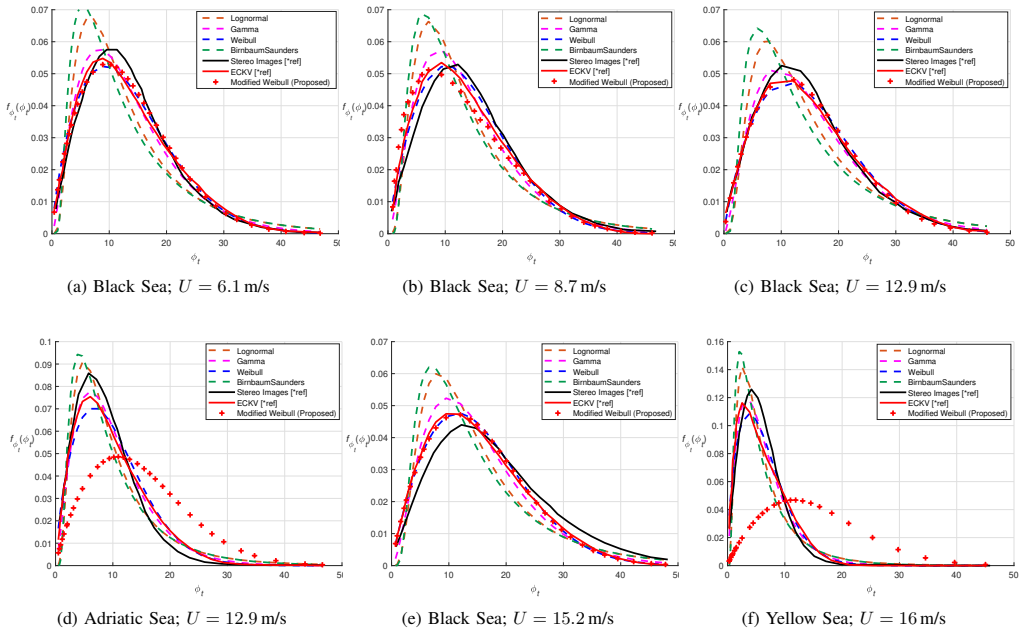
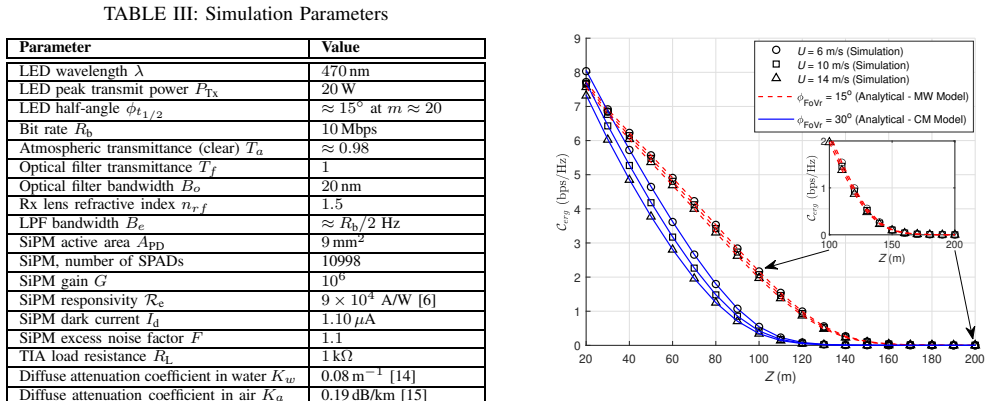
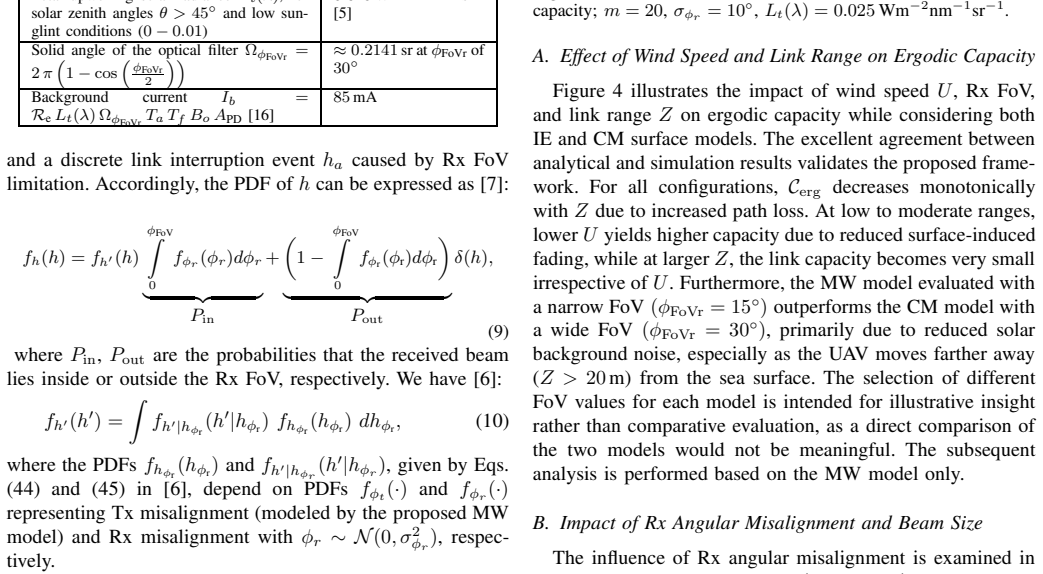
Air-sea surface interactions play a critical role in underwater-to-air optical wireless communication (OWC) links, particularly in vertical autonomous underwater vehicle (AUV) to unmanned aerial vehicle (UAV) scenarios, where the stochastic nature of the sea surface introduces optical distortions that impair link reliability. This work investigates the impact of air-sea surface roughness on AUV-to-UAV OWC systems using two experimentally validated models: the classical Cox-Munk and the Elfouhaily-Chapron-Katsaros-Vandemark (ECKV). A tractable analytical representation of the ECKV model is derived and validated against measured sea-state data. Using both analytical and Monte Carlo approaches, the link ergodic capacity is evaluated with particular emphasis on operating range, pointing errors, receiver field-of-view, and solar noise level, providing practical system design insights.
Editorial analysis
A structured set of objections, weighed in public.
Referee Report
Summary. The paper models air-sea surface roughness for vertical AUV-to-UAV optical wireless communication links using the Cox-Munk and ECKV spectra. It derives a tractable analytical simplification of the ECKV model, validates this representation against measured sea-state data, and evaluates link ergodic capacity via both analytical expressions and Monte Carlo simulation, with emphasis on operating range, pointing errors, receiver field-of-view, and solar noise.
Significance. If the derivations and validations hold, the work supplies concrete system-design guidance for maritime OWC links by quantifying how sea-surface statistics limit capacity and range, which is useful for AUV-UAV operations where optical links must contend with dynamic surface distortions.
major comments (3)
- [ECKV simplification section] The derivation of the tractable ECKV representation (likely §3 or equivalent) must include an explicit side-by-side comparison of key statistics (slope variance, PDF moments) between the simplified form and the original ECKV spectrum to demonstrate that essential propagation statistics are preserved; without this, the claim that the simplification introduces no material error remains unverified.
- [Validation section] Validation against measured sea-state data (likely §4) reports agreement but omits quantitative metrics (RMSE, Kolmogorov-Smirnov statistic, or error bars on fitted parameters) and the exact sea-state conditions (wind speed range, fetch) used; these details are required to confirm that the model is not over-fitted and that the subsequent capacity curves are not sensitive to post-hoc parameter choices.
- [Capacity evaluation section] The ergodic-capacity evaluation (analytical vs. Monte Carlo) assumes the Cox-Munk and ECKV roughness models remain accurate descriptors for the vertical geometry; a sensitivity test or literature citation addressing whether these spectra, calibrated for horizontal paths, introduce bias in the vertical AUV-UAV case is needed to support the operating-range claims.
minor comments (2)
- Figure captions should explicitly state the wind-speed values and sea-state parameters corresponding to each plotted curve.
- Notation for the pointing-error angle and receiver FOV should be defined consistently in the text and equations.
Simulated Author's Rebuttal
We thank the referee for the constructive comments, which help improve the clarity and rigor of our work on air-sea surface modeling for AUV-to-UAV optical links. We address each major comment point by point below.
read point-by-point responses
-
Referee: [ECKV simplification section] The derivation of the tractable ECKV representation (likely §3 or equivalent) must include an explicit side-by-side comparison of key statistics (slope variance, PDF moments) between the simplified form and the original ECKV spectrum to demonstrate that essential propagation statistics are preserved; without this, the claim that the simplification introduces no material error remains unverified.
Authors: We agree that an explicit comparison strengthens the claim. In the revised manuscript, we will add a table in the ECKV simplification section comparing slope variance, PDF moments, and other key statistics between the original ECKV spectrum and our tractable analytical form, confirming that essential propagation statistics are preserved with negligible deviation. revision: yes
-
Referee: [Validation section] Validation against measured sea-state data (likely §4) reports agreement but omits quantitative metrics (RMSE, Kolmogorov-Smirnov statistic, or error bars on fitted parameters) and the exact sea-state conditions (wind speed range, fetch) used; these details are required to confirm that the model is not over-fitted and that the subsequent capacity curves are not sensitive to post-hoc parameter choices.
Authors: We thank the referee for this observation. The revised validation section will incorporate quantitative metrics including RMSE and Kolmogorov-Smirnov statistics, error bars on fitted parameters, and explicit details on the sea-state conditions such as wind speed range and fetch lengths from the measured data. revision: yes
-
Referee: [Capacity evaluation section] The ergodic-capacity evaluation (analytical vs. Monte Carlo) assumes the Cox-Munk and ECKV roughness models remain accurate descriptors for the vertical geometry; a sensitivity test or literature citation addressing whether these spectra, calibrated for horizontal paths, introduce bias in the vertical AUV-UAV case is needed to support the operating-range claims.
Authors: The Cox-Munk and ECKV spectra model intrinsic surface slope statistics that are independent of link geometry. To address the concern directly, the revised capacity evaluation section will include relevant literature citations on vertical maritime OWC applications and a brief sensitivity discussion confirming applicability to the AUV-UAV vertical case. revision: yes
Circularity Check
No circularity: derivation uses external models with independent validation
full rationale
The paper starts from the established Cox-Munk and ECKV roughness spectra (externally validated in prior literature), derives a tractable analytical simplification of ECKV, and validates that simplification directly against measured sea-state data. Ergodic capacity is then computed from the resulting model via both closed-form analysis and Monte Carlo simulation; no parameters of the capacity expression are fitted back to the same sea-state data used for model validation, and no self-citation chain is invoked to justify the core modeling choices. The derivation chain therefore remains independent of its own outputs.
Axiom & Free-Parameter Ledger
axioms (1)
- domain assumption Sea-surface roughness statistics are adequately captured by the Cox-Munk and ECKV spectra for optical propagation calculations
Reference graph
Works this paper leans on
-
[1]
B. R. Angara, P . Shanmugam, and H. Ramachandran, “Influen ce of sea surface waves and bubbles on the performance of underwat er-to-air optical wireless communication system,” Optics & Laser Technology , vol. 174, p. 110652, 2024
work page 2024
-
[2]
Optical wireless communication based smart ocean sensor networks for environmental monitoring,
I. C. Ijeh, “Optical wireless communication based smart ocean sensor networks for environmental monitoring,” Second White Paper of NEW- FOCUS COST Action 19111 , pp. 39–42, 2023
work page 2023
-
[3]
Underwater optical wireless communi- cation,
H. Kaushal and G. Kaddoum, “Underwater optical wireless communi- cation,” IEEE Access , vol. 4, pp. 1518–1547, Apr. 2016
work page 2016
-
[4]
I. C. Ijeh, M. A. Khalighi, M. Elamassie, S. Hranilovic, a nd M. Uysal, “Outage probability analysis of a vertical underwater wire less optical link subject to oceanic turbulence and pointing errors,” IEEE/OSA J. Opt. Commun. Netw. , vol. 14, no. 6, pp. 439–453, 2022
work page 2022
-
[5]
B. R. Angara, P . Shanmugam, H. Ramachandran, and C. G. San dhani, “Performance assessment of underwater-to-air optical wir eless commu- nication system with the effect of solar noise and sea surfac e conditions,” IEEE Access , vol. 12, pp. 79 652–79 666, 2024
work page 2024
-
[6]
I. C. Ijeh, M. A. Khalighi, and S. Hranilovic, “Parameter optimization for an underwater optical wireless vertical link subject to link misalign- ments,” IEEE J. Ocean. Eng. , vol. 46, no. 4, pp. 1424–1437, 2021
work page 2021
-
[7]
I. C. Ijeh, O. Haddad, and M. A. Khalighi, “Ergodic capaci ty of a vertical underwater wireless optical communication link subject to misalign- ment,” in IEEE W est Asian Symposium on Optical and Millimeter-wave Wireless Communications (WASOWC), 2022, pp. 1–5
work page 2022
-
[8]
Revisit ing the Cox and Munk wave-slope statistics using IASI observations of the s ea surface,
C.-A. Gu´ erin, V . Capelle, and J.-M. Hartmann, “Revisit ing the Cox and Munk wave-slope statistics using IASI observations of the s ea surface,” Remote Sensing of Environment , vol. 288, p. 113508, 2023
work page 2023
-
[9]
A unified directional spectrum for long and short wind-driven waves,
T. Elfouhaily, B. Chapron, K. Katsaros, and D. V andemark , “A unified directional spectrum for long and short wind-driven waves, ” J. Geophys. Res., vol. 102, no. C7, pp. 781–796, July 1997
work page 1997
-
[10]
On capacity of downlink un derwater wireless optical MIMO systems with random sea surface,
H. Zhang, Y . Dong, and L. Hui, “On capacity of downlink un derwater wireless optical MIMO systems with random sea surface,” IEEE Com- mun. Lett. , vol. 19, no. 12, pp. 2166–2169, Dec 2015
work page 2015
-
[11]
Sea surface and energy dissipation,
P . V . Guimar˜ aes, “Sea surface and energy dissipation,” Ph.D. dissertation, ´Ecole centrale de Nantes, 2018
work page 2018
-
[12]
Stereo imaging and x-band radar wa ve data fusion: An assessment,
A. Benetazzo et al., “Stereo imaging and x-band radar wa ve data fusion: An assessment,” Ocean Engineering , vol. 152, pp. 346–352, 2018
work page 2018
-
[13]
Flexible camera calibration by viewing a pla ne from un- known orientations,
Z. Zhang, “Flexible camera calibration by viewing a pla ne from un- known orientations,” in International Conf. on Computer Vision , vol. 1, 1999, pp. 666–673
work page 1999
-
[14]
Mobley, Light and W ater: Radiative Transfer in Natural W aters
C. Mobley, Light and W ater: Radiative Transfer in Natural W aters . Academic Press, 1994
work page 1994
-
[15]
Z. Ghassemlooy, W. Popoola, and S. Rajbhandari, Optical wireless communications: system and channel modelling with Matlab® . CRC press, 2019
work page 2019
-
[16]
I. C. Ijeh, M. A. Khalighi, M. Elamassie, S. Hranilovic, and M. Uysal, “Bit-error-rate performance of an underwater wireless opt ical link under misalignment and turbulence effects,” in Int. Symp. Commun. Systems, Networks and Digital Signal Processing (CSNDSP) , 2022, pp. 21–25
work page 2022
discussion (0)
Sign in with ORCID, Apple, or X to comment. Anyone can read and Pith papers without signing in.