Recognition: unknown
Graph Neural Networks with Triangle-Based Messages for the Multicut Problem
Pith reviewed 2026-05-14 19:12 UTC · model grok-4.3
The pith
A graph neural network that passes messages only along triangles in edge-featured graphs finds higher-quality solutions to the multicut problem than existing heuristic solvers.
A machine-rendered reading of the paper's core claim, the machinery that carries it, and where it could break.
Core claim
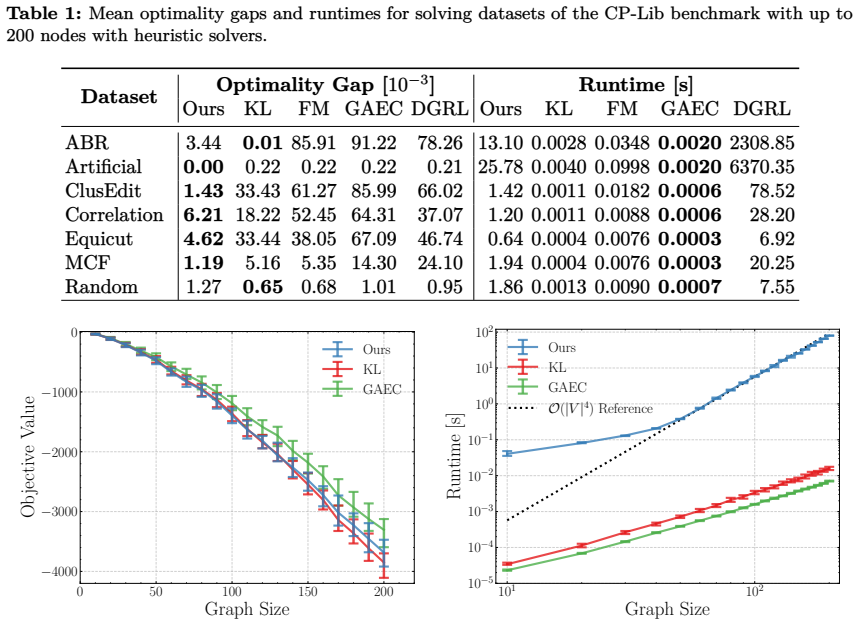
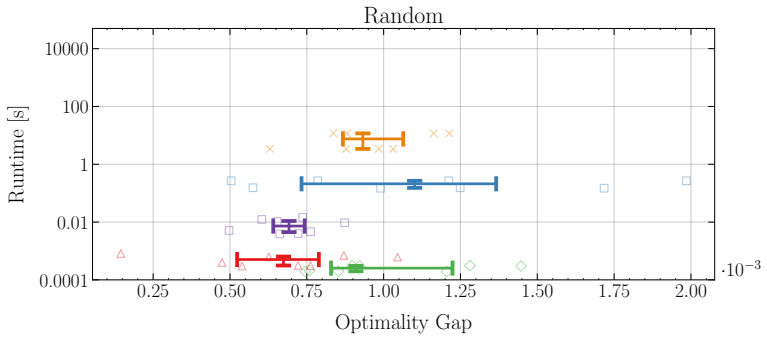
The authors introduce a graph neural network architecture for the multicut problem in which features are assigned only to edges and the computation of messages is based on triangles in the underlying graph. Experiments with synthetic and real-world instances with up to 200 nodes show that this method outperforms state-of-the-art heuristic solvers in terms of solution quality while maintaining feasible runtimes, and for some instances finds optimal solutions in seconds whereas exact solvers need hours to find and certify optimal solutions.
What carries the argument
Triangle-based message passing on an edge-only graph neural network, which aggregates information from three-edge cycles to update edge decisions for the multicut objective.
If this is right
- The network can serve as a fast generator of high-quality initial partitions that exact branch-and-cut solvers can refine further.
- Similar triangle-aware message schemes can be applied to other cut and clustering problems that contain many three-cycles.
- Mixed training on synthetic and real data enables the model to handle instances from multiple application domains without domain-specific retraining.
- Solution quality improvements hold across instance sizes up to a few hundred nodes while keeping inference times practical for interactive use.
Where Pith is reading between the lines
- The same motif-based message design could be tested on larger sparse graphs where exact methods become intractable, revealing whether the performance gap widens or narrows with scale.
- If the triangle messages capture local consistency constraints effectively, the approach may transfer to related problems such as correlation clustering or image segmentation without major redesign.
- Combining the GNN output with a single round of local search might close any remaining optimality gap on instances where the network stops short of the global optimum.
Load-bearing premise
Training the triangle-message GNN on the provided synthetic and real-world instances produces a model that generalizes reliably to new instances of the multicut problem without overfitting to the training distribution.
What would settle it
A collection of new multicut instances drawn from a different distribution on which the trained GNN returns strictly worse cuts than standard local-search heuristics such as Kernighan-Lin.
Figures


read the original abstract
The multicut problem is an NP-hard combinatorial optimization problem with diverse applications in fields such as bioinformatics, data mining and computer vision. Graph neural networks have been defined for the multicut problem but can be adapted further to its specific objective function and constraints. In this article, we introduce such an adapted graph neural network architecture in which features are assigned only to edges, and the computation of messages is based on triangles in the underlying graph. Experiments with synthetic and real-world instances with up to 200 nodes show that our method outperforms state-of-the-art heuristic solvers in terms of solution quality while maintaining feasible runtimes. For some instances, our method finds optimal solutions in seconds whereas exact solvers need hours to find and certify optimal solutions.
Editorial analysis
A structured set of objections, weighed in public.
Referee Report
Summary. The paper proposes a graph neural network architecture for the NP-hard multicut problem that restricts features to edges and bases message passing on triangles in the input graph. It reports that this model outperforms state-of-the-art heuristic solvers on both synthetic and real-world instances with up to 200 nodes, sometimes recovering optimal solutions in seconds where exact solvers require hours.
Significance. If the empirical claims hold under proper verification, the work would demonstrate a useful specialization of GNNs to the multicut objective and constraints, offering a practical heuristic for medium-sized instances in application domains such as computer vision and bioinformatics where exact methods scale poorly.
major comments (3)
- [Experiments] Experiments section: the central claim of outperformance on instances up to 200 nodes is presented without any description of the training-set generation process, train/test split, loss function (supervised against optima or self-supervised), or hyperparameter selection procedure, preventing assessment of whether reported gains reflect genuine generalization or distribution match.
- [Experiments] Experiments section: no ablation is reported that removes or replaces the triangle-based messages while keeping the rest of the architecture fixed, so it is impossible to determine whether the claimed performance advantage is attributable to this design choice or to other modeling decisions.
- [Results] Results section: the abstract and experimental claims provide no information on statistical significance testing, error bars across multiple runs, or implementation details of the baseline heuristic solvers, rendering the quantitative superiority statements unverifiable.
minor comments (1)
- [Abstract] Abstract: the statement that the method 'finds optimal solutions in seconds' for some instances would benefit from a concrete count or fraction of such instances rather than the qualitative phrasing.
Simulated Author's Rebuttal
We thank the referee for their thorough review and constructive comments. We address each of the major comments below and will incorporate the necessary revisions to improve the clarity and verifiability of our experimental results.
read point-by-point responses
-
Referee: [Experiments] Experiments section: the central claim of outperformance on instances up to 200 nodes is presented without any description of the training-set generation process, train/test split, loss function (supervised against optima or self-supervised), or hyperparameter selection procedure, preventing assessment of whether reported gains reflect genuine generalization or distribution match.
Authors: We agree that these experimental details were insufficiently described in the submitted manuscript. In the revised version, we will add a dedicated subsection in the Experiments section detailing the generation of the training and test sets (including the distribution of synthetic graphs), the train/test split ratios, the loss function used (which is supervised against optimal solutions obtained from exact solvers), and the hyperparameter selection procedure (including grid search ranges and validation strategy). This will enable proper assessment of generalization. revision: yes
-
Referee: [Experiments] Experiments section: no ablation is reported that removes or replaces the triangle-based messages while keeping the rest of the architecture fixed, so it is impossible to determine whether the claimed performance advantage is attributable to this design choice or to other modeling decisions.
Authors: We acknowledge the value of an ablation study to isolate the contribution of the triangle-based messages. We will include such an ablation in the revised manuscript, comparing the proposed model against a baseline GNN that uses standard edge-based message passing without triangle-specific computations, while keeping all other architectural components identical. Results from this ablation will be reported to demonstrate the specific benefit of the triangle-based design. revision: yes
-
Referee: [Results] Results section: the abstract and experimental claims provide no information on statistical significance testing, error bars across multiple runs, or implementation details of the baseline heuristic solvers, rendering the quantitative superiority statements unverifiable.
Authors: We will revise the Results section to include error bars representing standard deviations over multiple independent training and evaluation runs (e.g., 5 runs with different random seeds). We will also report the results of statistical significance tests, such as Wilcoxon signed-rank tests, comparing our method against the baselines. Additionally, we will provide full implementation details for the baseline solvers, including software versions, parameter settings, and the hardware environment used for all experiments. revision: yes
Circularity Check
No significant circularity in derivation or claims
full rationale
The paper introduces a GNN architecture with triangle-based messages for the multicut problem and supports its claims solely through empirical experiments on synthetic and real-world instances. No equations, derivations, or predictions are presented that reduce by construction to fitted parameters, self-definitions, or self-citation chains. The performance claims rest on direct experimental comparisons rather than any load-bearing theoretical step that collapses to the inputs.
Axiom & Free-Parameter Ledger
axioms (1)
- domain assumption Graph neural networks with message passing can learn to produce high-quality feasible solutions to the multicut problem
Reference graph
Works this paper leans on
-
[1]
Jung, Steffen and Keuper, Margret. Learning to Solve Minimum Cost Multicuts Efficiently Using Edge-Weighted Graph Convolutional Neural Networks. Machine Learning and Knowledge Discovery in Databases. 2023. doi:10.1007/978-3-031-26390-3_28
-
[2]
and Riley, Patrick F
Gilmer, Justin and Schoenholz, Samuel S. and Riley, Patrick F. and Vinyals, Oriol and Dahl, George E. , title =. 2017 , booktitle =
2017
-
[3]
2022 , url =
IBM , title =. 2022 , url =
2022
-
[4]
A State-of-the-Art Cutting Plane Algorithm for Clique Partitioning
Irmai, Jannik and Andres, Bjoern. A State-of-the-Art Cutting Plane Algorithm for Clique Partitioning. Pattern Recognition. 2025
2025
-
[5]
Mathematical Programming Computation , year=
S. Mathematical Programming Computation , year=
-
[6]
Deep Graph Reinforcement Learning for Solving Multicut Problem , year=
Li, Zhenchen and Yang, Xu and Zhang, Yanchao and Zeng, Shaofeng and Yuan, Jingbin and Liu, Jiazheng and Liu, Zhiyong and Han, Hua , journal=. Deep Graph Reinforcement Learning for Solving Multicut Problem , year=
-
[7]
and Levinkov, E
Keuper, M. and Levinkov, E. and Bonneel, N. and Lavoue, G. and Brox, T. and Andres, B. , title =. 2015 , booktitle =
2015
-
[8]
Visualizing Data using t-
Laurens. Visualizing Data using t-. Journal of Machine Learning Research , year =
-
[9]
Learning on Graphs Conference (LOG) , year=
A Generalist Neural Algorithmic Learner , author=. Learning on Graphs Conference (LOG) , year=
-
[10]
Highly accurate protein structure prediction with
Jumper, John and Evans, Richard and Pritzel, Alexander and Green, Tim and Figurnov, Michael and Ronneberger, Olaf and Tunyasuvunakool, Kathryn and Bates, Russ and. Highly accurate protein structure prediction with. Nature , year=
-
[11]
The Graph Neural Network Model , year=
Scarselli, Franco and Gori, Marco and Tsoi, Ah Chung and Hagenbuchner, Markus and Monfardini, Gabriele , journal=. The Graph Neural Network Model , year=
-
[12]
Prates, Marcelo and Avelar, Pedro H. C. and Lemos, Henrique and Lamb, Luis C. and Vardi, Moshe Y. , title =. 2019 , doi =
2019
-
[13]
Learning a
Daniel Selsam and Matthew Lamm and Benedikt B. Learning a. ICLR , year =
-
[14]
ICML , year =
Bodnar, Cristian and Frasca, Fabrizio and Wang, Yuguang and Otter, Nina and Montufar, Guido F and Li. ICML , year =
-
[15]
A Message Passing Algorithm for the Minimum Cost Multicut Problem , year=
Swoboda, Paul and Andres, Bjoern , booktitle=. A Message Passing Algorithm for the Minimum Cost Multicut Problem , year=
-
[16]
Gaussian Error Linear Units (GELUs)
Dan Hendrycks and Kevin Gimpel , year=. Gaussian Error Linear Units (. 1606.08415 , archivePrefix=
work page internal anchor Pith review Pith/arXiv arXiv
-
[17]
Exact combinatorial optimization with graph convolutional neural networks , year =
Gasse, Maxime and Ch\'. Exact combinatorial optimization with graph convolutional neural networks , year =. NeurIPS , url =
-
[18]
Learning to Compare Nodes in Branch and Bound with Graph Neural Networks , booktitle =
Abdel Ghani Labassi and Didier Ch. Learning to Compare Nodes in Branch and Bound with Graph Neural Networks , booktitle =. 2022 , url =
2022
-
[19]
CVPR , title=
Thorsten Beier and Thorben Kr. CVPR , title=. 2014 , doi=
2014
-
[20]
Facets of the clique partitioning polytope , journal=
Gr. Facets of the clique partitioning polytope , journal=. 1990 , volume=
1990
-
[21]
Chopra, Sunil and Rao, M. R. , title=. Mathematical Programming , year=
-
[22]
2022 , doi =
Abbas, Ahmed and Swoboda, Paul , booktitle =. 2022 , doi =
2022
-
[23]
Kingma and Jimmy Ba , title =
Diederik P. Kingma and Jimmy Ba , title =. ICLR , year =
-
[24]
o rg Hendrik and Speth, Markus and Andres, Bj \
Kappes, J \"o rg Hendrik and Speth, Markus and Andres, Bj \"o rn and Reinelt, Gerhard and Schn, Christoph. Globally Optimal Image Partitioning by Multicuts. Energy Minimization Methods in Computer Vision and Pattern Recognition. 2011. doi:10.1007/978-3-642-23094-3_3
-
[25]
and Denk, Winfried and Korogod, Natalya and Knott, Graham and Koethe, Ullrich and Hamprecht, Fred A
Andres, Bjoern and Kroeger, Thorben and Briggman, Kevin L. and Denk, Winfried and Korogod, Natalya and Knott, Graham and Koethe, Ullrich and Hamprecht, Fred A. Globally Optimal Closed-Surface Segmentation for Connectomics. ECCV. 2012. doi:10.1007/978-3-642-33712-3_56
-
[26]
The Mutex Watershed : Efficient, Parameter-Free Image Partitioning
Wolf, Steffen and Pape, Constantin and Bailoni, Alberto and Rahaman, Nasim and Kreshuk, Anna and K \"o the, Ullrich and Hamprecht, Fred A. The Mutex Watershed : Efficient, Parameter-Free Image Partitioning. ECCV. 2018
2018
-
[27]
Machine Learning , year=
Bansal, Nikhil and Blum, Avrim and Chawla, Shuchi , title=. Machine Learning , year=
-
[28]
and Pape, Constantin and Meechan, Kimberly I
Vergara, Hernando M. and Pape, Constantin and Meechan, Kimberly I. and Zinchenko, Valentyna and Genoud, Christel and Wanner, Adrian A. and Mutemi, Kevin Nzumbi and Titze, Benjamin and Templin, Rachel M. and Bertucci, Paola Y. and Simakov, Oleg and D. Whole-body integration of gene expression and single-cell morphology , journal=. 2021 , volume=
2021
-
[29]
Scalable community detection via parallel correlation clustering , year =
Shi, Jessica and Dhulipala, Laxman and Eisenstat, David and. Scalable community detection via parallel correlation clustering , year =. doi:10.14778/3476249.3476282 , booktitle =
-
[30]
Wolny, Adrian and Cerrone, Lorenzo and Vijayan, Athul and Tofanelli, Rachele and Barro, Amaya Vilches and Louveaux, Marion and Wenzl, Christian and Strauss, Sören and Wilson-Sánchez, David and Lymbouridou, Rena and Steigleder, Susanne S and Pape, Constantin and Bailoni, Alberto and Duran-Nebreda, Salva and Bassel, George W and Lohmann, Jan U and Tsiantis,...
-
[31]
CVPR , year =
Siyu Tang and Mykhaylo Andriluka and Bjoern Andres and Bernt Schiele , title =. CVPR , year =
-
[32]
Duy M. H. Nguyen and Roberto Henschel and Bodo Rosenhahn and Daniel Sonntag and Paul Swoboda , title =. CVPR , year =
-
[33]
doi:10.1088/1748-0221/18/07/P07013 , year =
Vadim Kostyukhin and Margret Keuper and Iskander Ibragimov and Nikolaus Owtscharenko and Markus Cristinziani , title =. doi:10.1088/1748-0221/18/07/P07013 , year =
-
[34]
2023 , url =
Abbas, Ahmed and Swoboda, Paul , booktitle =. 2023 , url =
2023
-
[35]
and Kappes, Jorg H
Beier, Thorsten and Hamprecht, Fred A. and Kappes, Jorg H. , booktitle =. Fusion moves for correlation clustering , year =
-
[36]
A Comparative Study of Local Search Algorithms for Correlation Clustering
Levinkov, Evgeny and Kirillov, Alexander and Andres, Bjoern. A Comparative Study of Local Search Algorithms for Correlation Clustering. GCPR. 2017. doi:10.1007/978-3-319-66709-6_9
-
[37]
Frontiers in Artificial Intelligence , VOLUME=
Tönshoff, Jan and Ritzert, Martin and Wolf, Hinrikus and Grohe, Martin , TITLE=. Frontiers in Artificial Intelligence , VOLUME=. 2021 , DOI=
2021
-
[38]
and Lenssen, Jan Eric and Rattan, Gaurav and Grohe, Martin , year=
Morris, Christopher and Ritzert, Martin and Fey, Matthias and Hamilton, William L. and Lenssen, Jan Eric and Rattan, Gaurav and Grohe, Martin , year=. Weisfeiler and. doi:10.1609/aaai.v33i01.33014602 , booktitle=
-
[39]
A cutting plane algorithm for a clustering problem , journal=
Gr. A cutting plane algorithm for a clustering problem , journal=. 1989 , volume=
1989
-
[40]
Oosten, Maarten and Rutten, Jeroen H. G. C. and Spieksma, Frits C. R. , title =. Networks , volume =. doi:10.1002/net.10004 , year =
-
[41]
A separation heuristic for 2-partition inequalities for the clique partitioning problem
S rensen, Michael M. A separation heuristic for 2-partition inequalities for the clique partitioning problem. 2020
2020
-
[42]
International Symposium on Combinatorial Optimization (ISCO) , year=
A separation algorithm for the clique partitioning problem , author=. International Symposium on Combinatorial Optimization (ISCO) , year=
discussion (0)
Sign in with ORCID, Apple, or X to comment. Anyone can read and Pith papers without signing in.