Recognition: 2 theorem links
· Lean TheoremDecoherence of spatial superpositions along stationary worldlines
Pith reviewed 2026-05-14 17:43 UTC · model grok-4.3
The pith
A particle's spatial superposition along a stationary worldline decoheres from a modified vacuum field spectrum and differential time dilation across its wavefunction.
A machine-rendered reading of the paper's core claim, the machinery that carries it, and where it could break.
Core claim
The central claim is that for a particle modeled with an internal degree of freedom coupled to a scalar field and quantized center-of-mass motion around a stationary worldline, the decoherence of the spatial superposition has two components that both take an effectively thermal form: one arising from a modified field spectrum observed by the particle and the other due to differential time-dilation over the extended spatial wavefunction. This is derived by obtaining an effective red-shifted polarizability from the separation of time scales and then a quantum Brownian motion master equation under the Born-Markov approximation.
What carries the argument
The effective red-shifted polarizability characterizing the trajectory-dependent linear response of the internal oscillator to the field, which enables derivation of the quantum Brownian motion master equation describing center-of-mass decoherence in the position basis.
If this is right
- Decoherence rates can be evaluated explicitly for hyperbolic motion.
- Decoherence rates can be evaluated explicitly for uniform circular motion.
- The master equation includes Hamiltonian modifications corresponding to a dispersive potential.
- Both contributions to decoherence take an effectively thermal form for stationary trajectories.
Where Pith is reading between the lines
- The approach could be generalized to non-stationary worldlines to determine if the thermal character of the decoherence persists.
- Similar two-component decoherence might arise in electromagnetic fields or other quantum fields beyond the scalar case.
- The differential time-dilation effect points to a geometric contribution to decoherence that could be tested in analog systems simulating acceleration.
- This links relativistic motion to effective thermal baths, with possible implications for quantum information processing in curved spacetime.
Load-bearing premise
The assumption of a separation of time scales between the particle's internal and external dynamics to obtain the effective red-shifted polarizability, combined with the Born-Markov approximation for the master equation.
What would settle it
An observation or calculation of the decoherence rate for a spatial superposition in hyperbolic motion that does not match the sum of the two predicted thermal-like contributions.
Figures


read the original abstract
We analyze the decoherence of a particle's spatial superposition moving along a stationary worldline through the Minkowski vacuum. The particle is modeled via an internal degree of freedom that couples to a scalar field, and an external degree of freedom, i.e., its quantized center-of-mass motion around the stationary worldline. Assuming a separation of time scales between the particle's internal and external dynamics, we first obtain an effective red-shifted polarizability of the particle, characterizing the trajectory-dependent linear response of the internal oscillator to the field. We then derive a quantum Brownian motion master equation for the particle's center of mass, under the Born-Markov approximation, which describes its decoherence in the position basis, as well as, Hamiltonian modifications corresponding to a dispersive potential. The resulting decoherence has two components: (1) arising from a modified field spectrum observed by the particle; and (2) due to a differential time-dilation over the particle's extended spatial wavefunction. For stationary trajectories, both contributions take an effectively thermal form. We evaluate the decoherence rates for two specific cases of hyperbolic and uniform circular motion.
Editorial analysis
A structured set of objections, weighed in public.
Referee Report
Summary. The manuscript analyzes decoherence of a particle's spatial superposition along stationary worldlines in Minkowski vacuum. The particle is modeled with an internal oscillator coupled to a scalar field and a quantized center-of-mass degree of freedom. Assuming separation of internal/external time scales, an effective red-shifted polarizability is obtained; a quantum Brownian motion master equation is then derived under the Born-Markov approximation. This yields decoherence with two components (modified field spectrum observed by the particle and differential time-dilation across the wavefunction), both taking effectively thermal form for stationary trajectories, with explicit rates evaluated for hyperbolic and uniform circular motion.
Significance. If the central approximations hold in the regimes studied, the result supplies a concrete, trajectory-dependent calculation distinguishing spectrum-modification and time-dilation contributions to decoherence, both reducible to thermal rates. This is a useful addition to the literature on relativistic quantum Brownian motion and Unruh-type effects for extended systems, with direct applicability to the two explicit cases treated.
major comments (2)
- [Derivation of effective polarizability (preceding the master equation)] The separation of time scales between the internal oscillator frequency and the external/CM plus field-correlation timescales along the worldline is invoked to reduce to an effective red-shifted polarizability. For hyperbolic motion this separation is not quantified against the acceleration scale a; when a becomes comparable to the internal frequency the linear-response reduction fails and the two decoherence components may mix or acquire non-Markovian corrections, undermining the claimed thermal structure.
- [Quantum Brownian motion master equation] The Born-Markov approximation is used to close the master equation for the quantized center-of-mass. No explicit check is provided that the resulting rates remain Markovian for the evaluated trajectories; for circular motion the orbital frequency can introduce additional timescales that violate the approximation and spoil the effectively thermal form asserted for both contributions.
minor comments (1)
- [Abstract] The abstract states that both contributions 'take an effectively thermal form' but does not define the effective temperature in terms of the trajectory parameters (acceleration or angular velocity); a short explicit expression would improve readability.
Simulated Author's Rebuttal
We thank the referee for their thorough review and valuable comments on our manuscript. We address each of the major comments below, providing clarifications and indicating the revisions we plan to make to strengthen the presentation of our assumptions and approximations.
read point-by-point responses
-
Referee: [Derivation of effective polarizability (preceding the master equation)] The separation of time scales between the internal oscillator frequency and the external/CM plus field-correlation timescales along the worldline is invoked to reduce to an effective red-shifted polarizability. For hyperbolic motion this separation is not quantified against the acceleration scale a; when a becomes comparable to the internal frequency the linear-response reduction fails and the two decoherence components may mix or acquire non-Markovian corrections, undermining the claimed thermal structure.
Authors: We appreciate the referee highlighting the need to quantify the timescale separation. Our derivation relies on the assumption that the internal oscillator frequency is sufficiently high compared to the external dynamics and field correlation times along the worldline. For hyperbolic motion, this corresponds to the internal frequency ω being much larger than the acceleration a. In the revised manuscript, we will explicitly state this condition (ω ≫ a) and discuss its implications for the validity of the effective polarizability and the thermal form of the decoherence rates. We will also note that when a approaches ω, non-Markovian effects may indeed arise, but our focus is on the regime where the separation holds. revision: yes
-
Referee: [Quantum Brownian motion master equation] The Born-Markov approximation is used to close the master equation for the quantized center-of-mass. No explicit check is provided that the resulting rates remain Markovian for the evaluated trajectories; for circular motion the orbital frequency can introduce additional timescales that violate the approximation and spoil the effectively thermal form asserted for both contributions.
Authors: We agree that verifying the Markovian nature of the approximation is important, especially for circular motion. The orbital frequency introduces a new timescale, and the Born-Markov approximation requires that the system-bath coupling is weak and the bath correlations decay faster than the system's evolution. In the revised manuscript, we will add a discussion providing order-of-magnitude estimates for the trajectories considered, showing that for typical parameters where the internal frequency dominates, the approximation holds and the thermal structure is preserved. We will also mention the conditions under which it might break down. revision: yes
Circularity Check
Standard QFT derivation with explicit approximations; no reduction to self-inputs or fitted predictions
full rationale
The paper begins from a standard scalar-field coupling to an internal oscillator plus quantized center-of-mass motion, invokes an explicit separation-of-timescales assumption to obtain a trajectory-dependent effective polarizability, and then applies the Born-Markov approximation to close the quantum Brownian motion master equation. Both the modified-spectrum and differential-time-dilation contributions to decoherence are obtained by direct calculation from these steps; the thermal form for stationary worldlines is a derived consequence rather than an input or a self-citation. No equations reduce to each other by construction, no parameters are fitted and relabeled as predictions, and no load-bearing uniqueness theorem or ansatz is imported from the authors' prior work. The derivation therefore remains self-contained against external QFT and open-systems benchmarks.
Axiom & Free-Parameter Ledger
axioms (2)
- domain assumption Separation of time scales between internal and external dynamics
- domain assumption Born-Markov approximation
Lean theorems connected to this paper
-
IndisputableMonolith/Cost/FunctionalEquation.leanwashburn_uniqueness_aczel unclearAssuming a separation of time scales between the particle’s internal and external dynamics, we first obtain an effective red-shifted polarizability... under the Born-Markov approximation... both contributions take an effectively thermal form.
-
IndisputableMonolith/Foundation/RealityFromDistinction.leanreality_from_one_distinction unclearThe resulting decoherence has two components: (1) arising from a modified field spectrum... (2) due to a differential time-dilation... For stationary trajectories, both contributions take an effectively thermal form.
Reference graph
Works this paper leans on
-
[1]
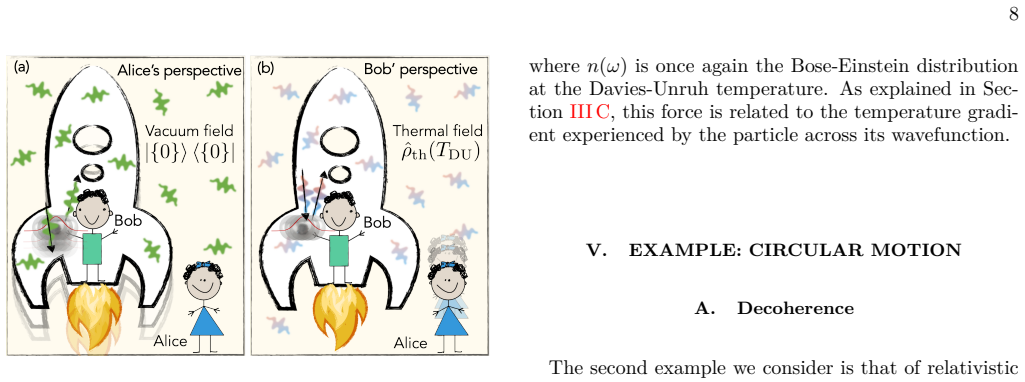
The particle’s quantized center-of-mass interacts with the field via the internal oscillator, as given by the following interaction Hamiltonian: ˆHDU int (τ)≡−1 2 ˆXi(τ) { ˙ˆd0,st(τ),∂i ˆϕ(τ) } (19) The trajectory-dependent vacuum state observed by the particle exerts a backaction leading to center-of-mass decoherence
-
[2]
The differential time dilation across the center-of- mass wavefunction, described by the redshift-factor g00, gives rise to the interaction Hamiltonian: ˆHTD int (τ)≡ai ˆXi(τ) 4c2 { ˙ˆd1,st(τ)−˙ˆd0,st(τ),ˆϕ(τ) } (20) These interaction terms stem from the red-shifted response functionα(ω)of the particle. Although the nature of time-dilation induced couplin...
-
[3]
The diagonal termsΛii correspond to the decoher- ence in the position basis: Λij = 1 2ℏ2 ∫ ∞ 0 dτ′ ⣨{ ˆBi(τ),ˆBj(τ−τ′) }⟩ .(27)
-
[4]
The dissipation of the center-of-mass energy into the environment is Γij≡i 2Mℏ ∫ ∞ 0 dτ′τ′ ⣨[ ˆBi(τ),ˆBj(τ−τ′) ]⟩ .(28) Decoherence rateΛ ii is related toΓ ii via the fluctuation-dissipation theorem:2MΓ iikBT= ℏ2Λii
-
[5]
The system Hamiltonian is modified by the terms: C(1) i ≡ ⣨ ˆBi(τ) ⟩ ,and (29) C(2) ij ≡i 2ℏ ∫ ∞ 0 dτ′ ⣨[ ˆBi(τ),ˆBj(τ−τ′) ]⟩ .(30) Remarkably, these contributions are akin to the first derivative of the first order (in polarizability) Casimir-Polder potential (C(1) i ∼∂iU(1) CP), and sec- ond derivative of the second-order Casimir-Polder potential (C(2) ...
-
[6]
(27) and the expression for the Davies-Unruh bath operator from Eq
‘Davies-Unruh’ decoherence Armed with these assumptions, we can calculate the decoherence coefficient using Eq. (27) and the expression for the Davies-Unruh bath operator from Eq. (19), as follows: Λ DU = 1 2ℏ2 ∫ ∞ 0 dτ′ ⣨{ ˆBDU i (τ),ˆBDU j (τ−τ′) }⟩ = 1 2ℏ2 ∫ ∞ 0 dτ′ ⣨ ˙ˆd(τ)˙ˆd(τ−τ′) ⟩ ⣨ ∂i ˆϕ(τ)∂i ˆϕ(τ−τ′) ⟩ + 1 2ℏ2 ∫ ∞ 0 dτ′ ⣨ ˙ˆd(τ−τ′) ˙ˆd(τ) ⟩ ⣨ ∂i...
-
[7]
We start with the decoherence coefficient of an inertial, polarizable par- ticle interacting with a thermal field [8, 9]: Λ th = 1 3(2π)3ϵ2 0c8 ∫ ∞ 0 dωω8|α0(ω)|2 (n(ω) + 1)n(ω)
Davies-Unruh Decoherence from Detailed Balance Remarkably, there is an analogy between the decoher- ence rateΛ DU derived above and the decoherence rate of an inertial detector coupled to an effective thermal bath, which suggests an alternative derivation. We start with the decoherence coefficient of an inertial, polarizable par- ticle interacting with a ...
-
[8]
Decoherence from time-dilation We similarly derive the contribution to the total deco- herence arising from the time-dilation interaction Hamil- tonian in Eq. (20). As mentioned above, this interaction arises from the differential time-dilation over the extent of the spatial wavefunction of the system. We will thus refer to the associated decoherence effe...
-
[9]
Using Eq
Coupled dynamics of the internal oscillator and the field In order to describe the response of the particle to the external field, we will now derive the polarizability of the particle. Using Eq. (5), the Heisenberg equations of motion for the internal oscillator are given by: ˙ˆq=−i ℏ [ ˆq,ˆHS ] = √−g00 m ( ˆp−eˆϕ(ˆXi,τ) ) (B1) ˙ˆp=−i ℏ [ ˆp,ˆHS ] =−√−g0...
-
[10]
Effective polarizability Taking the Fourier transform of Eq. (B14) allows us to write the steady state induced dipoleˆdst as: ˆdst( ˆXi,τ) =eˆq(ˆXi,τ) =−i 2π √−g00 ∫ dωωα(ω) ¯ ˆϕ(ˆXi,ω)eiωτ,(B18) whereα(ω)is the polarizability of the particle, which describes its response to an external field: α(ω):= e2/m 2i√−g00βω3−ω2−g00ω2q ;β := e2/m 8πϵ0c3.(B19) From ...
-
[11]
Using the bath operatorBDU i (τ)in the interaction picture (Eq
Davies-Unruh Decoherence from First Principles The derivation ofΛDU ij , withi=jcorresponding to the Davies-Unruh decoherence coefficient, goes as follows. Using the bath operatorBDU i (τ)in the interaction picture (Eq. (24)): Λ DU ij = 1 2ℏ2 ∫ ∞ 0 dτ′ ⣨{ ˆBDU i (τ),ˆBDU j (τ−τ′) }⟩ (C1) = 1 2ℏ2 ∫ ∞ 0 dτ′ ⣨ ˆBDU i (τ)ˆBDU j (τ−τ′) ⟩ + 1 2ℏ2 ∫ ∞ 0 dτ′ ⣨ ˆB...
-
[12]
(24) and (25)), we can obtain immediately the time-dilation decoherence coefficient by realizing that it is of the same structure as Eq
Time Dilation Decoherence As before, we start by writing the time-dilation decoherence coefficient as: Λ TD ij = 1 2ℏ2 ∫ ∞ 0 dτ′ ⣨{ ˆBTD i (τ),ˆBTD j (τ−τ′) }⟩ = 1 2ℏ2 ∫ ∞ 0 dτ′ ⣨ ˆBTD i (τ)ˆBTD j (τ−τ′) ⟩ + 1 2ℏ2 ∫ ∞ 0 dτ′ ⣨ ˆBTD j (τ−τ′) ˆBTD j (τ) ⟩ (C15) Comparing the bath operatorsˆBDU i (τ)andˆBTD i (τ)(Eqs. (24) and (25)), we can obtain immediately...
-
[13]
(C6) to simplify the correlator of spatial derivatives
Davies-Unruh Dispersion Potential The Davies-Unruh term of the dispersion potential is C(2),DU ij = i 2ℏ ∫ ∞ 0 dτ′ ⣨[ ˆBDU i (τ),ˆBDU j (τ−τ′) ]⟩ .(D1) Asdoneinthedecoherencecalculations, wesubstitute ˆBDU i (τ)andsplitthe4-pointcorrelatorsinto2-pointcorrelators, C(2),DU ij = i 2ℏ ∫ ∞ 0 dτ′ ⣨ ˙ˆd0,st(τ)˙ˆd0,st(τ−τ′) ⟩ ⣨ ∂i ˆϕ(τ)∂j ˆϕ(τ−τ′) ⟩ −(τ↔τ−τ′)(D2)...
-
[14]
Time-Dilation Dispersion Potential The time-dilation term of the dispersion potential is computed in a similar manner: C(2),TD ij = i 2ℏ ∫ ∞ 0 dτ [⣨ ˆBTD i (τ),ˆBTD j (0) ⟩] (D5) = iaiaj 8ℏc4 ∫ ∞ 0 dτ′ ⣨(˙ˆdst,1(τ)−˙ˆdst,0(τ) ) (˙ˆdst,1(τ−τ′)−˙ˆdst,0(τ−τ′) )⟩ ⣨ ˆϕ(τ)ˆϕ(τ−τ′) ⟩ −(τ↔τ−τ′)(D6) = iaiaj (2π)28ℏc4 ∫ ∞ 0 dτ′ ∫ ∞ −∞ dω ∫ ∞ −∞ dω′ω4|α0(ω)η(ω)−α0(ω...
-
[15]
S. A. Fulling, Nonuniqueness of canonical field quanti- zation in riemannian space-time, Phys. Rev. D7, 2850 (1973)
1973
-
[16]
P. C. W. Davies, Scalar production in schwarzschild and rindler metrics, Journal of Physics A: Mathematical and General8, 609 (1975)
1975
-
[17]
W. G. Unruh, Notes on black-hole evaporation, Phys. Rev. D14, 870 (1976)
1976
-
[18]
Sudhir, N
V. Sudhir, N. Stritzelberger, and A. Kempf, Unruh effect of detectors with quantized center of mass, Phys. Rev. D 103, 105023 (2021)
2021
-
[19]
Marino, A
J. Marino, A. Noto, and R. Passante, Thermal and non- thermal signatures of the unruh effect in casimir-polder forces, Phys. Rev. Lett.113, 020403 (2014)
2014
-
[20]
B. Šoda, V. Sudhir, and A. Kempf, Acceleration-induced effects in stimulated light-matter interactions, Phys. Rev. Lett.128, 163603 (2022)
2022
-
[21]
Sinha and P
K. Sinha and P. W. Milonni, Scalar qed model for polar- izable particles in thermal equilibrium or in hyperbolic motion in vacuum, Physics6, 356 (2024)
2024
-
[22]
Sinha and P
K. Sinha and P. W. Milonni, Dipoles in blackbody ra- diation: momentum fluctuations, decoherence, and drag force, Journal of Physics B: Atomic, Molecular and Op- tical Physics55, 204002 (2022)
2022
-
[23]
C.Jakubec, C.Jarzynski,andK.Sinha,Decoherenceand brownian motion of a polarizable particle near a medium, Phys. Rev. A112, 042225 (2025)
2025
-
[24]
Parentani, The recoils of the accelerated detector and the decoherence of its fluxes, Nuclear Physics B454, 227 (1995)
R. Parentani, The recoils of the accelerated detector and the decoherence of its fluxes, Nuclear Physics B454, 227 (1995)
1995
-
[25]
Lin and B
S.-Y. Lin and B. L. Hu, Accelerated detector-quantum field correlations: From vacuum fluctuations to radiation flux, Phys. Rev. D73, 124018 (2006)
2006
-
[26]
C. J. Fewster, B. A. Juárez-Aubry, and J. Louko, Waiting for unruh, Classical and Quantum Gravity33, 165003 (2016)
2016
-
[27]
B. A. Juárez-Aubry and D. Moustos, Asymptotic states for stationary unruh-dewitt detectors, Phys. Rev. D100, 025018 (2019)
2019
-
[28]
J. Foo, S. Onoe, and M. Zych, Unruh-dewitt detectors in quantum superpositions of trajectories, Phys. Rev. D 102, 085013 (2020)
2020
-
[29]
T. R. Perche, General features of the thermalization of particledetectorsandtheunruheffect,Phys.Rev.D104, 065001 (2021)
2021
-
[30]
Foo and M
J. Foo and M. Zych, Superpositions of thermalisations in relativistic quantum field theory, Quantum9, 1629 (2025)
2025
-
[31]
D. J. Stargen and V. Sudhir, Thermality and athermality in the unruh effect, Phys. Rev. D112, 105014 (2025)
2025
-
[32]
D. J. Stargen, Finite-time unruh effect: Waiting for the transient effects to fade off, Phys. Rev. D113, 065007 (2026)
2026
-
[33]
W. G. Unruh and R. M. Wald, Information loss, Reports on Progress in Physics80, 092002 (2017)
2017
-
[34]
D. L. Danielson, G. Satishchandran, and R. M. Wald, Black holes decohere quantum superpositions, Interna- tional Journal of Modern Physics D31, 2241003 (2022)
2022
-
[35]
D. L. Danielson, G. Satishchandran, and R. M. Wald, Killing horizons decohere quantum superpositions, Phys. Rev. D108, 025007 (2023)
2023
-
[36]
S. E. Gralla and H. Wei, Decoherence from horizons: General formulation and rotating black holes, Phys. Rev. D109, 065031 (2024)
2024
-
[37]
Wilson-Gerow, A
J. Wilson-Gerow, A. Dugad, and Y. Chen, Decoherence by warm horizons, Phys. Rev. D110, 045002 (2024)
2024
-
[38]
Pikovski, M
I. Pikovski, M. Zych, F.Costa, andČ. Brukner, Universal decoherence due to gravitational time dilation, Nature Physics11, 668 (2015)
2015
-
[39]
Pikovski, M
I. Pikovski, M. Zych, F. Costa, and v. Brukner, Time di- lation in quantum systems and decoherence, New Journal of Physics19, 025011 (2017)
2017
-
[40]
Paczos, K
J. Paczos, K. Dębski, P. T. Grochowski, A. R. H. Smith, and A. Dragan, Quantum time dilation in a gravitational field, Quantum8, 1338 (2024)
2024
-
[41]
J. R. Letaw, Stationary world lines and the vacuum ex- citation of noninertial detectors, Phys. Rev. D23, 1709 (1981)
1981
-
[42]
C. R. D. Bunney, Stationary trajectories in minkowski spacetimes, Journal of Mathematical Physics65, 052501 (2024)
2024
-
[43]
G. C. Hegerfeldt, Causality, particle localization and pos- itivityoftheenergy,inIrreversibility and Causality Semi- groups and Rigged Hilbert Spaces, edited by A. Bohm, H.-D. Doebner, and P. Kielanowski (Springer Berlin Hei- delberg, Berlin, Heidelberg, 1998) pp. 238–245
1998
-
[44]
Hegerfeldt, Instantaneous spreading and einstein 16 causality in quantum theory, Annalen der Physik510, 716 (1998)
G. Hegerfeldt, Instantaneous spreading and einstein 16 causality in quantum theory, Annalen der Physik510, 716 (1998)
1998
-
[45]
T. R. Perche, Localized nonrelativistic quantum systems in curved spacetimes: A general characterization of par- ticle detector models, Phys. Rev. D106, 025018 (2022)
2022
-
[46]
Sinha, S.-Y
K. Sinha, S.-Y. Lin, and B. L. Hu, Mirror-field entangle- mentinamicroscopicmodelforquantumoptomechanics, Phys. Rev. A92, 023852 (2015)
2015
-
[47]
Sinha, A
K. Sinha, A. E. R. López, and Y. Subaşı, Dissipative dy- namics of a particle coupled to a field via internal degrees of freedom, Phys. Rev. D103, 056023 (2021)
2021
-
[48]
Poisson, A
E. Poisson, A. Pound, and I. Vega, The motion of point particles in curved spacetime, Living Reviews in Relativ- ity14, 7 (2011)
2011
-
[49]
Breuer and F
H.-P. Breuer and F. Petruccione,The Theory of Open Quantum Systems(Oxford University Press, 2007)
2007
-
[50]
Calloni, L
E. Calloni, L. Di Fiore, G. Esposito, L. Milano, and L. Rosa, Vacuum fluctuation force on a rigid casimir cav- ity in a gravitational field, Physics Letters A297, 328 (2002)
2002
-
[51]
Sorge, Casimir effect in a weak gravitational field, Classical and Quantum Gravity22, 5109 (2005)
F. Sorge, Casimir effect in a weak gravitational field, Classical and Quantum Gravity22, 5109 (2005)
2005
-
[52]
S. A. Fulling, K. A. Milton, P. Parashar, A. Romeo, K. V. Shajesh, and J. Wagner, How does casimir energy fall?, Phys. Rev. D76, 025004 (2007)
2007
-
[53]
K. A. Milton, S. A. Fulling, P. Parashar, A. Romeo, K. V. Shajesh, and J. A. Wagner, Gravitational and inertial mass of casimir energy, Journal of Physics A: Mathemat- ical and Theoretical41, 164052 (2008)
2008
-
[54]
Sorge, Casimir energy in kerr space-time, Phys
F. Sorge, Casimir energy in kerr space-time, Phys. Rev. D90, 084050 (2014)
2014
-
[55]
Sorge and J
F. Sorge and J. H. Wilson, Casimir effect in free fall towards a schwarzschild black hole, Phys. Rev. D100, 105007 (2019)
2019
-
[56]
R. C. Tolman, On the weight of heat and thermal equi- librium in general relativity, Phys. Rev.35, 904 (1930)
1930
-
[57]
R. C. Tolman and P. Ehrenfest, Temperature equilibrium in a static gravitational field, Phys. Rev.36, 1791 (1930)
1930
-
[58]
Rovelli and M
C. Rovelli and M. Smerlak, Thermal time and tolman- ehrenfest effect: ’temperature as the speed of time’, Clas- sical and Quantum Gravity28, 075007 (2011)
2011
-
[59]
N. D. Birrell and P. C. W. Davies,Quantum Fields in Curved Space, Cambridge Monographs on Mathematical Physics (Cambridge University Press, Cambridge, UK, 1982)
1982
-
[60]
S. K. Kim, K. S. Soh, and J. H. Yee, Zero-point field in a circular-motion frame, Phys. Rev. D35, 557 (1987)
1987
-
[61]
Joos and H
E. Joos and H. D. Zeh, The emergence of classical prop- erties through interaction with the environment, Z. Phys. B - Cond. Matt.59, 223 (1985)
1985
-
[62]
Schlosshauer-Selbach,Decoherence and the quantum- to-classical transition, Frontiers Collection (Springer, Berlin, Germany, 2007)
M. Schlosshauer-Selbach,Decoherence and the quantum- to-classical transition, Frontiers Collection (Springer, Berlin, Germany, 2007)
2007
-
[63]
D. J. Raine, D. W. Sciama, and P. G. Grove, Does a uniformly accelerated quantum oscillator radiate?, Pro- ceedings: Mathematical and Physical Sciences435, 205 (1991)
1991
-
[64]
Ford and R
G. Ford and R. O’Connell, Is there unruh radiation?, Physics Letters A350, 17 (2006)
2006
-
[65]
Bell and J
J. Bell and J. Leinaas, Electrons as accelerated ther- mometers, Nuclear Physics B212, 131 (1983)
1983
-
[66]
Bell and J
J. Bell and J. Leinaas, The unruh effect and quantum fluctuations of electrons in storage rings, Nuclear Physics B284, 488 (1987)
1987
-
[67]
Arya and S
N. Arya and S. K. Goyal, Lamb shift as a witness for quantum noninertial effects, Phys. Rev. D108, 085011 (2023)
2023
-
[68]
C. R. Ordónez, A. Chakraborty, H. E. Camblong, M. O. Scully, and W. G. Unruh, Quantum aspects of spacetime: aquantumopticsviewofaccelerationradiationandblack holes, Philosophical Magazine0, 1 (2026)
2026
-
[69]
L. B. N. Batista, A. G. S. Landulfo, R. B. Mann, and G. E. A. Matsas, Nonperturbative danielson- satishchandran-wald decoherence with unruh-dewitt de- tectors, arXiv:2605.00956 (2026)
work page internal anchor Pith review Pith/arXiv arXiv 2026
-
[70]
Sinha and Y
K. Sinha and Y. Subaşı, Quantum brownian motion of a particle from casimir-polder interactions, Phys. Rev. A 101, 032507 (2020)
2020
-
[71]
A. Biggs and J. Maldacena, Comparing the decoher- ence effects due to black holes versus ordinary matter, arXiv:2405.02227 (2024)
-
[72]
Zych,Quantum Systems under Gravitational Time Dilation(Springer International Publishing, 2017)
M. Zych,Quantum Systems under Gravitational Time Dilation(Springer International Publishing, 2017)
2017
discussion (0)
Sign in with ORCID, Apple, or X to comment. Anyone can read and Pith papers without signing in.