Recognition: 2 theorem links
· Lean TheoremTheory of fracture initiation and propagation in viscoelastic media
Pith reviewed 2026-05-14 17:43 UTC · model grok-4.3
The pith
A variational framework based on the principle of virtual work predicts the delay time before cracks initiate in viscoelastic materials under arbitrary loads.
A machine-rendered reading of the paper's core claim, the machinery that carries it, and where it could break.
Core claim
The central claim is that the Lagrange-d'Alembert principle of virtual work supplies a rigorous way to determine the viscoelastic delay time and ensuing crack evolution for arbitrary loading histories. It also yields the first path-independent J-integral formulation for linear viscoelastic solids under time-dependent loads, restoring a generalized Griffith energy criterion that predicts delayed fracture initiation without needing the precise stress distribution inside the process zone provided the zone remains small relative to crack length.
What carries the argument
The Lagrange-d'Alembert principle of virtual work applied to fracture, which enforces energy balance for initiation and propagation and produces a path-independent J-integral for viscoelastic solids under arbitrary loading.
If this is right
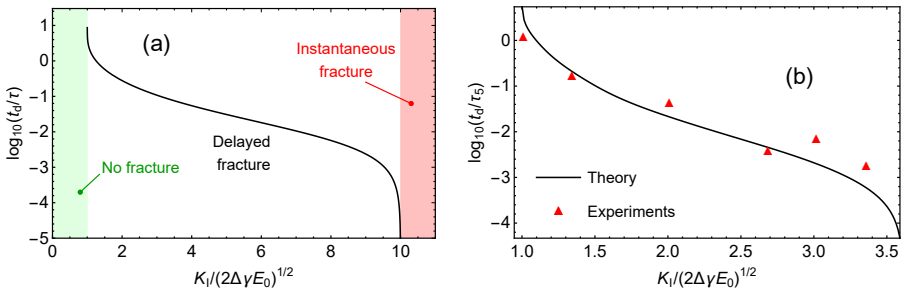
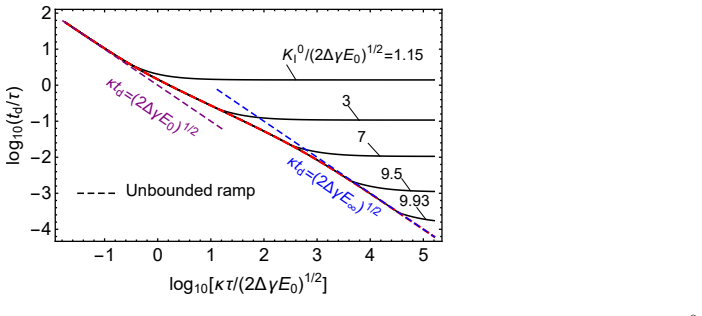
- Delay time before initiation increases or decreases systematically with the magnitude of the remote applied load.
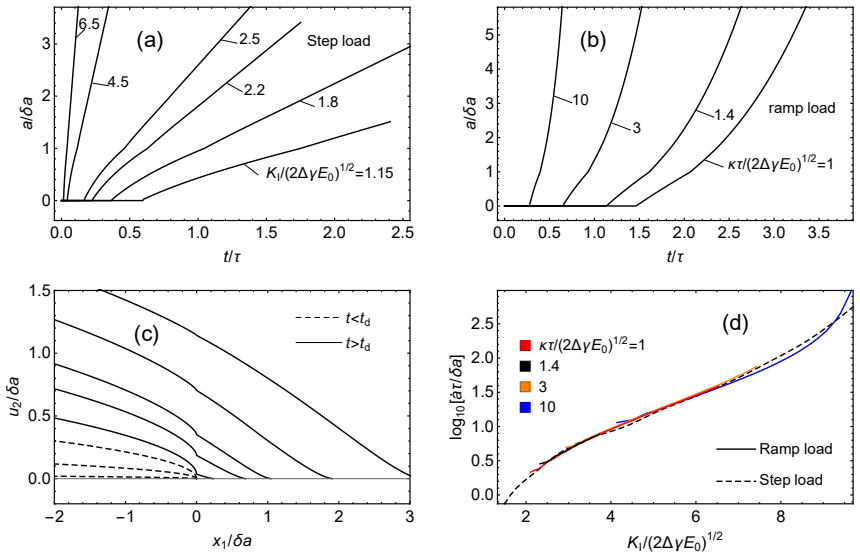
- Crack growth begins at finite speed and rapidly reaches a load-dependent steady-state propagation regime.
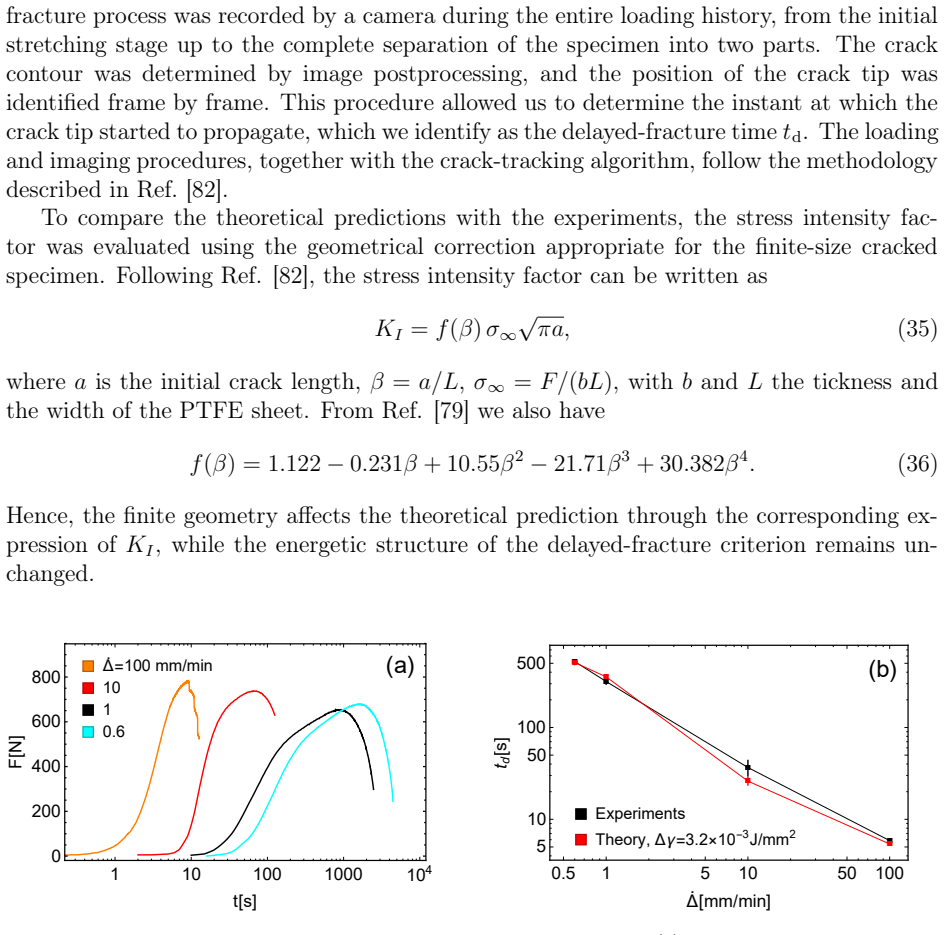
- The predicted delay times match experimental measurements quantitatively when material viscoelastic properties are taken from separate DMA tests.
- Finite-element results confirm that shorter interaction ranges for adhesion forces produce outcomes consistent with the analytical predictions at fixed adhesion energy.
Where Pith is reading between the lines
- The same variational setup could be used to forecast long-term reliability of viscoelastic parts such as elastomeric seals or tires held under constant tension.
- The framework suggests a route to model cumulative damage and eventual delayed failure under repeated cyclic loads in polymers.
- Direct tests that vary process-zone size relative to crack length would map the practical limits of the small-zone approximation.
Load-bearing premise
The process zone of intense deformation near the crack tip stays small compared to the crack length so that far-field quantities alone determine the energy release rate.
What would settle it
A measured crack initiation time that deviates from the predicted delay in an experiment where the process zone size is made comparable to the crack length, for example by using a softer material or much higher sustained load.
Figures





read the original abstract
Crack initiation and propagation are fundamental problems in materials science, often leading to catastrophic failure. While fracture in elastic solids occurs instantaneously above a critical load, viscoelastic materials may sustain high loads for a finite time before cracks start to propagate. This phenomenon, known as delayed fracture, has been widely observed experimentally but is still only partially understood theoretically. In this study, we present a rigorous framework based on the Lagrange--d'Alembert principle of virtual work (PVW) to predict both the viscoelastic delay time and the subsequent crack evolution under arbitrary loading histories. We derive how the delay time depends on the applied remote load and validate the theory through quantitative comparison with experiments, using directly measured delay times together with DMA-based viscoelastic characterization of the material. Very good agreement is obtained over a broad range of loading and delay times. Our results also show that crack propagation starts at finite speed and that load-dependent steady-state conditions are soon established. Finite element analyses further support the proposed framework and clarify the role of finite-ranged adhesion forces at fixed adhesion energy, showing that shorter interaction ranges yield results in quantitative agreement with theory. We also present, for the first time, a rigorous J-integral formulation valid for linear viscoelastic solids under arbitrary, time-varying loading histories. The result restores path independence and yields a generalized Griffith criterion that naturally predicts delayed fracture initiation in non-conservative materials. Remarkably, fracture initiation can be described without specifying the detailed stress distribution within the process zone, as long as it remains small relative to the crack length.
Editorial analysis
A structured set of objections, weighed in public.
Referee Report
Summary. The manuscript develops a theoretical framework for fracture initiation and propagation in linear viscoelastic solids, starting from the Lagrange-d'Alembert principle of virtual work. It derives the viscoelastic delay time under arbitrary loading histories, shows that propagation begins at finite speed before reaching load-dependent steady state, and presents a new path-independent J-integral formulation that yields a generalized Griffith criterion capable of predicting delayed fracture. The theory is validated by direct comparison to measured delay times using independent DMA viscoelastic data and is further supported by finite-element analyses that examine the role of finite-ranged adhesion forces.
Significance. If the derivations hold, the work supplies a parameter-free, principle-based account of delayed fracture that has been only partially understood. The restoration of path independence for the J-integral under time-varying loads and the demonstration that initiation can be predicted from far-field quantities alone (under the small-process-zone limit) are notable advances. Quantitative experimental agreement over broad ranges of load and delay time, together with the FEA checks, strengthens the central claim.
major comments (1)
- [J-integral and generalized Griffith criterion section] The central claim that fracture initiation can be described without specifying the detailed stress distribution inside the process zone (provided the zone remains small relative to crack length) is load-bearing for the generalized Griffith criterion. The manuscript should supply an explicit estimate or scaling argument showing how the error term vanishes with the ratio of process-zone size to crack length, and should compare this bound directly against the FEA results that vary interaction range at fixed adhesion energy.
minor comments (2)
- [Validation against experiments] The abstract states that 'very good agreement is obtained' but does not report quantitative metrics (e.g., mean relative error or R²) for the delay-time predictions; these should be added to the validation section.
- Notation for the remote load history and the resulting delay time should be introduced once and used consistently in both the analytic expressions and the figure captions.
Simulated Author's Rebuttal
We thank the referee for the careful reading, positive assessment, and recommendation for minor revision. We address the single major comment below and will revise the manuscript to incorporate the requested scaling analysis and direct comparison with the FEA results.
read point-by-point responses
-
Referee: [J-integral and generalized Griffith criterion section] The central claim that fracture initiation can be described without specifying the detailed stress distribution inside the process zone (provided the zone remains small relative to crack length) is load-bearing for the generalized Griffith criterion. The manuscript should supply an explicit estimate or scaling argument showing how the error term vanishes with the ratio of process-zone size to crack length, and should compare this bound directly against the FEA results that vary interaction range at fixed adhesion energy.
Authors: We agree that an explicit scaling argument strengthens the presentation of the generalized Griffith criterion. In the revised manuscript we will add a short asymptotic analysis in the J-integral section deriving that the error incurred by neglecting the detailed process-zone stress distribution vanishes as O(δ/a), where δ is the process-zone size and a the crack length; the derivation follows directly from the virtual-work principle and the decay of the viscoelastic kernel away from the tip. We will then overlay this predicted scaling on the existing FEA data by plotting the relative deviation from the theoretical delay-time prediction versus the normalized interaction range (which sets δ at fixed adhesion energy), confirming that the numerical results converge to the path-independent limit for small δ/a exactly as the bound requires. revision: yes
Circularity Check
Derivation from variational principles with independent experimental validation
full rationale
The framework is constructed from the Lagrange-d'Alembert principle of virtual work applied to viscoelastic fracture, yielding a path-independent J-integral and generalized Griffith criterion without reducing to fitted parameters or self-referential definitions. Delay-time predictions are validated against separate DMA-measured material properties and direct experimental delay times rather than internal fits. No load-bearing step collapses to a self-citation chain, ansatz smuggling, or renaming of known results; any prior-author citations serve only as background and do not substitute for the present derivation.
Axiom & Free-Parameter Ledger
axioms (2)
- domain assumption Linear viscoelastic constitutive behavior
- domain assumption Process zone remains small relative to crack length
Lean theorems connected to this paper
-
IndisputableMonolith/Cost/FunctionalEquation.leanwashburn_uniqueness_aczel unclear?
unclearRelation between the paper passage and the cited Recognition theorem.
G(t) = K_I(t) ∫_{-∞}^t J(t-t1) ḊK_I(t1) dt1 = 2Δγ (generalized Griffith criterion); J-integral formulation restores path independence for arbitrary loading histories
What do these tags mean?
- matches
- The paper's claim is directly supported by a theorem in the formal canon.
- supports
- The theorem supports part of the paper's argument, but the paper may add assumptions or extra steps.
- extends
- The paper goes beyond the formal theorem; the theorem is a base layer rather than the whole result.
- uses
- The paper appears to rely on the theorem as machinery.
- contradicts
- The paper's claim conflicts with a theorem or certificate in the canon.
- unclear
- Pith found a possible connection, but the passage is too broad, indirect, or ambiguous to say the theorem truly supports the claim.
Reference graph
Works this paper leans on
-
[1]
On the effective surface energy in viscoelastic hertzian contacts
Afferrante, L., Violano, G., 2022. On the effective surface energy in viscoelastic hertzian contacts. Journal of the Mechanics and Physics of Solids 158, 104669. URL:http: //dx.doi.org/10.1016/j.jmps.2021.104669, doi:10.1016/j.jmps.2021.104669
-
[2]
Ateshian, G.A., Kroupa, K., Petersen, C.A., Zimmerman, B., Maas, S.A., Weiss, J.A.,
-
[3]
Journal of Biomechanical Engineering URL:http://dx.doi.org/10.1115/1.4056063, doi:10.1 115/1.4056063
Damage mechanics of biological tissues in relation to viscoelasticity. Journal of Biomechanical Engineering URL:http://dx.doi.org/10.1115/1.4056063, doi:10.1 115/1.4056063
-
[4]
Cracks, microcracks and fracture in polymer structures: Formation, detection, autonomic repair
Awaja, F., Zhang, S., Tripathi, M., Nikiforov, A., Pugno, N., 2016. Cracks, microcracks and fracture in polymer structures: Formation, detection, autonomic repair. Progress in Materials Science 83, 536–573. URL:http://dx.doi.org/10.1016/j.pmatsci.2 016.07.007, doi:10.1016/j.pmatsci.2016.07.007
-
[5]
The Rheology of Semiliq- uid Foods
Barbosa-Cánovas, G.V., Kokini, J.L., Ma, L., Ibarz, A., 1996. The Rheology of Semiliq- uid Foods. Elsevier. p. 1–69. URL:http://dx.doi.org/10.1016/S1043-4526(08)6 0073-X, doi:10.1016/s1043-4526(08)60073-x
-
[6]
Delayed fracture of an inhomogeneous soft solid
Bonn, D., Kellay, H., Prochnow, M., Ben-Djemiaa, K., Meunier, J., 1998. Delayed fracture of an inhomogeneous soft solid. Science 280, 265–267. URL:http://dx.doi .org/10.1126/science.280.5361.265, doi:10.1126/science.280.5361.265
-
[7]
Failure in a soft gel: Delayed failure and the dynamic yield stress
Brenner, T., Matsukawa, S., Nishinari, K., Johannsson, R., 2013. Failure in a soft gel: Delayed failure and the dynamic yield stress. Journal of Non-Newtonian Fluid Mechanics 196, 1–7. URL:http://dx.doi.org/10.1016/j.jnnfm.2012.12.011, doi:10.1016/j.jnnfm.2012.12.011
-
[8]
Thermodynamics and an Introduction to Thermostatistics
Callen, H.B., 1985. Thermodynamics and an Introduction to Thermostatistics. 2 ed., John Wiley & Sons, New York
1985
-
[9]
Theory of viscoelastic adhesion and friction
Carbone, G., Mandriota, C., Menga, N., 2022. Theory of viscoelastic adhesion and friction. Extreme Mechanics Letters 56, 101877. URL:http://dx.doi.org/10.1016 /j.eml.2022.101877, doi:10.1016/j.eml.2022.101877
-
[10]
Crack motion in viscoelastic solids: The role of the flash temperature
Carbone, G., Persson, B.N.J., 2005a. Crack motion in viscoelastic solids: The role of the flash temperature. The European Physical Journal E 17, 261–281. URL:http: //dx.doi.org/10.1140/epje/i2005-10013-y, doi:10.1140/epje/i2005-10013-y
-
[11]
Hot cracks in rubber: Origin of the giant tough- ness of rubberlike materials
Carbone, G., Persson, B.N.J., 2005b. Hot cracks in rubber: Origin of the giant tough- ness of rubberlike materials. Physical Review Letters 95. URL:http://dx.doi.org/1 0.1103/PhysRevLett.95.114301, doi:10.1103/physrevlett.95.114301
-
[12]
Charmet, J.C., Barquins, M., 1996. Adhesive contact and rolling of a rigid cylinder under the pull of gravity on the underside of a smooth-surfaced sheet of rubber. Inter- national Journal of Adhesion and Adhesives 16, 249–254. URL:http://dx.doi.org /10.1016/S0143-7496(96)00013-9, doi:10.1016/s0143-7496(96)00013-9. 32
-
[13]
Cheng, A., Sun, L., Menga, N., Yang, W., Zhang, X., 2024. Interfacial performance evolution of ceramics-in-polymer composite electrolyte in solid-state lithium metal bat- teries. International Journal of Engineering Science 204, 104137. URL:http://dx.d oi.org/10.1016/j.ijengsci.2024.104137, doi:10.1016/j.ijengsci.2024.104137
-
[14]
Choi, B.H., Zhou, Z., Chudnovsky, A., Stivala, S.S., Sehanobish, K., Bosnyak, C.P.,
-
[15]
International Journal of Solids and Structures 42, 681–695
Fracture initiation associated with chemical degradation: observation and mod- eling. International Journal of Solids and Structures 42, 681–695. URL:http://dx.d oi.org/10.1016/j.ijsolstr.2004.06.028, doi:10.1016/j.ijsolstr.2004.06.028
-
[16]
Theory of Viscoelasticity
Christensen, R.M., 1982. Theory of Viscoelasticity. Elsevier
1982
-
[17]
Viscoelastic short cracks propagation
Ciavarella, M., 2022. Viscoelastic short cracks propagation. Engineering Fracture Me- chanics 264, 108276. URL:http://dx.doi.org/10.1016/j.engfracmech.2022.1082 76, doi:10.1016/j.engfracmech.2022.108276
-
[18]
A comparison of crack propagation theories in viscoelastic materials
Ciavarella, M., Cricri, G., McMeeking, R., 2021a. A comparison of crack propagation theories in viscoelastic materials. Theoretical and Applied Fracture Mechanics 116, 103113. URL:http://dx.doi.org/10.1016/j.tafmec.2021.103113, doi:10.1016/ j.tafmec.2021.103113
-
[19]
Crack propagation at the in- terface between viscoelastic and elastic materials
Ciavarella, M., Papangelo, A., McMeeking, R., 2021b. Crack propagation at the in- terface between viscoelastic and elastic materials. Engineering Fracture Mechanics 257, 108009. URL:http://dx.doi.org/10.1016/j.engfracmech.2021.108009, doi:10.1016/j.engfracmech.2021.108009
-
[20]
Delayed yielding of a plane stress viscoelastic dugdale model
DasGupta, A., Brinson, H., 1977. Delayed yielding of a plane stress viscoelastic dugdale model. Journal of Testing and Evaluation 5, 437–445. URL:http://dx.doi.org/10. 1520/JTE10556J, doi:10.1520/jte10556j
-
[21]
A review on the failure and regulation of solid electrolyte interphase in lithium batteries
Ding, J.F., Xu, R., Yan, C., Li, B.Q., Yuan, H., Huang, J.Q., 2021. A review on the failure and regulation of solid electrolyte interphase in lithium batteries. Journal of Energy Chemistry 59, 306–319. URL:http://dx.doi.org/10.1016/j.jechem.2020 .11.016, doi:10.1016/j.jechem.2020.11.016
-
[22]
Moving cracks in viscoelastic materials: Temperature and energy-release-rate measurements
D’Amico, F., Carbone, G., Foglia, M., Galietti, U., 2013. Moving cracks in viscoelastic materials: Temperature and energy-release-rate measurements. Engineering Fracture Mechanics 98, 315–325. URL:http://dx.doi.org/10.1016/j.engfracmech.2012. 10.026, doi:10.1016/j.engfracmech.2012.10.026
-
[23]
Dynamic strength of molecular adhesion bonds
Evans, E., Ritchie, K., 1997. Dynamic strength of molecular adhesion bonds. Biophys- ical Journal 72, 1541–1555. URL:http://dx.doi.org/10.1016/S0006-3495(97)788 02-7, doi:10.1016/s0006-3495(97)78802-7
-
[24]
Criteria for delayed fracture in solids and their experimental verification
Frankiewicz, K., Stankowski, S., Wnuk, M., 1972. Criteria for delayed fracture in solids and their experimental verification. Engineering Fracture Mechanics 4, 245–266. URL: 33 http://dx.doi.org/10.1016/0013-7944(72)90040-9, doi:10.1016/0013-7944(72 )90040-9
-
[25]
Experimentalanalysisofviscoelastic criteriaforcrackinitiationandgrowthinpolymers
Frassine, R., Rink, M., Leggio, A., Pavan, A., 1996. Experimentalanalysisofviscoelastic criteriaforcrackinitiationandgrowthinpolymers. InternationalJournalofFracture81, 55–75. URL:http://dx.doi.org/10.1007/BF00020755, doi:10.1007/bf00020755
-
[26]
de Gennes, P.G., 1996. Soft adhesives. Langmuir 12, 4497–4500. URL:http://dx.d oi.org/10.1021/la950886y, doi:10.1021/la950886y
-
[27]
Graham, G., Sabin, G., 1973. The correspondence principle of linear viscoelasticity for problems that involve time-dependent regions. International Journal of Engineering Science 11, 123–140. URL:http://dx.doi.org/10.1016/0020-7225(73)90074-8, doi:10.1016/0020-7225(73)90074-8
-
[28]
Two extending crack problems in linear viscoelasticity theory
Graham, G.A.C., 1970. Two extending crack problems in linear viscoelasticity theory. Quarterly of Applied Mathematics 27, 497–507
1970
-
[29]
The theory of viscoelastic crack propagation and healing
Greenwood, J.A., 2004. The theory of viscoelastic crack propagation and healing. Journal of Physics D: Applied Physics 37, 2557–2569. URL:http://dx.doi.org/10. 1088/0022-3727/37/18/011, doi:10.1088/0022-3727/37/18/011
-
[30]
Viscoelastic crack propagation and closing with lennard-jones surface forces
Greenwood, J.A., 2007. Viscoelastic crack propagation and closing with lennard-jones surface forces. Journal of Physics D: Applied Physics 40, 1769–1777. URL:http: //dx.doi.org/10.1088/0022-3727/40/6/025, doi:10.1088/0022-3727/40/6/025
-
[31]
The phenomena of rupture and flow in solids , volume=
Griffith, A., 1921. Philosophical Transactions of the Royal Society of London. Series A, Containing Papers of a Mathematical or Physical Character 221, 163–198. URL: http://dx.doi.org/10.1098/rsta.1921.0006, doi:10.1098/rsta.1921.0006
-
[32]
Capillary fracture of ultrasoft gels: variability and delayed nucleation
Grzelka, M., Bostwick, J.B., Daniels, K.E., 2017. Capillary fracture of ultrasoft gels: variability and delayed nucleation. Soft Matter 13, 2962–2966. URL:http://dx.doi .org/10.1039/C7SM00257B, doi:10.1039/c7sm00257b
-
[33]
Failure time and critical behaviour of fracture precursors in heterogeneous materials
Guarino, A., Ciliberto, S., Garcimartın, A., Zei, M., Scorretti, R., 2002. Failure time and critical behaviour of fracture precursors in heterogeneous materials. The European PhysicalJournalB26, 141–151. URL:http://dx.doi.org/10.1140/epjb/e20020075, doi:10.1140/epjb/e20020075
-
[34]
Modeling of size dependent failure in cardio- vascular stent struts under tension and bending
Harewood, F.J., McHugh, P.E., 2007. Modeling of size dependent failure in cardio- vascular stent struts under tension and bending. Annals of Biomedical Engineer- ing 35, 1539–1553. URL:http://dx.doi.org/10.1007/s10439- 007- 9326-6, doi:10.1007/s10439-007-9326-6
-
[35]
Steady state crack growth in viscoelastic solids: A comparative study
Hui, C.Y., Zhu, B., Long, R., 2022. Steady state crack growth in viscoelastic solids: A comparative study. Journal of the Mechanics and Physics of Solids 159, 104748. URL: 34 http://dx.doi.org/10.1016/j.jmps.2021.104748, doi:10.1016/j.jmps.2021.10 4748
-
[36]
Irez, A.B., Bayraktar, E., Miskioglu, I., 2020. Fracture toughness analysis of epoxy- recycled rubber-based composite reinforced with graphene nanoplatelets for structural applications in automotive and aeronautics. Polymers 12, 448. URL:http://dx.doi .org/10.3390/polym12020448, doi:10.3390/polym12020448
-
[37]
Journal of Applied Mechanics , author =
Irwin, G.R., 1957. Analysis of stresses and strains near the end of a crack traversing a plate. Journal of Applied Mechanics 24, 361–364. URL:http://dx.doi.org/10.1115 /1.4011547, doi:10.1115/1.4011547
-
[38]
Jiao, T., Clifton, R.J., Converse, G.L., Hopkins, R.A., 2012. Measurements of the effects of decellularization on viscoelastic properties of tissues in ovine, baboon, and human heart valves. Tissue Engineering Part A 18, 423–431. URL:http://dx.doi.o rg/10.1089/ten.tea.2010.0677, doi:10.1089/ten.tea.2010.0677
-
[39]
Fracture toughness evaluation of polytetrafluoroethylene
Joyce, J.A., 2003. Fracture toughness evaluation of polytetrafluoroethylene. Polymer Engineering and Science 43, 1702–1714. doi:10.1002/pen.10144
-
[40]
Evaluation of the fracture toughness properties of poly- tetrafluoroethylene
Joyce, P.J., Joyce, J.A., 2004. Evaluation of the fracture toughness properties of poly- tetrafluoroethylene. International Journal of Fracture 127, 361–385. doi:10.1023/B: FRAC.0000037674.46965.FB
work page doi:10.1023/b: 2004
-
[41]
Real-time early detection of crack propagation precursors in delayed fracture of soft elastomers
Ju, J., Sanoja, G.E., Nagazi, M.Y., Cipelletti, L., Liu, Z., Hui, C.Y., Ciccotti, M., Narita, T., Creton, C., 2023. Real-time early detection of crack propagation precursors in delayed fracture of soft elastomers. Physical Review X 13. URL:http://dx.doi.o rg/10.1103/PhysRevX.13.021030, doi:10.1103/physrevx.13.021030
-
[42]
Mechanics of the delayed fracture of viscoelastic bodies with cracks: Theory and experiment (review)
Kaminsky, A.A., 2014. Mechanics of the delayed fracture of viscoelastic bodies with cracks: Theory and experiment (review). International Applied Mechanics 50, 485–548. URL:http://dx.doi.org/10.1007/s10778-014-0652-8, doi:10.1007/s10778-014 -0652-8
-
[43]
Karobi, S.N., Sun, T.L., Kurokawa, T., Luo, F., Nakajima, T., Nonoyama, T., Gong, J.P., 2016. Creep behavior and delayed fracture of tough polyampholyte hydrogels by tensile test. Macromolecules 49, 5630–5636. URL:http://dx.doi.org/10.1021/acs .macromol.6b01016, doi:10.1021/acs.macromol.6b01016
work page doi:10.1021/acs 2016
-
[44]
Delayed failure — the griffith problem for linearly viscoelastic materials
Knauss, W.G., 1970. Delayed failure — the griffith problem for linearly viscoelastic materials. International Journal of Fracture Mechanics 6, 7–20. URL:http://dx.doi .org/10.1007/BF00183655, doi:10.1007/bf00183655
-
[45]
Areviewoffractureinviscoelasticmaterials
Knauss, W.G., 2015. Areviewoffractureinviscoelasticmaterials. InternationalJournal of Fracture 196, 99–146. URL:http://dx.doi.org/10.1007/s10704-015-0058-6, doi:10.1007/s10704-015-0058-6. 35
-
[46]
Laser speckle strain imaging reveals the origin of delayed fracture in a soft solid
van der Kooij, H.M., Dussi, S., van de Kerkhof, G.T., Frijns, R.A.M., van der Gucht, J., Sprakel, J., 2018. Laser speckle strain imaging reveals the origin of delayed fracture in a soft solid. Science Advances 4. URL:http://dx.doi.org/10.1126/sciadv.aar1926, doi:10.1126/sciadv.aar1926
-
[47]
The fluctuation-dissipation theorem
Kubo, R., 1966. The fluctuation-dissipation theorem. Reports on Progress in Physics 29, 255–284. URL:http://dx.doi.org/10.1088/0034-4885/29/1/306, doi:10.108 8/0034-4885/29/1/306
-
[48]
Kuduzović, A., Poletti, M., Sommitsch, C., Domankova, M., Mitsche, S., Kienreich, R.,
-
[49]
Materials Science and Engineering: A 590, 66–73
Investigations into the delayed fracture susceptibility of 34crnimo6 steel, and the opportunities for its application in ultra-high-strength bolts and fasteners. Materials Science and Engineering: A 590, 66–73. URL:http://dx.doi.org/10.1016/j.msea. 2013.10.019, doi:10.1016/j.msea.2013.10.019
-
[50]
Creep rupture has two universality classes
Kun, F., Moreno, Y., Hidalgo, R.C., Herrmann, H.J., 2003. Creep rupture has two universality classes. Europhysics Letters (EPL) 63, 347–353. URL:http://dx.doi.o rg/10.1209/epl/i2003-00469-9, doi:10.1209/epl/i2003-00469-9
-
[51]
Structures, stresses, and fluctuations in the delayed failure of colloidal gels
Lindström, S.B., Kodger, T.E., Sprakel, J., Weitz, D.A., 2012. Structures, stresses, and fluctuations in the delayed failure of colloidal gels. Soft Matter 8, 3657. URL: http://dx.doi.org/10.1039/C2SM06723D, doi:10.1039/c2sm06723d
-
[52]
Adhesion: role of bulk viscoelasticity and surface roughness
Lorenz, B., Krick, B.A., Mulakaluri, N., Smolyakova, M., Dieluweit, S., Sawyer, W.G., Persson, B.N.J., 2013. Adhesion: role of bulk viscoelasticity and surface roughness. Journal of Physics: Condensed Matter 25, 225004. URL:http://dx.doi.org/10.10 88/0953-8984/25/22/225004, doi:10.1088/0953-8984/25/22/225004
-
[53]
Nanomechanical testing in drug delivery: Theory, applications, and emerging trends
Majumder, S., Sun, C.C., Mara, N.A., 2022. Nanomechanical testing in drug delivery: Theory, applications, and emerging trends. Advanced Drug Delivery Reviews 183, 114167. URL:http://dx.doi.org/10.1016/j.addr.2022.114167, doi:10.1016/j. addr.2022.114167
-
[54]
Adhesive contact mechanics of vis- coelastic materials
Mandriota, C., Menga, N., Carbone, G., 2024a. Adhesive contact mechanics of vis- coelastic materials. International Journal of Solids and Structures 290, 112685. URL: http://dx.doi.org/10.1016/j.ijsolstr.2024.112685, doi:10.1016/j.ijsolstr .2024.112685
-
[55]
Enhancement of adhesion strength in viscoelastic unsteady contacts
Mandriota, C., Menga, N., Carbone, G., 2024b. Enhancement of adhesion strength in viscoelastic unsteady contacts. Journal of the Mechanics and Physics of Solids 192, 105826. URL:http://dx.doi.org/10.1016/j.jmps.2024.105826, doi:10.1016/j. jmps.2024.105826
-
[56]
Rupture and Adherence of Elastic Solids
Maugis, D., 2000. Rupture and Adherence of Elastic Solids. Springer Berlin Heidelberg. p. 133–202. URL:http://dx.doi.org/10.1007/978-3-662-04125-3_3, doi:10.100 7/978-3-662-04125-3_3. 36
-
[57]
Investigation of failure behavior of a thermoplastic elastomer gel
Mishra, S., Badani Prado, R.M., Lacy, T.E., Kundu, S., 2018. Investigation of failure behavior of a thermoplastic elastomer gel. Soft Matter 14, 7958–7969. URL:http: //dx.doi.org/10.1039/c8sm01397g, doi:10.1039/c8sm01397g
-
[58]
Transport, collective motion, and brownian motion
Mori, H., 1965. Transport, collective motion, and brownian motion. Progress of The- oretical Physics 33, 423–455. URL:http://dx.doi.org/10.1143/PTP.33.423, doi:10.1143/ptp.33.423
-
[59]
Stable crack propagation in a viscoelastic strip
Mueller, H.K.C.A., 1968. Stable crack propagation in a viscoelastic strip. Ph.D. thesis. California Institute of Technology. URL:https://resolver.caltech.edu/Caltech ETD:etd-11152005-142505, doi:10.7907/MGSD-R362
-
[60]
Crack and pull-off dynamics of adhesive, viscoelas- tic solids
Müser, M.H., Persson, B.N.J., 2022. Crack and pull-off dynamics of adhesive, viscoelas- tic solids. Europhysics Letters 137, 36004. URL:http://dx.doi.org/10.1209/029 5-5075/ac535c, doi:10.1209/0295-5075/ac535c
work page doi:10.1209/029 2022
-
[61]
One step creation of multifunctional 3d architectured hydrogels inducing bone regeneration
Neffe, A.T., Pierce, B.F., Tronci, G., Ma, N., Pittermann, E., Gebauer, T., Frank, O., Schossig, M., Xu, X., Willie, B.M., Forner, M., Ellinghaus, A., Lienau, J., Duda, G.N., Lendlein, A., 2015. One step creation of multifunctional 3d architectured hydrogels inducing bone regeneration. Advanced Materials 27, 1738–1744. URL:http://dx.doi .org/10.1002/adma....
-
[62]
A path-independent integral for transient crack problems
Nilsson, F., 1973. A path-independent integral for transient crack problems. Interna- tional Journal of Solids and Structures 9, 1107–1115. doi:10.1016/0020-7683(73)900 09-8
-
[63]
Reciprocal relations in irreversible processes
Onsager, L., 1931a. Reciprocal relations in irreversible processes. i. Physical Review 37, 405–426. URL:http://dx.doi.org/10.1103/PhysRev.37.405, doi:10.1103/ph ysrev.37.405
-
[64]
Reciprocal relations in irreversible processes
Onsager, L., 1931b. Reciprocal relations in irreversible processes. ii. Physical Review 38, 2265–2279. URL:http://dx.doi.org/10.1103/PhysRev.38.2265, doi:10.1103/ physrev.38.2265
-
[65]
On opening crack propagation in viscoelastic solids
Persson, B.N.J., 2021. On opening crack propagation in viscoelastic solids. Tribology Letters 69. URL:http://dx.doi.org/10.1007/s11249-021-01494-y, doi:10.1007/ s11249-021-01494-y
-
[66]
Crack propagation in viscoelastic solids
Persson, B.N.J., Brener, E.A., 2005. Crack propagation in viscoelastic solids. Physical Review E 71. URL:http://dx.doi.org/10.1103/PhysRevE.71.036123, doi:10.110 3/physreve.71.036123
-
[67]
Rice, J.R., 1968. A path independent integral and the approximate analysis of strain concentration by notches and cracks. Journal of Applied Mechanics 35, 379–386. URL: http://dx.doi.org/10.1115/1.3601206, doi:10.1115/1.3601206. 37
-
[68]
Ruptureofrubber.i.characteristicenergyfortearing
Rivlin, R.S., Thomas, A.G., 1953. Ruptureofrubber.i.characteristicenergyfortearing. Journal of Polymer Science 10, 291–318. URL:http://dx.doi.org/10.1002/pol.1 953.120100303, doi:10.1002/pol.1953.120100303
-
[69]
A theory of crack initiation and growth in viscoelastic media: I
Schapery, R.A., 1975a. A theory of crack initiation and growth in viscoelastic media: I. theoretical development. International Journal of Fracture 11, 141–159
-
[70]
A theory of crack initiation and growth in viscoelastic media ii
Schapery, R.A., 1975b. A theory of crack initiation and growth in viscoelastic media ii. approximate methods of analysis. International Journal of Fracture 11, 369–388. URL: http://dx.doi.org/10.1007/BF00033526, doi:10.1007/bf00033526
-
[71]
Schapery, R.A., 1984. Correspondence principles and a generalizedj integral for large deformation and fracture analysis of viscoelastic media. International Jour- nal of Fracture 25, 195–223. URL:http://dx.doi.org/10.1007/BF01140837, doi:10.1007/bf01140837
-
[72]
A theory of viscoelastic crack growth: revisited
Schapery, R.A., 2022. A theory of viscoelastic crack growth: revisited. International Journal of Fracture 233, 1–16. URL:http://dx.doi.org/10.1007/s10704-021-006 05-z, doi:10.1007/s10704-021-00605-z
-
[73]
Viscoelastic braided stent: Finite element modelling and validation of crimping behaviour
Shanahan, C., Tofail, S.A., Tiernan, P., 2017. Viscoelastic braided stent: Finite element modelling and validation of crimping behaviour. Materials and Design 121, 143–153. URL:http://dx.doi.org/10.1016/j.matdes.2017.02.044, doi:10.1016/j.matdes .2017.02.044
-
[74]
The delayed fracture test for viscoelastic elas- tomers
Shrimali, B., Lopez-Pamies, O., 2023a. The delayed fracture test for viscoelastic elas- tomers. International Journal of Fracture 242, 23–38. URL:http://dx.doi.org/10. 1007/s10704-023-00700-3, doi:10.1007/s10704-023-00700-3
-
[75]
Shrimali, B., Lopez-Pamies, O., 2023b. The “pure-shear” fracture test for viscoelastic elastomers and its revelation on griffith fracture. Extreme Mechanics Letters 58, 101944. URL:http://dx.doi.org/10.1016/j.eml.2022.101944, doi:10.1016/j.eml.2022 .101944
-
[76]
Early failure of the tissue engineered porcine heart valve synergraft™in pediatric patients
Simon, P., 2003. Early failure of the tissue engineered porcine heart valve synergraft™in pediatric patients. European Journal of Cardio-Thoracic Surgery 23, 1002–1006. URL: http://dx.doi.org/10.1016/S1010-7940(03)00094-0, doi:10.1016/s1010-794 0(03)00094-0
-
[77]
Fracture and self-healing in a well-defined self-assembled polymer network
Skrzeszewska, P.J., Sprakel, J., de Wolf, F.A., Fokkink, R., Cohen Stuart, M.A., van der Gucht, J., 2010. Fracture and self-healing in a well-defined self-assembled polymer network. Macromolecules 43, 3542–3548. URL:http://dx.doi.org/10.1021/ma100 0173, doi:10.1021/ma1000173
-
[78]
Stress enhancement in the delayed yielding of colloidal gels
Sprakel, J., Lindström, S.B., Kodger, T.E., Weitz, D.A., 2011. Stress enhancement in the delayed yielding of colloidal gels. Physical Review Letters 106. URL:http://dx.d oi.org/10.1103/PhysRevLett.106.248303, doi:10.1103/physrevlett.106.248303. 38
-
[79]
Damage and fracture mechanics of porcine subcutaneous tissue under tensile loading
Sree, V.D., Toaquiza-Tubon, J.D., Payne, J., Solorio, L., Tepole, A.B., 2023. Damage and fracture mechanics of porcine subcutaneous tissue under tensile loading. Annals of Biomedical Engineering 51, 2056–2069. URL:http://dx.doi.org/10.1007/s1043 9-023-03233-x, doi:10.1007/s10439-023-03233-x
-
[80]
Rheology for the food industry
Tabilo-Munizaga, G., Barbosa-Cánovas, G.V., 2005. Rheology for the food industry. Journal of Food Engineering 67, 147–156. URL:http://dx.doi.org/10.1016/j.jfo odeng.2004.05.062, doi:10.1016/j.jfoodeng.2004.05.062
discussion (0)
Sign in with ORCID, Apple, or X to comment. Anyone can read and Pith papers without signing in.