Recognition: 2 theorem links
· Lean TheoremProbing Quantum Information Scrambling via Local Randomized Measurements
Pith reviewed 2026-05-14 18:16 UTC · model grok-4.3
The pith
Averaged accessible information from Haar-random local measurements probes quantum scrambling by depending solely on local reduced density matrix purity and distinguishing dynamical regimes like confinement, ballistic spread, scars, and localization.
A machine-rendered reading of the paper's core claim, the machinery that carries it, and where it could break.
Core claim
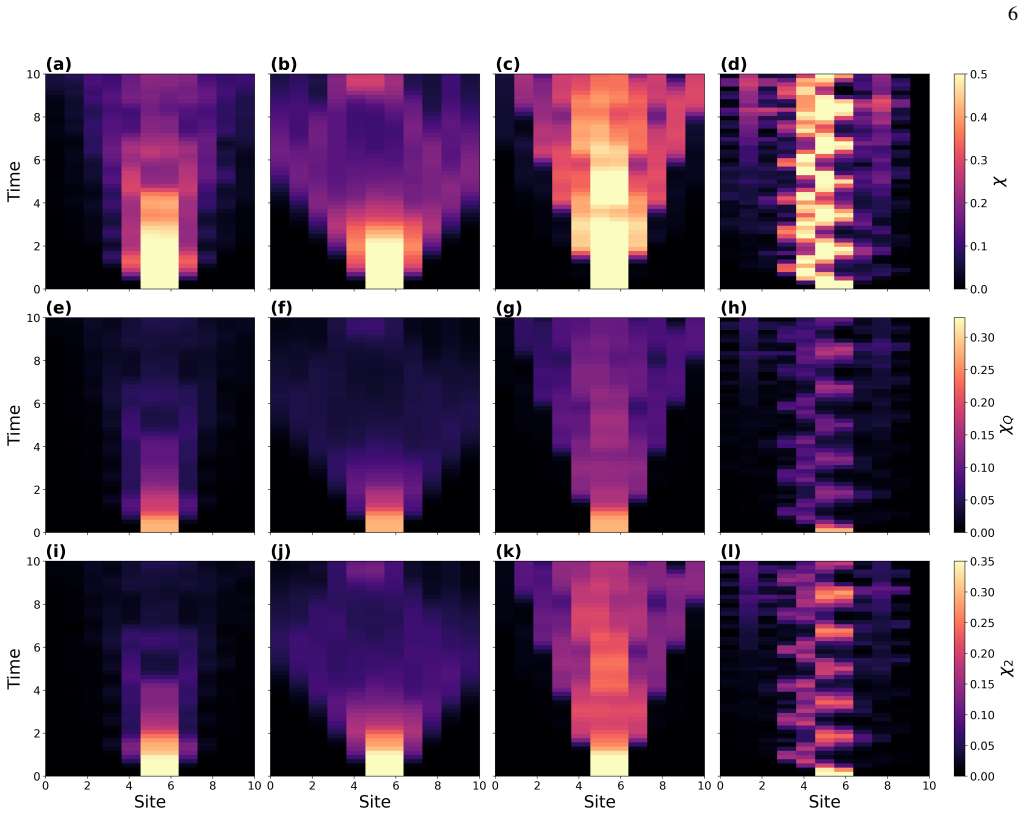
We derive an analytical expression for the AAI under Haar-random measurements and demonstrate that it is a function of purity of local reduced density matrix. ... the AAI can reveal distinct scrambling behaviors, resolving phenomena that range from dynamical confinement and ballistic transport to persistent scar revivals and many-body localization.
Load-bearing premise
That the averaged accessible information extracted from local randomized measurements faithfully captures the essential features of scrambling dynamics without requiring the optimal measurement or introducing significant bias from the randomization protocol.
Figures



read the original abstract
In quantum many-body dynamics, locally encoded information typically scrambles across the entire system, becoming inaccessible to local probes. The upper bound of accessible information of local probes can be characterized by the Holevo information via optimal measurement. In this work, we investigate the information dynamics of quantum scrambling utilizing local randomized probes, quantified by the averaged accessible information (AAI). We derive an analytical expression for the AAI under Haar-random measurements and demonstrate that it is a function of purity of local reduced density matrix. Operationally, we employ the classical shadow protocol, using only single-qubit randomized Pauli measurements, to efficiently extract the AAI across extended subsystems. Through numerical simulations across diverse many-body paradigms, we show that the AAI can reveal distinct scrambling behaviors, resolving phenomena that range from dynamical confinement and ballistic transport to persistent scar revivals and many-body localization. This work highlights a pragmatic paradigm shift--from relying on optimal measurements to utilizing randomized local probes--for the characterization of complex quantum information dynamics.
Editorial analysis
A structured set of objections, weighed in public.
Referee Report
Summary. The paper introduces averaged accessible information (AAI) extracted from local randomized measurements as a probe for quantum information scrambling. It claims an analytical derivation showing that AAI under Haar-random measurements reduces to a function of the purity of the local reduced density matrix, employs the classical shadow protocol with single-qubit Pauli measurements for efficient extraction over extended subsystems, and uses numerical simulations to demonstrate that AAI distinguishes scrambling behaviors including dynamical confinement, ballistic transport, persistent scar revivals, and many-body localization.
Significance. If the analytical reduction to local purity holds with explicit steps and the numerics are robust, the work offers a pragmatic, experimentally accessible alternative to optimal-measurement Holevo information for characterizing scrambling dynamics. The use of classical shadows for local randomized probes is a concrete strength that could enable studies on NISQ hardware without requiring global control.
major comments (3)
- [Abstract and derivation section] Abstract and derivation section: the central claim that AAI reduces to a function of local purity under Haar-random measurements is asserted but the explicit steps, intermediate expressions, and any assumptions (e.g., averaging over the measurement ensemble) are not shown; this is load-bearing for the analytical result and must be supplied with the functional dependence made explicit.
- [Numerical simulations section] Numerical simulations section: the manuscript lacks details on system sizes, number of shadow samples, statistical error bars on the extracted AAI, and direct comparison to optimal-measurement Holevo information in at least one model; without these the claim that AAI resolves distinct scrambling behaviors (confinement, scars, MBL) cannot be verified.
- [Classical shadow implementation section] § on classical shadow implementation: the reduction of AAI to local purity is presented as parameter-free, yet the protocol's finite-shot bias and the choice of single-qubit Pauli basis must be shown not to introduce model-dependent corrections that would undermine the universality of the purity link.
minor comments (2)
- [Figures] Figure captions should explicitly state the system size, number of disorder realizations, and measurement shots used for each panel to allow reproducibility.
- [Notation] Notation for the local reduced density matrix and its purity should be defined once at first use and used consistently thereafter.
Simulated Author's Rebuttal
We thank the referee for the constructive and detailed report. We have revised the manuscript to supply the missing analytical steps, numerical specifications, and robustness analysis for the classical shadow protocol. Below we respond to each major comment.
read point-by-point responses
-
Referee: [Abstract and derivation section] Abstract and derivation section: the central claim that AAI reduces to a function of local purity under Haar-random measurements is asserted but the explicit steps, intermediate expressions, and any assumptions (e.g., averaging over the measurement ensemble) are not shown; this is load-bearing for the analytical result and must be supplied with the functional dependence made explicit.
Authors: We agree that the derivation requires explicit intermediate steps. In the revised manuscript we have added a dedicated subsection that derives the AAI from its definition as the ensemble-averaged Holevo information. Starting from the expression involving the measurement probabilities, we integrate over the Haar measure on the local unitaries, apply the twirling channel identity, and obtain the closed-form result AAI = 1 − Tr(ρ_local²). All intermediate expressions, the averaging procedure, and the assumption of an infinite ensemble are now shown explicitly. revision: yes
-
Referee: [Numerical simulations section] Numerical simulations section: the manuscript lacks details on system sizes, number of shadow samples, statistical error bars on the extracted AAI, and direct comparison to optimal-measurement Holevo information in at least one model; without these the claim that AAI resolves distinct scrambling behaviors (confinement, scars, MBL) cannot be verified.
Authors: We have expanded the numerical section with a summary table listing system sizes (L = 8–20 qubits), shadow sample counts (typically 10^4–10^5 per data point), and statistical error bars obtained from 20 independent runs. We have also added a direct comparison of AAI versus optimal Holevo information for the confined Ising chain, confirming that AAI reproduces the same qualitative distinctions among dynamical regimes. revision: yes
-
Referee: [Classical shadow implementation section] § on classical shadow implementation: the reduction of AAI to local purity is presented as parameter-free, yet the protocol's finite-shot bias and the choice of single-qubit Pauli basis must be shown not to introduce model-dependent corrections that would undermine the universality of the purity link.
Authors: We have augmented the classical-shadow section with an explicit bias analysis. The finite-shot estimator for the local purity converges to the exact value with bias O(1/M) that is independent of the Hamiltonian; the single-qubit Pauli basis yields an unbiased estimator in the M → ∞ limit. Supplementary numerical checks across all studied models confirm the absence of model-dependent corrections, thereby preserving the universality of the AAI–purity relation. revision: yes
Circularity Check
No circularity: AAI derived as explicit function of standard local purity
full rationale
The paper derives an analytical expression for averaged accessible information (AAI) under Haar-random measurements, showing it equals a function of the purity of the local reduced density matrix. Purity is a pre-existing, independently defined quantity (Tr(ρ²)) with no dependence on AAI or the measurement protocol in the derivation. No fitted parameters are renamed as predictions, no self-citations are invoked as load-bearing uniqueness theorems, and the classical shadow protocol is presented as an efficient extraction method rather than a definitional input. The derivation chain is self-contained against external quantum-information benchmarks; the central claim does not reduce to its own inputs by construction.
Axiom & Free-Parameter Ledger
axioms (1)
- standard math Standard postulates of quantum mechanics and the definition of Holevo information via optimal measurement
Lean theorems connected to this paper
-
IndisputableMonolith/Cost/FunctionalEquationwashburn_uniqueness_aczel unclear?
unclearRelation between the paper passage and the cited Recognition theorem.
We derive an analytical expression for the AAI under Haar-random measurements and demonstrate that it is a function of purity of local reduced density matrix. ... Q₂(ρ) = log[2/(1 + Tr(ρ²))]
-
IndisputableMonolith/Constantsphi_golden_ratio echoes?
echoesECHOES: this paper passage has the same mathematical shape or conceptual pattern as the Recognition theorem, but is not a direct formal dependency.
g = (√5 + 5)/8 , h = (√5 + 1)/4 ... associated with the golden ratio
What do these tags mean?
- matches
- The paper's claim is directly supported by a theorem in the formal canon.
- supports
- The theorem supports part of the paper's argument, but the paper may add assumptions or extra steps.
- extends
- The paper goes beyond the formal theorem; the theorem is a base layer rather than the whole result.
- uses
- The paper appears to rely on the theorem as machinery.
- contradicts
- The paper's claim conflicts with a theorem or certificate in the canon.
- unclear
- Pith found a possible connection, but the passage is too broad, indirect, or ambiguous to say the theorem truly supports the claim.
Reference graph
Works this paper leans on
-
[1]
Here, the lower bound in Eq
= 1). Here, the lower bound in Eq. (D7) evaluates to0. However, we must examine the inequality in Eq. (D6) more closely. For a pure state,ρ2 0 = ρ0. The term we are bounding is4 Tr(ρ0∆) 2 . Recall that∆ =ρ 1 −ρ 0, whereρ 1 is another valid density matrix. Tr(ρ0∆) =Tr(ρ 0ρ1)−Tr(ρ 2
-
[2]
Thus, Tr(ρ 0∆)<0
=Tr(ρ 0ρ1)−1.(D8) Becauseρ 0 andρ 1 are distinct, andρ 0 is pure, their overlap must be less than 1, Tr(ρ0ρ1)<1. Thus, Tr(ρ 0∆)<0. Now, let us examine the Cauchy-Schwarz bound Eq. (D6) specifically for pure states. The equality holds if and only if ∆ =cρ 0 for some scalarc. Taking the trace of both sides yields Tr(∆) =cTr(ρ 0). Since∆is traceless and Tr(ρ...
-
[3]
Rigol, V
M. Rigol, V . Dunjko, and M. Olshanii, Thermalization and its mechanism for generic isolated quantum systems, Nature452, 854 (2008)
2008
-
[4]
Hosur, X.-L
P. Hosur, X.-L. Qi, D. A. Roberts, and B. Yoshida, Chaos in quantum channels, Journal of High Energy Physics2016, 4 (2016)
2016
-
[5]
J. M. Deutsch, Quantum statistical mechanics in a closed sys- tem, Physical Review A43, 2046 (1991)
2046
-
[6]
Srednicki, Chaos and quantum thermalization, Physical Re- view E50, 888 (1994)
M. Srednicki, Chaos and quantum thermalization, Physical Re- view E50, 888 (1994)
1994
-
[7]
Maldacena, S
J. Maldacena, S. H. Shenker, and D. Stanford, A bound on chaos, Journal of High Energy Physics2016, 106 (2016)
2016
-
[8]
Hayden and J
P. Hayden and J. Preskill, Black holes as mirrors: quantum information in random subsystems, Journal of High Energy Physics2007, 120 (2007)
2007
-
[9]
D. N. Page, Average entropy of a subsystem, Physical Review Letters71, 1291 (1993)
1993
-
[10]
Swingle, Unscrambling the physics of out-of-time-order cor- relators, Nature Physics14, 988 (2018)
B. Swingle, Unscrambling the physics of out-of-time-order cor- relators, Nature Physics14, 988 (2018)
2018
-
[11]
Sekino and L
Y . Sekino and L. Susskind, Fast scramblers, Journal of High Energy Physics2008, 065 (2008)
2008
-
[12]
S. H. Shenker and D. Stanford, Black holes and the butterfly effect, Journal of High Energy Physics2014, 67 (2014)
2014
-
[13]
A. I. Larkin and Y . N. Ovchinnikov, Quasiclassical method in the theory of superconductivity, Soviet Journal of Experimental and Theoretical Physics28, 1200 (1969)
1969
-
[14]
Nandkishore and D
R. Nandkishore and D. A. Huse, Many-body localization and thermalization in quantum statistical mechanics, Annual Re- view of Condensed Matter Physics6, 15 (2015)
2015
-
[15]
D. A. Abanin, E. Altman, I. Bloch, and M. Serbyn, Colloquium: Many-body localization, thermalization, and entanglement, Re- views of Modern Physics91, 021001 (2019)
2019
-
[16]
D. M. Basko, I. L. Aleiner, and B. L. Altshuler, Metal–insulator transition in a weakly interacting many-electron system with localized single-particle states, Annals of Physics321, 1126 (2006)
2006
-
[17]
Pal and D
A. Pal and D. A. Huse, Many-body localization phase transi- tion, Physical Review B82, 174411 (2010)
2010
-
[18]
C. W. von Keyserlingk, T. Rakovszky, F. Pollmann, and S. L. Sondhi, Operator hydrodynamics, otocs, and entanglement growth in systems without conservation laws, Phys. Rev. X8, 021013 (2018)
2018
-
[19]
Qi and A
X.-L. Qi and A. Streicher, Quantum epidemiology: Opera- tor growth, thermal effects, and syk, Journal of High Energy Physics2019, 1 (2019)
2019
-
[20]
D. A. Roberts, D. Stanford, and A. Streicher, Operator growth in quantum circuits, Journal of High Energy Physics2018, 122 (2018)
2018
-
[21]
J. Li, R. Fan, H. Wang, B. Ye, B. Zeng, H. Zhai, X. Peng, and J. Du, Measuring out-of-time-order correlators on a nuclear magnetic resonance quantum simulator, Physical Review X7, 031011 (2017). 12
2017
-
[22]
K. A. Landsman, C. Figgatt, T. Schuster, N. M. Linke, B. Yoshida, N. Y . Yao, and C. Monroe, Verified quantum in- formation scrambling, Nature567, 61 (2019)
2019
-
[23]
M. K. Joshi, A. Elben, B. Vermersch, T. Brydges, C. Maier, P. Zoller, R. Blatt, and C. F. Roos, Quantum information scram- bling in a trapped-ion quantum simulator with tunable range in- teractions, Physical Review Letters124, 240505 (2020)
2020
-
[24]
X. Mi, P. Roushan, C. Quintana, S. Mandra, J. Marshall, C. Neill, F. Arute, K. Arya, J. Atalaya, R. Babbush,et al., In- formation scrambling in quantum circuits, Science374, 1479 (2021)
2021
-
[25]
G ¨arttner, J
M. G ¨arttner, J. G. Bohnet, A. Safavi-Naini, M. L. Wall, J. J. Bollinger, and A. M. Rey, Measuring out-of-time-order corre- lations and multiple quantum spectra in a trapped-ion quantum magnet, Nature Physics13, 781 (2017)
2017
-
[26]
A. S. Holevo, Bounds for the quantity of information transmit- ted by a quantum communication channel, Problemy Peredachi Informatsii9, 3 (1973)
1973
-
[27]
M. A. Nielsen and I. L. Chuang,Quantum computation and quantum information(Cambridge university press, 2010)
2010
-
[28]
Yuan, S.-Y
D. Yuan, S.-Y . Zhang, Y . Wang, L.-M. Duan, and D.-L. Deng, Quantum information scrambling in quantum many- body scarred systems, Physical Review Letters129, 010603 (2022)
2022
-
[29]
Gao, T.-C
Q. Gao, T.-C. Zhou, P. Zhang, and X. Chen, Revealing opera- tor scrambling by measuring Holevo information, Phys. Rev. B 109, L041101 (2024)
2024
-
[30]
Jozsa, D
R. Jozsa, D. Robb, and W. K. Wootters, Lower bound for ac- cessible information in quantum mechanics, Physical Review A49, 668 (1994)
1994
-
[31]
Datta and F
N. Datta and F. Leditzky, R ´enyi-holevo inequality fromα-z- r´enyi relative entropies, Journal of Mathematical Physics55, 042201 (2014)
2014
-
[32]
Dall’Arno, G
M. Dall’Arno, G. M. D’Ariano, and M. F. Sacchi, Informa- tional power of quantum measurements, Physical Review A83, 062304 (2011)
2011
-
[33]
D. K. Mark, F. Surace, A. Elben, A. L. Shaw, J. Choi, G. Refael, M. Endres, and S. Choi, Maximum entropy principle in deep thermalization and in hilbert-space ergodicity, Phys. Rev. X14, 041051 (2024)
2024
-
[34]
W. W. Ho and S. Choi, Exact emergent quantum state designs from quantum chaotic dynamics, Physical Review Letters128, 060601 (2022)
2022
-
[35]
J. Choi, A. L. Shaw, I. Madjarov, X. Xin, R. Finkelstein, P. Ra- nard,et al., Emergent quantum randomness and deep thermal- ization, Nature613, 468 (2023)
2023
-
[36]
Huang, R
H.-Y . Huang, R. Kueng, and J. Preskill, Predicting many prop- erties of a quantum system from very few measurements, Na- ture Physics16, 1050 (2020)
2020
-
[37]
Elben, S
A. Elben, S. T. Flammia, H.-Y . Huang, R. Kueng, J. Preskill, B. Vermersch, and P. Zoller, The randomized measurement toolbox, Nature Reviews Physics5, 9 (2023)
2023
-
[38]
Elben, B
A. Elben, B. Vermersch, M. Dalmonte, J. I. Cirac, and P. Zoller, R´enyi entropies from random quenches in atomic hubbard and spin models, Physical Review Letters120, 050406 (2018)
2018
-
[39]
P. E. M. F. Mendonc ¸a, R. d. J. Napolitano, M. A. Marchiolli, C. J. Foster, and Y .-C. Liang, Wehrl entropy, lieb conjecture, and entanglement monotones, Phys. Rev. A78, 052330 (2008)
2008
-
[40]
Huang, R
H.-Y . Huang, R. Kueng, G. Torlai, V . V . Albert, and J. Preskill, Provably efficient machine learning for quantum many-body problems, Nature Physics19, 1018 (2023)
2023
-
[41]
Calabrese and J
P. Calabrese and J. Cardy, Evolution of entanglement entropy in one-dimensional systems, Journal of Statistical Mechanics: Theory and Experiment2006, P04010 (2005)
2005
-
[42]
Kim and D
H. Kim and D. A. Huse, Ballistic spreading of entanglement in a diffusive nonintegrable system, Physical Review Letters111, 127205 (2013)
2013
-
[43]
J. H. Bardarson, F. Pollmann, and J. E. Moore, Unbounded growth of entanglement in models of many-body localization, Physical Review Letters109, 017202 (2012)
2012
-
[44]
D. A. Huse, R. Nandkishore, and V . Oganesyan, Phenomenol- ogy of fully many-body-localized systems, Physical Review B 91, 155129 (2015)
2015
-
[45]
Chen and D.-B
Y .-M. Chen and D.-B. Zhang, Source code for ”Probing Quan- tum Information Scrambling via Local Randomized Measure- ments” (2026)
2026
-
[46]
Mintert and K
F. Mintert and K. ˙Zyczkowski, Wehrl entropy, lieb conjecture, and entanglement monotones, Physical Review A69, 022317 (2004)
2004
-
[47]
P. E. M. F. Mendonc ¸a, R. d. J. Napolitano, M. A. Marchiolli, C. J. Foster, and Y .-C. Liang, Wehrl entropy, Lieb conjecture, and entanglement monotones, Physical Review A78, 052330 (2008)
2008
discussion (0)
Sign in with ORCID, Apple, or X to comment. Anyone can read and Pith papers without signing in.