Recognition: unknown
Quantum selective measurement as a quasilinear evolution
Pith reviewed 2026-05-14 18:06 UTC · model grok-4.3
The pith
A quasilinear continuous evolution is introduced for selective quantum measurements that converges to von Neumann projection outcomes while preserving ensemble equivalence and no-signaling.
A machine-rendered reading of the paper's core claim, the machinery that carries it, and where it could break.
Core claim
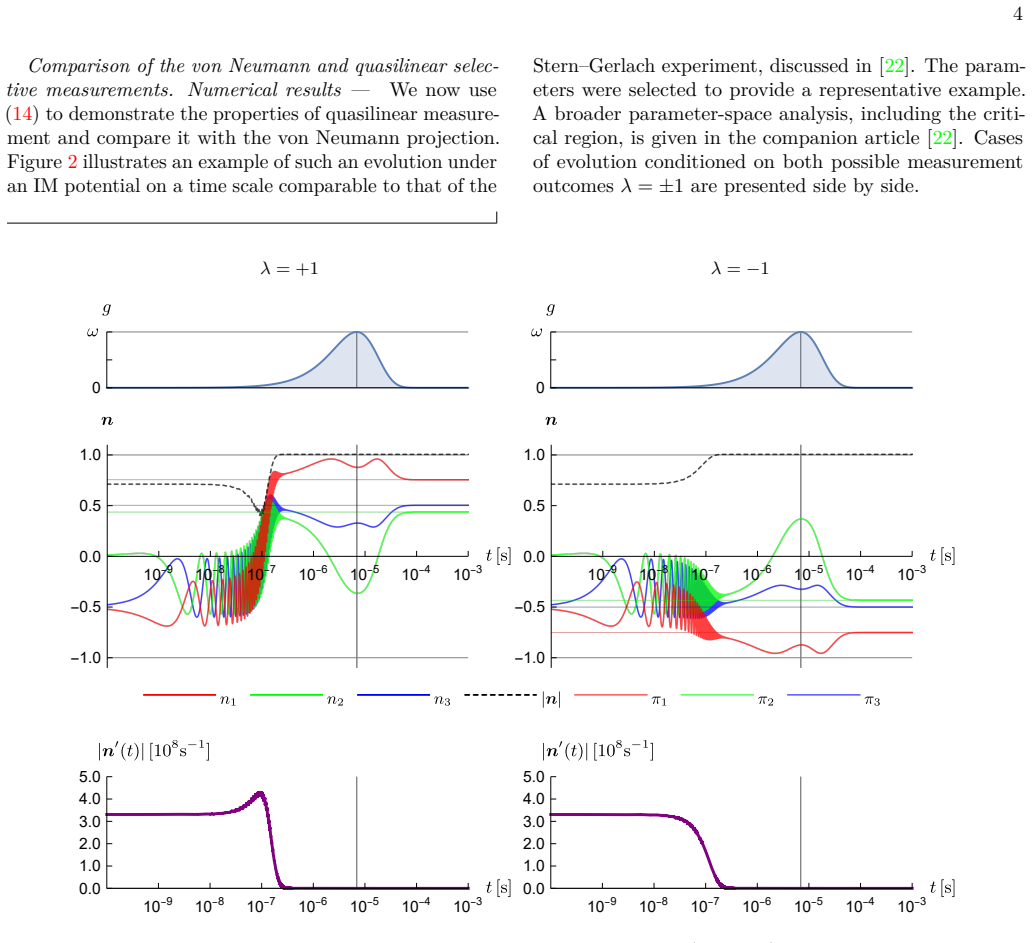
We propose replacing the instantaneous state reduction in von Neumann selective measurement with continuous nonlinear evolution. Despite its nonlinearity, this evolution preserves the equivalence of quantum ensembles and hence obeys the no-signaling principle. Its final states coincide with those produced by the von Neumann projection.
Load-bearing premise
That a nonlinear evolution operator can be defined which simultaneously preserves ensemble equivalence (hence no-signaling), drives every initial state to the selected eigenstate, and remains independent of the initial state while acting consistently on entangled systems.
Figures



read the original abstract
We propose replacing the instantaneous state reduction in von Neumann selective measurement with continuous nonlinear evolution. Despite its nonlinearity, this evolution preserves the equivalence of quantum ensembles and hence obeys the no-signaling principle. Its final states coincide with those produced by the von Neumann projection. The defining features of rank-one projective measurement are retained: convergence to the eigenstate of the observable associated with the selected outcome, independence of this final state from the initial state, and consistent action on entangled states.
Editorial analysis
A structured set of objections, weighed in public.
Referee Report
Summary. The manuscript proposes replacing the instantaneous von Neumann projection in selective measurement with a continuous nonlinear quasilinear evolution. It asserts that this evolution, despite nonlinearity, preserves equivalence of quantum ensembles (hence obeys no-signaling), converges to the selected eigenstate of the measured observable independently of the initial state, and acts consistently on entangled systems so that the final reduced states match those of the standard projective measurement.
Significance. If the construction is rigorously verified, the result would supply a continuous-time dynamical model for selective measurement that retains the key operational features of von Neumann theory while avoiding signaling. Such a model could be relevant to foundational questions about the measurement process and to the design of continuous monitoring protocols in quantum information.
major comments (2)
- [Section 3] The central claim requires an explicit operator that is independent of the initial state, maps every vector to the same eigenstate, yet preserves convex combinations of density operators on entangled systems. No derivation or verification of this preservation is supplied for the quasilinear map acting on a bipartite state; without it the no-signaling assertion remains unestablished.
- [Eq. (8)] The final-state independence from the initial state is asserted for the quasilinear flow, but the manuscript does not exhibit the explicit differential equation or integral form that would allow direct confirmation that every trajectory ends at the identical projector regardless of starting vector while remaining consistent with ensemble equivalence.
minor comments (2)
- [Section 2] Notation for the quasilinear generator is introduced without a clear comparison table to the standard Lindblad or nonlinear Schrödinger forms used in the literature.
- The abstract states that the evolution 'preserves the equivalence of quantum ensembles,' but the corresponding theorem or lemma number is not referenced in the main text.
Simulated Author's Rebuttal
We thank the referee for the careful reading and constructive feedback. We address each major comment below and will revise the manuscript to strengthen the presentation of the key derivations.
read point-by-point responses
-
Referee: [Section 3] The central claim requires an explicit operator that is independent of the initial state, maps every vector to the same eigenstate, yet preserves convex combinations of density operators on entangled systems. No derivation or verification of this preservation is supplied for the quasilinear map acting on a bipartite state; without it the no-signaling assertion remains unestablished.
Authors: We agree that an explicit verification of convex-combination preservation for bipartite states is required to rigorously establish no-signaling. In the revised manuscript we will add a detailed derivation in Section 3 showing that the quasilinear evolution, when applied to an entangled state, leaves the reduced density operators unchanged relative to the standard projective case, thereby confirming ensemble equivalence. revision: yes
-
Referee: [Eq. (8)] The final-state independence from the initial state is asserted for the quasilinear flow, but the manuscript does not exhibit the explicit differential equation or integral form that would allow direct confirmation that every trajectory ends at the identical projector regardless of starting vector while remaining consistent with ensemble equivalence.
Authors: The governing differential equation appears immediately before Eq. (8). To make the independence explicit, the revised version will include the closed-form integral solution of the flow, demonstrating that every initial vector converges to the same rank-one projector while the ensemble-averaged evolution remains linear and therefore consistent with no-signaling. revision: yes
Circularity Check
No circularity: quasilinear evolution constructed to satisfy independent conditions
full rationale
The paper introduces a continuous nonlinear evolution operator whose final states are required to match von Neumann projections while preserving ensemble equivalence (hence no-signaling) and acting consistently on entangled systems. No equations or steps in the manuscript reduce the claimed properties to a fitted parameter, a self-citation chain, or a definition that already encodes the target outcome. The construction is presented as satisfying three independent requirements simultaneously; the preservation of convex combinations and state-independence are asserted as verified properties of the explicit operator rather than imposed by renaming or tautological fitting. The derivation therefore remains self-contained against external benchmarks.
Axiom & Free-Parameter Ledger
axioms (2)
- domain assumption Standard quantum mechanics with von Neumann selective measurement as baseline
- domain assumption Nonlinear evolution must preserve ensemble equivalence
Reference graph
Works this paper leans on
-
[1]
B. d’Espagnat,Veiled Reality: An Analysis of Present- Day Quantum Mechanical Concepts(Westview Press, 2003)
work page 2003
-
[2]
Decoherence, the measurement problem, and interpretations of quantum mechanics
M. Schlosshauer, Decoherence, the measurement problem, and interpretations of quantum mechanics, Reviews of Modern Physics76, 1267 (2004), arXiv:quant-ph/0312059 [quant-ph]
work page internal anchor Pith review Pith/arXiv arXiv 2004
- [3]
-
[4]
D. Z. Albert,A Guess at the Riddle: Essays on the Phys- ical Underpinnings of Quantum Mechanics(Harvard Uni- versity Press, 2023)
work page 2023
- [5]
- [6]
-
[7]
A. A. Tomaz, R. S. Mattos, and M. Barbatti, The quantum measurement problem: A re- view of recent trends, Philosophical Magazine C 10.1080/14786435.2025.2601922 (2025), arXiv:2502.19278 [quant-ph]
-
[8]
M. Carlesso, S. Donadi, L. Ferialdi, M. Paternostro, H. Ul- bricht, and A. Bassi, Present status and future challenges of non-interferometric tests of collapse models, Nature Physics18, 243 (2022)
work page 2022
-
[9]
Y. Zhan and M. G. A. Paris, Quantum ensembles and the statistical operator: a tutorial, International Journal of Software and Informatics8, 241 (2014), journal-ref per arXiv record; also circulated as arXiv:2212.13027 (posted 2022)., arXiv:2212.13027 [quant-ph]
-
[10]
M. G. A. Paris, The modern tools of quantum mechanics: A tutorial on quantum states, measurements, and opera- tions, The European Physical Journal Special Topics203, 61 (2012), arXiv:1110.6815 [quant-ph]
work page internal anchor Pith review Pith/arXiv arXiv 2012
-
[11]
Gisin, Stochastic quantum dynamics and relativity, Helvetica Physica Acta62, 363 (1989)
N. Gisin, Stochastic quantum dynamics and relativity, Helvetica Physica Acta62, 363 (1989)
work page 1989
-
[12]
N. Gisin, Weinberg’s non-linear quantum mechanics and supraluminal communications, Physics Letters A143, 1 (1990)
work page 1990
- [13]
-
[14]
M. Czachor, Nonlocal-looking equations can make nonlin- ear quantum dynamics local, Physical Review A57, 4122 (1998)
work page 1998
-
[15]
Correlation experiments in nonlinear quantum mechanics
M. Czachor and H.-D. Doebner, Correlation experiments in nonlinear quantum mechanics, Physics Letters A301, 139 (2002), arXiv:quant-ph/0110008 [quant-ph]
work page internal anchor Pith review Pith/arXiv arXiv 2002
-
[16]
Nonlinearity without Superluminality
A. Kent, Nonlinearity without superluminality, Physical Review A72, 012108 (2005), arXiv:quant-ph/0204106 [quant-ph]
work page internal anchor Pith review Pith/arXiv arXiv 2005
-
[17]
B. Helou and Y. Chen, Extensions of born’s rule to non- linear quantum mechanics, some of which do not imply superluminal communication, Journal of Physics: Confer- ence Series880, 012021 (2017)
work page 2017
-
[18]
M. E. Bielińska, M. Eckstein, and P. Horodecki, Superlu- minal signaling and chaos in nonlinear quantum dynamics, New Journal of Physics27, 053002 (2025)
work page 2025
-
[19]
J. Rembieliński and P. Caban, Nonlinear evolution and signaling, Physical Review Research2, 012027 (2020)
work page 2020
-
[20]
J. Rembieliński and P. Caban, Nonlinear extension of the quantum dynamical semigroup, Quantum5, 420 (2021), arXiv:2003.09170 [quant-ph]
-
[21]
J. Rembieliński and J. Ciborowski, On nonlinear descrip- tion of neutrino flavour evolution in solar matter, Annals of Physics458, 169481 (2023)
work page 2023
-
[22]
J. Rembieliński and K. Ławniczak, Quasilinear evolution versus von neumann selective measurement (2026), com- panion paper, submitted together with this letter
work page 2026
- [23]
-
[24]
G. Lindblad, On the generators of quantum dynamical semigroups, Communications in Mathematical Physics 48, 119 (1976)
work page 1976
-
[25]
V. I. Arnol’d, V. S. Afrajmovich, Y. S. Il’yashenko, and L. P. Shil’nikov,Dynamical Systems V: Bifurcation The- ory and Catastrophe Theory(Springer Berlin, Heidelberg, 1994)
work page 1994
-
[26]
B. Mielnik, Nonlinear quantum mechanics: a conflict with the ptolomean structure?, Physics Letters A289, 1 (2001)
work page 2001
-
[27]
A. N. Jordan and I. A. Siddiqi,Quantum Measurement: Theory and Practice(Cambridge University Press, Cam- bridge, United Kingdom, 2024)
work page 2024
discussion (0)
Sign in with ORCID, Apple, or X to comment. Anyone can read and Pith papers without signing in.