Recognition: no theorem link
Optimal Quantum Illumination with Nonlocal Non-Gaussian Operations
Pith reviewed 2026-05-14 17:59 UTC · model grok-4.3
The pith
Nonlocal non-Gaussian operations create probe states that raise signal-to-noise ratio in quantum illumination above local non-Gaussian states and the two-mode squeezed state
A machine-rendered reading of the paper's core claim, the machinery that carries it, and where it could break.
Core claim
The state produced by the nonlocal non-Gaussian operation protocol outperforms earlier local non-Gaussian states under realistic photon loss; when used with a 50:50 beam splitter and photon-number difference detection it delivers a significant enhancement in signal-to-noise ratio for target detection relative to the two-mode squeezed state.
What carries the argument
The nonlocal non-Gaussian operation protocol that engineers an improved entangled probe state from two input modes
If this is right
- The protocol supplies a resource-efficient entangled probe for quantum illumination that remains effective under photon loss.
- Detection signal-to-noise ratio improves measurably over both local non-Gaussian constructions and the two-mode squeezed state.
- The 50:50 beam splitter plus photon-number difference detection scheme suffices to extract the advantage.
- The approach is presented as experimentally feasible with current continuous-variable technology.
Where Pith is reading between the lines
- The same nonlocal operation could be tested in other continuous-variable sensing tasks that rely on photon loss, such as quantum ranging or imaging.
- If the required non-Gaussian gates can be realized with linear optics and photon counting, the protocol lowers the resource threshold for quantum-enhanced detection schemes.
- The performance gap between nonlocal and local non-Gaussian states suggests that entanglement distribution before the non-Gaussian step is a key design choice worth optimizing further.
Load-bearing premise
The nonlocal non-Gaussian operations can be performed with high fidelity and introduce no extra noise or loss beyond the photon-loss channel already modeled.
What would settle it
An experiment that implements the proposed nonlocal operation, sends the engineered state through the same loss channel, and records a signal-to-noise ratio no higher than that of the two-mode squeezed state under identical conditions.
Figures



read the original abstract
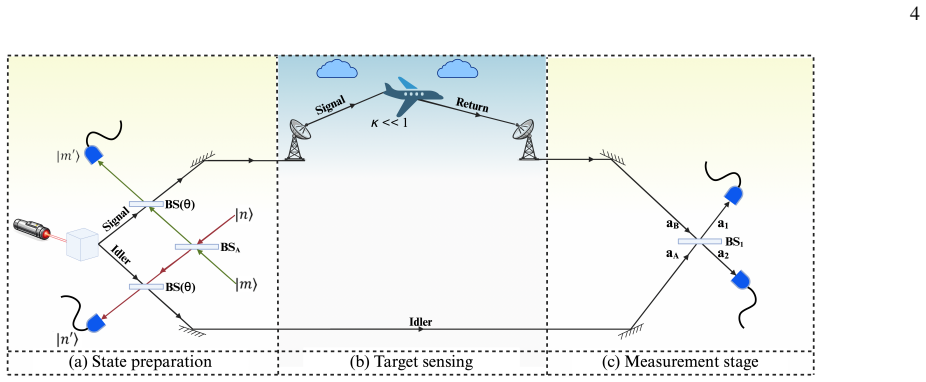
Enhancing quantum illumination with highly entangled probes remains an active area of research. In this context, non-Gaussian operations provide an effective route for engineering probe states that can surpass the standard two-mode squeezed state (TMSS). In this work, we investigate a specific nonlocal non-Gaussian operation protocol and show that the engineered state using this protocol outperforms previously considered local non-Gaussian scenarios, engineered based on photon catalysis, addition, and subtraction under realistic conditions, including photon loss. Furthermore, by employing a $50{:}50$ beam splitter with photon-number difference detection, we demonstrate a significant enhancement in the signal-to-noise ratio (SNR) for target detection relative to the TMSS. Thus, our protocol exhibits improved performance, highlighting a resource-efficient and experimentally feasible probe for enhanced quantum illumination.
Editorial analysis
A structured set of objections, weighed in public.
Referee Report
Summary. The manuscript proposes a nonlocal non-Gaussian operation protocol to engineer probe states for quantum illumination. It claims these states outperform those produced by local non-Gaussian operations (photon catalysis, addition, and subtraction) and the standard two-mode squeezed state (TMSS) in signal-to-noise ratio (SNR) for target detection, even under photon loss, when a 50:50 beam splitter and photon-number-difference detection are employed.
Significance. If the central claims are substantiated with complete derivations and error analysis, the work would advance quantum illumination by identifying a resource-efficient nonlocal route to non-Gaussian entanglement that yields measurable SNR gains under realistic loss. This could inform experimental designs for quantum-enhanced sensing and radar protocols.
major comments (2)
- [Abstract] Abstract: The assertion that the nonlocal protocol outperforms local non-Gaussian scenarios 'under realistic conditions, including photon loss' is load-bearing for the central claim, yet the text provides no explicit model or fidelity parameter for the nonlocal operation step itself. Any additional loss or noise from its physical realization (cross-Kerr, conditional measurements, or beam-splitter cascades) would constitute an unmodeled channel whose effect on the engineered state's photon statistics and SNR must be quantified.
- [Results] Results section (performance comparison): The SNR enhancement relative to TMSS and local operations is presented without visible full derivations or sensitivity analysis to the squeezing strength and loss rate parameters. Without these, it is not possible to verify that the reported gains survive the photon-loss channel alone.
minor comments (2)
- [Abstract] The abstract would benefit from a brief statement of the specific squeezing parameter and loss-rate values at which the SNR improvement is demonstrated.
- [Introduction] Notation for the nonlocal operation should be defined explicitly on first use to avoid ambiguity with local operations.
Simulated Author's Rebuttal
We thank the referee for the insightful comments, which have helped us improve the clarity and completeness of the manuscript. We address each major comment below and have incorporated revisions accordingly.
read point-by-point responses
-
Referee: [Abstract] Abstract: The assertion that the nonlocal protocol outperforms local non-Gaussian scenarios 'under realistic conditions, including photon loss' is load-bearing for the central claim, yet the text provides no explicit model or fidelity parameter for the nonlocal operation step itself. Any additional loss or noise from its physical realization (cross-Kerr, conditional measurements, or beam-splitter cascades) would constitute an unmodeled channel whose effect on the engineered state's photon statistics and SNR must be quantified.
Authors: We agree that the physical realization of the nonlocal non-Gaussian operation requires explicit discussion. In the revised manuscript, we have added a new subsection in Section II detailing the assumptions for the nonlocal operation, modeled as an ideal operation on the initial TMSS with no additional loss introduced at that step. We have also included a sensitivity analysis showing the impact of hypothetical additional loss (e.g., 5-20% transmission) on the final SNR, confirming that the performance advantage over local protocols and TMSS persists for realistic loss levels in the operation. The abstract has been updated to specify that the photon loss refers to the illumination channel. revision: yes
-
Referee: [Results] Results section (performance comparison): The SNR enhancement relative to TMSS and local operations is presented without visible full derivations or sensitivity analysis to the squeezing strength and loss rate parameters. Without these, it is not possible to verify that the reported gains survive the photon-loss channel alone.
Authors: The full analytical derivations of the SNR for the photon-number-difference detection scheme are provided in Appendix B of the manuscript, including the expressions for the mean and variance of the difference operator after the 50:50 beam splitter. To address the sensitivity analysis, we have added Figure 5 in the revised version, which plots the SNR as a function of the squeezing parameter r (from 0.5 to 2.0) and loss rate η (from 0 to 0.5), demonstrating that the nonlocal protocol maintains superior performance across these ranges. We have also referenced these derivations more explicitly in the Results section. revision: yes
Circularity Check
No circularity: performance gains derived from explicit state calculations against independent baselines
full rationale
The paper computes the engineered probe state via the nonlocal non-Gaussian protocol, then evaluates its SNR under a photon-loss channel using 50:50 beam-splitter and photon-number-difference detection. These quantities are obtained from direct covariance-matrix and photon-number statistics calculations rather than any fitted parameter or self-referential definition. Comparisons to TMSS and local photon catalysis/addition/subtraction are performed on the same loss model with no reduction of the claimed enhancement to the input assumptions by construction. No self-citation is load-bearing for the central SNR result, and the derivation remains self-contained against external benchmarks.
Axiom & Free-Parameter Ledger
free parameters (2)
- squeezing strength
- photon loss rate
axioms (1)
- standard math Linear optical transformations and photon-number-resolving detection follow standard quantum mechanics
Reference graph
Works this paper leans on
-
[1]
Pirandola, U
S. Pirandola, U. L. Andersen, L. Banchi, M. Berta, D. Bunan- dar, R. Colbeck, D. Englund, T. Gehring, C. Lupo, C. Ottaviani, et al., Advances in optics and photonics12, 1012 (2020)
2020
-
[2]
J. F. Fitzsimons and E. Kashefi, Physical Review A96, 012303 (2017)
2017
-
[3]
M. A. Nielsen and I. L. Chuang,Quantum computation and quantum information(Cambridge university press, 2010)
2010
-
[4]
Pirandola, B
S. Pirandola, B. R. Bardhan, T. Gehring, C. Weedbrook, and S. Lloyd, Nature Photonics12, 724 (2018)
2018
-
[5]
von Neumann,Mathematical F oundations of Quantum Me- chanics(Princeton University Press, Princeton, NJ, 1955)
J. von Neumann,Mathematical F oundations of Quantum Me- chanics(Princeton University Press, Princeton, NJ, 1955)
1955
-
[6]
Maleki, L
Y . Maleki, L. D. Z. Palma, and M. S. Zubairy, Phys. Rev. A 113, 012215 (2026)
2026
-
[7]
L. D. Z. Palma, Y . Maleki, and M. S. Zubairy, Fluctuation and Noise Letters25, 2540028 (2026), https://doi.org/10.1142/S0219477525400280
-
[8]
Giovannetti, S
V . Giovannetti, S. Lloyd, and L. Maccone, Nature photonics5, 222 (2011)
2011
-
[9]
C. L. Degen, F. Reinhard, and P. Cappellaro, Reviews of mod- ern physics89, 035002 (2017)
2017
-
[10]
Horodecki, P
R. Horodecki, P. Horodecki, M. Horodecki, and K. Horodecki, Reviews of modern physics81, 865 (2009)
2009
-
[11]
Maleki, M
Y . Maleki, M. O. Scully, and A. M. Zheltikov, Physical Review A104, 053712 (2021)
2021
-
[12]
J. H. Shapiro and S. Lloyd, New Journal of Physics11, 063045 (2009)
2009
-
[13]
M. F. Sacchi, Phys. Rev. A72, 014305 (2005)
2005
-
[14]
J. H. Shapiro, Phys. Rev. A80, 022320 (2009)
2009
-
[15]
Karsa, A
A. Karsa, A. Fletcher, G. Spedalieri, and S. Pirandola, Reports on progress in physics87, 094001 (2024)
2024
-
[16]
P. S. Blakey, H. Liu, G. Papangelakis, Y . Zhang, Z. M. L ´eger, M. L. Iu, and A. S. Helmy, Nature communications13, 5633 (2022)
2022
-
[17]
H. Liu, C. Qin, G. Papangelakis, M. L. Iu, and A. S. Helmy, Nature Communications14, 5344 (2023)
2023
-
[18]
Las Heras, R
U. Las Heras, R. Di Candia, K. Fedorov, F. Deppe, M. Sanz, and E. Solano, Scientific reports7, 9333 (2017)
2017
-
[19]
C. W. Helstrom, Journal of statistical physics1, 231 (1969)
1969
-
[20]
S. M. Barnett and S. Croke, Advances in Optics and Photonics 1, 238 (2009)
2009
-
[21]
Bae and L.-C
J. Bae and L.-C. Kwek, Journal of Physics A: Mathematical and Theoretical48, 083001 (2015)
2015
-
[22]
Calsamiglia, R
J. Calsamiglia, R. Mu ˜noz Tapia, L. Masanes, A. Acin, and E. Bagan, Phys. Rev. A77, 032311 (2008)
2008
-
[23]
Pirandola and S
S. Pirandola and S. Lloyd, Phys. Rev. A78, 012331 (2008)
2008
-
[24]
M. Sanz, U. Las Heras, J. J. Garc ´ıa-Ripoll, E. Solano, and R. Di Candia, Phys. Rev. Lett.118, 070803 (2017)
2017
-
[25]
M. F. Sacchi, Phys. Rev. A71, 062340 (2005)
2005
-
[26]
Lloyd, Science321, 1463 (2008), https://www.science.org/doi/pdf/10.1126/science.1160627
S. Lloyd, Science321, 1463 (2008), https://www.science.org/doi/pdf/10.1126/science.1160627
-
[27]
K. M. Audenaert, J. Calsamiglia, R. Munoz-Tapia, E. Bagan, L. Masanes, A. Acin, and F. Verstraete, Physical review letters 98, 160501 (2007)
2007
-
[28]
S.-H. Tan, B. I. Erkmen, V . Giovannetti, S. Guha, S. Lloyd, L. Maccone, S. Pirandola, and J. H. Shapiro, Phys. Rev. Lett. 101, 253601 (2008)
2008
-
[29]
Guha and B
S. Guha and B. I. Erkmen, Physical Review A ˆa€”Atomic, Molecular, and Optical Physics80, 052310 (2009)
2009
-
[30]
Zhang, S
Z. Zhang, S. Mouradian, F. N. Wong, and J. H. Shapiro, Phys- ical review letters114, 110506 (2015)
2015
-
[31]
Zhuang, Z
Q. Zhuang, Z. Zhang, and J. H. Shapiro, Physical review letters 118, 040801 (2017)
2017
-
[32]
J. H. Shapiro, IEEE Aerospace and Electronic Systems Maga- zine35, 8 (2020)
2020
-
[33]
Ourjoumtsev, A
A. Ourjoumtsev, A. Dantan, R. Tualle-Brouri, and P. Grangier, Phys. Rev. Lett.98, 030502 (2007)
2007
-
[34]
Yang and F.-L
Y . Yang and F.-L. Li, Phys. Rev. A80, 022315 (2009)
2009
-
[35]
H.-J. Kim, J. Kim, and H. Nha, Phys. Rev. A88, 032109 (2013)
2013
-
[36]
Zhang, J
S. Zhang, J. Guo, W. Bao, J. Shi, C. Jin, X. Zou, and G. Guo, Physical review A89, 062309 (2014)
2014
-
[37]
Zhang, X
S. Zhang, X. Zou, J. Shi, J. Guo, and G. Guo, Physical Review A90, 052308 (2014)
2014
-
[38]
Fan and M
L. Fan and M. S. Zubairy, Physical Review A98, 012319 (2018)
2018
-
[39]
Zhang, L
S. Zhang, L. Li, M. Liu, J. Li, W. Sun, and Q. Yu, Physical Review A111, 022627 (2025)
2025
-
[40]
Zhang, Y
H. Zhang, Y . Xia, W. Ye, S. Chang, and Z. Liao, Physical Re- view A109, 062440 (2024)
2024
-
[41]
J. Liu, Y . Maleki, and M. S. Zubairy, Physical Review A105, 062405 (2022)
2022
-
[42]
S. L. Braunstein and P. van Loock, Rev. Mod. Phys.77, 513 (2005)
2005
-
[43]
Weedbrook, S
C. Weedbrook, S. Pirandola, R. Garc´ıa-Patr´on, N. J. Cerf, T. C. Ralph, J. H. Shapiro, and S. Lloyd, Rev. Mod. Phys.84, 621 (2012)
2012
-
[44]
M. O. Scully and M. S. Zubairy,Quantum optics(Cambridge university press, 1997)
1997
-
[45]
C. H. Bennett, H. J. Bernstein, S. Popescu, and B. Schumacher, Physical Review A53, 2046 (1996)
2046
-
[46]
Assouly, R
R. Assouly, R. Dassonneville, T. Peronnin, A. Bienfait, and B. Huard, Nature Physics19, 1418 (2023)
2023
-
[47]
Y . Jo, S. Lee, Y . S. Ihn, Z. Kim, and S.-Y . Lee, Physical Review Research3, 013006 (2021)
2021
-
[48]
Wang and T
T. Wang and T. S. Usuda, Opt. Continuum3, 543 (2024)
2024
discussion (0)
Sign in with ORCID, Apple, or X to comment. Anyone can read and Pith papers without signing in.