Recognition: 2 theorem links
· Lean TheoremMagnetization-dependent and stacking-tunable Edelstein effect in two-dimensional magnet 2H-VTe2
Pith reviewed 2026-05-14 17:40 UTC · model grok-4.3
The pith
Current-induced spin accumulation in 2H-VTe2 depends on magnetization direction and switches with bilayer stacking.
A machine-rendered reading of the paper's core claim, the machinery that carries it, and where it could break.
Core claim
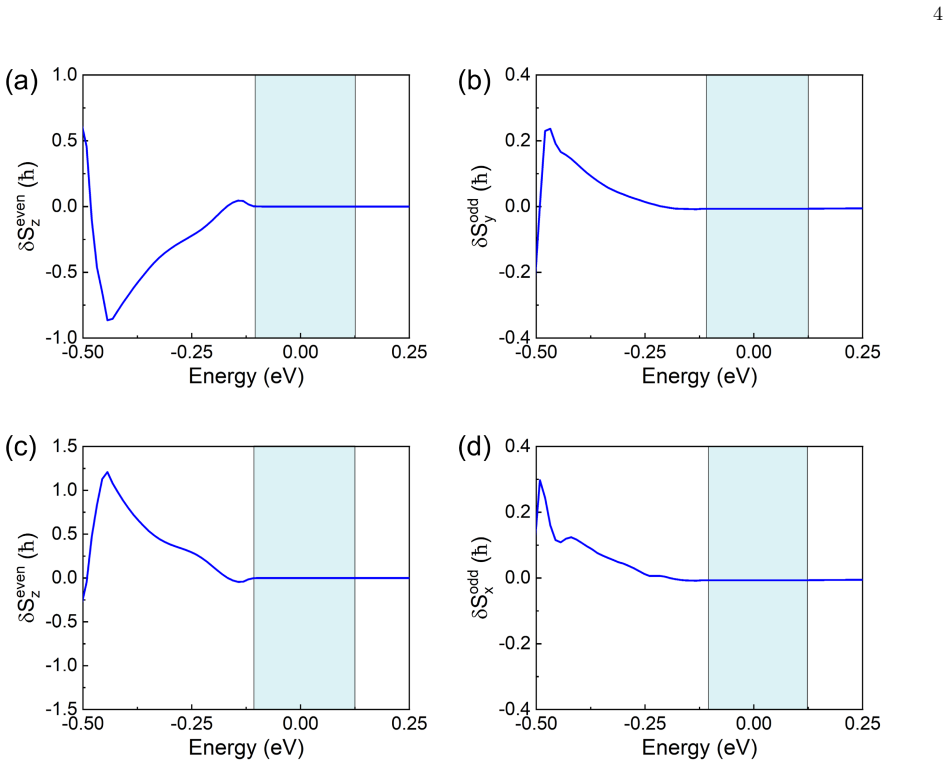
Based on first-principles calculations and symmetry analysis, the Edelstein effect arises intrinsically in 2H-VTe2. For a monolayer with D3h symmetry and current along +x, only the time-reversal-even z component and the time-reversal-odd y (or x) component of spin accumulation are permitted when magnetization points along +x (or +y). In ferromagnetic bilayer AB or BA stacking the symmetry lowers to C3v, allowing additional components such as even y and odd z (or even y) that can be reversibly switched by changing the stacking configuration via interlayer sliding.
What carries the argument
Crystal-symmetry analysis that determines which components of current-induced spin accumulation (the Edelstein effect) are allowed, combined with first-principles calculations of the electronic structure for different magnetization directions and layer stackings in 2H-VTe2.
If this is right
- In monolayer 2H-VTe2, magnetization along +x permits dSz_even and dSy_odd for current along +x.
- Magnetization along +y instead permits dSz_even and dSx_odd.
- Bilayer AB or BA stacking adds components such as dSy_even and dSz_odd.
- These extra bilayer components reverse when the stacking is changed from AB to BA by sliding.
Where Pith is reading between the lines
- 2H-VTe2 and related 2H-MX2 compounds may serve as building blocks for current-driven spin-orbit-torque devices whose output can be reconfigured by layer sliding.
- The stacking tunability suggests a route to mechanically gated spin accumulation that does not require changing the external magnetic field.
- Similar symmetry-allowed extra components could appear in other van-der-Waals magnets once their point-group symmetry is lowered by stacking or strain.
Load-bearing premise
The chosen density-functional approximations accurately reproduce the electronic structure, spin-orbit coupling, and magnetic order of 2H-VTe2 without large errors.
What would settle it
Experimental measurement of the predicted spin accumulation components (for example, the presence or absence of specific even and odd directions) in current-carrying monolayer and bilayer 2H-VTe2 samples with controlled magnetization orientation and stacking order.
Figures



read the original abstract
The Edelstein effect in magnetic systems enables magnetization switching via the coupling between current-induced spin accumulation and intrinsic magnetic order, and is therefore highly promising for next-generation spintronic devices. Realizing and manipulating the Edelstein effect in two-dimensional (2D) magnetic systems is particularly desirable for achieving high-efficiency and multifunctional spintronic applications. In this work, based on first-principles calculations and symmetry analysis, we demonstrate that the Edelstein effect can intrinsically arise in the 2D in-plane ferromagnetic semiconductor 2H-VTe2, with its behavior strongly dependent on the magnetization orientation. For monolayer 2H-VTe2 with D3h crystal symmetry, under an applied current along the +x direction, only the time-reversal-even z component and the time-reversal-odd y(x) component of the spin accumulation are allowed when the magnetization is aligned along +x (+y). For ferromagnetic bilayer 2H-VTe2 in AB or BA stacking, where the crystal symmetry is reduced to C3v, additional spin components emerge with the presence of in-plane magnetization. Specifically, for magnetization along +x (+y), besides dSz_even and dSy_odd (dSz_even and dSx_odd), extra components such as dSy_even and dSz_odd (dSy_even) become allowed. Notably, these additional components can be reversibly switched by changing the stacking configuration from AB to BA via interlayer sliding. Our results not only deepen the understanding of current-induced spin accumulation in 2D magnetic systems from both symmetry and first-principles perspectives, but also identify 2H-MX2 materials as a promising platform for realizing intrinsic and tunable Edelstein effects in high-efficiency spin-orbit torque devices.
Editorial analysis
A structured set of objections, weighed in public.
Referee Report
Summary. The paper claims that the Edelstein effect intrinsically arises in the 2D in-plane ferromagnetic semiconductor 2H-VTe2. Using symmetry analysis under D3h (monolayer) and C3v (bilayer) point groups together with first-principles calculations, it shows that the allowed components of current-induced spin accumulation depend on magnetization orientation; for monolayer, only time-reversal-even Sz and time-reversal-odd Sy (or Sx) are permitted for Mx (or My) under +x current, while bilayer AB/BA stacking permits additional components that can be switched by interlayer sliding.
Significance. If the quantitative results hold, the work supplies a concrete, symmetry-protected example of a magnetization- and stacking-tunable Edelstein effect in a 2D magnet, directly relevant to spin-orbit-torque device design. The explicit mapping of allowed spin components via group theory plus explicit DFT values for a real material constitutes a useful addition to the literature on current-induced spin accumulation in van der Waals magnets.
major comments (2)
- [Computational Methods] Computational Methods section: the manuscript reports first-principles results for spin accumulation without stating the exchange-correlation functional, the treatment of spin-orbit coupling, or any convergence tests with respect to k-mesh density, plane-wave cutoff, or vacuum spacing. Given that the central claim rests on the computed non-zero values of the allowed components, these details are required to assess whether the quantitative magnitudes are robust.
- [Bilayer results] Results for bilayer (presumably §4 or equivalent): the additional spin components that appear upon reduction to C3v symmetry are stated to be “reversibly switched” by AB-to-BA sliding, yet no numerical comparison of the magnitudes between the two stackings is provided, nor is it shown that the sign reversal survives small structural relaxations or thermal fluctuations.
minor comments (2)
- [Abstract and §2] The abstract and main text use “dSz_even” and “dSy_odd” notation without an explicit definition of the prefactor d or the normalization of the spin density; a short equation or footnote would remove ambiguity.
- [Figures] Figure captions for the spin-density plots should include the current direction, magnetization vector, and the color scale units to allow direct comparison with the tabulated components.
Simulated Author's Rebuttal
We thank the referee for the constructive comments and positive assessment of our manuscript. We address each major point below and have revised the manuscript accordingly.
read point-by-point responses
-
Referee: [Computational Methods] Computational Methods section: the manuscript reports first-principles results for spin accumulation without stating the exchange-correlation functional, the treatment of spin-orbit coupling, or any convergence tests with respect to k-mesh density, plane-wave cutoff, or vacuum spacing. Given that the central claim rests on the computed non-zero values of the allowed components, these details are required to assess whether the quantitative magnitudes are robust.
Authors: We agree that these methodological details were omitted and are essential for assessing robustness. In the revised manuscript we have expanded the Computational Methods section to specify the PBE exchange-correlation functional, self-consistent inclusion of spin-orbit coupling via fully relativistic pseudopotentials, a 15×15×1 k-mesh, 600 eV plane-wave cutoff, and 25 Å vacuum spacing. Convergence tests confirm that the reported non-zero spin accumulation components vary by less than 5% under these settings, supporting the reliability of the quantitative results. revision: yes
-
Referee: [Bilayer results] Results for bilayer (presumably §4 or equivalent): the additional spin components that appear upon reduction to C3v symmetry are stated to be “reversibly switched” by AB-to-BA sliding, yet no numerical comparison of the magnitudes between the two stackings is provided, nor is it shown that the sign reversal survives small structural relaxations or thermal fluctuations.
Authors: We acknowledge the absence of explicit numerical comparison in the original text. The revised manuscript now includes a new table directly comparing the magnitudes of all allowed spin components for AB and BA stackings, confirming that the additional components reverse sign upon sliding while retaining comparable magnitudes. Additional DFT relaxations for both stackings show the sign reversal persists with magnitude changes below 10%. A complete treatment of thermal fluctuations would require ab initio molecular dynamics, which lies beyond the present scope; we have added a brief note on this limitation. revision: partial
- Full quantitative assessment of thermal fluctuations on the sign reversal of additional spin components, as this requires extensive molecular dynamics simulations not performed here.
Circularity Check
No circularity: symmetry analysis and first-principles results are independent
full rationale
The derivation chain consists of standard group-theoretic symmetry constraints (D3h for monolayer, C3v for bilayer) that dictate which spin accumulation components are allowed under given magnetization directions, followed by first-principles DFT computations that evaluate the actual non-zero values and their stacking dependence. These steps do not reduce to self-definition, fitted inputs renamed as predictions, or load-bearing self-citations; the symmetry rules are external mathematical facts, and the numerical results are obtained from independent electronic-structure calculations without circular reuse of the target quantities.
Axiom & Free-Parameter Ledger
axioms (2)
- domain assumption Density functional theory with standard approximations accurately captures spin-orbit coupling and magnetic order in 2H-VTe2
- standard math Crystal point-group symmetries (D3h monolayer, C3v bilayer) strictly determine which spin-accumulation components are allowed under current flow
Lean theorems connected to this paper
-
IndisputableMonolith/Foundation/AlexanderDuality.leanalexander_duality_circle_linking unclear?
unclearRelation between the paper passage and the cited Recognition theorem.
For monolayer 2H-VTe2 with D3h crystal symmetry... only the time-reversal-even z component and the time-reversal-odd y(x) component... For ferromagnetic bilayer... C3v, additional spin components emerge
-
IndisputableMonolith/Foundation/ArithmeticFromLogic.leanreality_from_one_distinction unclear?
unclearRelation between the paper passage and the cited Recognition theorem.
χeven_ij and χodd_ij via Kubo formula with Γ broadening
What do these tags mean?
- matches
- The paper's claim is directly supported by a theorem in the formal canon.
- supports
- The theorem supports part of the paper's argument, but the paper may add assumptions or extra steps.
- extends
- The paper goes beyond the formal theorem; the theorem is a base layer rather than the whole result.
- uses
- The paper appears to rely on the theorem as machinery.
- contradicts
- The paper's claim conflicts with a theorem or certificate in the canon.
- unclear
- Pith found a possible connection, but the passage is too broad, indirect, or ambiguous to say the theorem truly supports the claim.
Reference graph
Works this paper leans on
-
[1]
S. D. Ganichev, E. Ivchenko, V. Bel’Kov, S. Tarasenko, M. Sollinger, D. Weiss, W. Wegscheider, and W. Prettl, Spin-galvanic effect, Nature417, 153 (2002)
work page 2002
-
[2]
Johansson, Theory of spin and orbital edelstein effects, J
A. Johansson, Theory of spin and orbital edelstein effects, J. Phys.: Condens. Matter36, 423002 (2024)
work page 2024
-
[3]
D. Go, F. Freimuth, J.-P. Hanke, F. Xue, O. Gomonay, K.-J. Lee, S. Bl¨ ugel, P. M. Haney, H.-W. Lee, and Y. Mokrousov, Theory of current-induced angular mo- mentum transfer dynamics in spin-orbit coupled systems, Phys. Rev. Res.2, 033401 (2020)
work page 2020
-
[4]
A. Manchon, J. ˇZelezn´ y, I. M. Miron, T. Jungwirth, J. Sinova, A. Thiaville, K. Garello, and P. Gambardella, Current-induced spin-orbit torques in ferromagnetic and antiferromagnetic systems, Rev. Mod. Phys.91, 035004 (2019)
work page 2019
-
[5]
A. Fert, R. Ramesh, V. Garcia, F. Casanova, and M. Bibes, Electrical control of magnetism by electric field and current-induced torques, Rev. Mod. Phys.96, 015005 (2024)
work page 2024
-
[6]
Q. Shao, P. Li, L. Liu, H. Yang, S. Fukami, A. Razavi, H. Wu, K. Wang, F. Freimuth, Y. Mokrousov, M. D. Stiles, S. Emori, A. Hoffmann, J. ˚Akerman, K. Roy, J.-P. Wang, S.-H. Yang, K. Garello, and W. Zhang, Roadmap of spin–orbit torques, IEEE Transactions on Magnetics 57, 1 (2021)
work page 2021
-
[7]
L. Berger, Exchange interaction between ferromagnetic domain wall and electric current in very thin metallic films, J. Appl. Phys.55, 1954 (1984)
work page 1954
-
[8]
C. Song, R. Zhang, L. Liao, Y. Zhou, X. Zhou, R. Chen, Y. You, X. Chen, and F. Pan, Spin-orbit torques: Mate- rials, mechanisms, performances, and potential applica- tions, Progress in Materials Science118, 100761 (2021)
work page 2021
-
[9]
G. G´ eranton, B. Zimmermann, N. H. Long, P. Mavropou- los, S. Bl¨ ugel, F. Freimuth, and Y. Mokrousov, Spin-orbit torques and spin accumulation in FePt/Pt and Co/Cu thin films from first principles: The role of impurities, Phys. Rev. B93, 224420 (2016)
work page 2016
-
[10]
A. Pezo, N. Sebe, A. Manchon, V. Cros, and H. Jaffr` es, Anatomy of torques from orbital rashba textures: The case of Co/Al interfaces, Phys. Rev. B112, 214426 (2025)
work page 2025
-
[11]
F. Freimuth, S. Bl¨ ugel, and Y. Mokrousov, Spin-orbit torques in Co/Pt(111) and Mn/W(001) magnetic bilayers from first principles, Phys. Rev. B90, 174423 (2014)
work page 2014
-
[12]
K. Ando, S. Takahashi, K. Harii, K. Sasage, J. Ieda, S. Maekawa, and E. Saitoh, Electric manipulation of spin relaxation using the spin hall effect, Phys. Rev. Lett.101, 036601 (2008)
work page 2008
-
[13]
M. Filianina, J.-P. Hanke, K. Lee, D.-S. Han, S. Jaiswal, A. Rajan, G. Jakob, Y. Mokrousov, and M. Kl¨ aui, Electric-field control of spin-orbit torques in perpendicu- larly magnetized W/CoFeB/MgO films, Phys. Rev. Lett. 124, 217701 (2020)
work page 2020
-
[14]
T.-Y. Chen, H.-I. Chan, W.-B. Liao, and C.-F. Pai, Current-induced spin-orbit torque and field-free switch- ing in Mo-based magnetic heterostructures, Phys. Rev. Appl.10, 044038 (2018)
work page 2018
- [15]
-
[16]
P. M. Haney, H.-W. Lee, K.-J. Lee, A. Manchon, and M. D. Stiles, Current-induced torques and interfacial spin-orbit coupling, Phys. Rev. B88, 214417 (2013)
work page 2013
-
[17]
H. Kurebayashi, J. H. Garcia, S. Khan, J. Sinova, and S. Roche, Magnetism, symmetry and spin transport in van der waals layered systems, Nat. Rev. Phys.4, 150 (2022)
work page 2022
-
[18]
H. Yang, B. Mart´ ın-Garc´ ıa, J. Kim´ ak, E. Schmoranze- rov´ a, E. Dolan, Z. Chi, M. Gobbi, P. Nˇ emec, L. E. Hueso, and F. Casanova, Twist-angle-tunable spin tex- ture in WSe 2/graphene van der waals heterostructures, Nat. Mater.23, 1502 (2024)
work page 2024
- [19]
-
[20]
K. Zollner, S. a. M. Jo˜ ao, B. K. Nikoli´ c, and J. Fabian, Twist- and gate-tunable proximity spin-orbit coupling, spin relaxation anisotropy, and charge-to-spin conver- sion in heterostructures of graphene and transition metal dichalcogenides, Phys. Rev. B108, 235166 (2023)
work page 2023
-
[21]
Y. Chen, K. Samanta, N. A. Shahed, H. Zhang, C. Fang, A. Ernst, E. Y. Tsymbal, and S. S. Parkin, Twist-assisted all-antiferromagnetic tunnel junction in the atomic limit, Nature632, 1045 (2024)
work page 2024
-
[22]
B. Yang, T. Patel, M. Cheng, K. Pichugin, L. Tian, N. Sherlekar, S. Yan, Y. Fu, S. Tian, H. Lei,et al., Macro- scopic tunneling probe of moir´ e spin textures in twisted cri3, Nat. Commun.15, 4982 (2024)
work page 2024
-
[23]
Y. Liu, J. Yu, and C.-C. Liu, Twisted magnetic van der waals bilayers: An ideal platform for altermagnetism, Phys. Rev. Lett.133, 206702 (2024)
work page 2024
-
[24]
Y. Zhu, M. Gu, Y. Liu, X. Chen, Y. Li, S. Du, and Q. Liu, Sliding ferroelectric control of unconventional magnetism in stacked bilayers, Phys. Rev. Lett.135, 056801 (2025)
work page 2025
-
[25]
J. Ji, G. Yu, C. Xu, and H. J. Xiang, General theory for bilayer stacking ferroelectricity, Phys. Rev. Lett.130, 146801 (2023)
work page 2023
-
[26]
B. Pan, P. Zhou, P. Lyu, H. Xiao, X. Yang, and L. Sun, General stacking theory for altermagnetism in bilayer systems, Phys. Rev. Lett.133, 166701 (2024)
work page 2024
- [27]
- [28]
-
[29]
X. Li, H. Chen, and Q. Niu, Out-of-plane carrier spin in transition-metal dichalcogenides under electric current, Proc. Natl. Acad. Sci. U.S.A.117, 16749 (2020)
work page 2020
-
[30]
W.-Y. Tong, S.-J. Gong, X. Wan, and C.-G. Duan, Con- cepts of ferrovalley material and anomalous valley hall effect, Nat. Commun.7, 13612 (2016)
work page 2016
-
[31]
S.-J. Gong, C. Gong, Y.-Y. Sun, W.-Y. Tong, C.-G. Duan, J.-H. Chu, and X. Zhang, Electrically induced 2d half-metallic antiferromagnets and spin field effect tran- sistors, Proc. Natl. Acad. Sci. U.S.A.115, 8511 (2018)
work page 2018
-
[32]
F. Wang, Y. Zhou, X. Shen, S. Dong, and J. Zhang, Magnetoelectric coupling and cross control in two- dimensional ferromagnets, Phys. Rev. Appl.20, 064011 (2023). 15
work page 2023
-
[33]
M. Abdollahi and M. B. Tagani, Tuning the magnetic properties of a VSe2 monolayer via the magnetic proxim- ity effect mediated by zeeman-type spin-orbit interaction, Phys. Rev. B108, 024427 (2023)
work page 2023
- [34]
-
[35]
J. Ma, X. Luo, and Y. Zheng, Strain engineering the spin-valley coupling of the r-stacking sliding ferroelectric bilayer 2H-VSe2 (X=S,Se,Te), npj Comput. Mater.10, 102 (2024)
work page 2024
- [36]
-
[37]
W. Pan, Tuning the magnetic anisotropy and topological phase with electronic correlation in single-layer H−FeBr2, Phys. Rev. B106, 125122 (2022)
work page 2022
-
[38]
S. Ji, R. Yao, C. Quan, Y. Wang, J. Yang, and X. Li, Observing topological phase transition in ferromagnetic transition metal dichalcogenides, Phys. Rev. B108, 224422 (2023)
work page 2023
-
[39]
N.-J. Yang, J.-H. Li, Z. Huang, and J.-M. Zhang, Or- bital hall effect characterizing higher-order topological phase transitions in monolayers of ferromagnetic mate- rials, Phys. Rev. B111, 235435 (2025)
work page 2025
-
[40]
F. Xue, M. D. Stiles, and P. M. Haney, Angular depen- dence of spin-orbit torque in monolayer Fe3GeTe2, Phys. Rev. B108, 144422 (2023)
work page 2023
-
[41]
O. Johansen, V. Risingg˚ ard, A. Sudbø, J. Linder, and A. Brataas, Current control of magnetism in two- dimensional Fe 3GeTe2, Phys. Rev. Lett.122, 217203 (2019)
work page 2019
-
[42]
J. ˇZelezn´ y, H. Gao, A. Manchon, F. Freimuth, Y. Mokrousov, J. Zemen, J. Maˇ sek, J. Sinova, and T. Jungwirth, Spin-orbit torques in locally and globally noncentrosymmetric crystals: Antiferromagnets and fer- romagnets, Phys. Rev. B95, 014403 (2017)
work page 2017
-
[43]
Y. Zhou, H. Ye, J. Zhang, and S. Dong, Record-large magnetically driven polarization in room temperature ferromagnets Os𝑋 2 monolayers, Phys. Rev. Mater.8, 104403 (2024)
work page 2024
-
[44]
W. Xun, C. Wu, H. Sun, W. Zhang, Y.-Z. Wu, and P. Li, Coexisting magnetism, ferroelectric, and ferrovalley mul- tiferroic in stacking-dependent two-dimensional materi- als, Nano Lett.24, 3541 (2024)
work page 2024
-
[45]
Y. Wu, J. Tong, L. Deng, F. Luo, F. Tian, G. Qin, and X. Zhang, Coexisting ferroelectric and ferrovalley po- larizations in bilayer stacked magnetic semiconductors, Nano Lett.23, 6226 (2023)
work page 2023
-
[46]
J. Li, B. Zhao, P. Chen, R. Wu, B. Li, Q. Xia, G. Guo, J. Luo, K. Zang, Z. Zhang, H. Ma, G. Sun, X. Duan, and X. Duan, Synthesis of ultrathin metallic MTe2 (M=V,Nb,Ta) single-crystalline nanoplates, Adv. Mater.30, 1801043 (2018)
work page 2018
-
[47]
Y. Wang, J. Ren, J. Li, Y. Wang, H. Peng, P. Yu, W. Duan, and S. Zhou, Evidence of charge density wave with anisotropic gap in a monolayer VTe 2 film, Phys. Rev. B100, 241404(R) (2019)
work page 2019
-
[48]
Z.-H. Chen, X. Liao, J.-W. Dong, X.-Y. Liu, T.-Y. Zhao, D. Li, A.-Q. Wang, and Z.-M. Liao, Charge density wave modulated third-order nonlinear hall effect in 1T−VSe 2 nanosheets, Phys. Rev. B110, 235135 (2024)
work page 2024
-
[49]
Z. Guan and S. Ni, Predicted 2d ferromagnetic janus vsete monolayer with high curie temperature, large valley polarization and magnetic crystal anisotropy, Nanoscale 12, 22735 (2020)
work page 2020
-
[50]
C. Wang and Y. An, Valley polarization, magnetic anisotropy and band alignment engineering in two- dimensional 2H-VTe 2/ 1T-FeCl 2 van der waals het- erostructures, App. Sur. Sci.583, 152520 (2022)
work page 2022
-
[51]
G. Liu, H. Jiang, Z. Guo, X. Zhang, L. Jin, C. Liu, and Y. Liu, Magnetic second-order topological insula- tors in 2h-transition metal dichalcogenides, Adv. Sci.10, 2301952 (2023)
work page 2023
-
[52]
C. Wang and Y. An, Effects of strain and stacking pat- terns on the electronic structure, valley polarization and magnetocrystalline anisotropy of layered VTe2, App. Sur. Sci.538, 148098 (2021)
work page 2021
-
[53]
P. Giannozzi, S. Baroni, N. Bonini, M. Calandra, R. Car, C. Cavazzoni, D. Ceresoli, G. L. Chiarotti, M. Cococ- cioni, I. Dabo,et al., Quantum espresso: a modular and open-source software project for quantumsimulations of materials, J. Phys.: Condens. Matter21, 395502 (2009)
work page 2009
-
[54]
P. E. Bl¨ ochl, Projector augmented-wave method, Phys. Rev. B50, 17953 (1994)
work page 1994
-
[55]
J. P. Perdew, K. Burke, and M. Ernzerhof, Generalized gradient approximation made simple, Phys. Rev. Lett. 77, 3865 (1996)
work page 1996
- [56]
-
[57]
S. Grimme, Semiempirical gga-type density functional constructed with a long-range dispersion correction, J. Comput. Chem.27, 1787 (2006)
work page 2006
-
[58]
A. A. Mostofi, J. R. Yates, Y.-S. Lee, I. Souza, D. Van- derbilt, and N. Marzari, Wannier90: A tool for obtaining maximally-localised wannier functions, Comput. Phys. Commun.178, 685 (2008)
work page 2008
-
[59]
Q. Wu, S. Zhang, H.-F. Song, M. Troyer, and A. A. Soluyanov, Wanniertools: An open-source software pack- age for novel topological materials, Comput. Phys. Com- mun.224, 405 (2018)
work page 2018
-
[60]
Zelezny, Wannier linear response, https://bitbucket.org/zeleznyj/wannier-linear- response/wiki/Home
J. Zelezny, Wannier linear response, https://bitbucket.org/zeleznyj/wannier-linear- response/wiki/Home
-
[61]
R. Gonz´ alez-Hern´ andez, P. Ritzinger, K. V` yborn` y, J. ˇZelezn` y, and A. Manchon, Non-relativistic torque and edelstein effect in non-collinear magnets, Nat. Commun. 15, 7663 (2024)
work page 2024
-
[62]
A. Chakraborty, A. Birk Hellenes, R. Jaeschke-Ubiergo, T. Jungwirth, L. ˇSmejkal, and J. Sinova, Highly efficient non-relativistic edelstein effect in nodal p-wave magnets, Nat. Commun.16, 7270 (2025)
work page 2025
-
[63]
A. Popoola, R. Kashikar, A. Azmy, I. Spanopoulos, H. Jafari, J. S lawi´ nska, S. Witanachchi, S. Lisenkov, and I. Ponomareva, Mechanically and electrically tun- able rashba-edelstein effect in ferroelectric semiconduc- tors, CsGe𝑋3 (X=I,Br,Cl), Phys. Rev. Mater.9, 084412 (2025)
work page 2025
- [64]
-
[65]
S. Lee, D. J. P. de Sousa, Y.-K. Kwon, F. de Juan, Z. Chi, F. Casanova, and T. Low, Charge-to-spin conversion in 16 twisted graphene/WSe 2 heterostructures, Phys. Rev. B 106, 165420 (2022)
work page 2022
discussion (0)
Sign in with ORCID, Apple, or X to comment. Anyone can read and Pith papers without signing in.