Recognition: 2 theorem links
· Lean TheoremThin Accretion Disks around Rotating Charged Black Holes in an Effective Higher-Curvature Spacetime
Pith reviewed 2026-05-14 17:40 UTC · model grok-4.3
The pith
An effective higher-curvature parameter moves the ISCO inward and raises radiation flux and temperature in thin accretion disks around rotating charged black holes.
A machine-rendered reading of the paper's core claim, the machinery that carries it, and where it could break.
Core claim
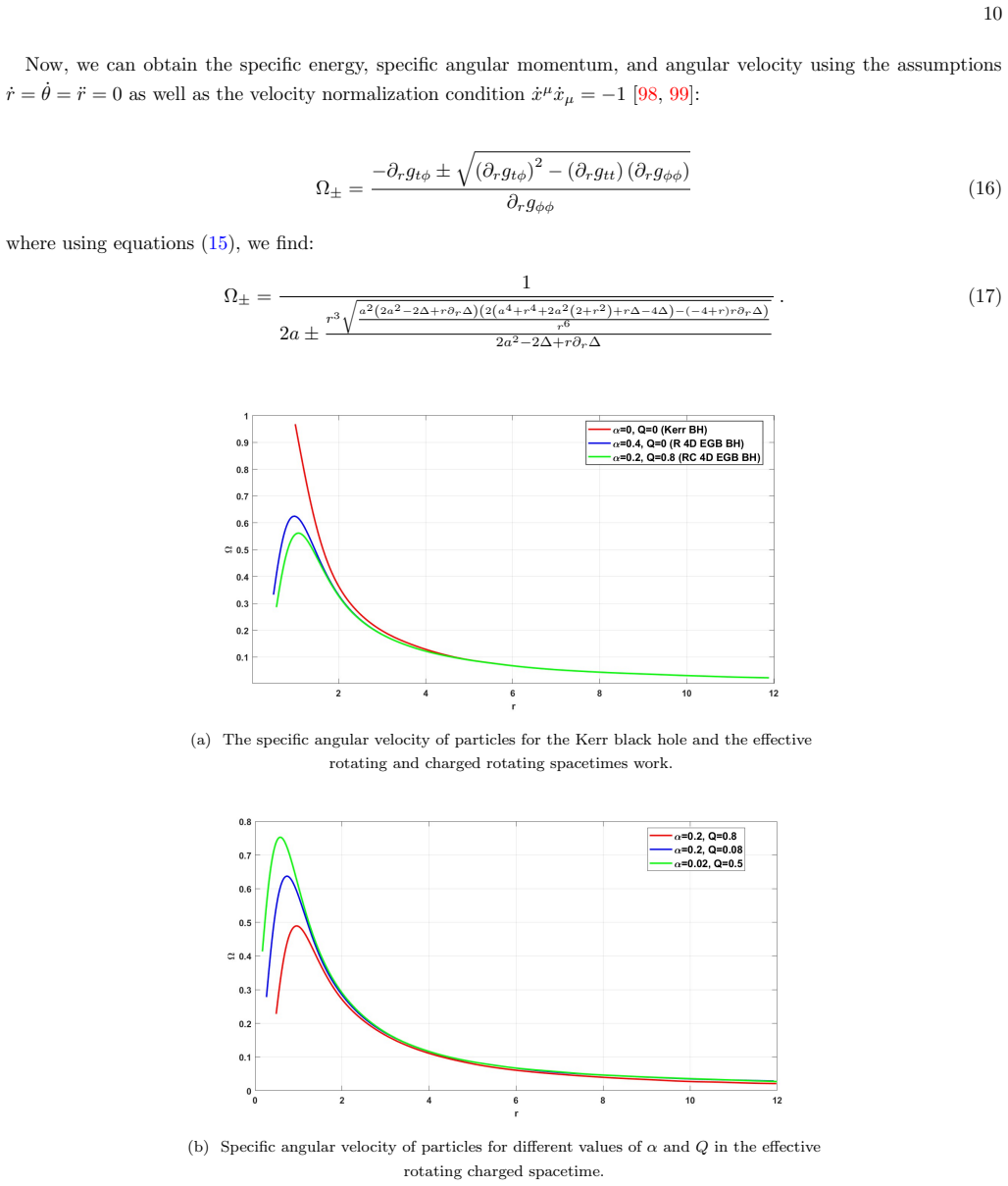
In the deformed Kerr-Newman geometry the effective parameter alpha modifies the radial structure of circular orbits so that the ISCO radius decreases as alpha grows. This inward shift allows orbiting matter to reach higher orbital velocities and release more gravitational energy, producing higher radiation flux, higher disk temperature, and higher differential luminosity. The charge parameter Q acts in the opposite direction by adding an electrostatic repulsion that pushes the ISCO outward and lowers the emission quantities. All quantities are obtained from the standard Novikov-Thorne thin-disk formalism applied to the modified metric.
What carries the argument
the effective Gauss-Bonnet-like parameter alpha inserted into the Delta function of the Kerr-Newman metric, which alters the effective potential governing circular geodesic motion and thereby controls the ISCO location and disk emission.
If this is right
- The ISCO radius shrinks with rising alpha, allowing matter to orbit closer and convert a larger fraction of rest mass into radiation.
- Disk radiation flux and effective temperature both increase as alpha grows.
- Electric charge Q pushes the ISCO outward and reduces flux and temperature through electrostatic repulsion.
- The resulting spectra and light curves deviate measurably from standard Kerr predictions for any nonzero alpha.
- Accretion disks therefore function as sensitive detectors of effective higher-curvature corrections in strong gravity.
Where Pith is reading between the lines
- X-ray observations of stellar-mass black holes in binaries could place upper bounds on alpha by comparing measured disk temperatures with Kerr-Newman templates.
- The same phenomenological deformation technique could be applied to other modified-gravity metrics to generate quick observational forecasts.
- If alpha is nonzero, the model predicts a partial degeneracy between curvature corrections and charge that future multi-wavelength data might break.
- Stability of the deformed spacetime under linear perturbations is not examined and would need separate analysis before the solutions can be regarded as physically viable.
Load-bearing premise
The deformed metric is used as a fixed phenomenological background without being derived from a consistent higher-curvature action or checked for stability and causality.
What would settle it
A high-precision X-ray measurement of the inner-disk radius or peak temperature in a spinning, charged black-hole candidate that fails to follow the predicted monotonic increase with alpha and decrease with Q.
Figures



read the original abstract
We investigate the structure and emission properties of a thin accretion disk around a rotating charged black hole described by an effective higher-curvature-inspired spacetime, constructed as a phenomenological deformation of the Kerr Newman geometry. In this framework, the deformation is introduced through a modification of the metric function $\Delta$ by an effective Gauss-Bonnet-like parameter $\alpha$, such that the spacetime reduces to the standard Kerr Newman solution in the limit $\alpha \to 0$. Adopting a kinematical approach, we use test-particle motion to derive the specific energy, specific angular momentum, and angular velocity of circular orbits, and analyze the effects of the parameters $\alpha$ and charge $Q$ on the innermost stable circular orbit (ISCO), radiative efficiency, radiation flux, temperature, and differential luminosity of the disk. We find that increasing $\alpha$ shifts the ISCO inward and enhances the disk's radiation flux and temperature, while the presence of charge suppresses these quantities due to electrostatic effects. Our results demonstrate that effective higher curvature deformations of rotating black hole spacetimes can lead to observable deviations from the Kerr case, highlighting accretion disks as sensitive probes of strong-gravity effects without relying on a specific underlying gravitational theory.
Editorial analysis
A structured set of objections, weighed in public.
Referee Report
Summary. The paper constructs a phenomenological deformation of the Kerr-Newman metric by adding an effective Gauss-Bonnet-like term proportional to alpha in the Delta function, reducing to Kerr-Newman at alpha=0. It then uses geodesic motion to compute specific energy, angular momentum, and angular velocity for circular orbits, and applies the Novikov-Thorne thin-disk model to derive the ISCO location, radiative efficiency, radiation flux, temperature, and differential luminosity as functions of alpha and charge Q. The central results are that increasing alpha moves the ISCO inward and boosts flux and temperature, while Q suppresses these quantities.
Significance. If the deformed metric is accepted as a valid effective background, the work shows that thin-disk observables respond systematically to the deformation parameter, providing a concrete example of how accretion-disk measurements could constrain phenomenological deviations from Kerr-Newman without committing to a specific higher-curvature theory. The geodesic and thin-disk calculations are direct and internally consistent.
major comments (1)
- [§2] §2 (metric definition): the spacetime is introduced purely phenomenologically by altering only Delta; no derivation from a higher-curvature action is given, and no verification is performed that the metric satisfies the null energy condition or remains free of closed timelike curves for the alpha and Q values used in the ISCO and Novikov-Thorne calculations. Because the central claim interprets the reported orbital shifts and radiative enhancements as signatures of effective higher-curvature effects, this omission is load-bearing.
minor comments (1)
- [Abstract] The abstract and introduction repeatedly use the phrase 'effective higher-curvature-inspired' without a clear statement that the construction is purely phenomenological; a single clarifying sentence would prevent misreading.
Simulated Author's Rebuttal
We thank the referee for their detailed and constructive report on our manuscript. We address the major comment below.
read point-by-point responses
-
Referee: §2 (metric definition): the spacetime is introduced purely phenomenologically by altering only Delta; no derivation from a higher-curvature action is given, and no verification is performed that the metric satisfies the null energy condition or remains free of closed timelike curves for the alpha and Q values used in the ISCO and Novikov-Thorne calculations. Because the central claim interprets the reported orbital shifts and radiative enhancements as signatures of effective higher-curvature effects, this omission is load-bearing.
Authors: We acknowledge that the metric is constructed phenomenologically by modifying only the Delta function, without a derivation from a specific higher-curvature action. This is intentional to explore generic effects of effective deformations. We agree that verifying the null energy condition and absence of closed timelike curves is important. In the revised manuscript, we will add explicit checks for these properties in the relevant parameter ranges to support our claims. revision: partial
- Derivation from a higher-curvature action
Circularity Check
No circularity: phenomenological metric deformation yields direct geodesic and disk calculations from given inputs
full rationale
The paper defines the spacetime explicitly as a phenomenological modification of the Kerr-Newman Delta function by an external parameter alpha (reducing to Kerr-Newman at alpha=0). All reported quantities (ISCO radius, specific energy/angular momentum, flux, temperature) are obtained by applying standard test-particle geodesic equations and the Novikov-Thorne thin-disk model to this input metric. No parameters are fitted to a data subset and then re-predicted; alpha is treated as a free input. No self-citations are invoked to justify uniqueness theorems, ansatze, or load-bearing premises. The derivation chain is therefore self-contained and does not reduce to its own inputs by construction.
Axiom & Free-Parameter Ledger
free parameters (1)
- alpha
axioms (2)
- standard math Test particles follow geodesics of the given metric
- domain assumption Thin-disk approximation with radiative efficiency set by ISCO binding energy
invented entities (1)
-
Effective higher-curvature spacetime with parameter alpha
no independent evidence
Lean theorems connected to this paper
-
IndisputableMonolith/Foundation/AlexanderDuality.leanalexander_duality_circle_linking unclearthe deformation is introduced through a modification of the metric function Δ by an effective Gauss-Bonnet-like parameter α, such that the spacetime reduces to the standard Kerr-Newman solution in the limit α→0
-
IndisputableMonolith/Foundation/ArithmeticFromLogic.leanabsolute_floor_iff_bare_distinguishability unclearAdopting a kinematical approach, we use test-particle motion to derive the specific energy, specific angular momentum, and angular velocity of circular orbits
Reference graph
Works this paper leans on
-
[1]
Carroll, S. M. (2019). Spacetime and geometry. Cambridge University Press
2019
-
[2]
K. Schwarzschild, ¨Uber das Gravitationsfeld eines Massenpunktes nach der Einsteinschen Theorie, Sitzungsberichte der K¨ oniglich Preußischen Akademie der Wissenschaften (Berlin), 189–196 (1916)
1916
-
[3]
Kerr, R. P. (1963). Gravitational field of a spinning mass as an example of algebraically special metrics. Physical review letters, 11(5), 237
1963
-
[4]
Baumann, D. (2022). Cosmology. Cambridge University Press
2022
-
[5]
G., Padilla, A., & Skordis, C
Clifton, T., Ferreira, P. G., Padilla, A., & Skordis, C. (2012). Modified gravity and cosmology. Physics reports, 513(1-3), 1-189
2012
-
[6]
Zwiebach, B. (1985). Curvature squared terms and string theories. Physics Letters B, 156(5-6), 315-317
1985
-
[7]
Glavan, D., & Lin, C. (2020). Einstein-Gauss-Bonnet gravity in four-dimensional spacetime. Physical review letters, 124(8), 081301
2020
-
[8]
A., & Mukohyama, S
Aoki, K., Gorji, M. A., & Mukohyama, S. (2020). A consistent theory of D→4 Einstein-Gauss-Bonnet gravity. Physics Letters B, 810, 135843
2020
-
[9]
A., Kubizˇ n´ ak, D., Mann, R
Hennigar, R. A., Kubizˇ n´ ak, D., Mann, R. B., & Pollack, C. (2020). On taking the D→4 limit of Gauss-Bonnet gravity: theory and solutions. Journal of High Energy Physics, 2020(7), 1-18
2020
-
[10]
Murodov, S., Rayimbaev, J., Ahmedov, B., & Karimbaev, E. (2023). Quasiperiodic oscillations and dynamics of test particles around quasi-and non-Schwarzschild black holes. Universe, 9(9), 391
2023
-
[11]
Ai, W. Y. (2020). A note on the novel 4D Einstein–Gauss–Bonnet gravity. Communications in Theoretical Physics, 72(9), 095402
2020
-
[12]
M. Heydari-Fard, M. F. da Silva, N. R. da Silva, H. Razmi, Charged black holes in 4D Einstein-Gauss-Bonnet gravity: exact solutions and thermodynamics, Gen. Rel. Grav. 54, 124 (2022). arXiv:2204.04927
-
[13]
A., & Zhidenko, A
Konoplya, R. A., & Zhidenko, A. (2020). Black holes in the four-dimensional Einstein-Lovelock gravity. Physical Review D, 101(8), 084038. 27
2020
-
[14]
Kumar, R., & Ghosh, S. G. (2020). Rotating black holes in 4D Einstein-Gauss-Bonnet gravity and its shadow. Journal of Cosmology and Astroparticle Physics, 2020(07), 053
2020
-
[15]
Event Horizon Telescope Collaboration. (2019). First M87 event horizon telescope results. I. The shadow of the super- massive black hole. arXiv preprint arXiv:1906.11238
work page internal anchor Pith review Pith/arXiv arXiv 2019
-
[16]
G., Carrilho, P., Clifton, T., & Mulryne, D
Fernandes, P. G., Carrilho, P., Clifton, T., & Mulryne, D. J. (2022). The 4D Einstein–Gauss–Bonnet theory of gravity: a review. Classical and Quantum Gravity, 39(6), 063001
2022
-
[17]
Y., Li, P
Zhang, C. Y., Li, P. C., & Guo, M. (2020). Greybody factor and power spectra of the Hawking radiation in the 4 D Einstein–Gauss–Bonnet de-Sitter gravity. The European Physical Journal C, 80(9), 874
2020
-
[18]
Bolokhov, S. V., & Skvortsova, M. (2025). Review of analytic results on quasinormal modes of black holes. arXiv preprint arXiv:2504.05014
-
[19]
Nojiri, S. S. D. O., Odintsov, S. D., & Oikonomou, V. (2017). Modified gravity theories on a nutshell: Inflation, bounce and late-time evolution. Physics Reports, 692, 1-104
2017
-
[20]
Lovelock, D. (1971). The Einstein tensor and its generalizations. Journal of Mathematical Physics, 12(3), 498-501
1971
-
[21]
C ¸ ., & Tekin, B
G¨ urses, M., S ¸i¸ sman, T. C ¸ ., & Tekin, B. (2020). Is there a novel Einstein–Gauss–Bonnet theory in four dimensions?. The European Physical Journal C, 80(7), 647
2020
-
[22]
Bonifacio, J., Hinterbichler, K., & Johnson, L. A. (2020). Amplitudes and 4D Gauss-Bonnet Theory. Physical Review D, 102(2), 024029
2020
-
[23]
A., Jahani Poshteh, M
Hennigar, R. A., Jahani Poshteh, M. B., & Mann, R. B. (2018). Shadows, signals, and stability in Einsteinian cubic gravity. Physical Review D, 97(6), 064041
2018
-
[24]
Fernandes, P. G. (2020). Charged black holes in AdS spaces in 4D Einstein Gauss-Bonnet gravity. Physics Letters B, 805, 135468
2020
-
[25]
Meng, L., Xu, Z., & Tang, M. (2025). Periodic Orbits and Gravitational Wave Radiation of Black Holes in 4D-EGB gravity. arXiv preprint arXiv:2506.05015
work page internal anchor Pith review Pith/arXiv arXiv 2025
-
[27]
Hoyle, F., & Lyttleton, R. A. (1939, July). The effect of interstellar matter on climatic variation. In Mathematical proceedings of the Cambridge philosophical society (Vol. 35, No. 3, pp. 405-415). Cambridge University Press
1939
-
[28]
H., & Burbidge, G
Prendergast, K. H., & Burbidge, G. R. (1989). On the nature of some galactic X-ray sources. The Astrophysical Journal, 151, L83
1989
-
[29]
I., & Sunyaev, R
Shakura, N. I., & Sunyaev, R. A. (1973). Black holes in binary systems. Observational appearance. Astronomy and Astrophysics, Vol. 24, p. 337-355, 24, 337-355
1973
-
[30]
N., & Thorne, K
Page, D. N., & Thorne, K. S. (1974). Disk-accretion onto a black hole. Time-averaged structure of accretion disk. The Astrophysical Journal, 191, 499-506
1974
-
[31]
A., & Fragile, P
Abramowicz, M. A., & Fragile, P. C. (2013). Foundations of black hole accretion disk theory. Living Reviews in Relativity, 16(1), 1
2013
-
[32]
A., & McClintock, J
Remillard, R. A., & McClintock, J. E. (2006). X-ray properties of black-hole binaries. Annu. Rev. Astron. Astrophys., 44(1), 49-92
2006
-
[33]
A., & Nampalliwar, S
Bambi, C., C´ ardenas-Avenda˜ no, A., Dauser, T., Garc´ ıa, J. A., & Nampalliwar, S. (2017). Testing the Kerr black hole hypothesis using X-ray reflection spectroscopy. The Astrophysical Journal, 842(2), 76
2017
-
[34]
E., Narayan, R., & Steiner, J
McClintock, J. E., Narayan, R., & Steiner, J. F. (2014). Black hole spin via continuum fitting and the role of spin in powering transient jets. Space Science Reviews, 183(1), 295-322
2014
-
[35]
Kormendy, J., & Ho, L. C. (2013). Coevolution (or not) of supermassive black holes and host galaxies. Annual Review of Astronomy and Astrophysics, 51(1), 511-653
2013
-
[36]
A., & Hawley, J
Balbus, S. A., & Hawley, J. F. (1998). Instability, turbulence, and enhanced transport in accretion disks. Reviews of modern physics, 70(1), 1
1998
-
[37]
N., Lesaffre, P., & Balbus, S
Latter, H. N., Lesaffre, P., & Balbus, S. A. (2009). MRI channel flows and their parasites. Monthly Notices of the Royal Astronomical Society, 394(2), 715-729
2009
-
[38]
C., Tchekhovskoy, A., & Blandford, R
McKinney, J. C., Tchekhovskoy, A., & Blandford, R. D. (2012). General relativistic magnetohydrodynamic simulations of magnetically choked accretion flows around black holes. Monthly Notices of the Royal Astronomical Society, 423(4), 3083-3117. 28
2012
-
[39]
Di Matteo, T., Springel, V., & Hernquist, L. (2005). Energy input from quasars regulates the growth and activity of black holes and their host galaxies. nature, 433(7026), 604-607
2005
-
[40]
Mustafa, G., Donmez, O., Gogoi, D. J., Ghosh, S. G., Hussain, I., Yuan, C. (2026). Dynamics, Ringdown, and Accretion- Driven Multiple Quasi-Periodic Oscillations of Kerr-Bertotti-Robinson Black Holes. arXiv preprint arXiv:2602.08911
-
[41]
Mustafa, G., Donmez, O., Errehymy, A., Javed, F., Ditta, A., Naseer, T., ... Atamurotov, F. (2025). Analytical and numerical study of accretion processes around charged spherically symmetric black holes in scalar-tensor Gauss-Bonnet gravity. arXiv preprint arXiv:2511.12670
- [42]
-
[43]
G., Yousaf, M., Mustafa, G., Atamurotov, F
Donmez, O., Ghosh, S. G., Yousaf, M., Mustafa, G., Atamurotov, F. (2026). Accretion flow around Kerr metric in the infra-red limit of asymptotically safe gravity. arXiv preprint arXiv:2601.14113
- [44]
- [45]
-
[46]
Donmez, O., Mustafa, G., Chaudhary, H., Yousaf, M., Bouzenada, A., Ditta, A., Atamurotov, F. (2026). Relativistic accretion process onto rotating black holes in Einstein-Euler-Heisenberg nonlinear electrodynamic gravity. Physics of the Dark Universe, 102271
2026
-
[47]
K., Ditta, A., Donmez, O., Naseer, T.,
Mustafa, G., Javed, F., Maurya, S. K., Ditta, A., Donmez, O., Naseer, T., ... Atamurotov, F. (2025). Magnetized particle motion and accretion process with shock cone morphology around a decoupled hairy black holes. arXiv preprint arXiv:2511.17137
-
[48]
Fabian, A. C. (2012). Observational evidence of active galactic nuclei feedback. Annual Review of Astronomy and Astro- physics, 50(1), 455-489
2012
-
[49]
P., Bonnet, H., Brandner, W.,
Abuter, R., Amorim, A., Baub¨ ock, M., Berger, J. P., Bonnet, H., Brandner, W., ... & Yazici, S. (2018). Detection of orbital motions near the last stable circular orbit of the massive black hole SgrA. Astronomy & Astrophysics, 618, L10
2018
-
[50]
Nozari, K., Saghafi, S., & Aliyan, F. (2025). Investigating QED effects on the thin accretion disk properties around rotating Euler–Heisenberg black holes. The European Physical Journal C, 85(7), 735
2025
-
[51]
Jusufi, K., Anand, A., Saghafi, S., Cuadros-Melgar, B., & Nozari, K. (2025). Black holes surrounded by massive vector fields in Kaluza–Klein gravity. The European Physical Journal C, 85(5), 528
2025
- [52]
-
[53]
Nozari, K., Saghafi, S., & Hassani, M. (2025). Accretion onto a charged black hole in consistent 4D Einstein-Gauss-Bonnet gravity. Journal of High Energy Astrophysics, 45, 214-230
2025
-
[54]
Salahshoor, K., & Nozari, K. (2018). Circular orbits and accretion process in a class of Horndeski/Galileon black holes. The European Physical Journal C, 78(6), 486
2018
-
[55]
Faraji, S. (2025). The impact of compact object deformation on thin accretion disk properties. The European Physical Journal C, 85(2), 148
2025
- [56]
- [57]
-
[58]
Capozziello, S., Gambino, S., & Luongo, O. (2025). Comparing Bondi and Novikov-Thorne accretion disk luminosity around regular black holes. Physics of the Dark Universe, 101950
2025
-
[59]
Li, Z., & Guo, X. K. (2025). Thin accretion disk around rotating hairy black hole: radiative property and optical appearance. The European Physical Journal C, 85(6), 679
2025
-
[60]
B., Wu, M
Zheng, H. B., Wu, M. Q., Li, G. P., & Jiang, Q. Q. (2025). Shadows and accretion disk images of charged rotating black hole in modified gravity theory. The European Physical Journal C, 85(1), 46
2025
- [61]
-
[62]
Alloqulov, M., & Shaymatov, S. (2024). Electric Penrose process and the accretion disk around a 4D-charged Einstein- Gauss-Bonnet black hole. The European Physical Journal Plus, 139(8), 731
2024
-
[63]
K., Ditta, A., Ray, S., & Atamurotov, F
Mustafa, G., Maurya, S. K., Ditta, A., Ray, S., & Atamurotov, F. (2024). Circular orbits and accretion disk around AdS black holes surrounded by dark fluid with Chaplygin-like equation of state. The European Physical Journal C, 84(7), 690
2024
- [64]
-
[66]
Donmez, O. (2024). Perturbing the Stable Accretion Disk in Kerr and 4D Einstein–Gauss–Bonnet Gravities: Compre- hensive Analysis of Instabilities and Dynamics. Research in Astronomy and Astrophysics, 24(8), 085001
2024
-
[67]
W., & Liu, Y
Wei, S. W., & Liu, Y. X. (2021). Testing the nature of Gauss–Bonnet gravity by four-dimensional rotating black hole shadow. The European Physical Journal Plus, 136(4), 436
2021
-
[68]
Bhar, P., Govender, M., & Sharma, R. (2017). A comparative study between EGB gravity and GTR by modeling compact stars. The European Physical Journal C, 77(2), 109
2017
-
[69]
Guo, M., & Li, P. C. (2020). Innermost stable circular orbit and shadow of the 4D Einstein–Gauss–Bonnet black hole. The European Physical Journal C, 80(6), 1-8
2020
-
[70]
A., Klu´ zniak, W., & Stuchl´ ık, Z
T¨ or¨ ok, G., Abramowicz, M. A., Klu´ zniak, W., & Stuchl´ ık, Z. (2005). The orbital resonance model for twin peak kHz quasi periodic oscillations in microquasars. Astronomy & Astrophysics, 436(1), 1-8
2005
-
[72]
F., DeBra, D
Everitt, C. F., DeBra, D. B., Parkinson, B. W., Turneaure, J. P., Conklin, J. W., Heifetz, M. I., ... & Wang, S. (2011). Gravity probe B: final results of a space experiment to test general relativity. Physical Review Letters, 106(22), 221101
2011
-
[73]
Carter, B. (1968). Global structure of the Kerr family of gravitational fields. Physical Review, 174(5), 1559
1968
-
[74]
Von Zeipel, H. (1924). The radiative equilibrium of a rotating system of gaseous masses. Monthly Notices of the Royal Astronomical Society, Vol. 84, p. 665-683, 84, 665-683
1924
-
[75]
G., & Maharaj, S
Ghosh, S. G., & Maharaj, S. D. (2020). Radiating black holes in the novel 4D Einstein–Gauss–Bonnet gravity. Physics of the Dark Universe, 30, 100687
2020
-
[76]
Chandrasekhar, S. (1933). The equilibrium of distorted polytropes. I. The rotational problem. Monthly Notices of the Royal Astronomical Society, Vol. 93, p. 390-406, 93, 390-406
1933
-
[77]
Collins, G. W. (1978). The virial theorem in stellar astrophysics. Tucson, Ariz., Pachart Publishing House (Astronomy and Astrophysics Series. Volume 7), 1978. 143 p
1978
-
[78]
E., & Rieutord, M
Lara, F. E., & Rieutord, M. (2011). Gravity darkening in rotating stars. Astronomy & Astrophysics, 533, A43
2011
-
[79]
Tassoul, J. L. (2015). Theory of Rotating Stars.(PSA-1), Volume 1. Princeton University Press
2015
-
[80]
Townsend, R. H. D. (1997). Spectroscopic modelling of non-radial pulsation in rotating early-type stars. Monthly Notices of the Royal Astronomical Society, 284(4), 839-858
1997
-
[81]
E., & Rieutord, M
Lara, F. E., & Rieutord, M. (2013). Self-consistent 2D models of fast-rotating early-type stars. Astronomy & Astrophysics, 552, A35
2013
-
[82]
The MiMeS Survey of Magnetism in Massive Stars
Wade, G. A., Grunhut, J. H., & MiMeS Collaboration. (2012). The MiMeS survey of magnetism in massive stars. arXiv preprint arXiv:1206.5163
work page internal anchor Pith review Pith/arXiv arXiv 2012
-
[83]
D., Kervella, P., Jankov, S., Abe, L., Vakili, F., Di Folco, E., & Paresce, F
de Souza, A. D., Kervella, P., Jankov, S., Abe, L., Vakili, F., Di Folco, E., & Paresce, F. (2003). The spinning-top Be star Achernar from VLTI-VINCI. Astronomy & Astrophysics, 407(3), L47-L50
2003
discussion (0)
Sign in with ORCID, Apple, or X to comment. Anyone can read and Pith papers without signing in.