Recognition: unknown
Chiral molecule-induced contributions to ferromagnetic resonance
Pith reviewed 2026-05-14 17:36 UTC · model grok-4.3
The pith
Chiral molecular interfaces produce no measurable effect on ferromagnetic resonance in Co/Ni multilayers
A machine-rendered reading of the paper's core claim, the machinery that carries it, and where it could break.
Core claim
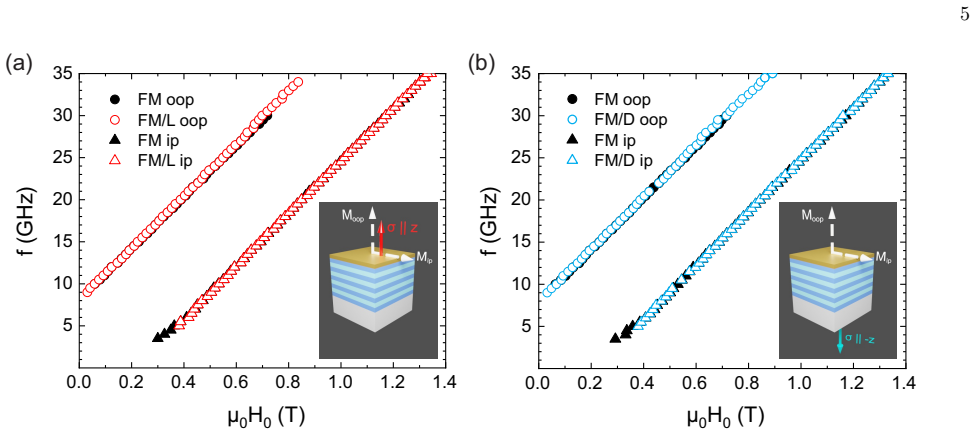
Chiral molecule functionalization produces no measurable changes in either the resonance field or the linewidth of perpendicularly magnetized Co/Ni multilayers. The macrospin analysis shows that equilibrium modifications alter the resonance condition through the free-energy landscape and effective field, whereas damping-like non-equilibrium torques modify the effective damping rate, yielding clear experimental criteria to distinguish the two classes of chiral-interface contributions.
What carries the argument
Macrospin description that distinguishes equilibrium modifications of the magnetic free-energy landscape from non-equilibrium CISS-induced spin torques
If this is right
- Equilibrium modifications primarily shift the resonance condition via changes to the free energy landscape and thereby the effective field.
- Damping-like non-equilibrium torques provide a distinct channel for varying the effective damping rate.
- The approach supplies clear criteria for disentangling chiral-interface-induced energy modifications from torque-driven dynamical effects in ferromagnetic resonance experiments.
Where Pith is reading between the lines
- The null result suggests chiral effects in these multilayers may be confined to static properties or require probes more sensitive than standard FMR linewidth.
- Application of the same separation to other magnetic systems could test whether CISS torques appear under different driving conditions or material stacks.
- Direct comparison with static magnetometry on the same samples would clarify whether equilibrium energy changes are detectable outside resonance.
Load-bearing premise
Any chiral-interface effects would appear as shifts in resonance field or linewidth rather than in other unmeasured quantities, and sample preparation introduces no confounding changes in anisotropy or damping unrelated to chirality.
What would settle it
Observation of a statistically significant difference in resonance field or linewidth between bare and molecule-functionalized samples, or detection of torque-driven changes in effective damping under controlled excitation conditions.
Figures




read the original abstract
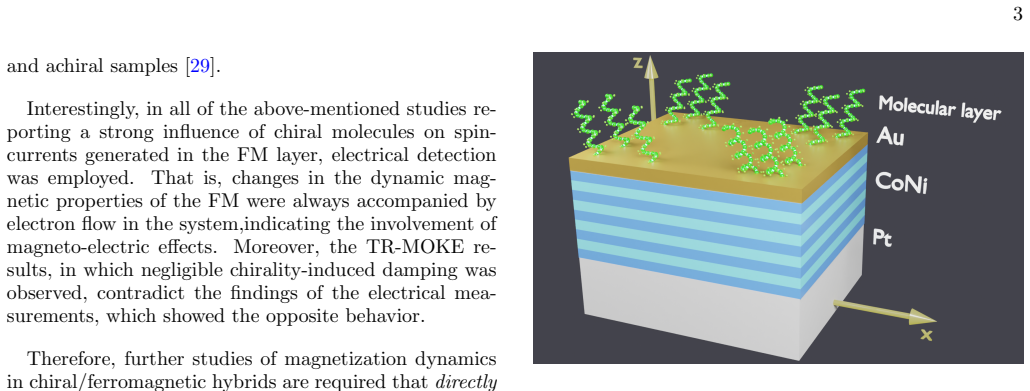
Despite extensive research on chirality-driven spin selectivity, most studies have focused on static magnetic properties, while the influence of chirality on the dynamic magnetic response remains largely unexplored. Here, we investigate how chiral molecular interfaces affect magnetization dynamics in thin Co/Ni multilayers with perpendicular magnetic anisotropy using broadband ferromagnetic resonance spectroscopy. A comparison between bare (reference) films and molecule-functionalized (hybrid) samples reveals no measurable changes in either the resonance field or the linewidth that could be attributed to the presence of the chiral environment. Motivated by our findings we develop a macrospin description that distinguishes equilibrium modifications of the magnetic free-energy landscape (MIPAC-type effects) from non-equilibrium, CISS-induced spin torques. Our analysis shows that equilibrium modifications primarily shift the resonance condition via changes to the free energy landscape and thereby the effective field, whereas damping-like non-equilibrium torques provide a distinct channel for varying the effective damping rate. This approach establishes clear criteria for disentangling chiral-interface-induced energy modifications from torque-driven dynamical effects in ferromagnetic resonance experiments.
Editorial analysis
A structured set of objections, weighed in public.
Referee Report
Summary. The manuscript reports broadband FMR measurements on perpendicularly magnetized Co/Ni multilayers, comparing bare reference films to chiral-molecule-functionalized hybrid samples. It finds no measurable shifts in resonance field or linewidth attributable to the chiral interface. Motivated by this null result, the authors introduce a macrospin model that separates equilibrium modifications to the magnetic free-energy landscape from non-equilibrium damping-like torques arising from CISS.
Significance. If the null result is robust, the work supplies useful negative evidence on the magnitude of chiral-interface effects in dynamic magnetization response and supplies a clear theoretical distinction between equilibrium (free-energy) and non-equilibrium (torque) channels. This framework can guide the design of future FMR experiments aimed at detecting or bounding CISS contributions.
major comments (2)
- [Experimental results (comparison of resonance field and linewidth)] The central claim of no chiral-induced changes rests on the assumption that bare and hybrid samples are otherwise identical in their magnetic free-energy landscape and Gilbert damping. No independent magnetometry, XRD, or AFM data are presented to confirm that molecule deposition introduces no confounding changes in anisotropy or damping at the level of the FMR linewidth resolution.
- [Theoretical analysis section] The macrospin model is introduced to distinguish MIPAC-type equilibrium shifts from non-equilibrium torques, but the explicit derivation of the modified resonance condition (effective field) and the expression for the effective damping rate from the added torque terms is not shown, preventing quantitative assessment of the predicted signatures.
minor comments (1)
- [Abstract] The acronym MIPAC is used without expansion on first appearance.
Simulated Author's Rebuttal
We thank the referee for the constructive comments and positive assessment of the significance of our null-result findings. We address each major comment below, indicating the revisions we will make to strengthen the manuscript.
read point-by-point responses
-
Referee: [Experimental results (comparison of resonance field and linewidth)] The central claim of no chiral-induced changes rests on the assumption that bare and hybrid samples are otherwise identical in their magnetic free-energy landscape and Gilbert damping. No independent magnetometry, XRD, or AFM data are presented to confirm that molecule deposition introduces no confounding changes in anisotropy or damping at the level of the FMR linewidth resolution.
Authors: We agree that independent characterization would strengthen the claim that observed differences (or lack thereof) arise solely from the chiral interface. All films were grown in a single deposition run under identical conditions, with molecule deposition performed in a controlled glovebox environment on identically prepared substrates. The broadband FMR data themselves are highly sensitive to small variations in anisotropy and damping; any confounding changes at the level of our linewidth resolution would have produced detectable shifts or broadening across the measured frequency range. In the revised manuscript we will expand the methods section with a detailed account of sample preparation and measurement protocols, include any available AFM or XRD data from companion samples, and add a brief discussion of the FMR sensitivity limits to argue that significant confounding effects are inconsistent with the reported consistency of the resonance fields and linewidths. revision: partial
-
Referee: [Theoretical analysis section] The macrospin model is introduced to distinguish MIPAC-type equilibrium shifts from non-equilibrium torques, but the explicit derivation of the modified resonance condition (effective field) and the expression for the effective damping rate from the added torque terms is not shown, preventing quantitative assessment of the predicted signatures.
Authors: We agree that the explicit derivations are necessary for quantitative assessment. In the revised manuscript we will insert a new subsection that starts from the Landau-Lifshitz-Gilbert equation augmented by the equilibrium free-energy modification (MIPAC-type term) and the non-equilibrium CISS torque. We will derive the modified resonance condition by linearizing around equilibrium and obtaining the effective field, and we will obtain the expression for the effective damping rate by projecting the torque onto the precessional motion. The key algebraic steps and resulting analytic expressions will be shown explicitly. revision: yes
Circularity Check
No circularity: standard macrospin model applied to null-result data
full rationale
The paper reports a direct experimental comparison of resonance field and linewidth between bare and molecule-functionalized Co/Ni films, finding no measurable difference. It then introduces a macrospin description based on the Landau-Lifshitz-Gilbert equation augmented with equilibrium free-energy modifications and damping-like torques. These additions follow from established torque terms in the LLG equation and do not reduce by construction to parameters fitted from the same FMR dataset. No self-citation chain, uniqueness theorem, or ansatz smuggling is invoked to justify the central null-result claim or the model distinction. The derivation chain is therefore self-contained against external benchmarks of FMR theory.
Axiom & Free-Parameter Ledger
axioms (1)
- domain assumption Magnetization dynamics of the thin film can be described by a single macrospin vector
Reference graph
Works this paper leans on
-
[1]
(15) on Eq
Damping-like torque Using the vector identity from Eq. (15) on Eq. (23), we get τDL = ˆσ− ˆm( ˆm· ˆσ).(25) For ˆσ=− ˆz, this becomes τDL =− ˆz+ cosθ ˆm.(26) In Cartesian components, τDL = cosθsinθcosφ cosθsinθsinφ −1 + cos2 θ .(27) Its magnitude is|τ DL|= sinθ, so that one can write τDL = sinθ cosθcosφ cosθsinφ −sinθ = sinθˆ eθ,(28) wh...
-
[2]
Field-like torque For ˆσ=− ˆzthe field-like torque can be expressed in Cartesian components as τFL = −sinθsinφ sinθcosφ 0 .(30) Its magnitude is|τ FL|= sinθ, which is equal to|τ DL|, and therefore τFL = sinθ −sinφ cosφ 0 = sinθˆ eφ,(31) where ˆeφ is the azimuthal unit vector. This implies that τFL is purely tangential, ˆm·τ FL = 0.(32)...
-
[3]
in the ab- sence of spin torques, d ˆm dt = 0 requires ˆm×H eff = 0, which enforces collinearity between ˆmandH eff
Stationary state and linearization The stationary magnetization direction ˆm0 is defined by the condition of vanishing total torque, d ˆm dt ˆm= ˆm0 = 0.(34) In case of purely conservative dynamics, i.e. in the ab- sence of spin torques, d ˆm dt = 0 requires ˆm×H eff = 0, which enforces collinearity between ˆmandH eff. Since Heff =− 1 µ0Ms ∂F/∂ ˆm, this c...
-
[4]
(41) In this basis, the linear operator ˆLrestricted to the tan- gent plane is represented by the dynamic matrix
Local transverse dynamics As discussed in detail in Appendices B and C, by in- troducing the local orthonormal basis{ ˆe1, ˆe2, ˆe3}with ˆe3 = ˆm0 and δm=m 1 ˆe1 +m 2 ˆe2,(40) the linearized equation (36) reduces, after projection onto the transverse plane, to ˙m1 ˙m2 ! =γµ 0 −αH1 − cDL γ σ3 −H2 + cFL γ σ3 H1 − cFL γ σ3 −αH2 − cDL γ σ3 ! m1 m2 ! . (41) In...
-
[5]
These expressions clearly separate the roles of the two spin-torque components
Eigenvalues and physical interpretation Retaining only terms to first order inα,c DL, andc FL, and neglecting products of these quantities, the eigenval- ues of the dynamic matrix are λ=− h γµ0α 2 (H1 +H 2) +c DLσ3 i ±i γµ0 p H1H2 − cFLσ3 2 H1 +H 2√H1H2 .(43) We thus identify the decay rate Γ = γµ0α 2 (H1 +H 2) +c DLσ3,(44) and the resonance frequency ω=γ...
-
[6]
Thus, the Landau–Lifshitz field torque is strictly conservative: it generates motion along constant-energy trajectories on the unit sphere
Landau–Lifshitz field torque The precessional Landau–Lifshitz torque is given by d ˆm dt prec =−γ ˆm×H eff.(47) Its contribution to the energy change reads dF dt prec =−µ 0Ms Heff ·(−γ ˆm×H eff) =γµ 0Ms Heff ·( ˆm×H eff) = 0,(48) sinceH eff ·( ˆm×H eff) = 0. Thus, the Landau–Lifshitz field torque is strictly conservative: it generates motion along constan...
-
[7]
It can therefore be absorbed into the effective field and be- haves like a conservative contribution
Field-like torque The field-like torque contributes d ˆm dt FL =c FL ˆm× ˆσ.(49) This term is mathematically equivalent to precession in an additional effective field directed along ˆσ. It can therefore be absorbed into the effective field and be- haves like a conservative contribution. Equivalently, it may be associated with an additional Zeeman-like fre...
-
[8]
Landau–Lifshitz damping For the damping term, we obtain dF dt LL =γαµ 0Ms Heff · ˆm×( ˆm×H eff) .(50) Using Eq. (15) we find dF dt LL =γαµ 0Ms ( ˆm·H eff)2 − |Heff|2 .(51) Using [38] | ˆm×H eff|2 =|H eff|2 −( ˆm·H eff)2,(52) this becomes dF dt LL =−γαµ 0Ms | ˆm×H eff|2 ≤0.(53) The Landau–Lifshitz damping term is strictly dissipative, always reducing the m...
-
[9]
In particular, for Heff ∥ ˆσone obtains dF dt DL =−µ 0MscDL sin2 θ,(56) which vanishes only at the poles
Damping-like torque For the damping-like contribution, d ˆm dt DL =c DL − ˆm×( ˆm× ˆσ) ,(54) the energy change becomes dF dt DL =−µ 0MscDL h Heff · ˆσ−( ˆm· ˆσ)(Heff · ˆm) i .(55) This expression is nonzero in general. In particular, for Heff ∥ ˆσone obtains dF dt DL =−µ 0MscDL sin2 θ,(56) which vanishes only at the poles. The damping-like torque is there...
-
[10]
For a system governed by LL damping, according to Eqs
Relation between LL damping and FMR linewidth At this point, we need to make a short statement about the connection between the intrinsic damping (rate) and the measured FMR linewidth. For a system governed by LL damping, according to Eqs. (44) and (45) the decay rate of the uniform mode in the linearized regime is Γ = γµ0α 2 (H1 +H 2),(57) while the reso...
-
[11]
(41) to thin-film geometries with either in-plane or out-of-plane equilibrium magnetiza- tion to analyze the impact of the field- and damping-like torques on the FMR response
Impact of CISS-related torque on different thin-film geometries We now specialize Eq. (41) to thin-film geometries with either in-plane or out-of-plane equilibrium magnetiza- tion to analyze the impact of the field- and damping-like torques on the FMR response. The configurations con- sidered are illustrated in Fig. 8. For the CoNi multilayers considered ...
-
[12]
These cases depicted in Fig
Spin-polarization geometries The effect of the spin torque depends on the projection of ˆσonto ˆm0: (i) ˆσ∥ ˆm0 (parallel), (ii) ˆσ∥ − ˆm0 (antiparallel), (iii) ˆσ⊥ ˆm0 (transverse). These cases depicted in Fig. 8 are independent of whether the magnetization is oriented in- or out-of-plane. Parallel and antiparallel configurationsFor ˆσ∥ ± ˆm0, one has ˆm...
2020
-
[13]
Sinova, S
J. Sinova, S. O. Valenzuela, J. Wunderlich, C. H. Back, and T. Jungwirth, Spin Hall effects, Rev. Mod. Phys.87, 1213 (2015)
2015
-
[14]
K. Ray, S. P. Ananthavel, D. H. Waldeck, and R. Naa- man, Asymmetric Scattering of Polarized Electrons by Organized Organic Films of Chiral Molecules, Science 283, 814 (1999)
1999
-
[15]
G¨ ohler, V
B. G¨ ohler, V. Hamelbeck, T. Z. Markus, M. Kettner, G. F. Hanne, Z. Vager, R. Naaman, and H. Zacharias, Spin Selectivity in Electron Transmission Through Self- Assembled Monolayers of Double-Stranded DNA, Science 331, 894 (2011)
2011
-
[16]
Naaman and D
R. Naaman and D. H. Waldeck, Chiral-Induced Spin Se- lectivity Effect, J. Phys. Chem. Lett.3, 2178 (2012)
2012
-
[17]
Naaman, Y
R. Naaman, Y. Paltiel, and D. H. Waldeck, Chiral Molecules and the Spin Selectivity Effect, J. Phys. Chem. Lett.11, 3660 (2020)
2020
-
[18]
Koplovitz, G
G. Koplovitz, G. Leitus, S. Ghosh, B. P. Bloom, S. Yoche- lis, D. Rotem, F. Vischio, M. Striccoli, E. Fanizza, R. Naaman, D. H. Waldeck, D. Porath, and Y. Paltiel, Single Domain 10 nm Ferromagnetism Imprinted on Su- perparamagnetic Nanoparticles Using Chiral Molecules, Small15, e1804557 (2019)
2019
-
[19]
Ben Dor, S
O. Ben Dor, S. Yochelis, A. Radko, K. Vankayala, E. Capua, A. Capua, S. H. Yang, L. T. Baczewski, S. S. P. Parkin, R. Naaman, and Y. Paltiel, Magne- tization switching in ferromagnets by adsorbed chiral molecules without current or external magnetic field, Nat. Commun.8, 14567 (2017)
2017
-
[20]
B. P. Bloom, Y. Paltiel, R. Naaman, and D. H. Waldeck, Chiral Induced Spin Selectivity, Chem. Rev.124, 1950 (2024)
1950
-
[21]
H. J. Eckvahl, N. A. Tcyrulnikov, A. Chiesa, J. M. Bradley, R. M. Young, S. Carretta, M. D. Krzya- niak, and M. R. Wasielewski, Direct observation of chirality-induced spin selectivity in electron donor– acceptor molecules, Science382, 197 (2023)
2023
-
[22]
Banerjee-Ghosh, O
K. Banerjee-Ghosh, O. Ben Dor, F. Tassinari, E. Ca- pua, S. Yochelis, A. Capua, S.-H. Yang, S. S. P. Parkin, S. Sarkar, L. Kronik, L. T. Baczewski, R. Naaman, and Y. Paltiel, Separation of enantiomers by their enantiospe- cific interaction with achiral magnetic substrates, Science 360, 1331 (2018)
2018
-
[23]
Aizawa, T
H. Aizawa, T. Sato, S. Maki-Yonekura, K. Yonekura, K. Takaba, T. Hamaguchi, T. Minato, and H. M. Yamamoto, Enantioselectivity of discretized helical supramolecule consisting of achiral cobalt phthalocya- nines via chiral-induced spin selectivity effect, Nat. Com- mun.14, 4530 (2023)
2023
-
[24]
P. V. M¨ ollers, B. G¨ ohler, and H. Zacharias, Chirality In- duced Spin Selectivity – the Photoelectron View, Isr. J. Chem.62, e202200062 (2022)
2022
-
[25]
Naaman and D
R. Naaman and D. H. Waldeck, Spintronics and Chiral- ity: Spin Selectivity in Electron Transport Through Chi- ral Molecules, Ann. Rev. Phys. Chem.66, 263 (2015)
2015
-
[26]
A. C. Aragon` es, D. Aravena, J. M. Ugalde, E. Med- ina, R. Gutierrez, E. Ruiz, V. Mujica, and I. D´ ıez-P´ erez, Magnetoresistive Single-Molecule Junctions: the Role of the Spinterface and the CISS Effect, Isr. J. Chem.62, e202200090 (2022)
2022
-
[27]
J. A. Albro, N. T. Garrett, K. Govindaraj, B. P. Bloom, N. L. Rosi, and D. H. Waldeck, Measurement Platform to Probe the Mechanism of Chiral-Induced Spin Selectiv- ity through Direction-Dependent Magnetic Conductive Atomic Force Microscopy, ACS Nano19, 17941 (2025)
2025
-
[28]
M. A. Hossain, S. Illescas-Lopez, S. Firouzeh, J. M. Cuerva, L. ´A. de Cienfuegos, and S. Pramanik, Observa- tion of Two-Terminal CISS Magnetoresistance with Non- magnetic Contacts, Nano Lett.25, 9623 (2025)
2025
-
[29]
T. N. H. Nguyen, G. Salvan, O. Hellwig, Y. Paltiel, L. T. Baczewski, and C. Tegenkamp, The mechanism of the molecular CISS effect in chiral nano-junctions, Chem. Sci.15, 14905 (2024)
2024
-
[30]
T. N. H. Nguyen, L. Rasabathina, O. Hellwig, A. Sharma, G. Salvan, S. Yochelis, Y. Paltiel, L. T. Baczewski, and C. Tegenkamp, Cooperative Effect of Electron Spin Po- larization in Chiral Molecules Studied with Non-Spin- Polarized Scanning Tunneling Microscopy, ACS Appl. Mater. Interfaces14, 38013 (2022)
2022
-
[31]
Eckshtain-Levi, E
M. Eckshtain-Levi, E. Capua, S. Refaely-Abramson, S. Sarkar, Y. Gavrilov, S. P. Mathew, Y. Paltiel, Y. Levy, L. Kronik, and R. Naaman, Cold denaturation induces inversion of dipole and spin transfer in chiral peptide monolayers, Nat. Commun.7, 10744 (2016)
2016
-
[32]
Einati, D
H. Einati, D. Mishra, N. Friedman, M. Sheves, and R. Naaman, Light-Controlled Spin Filtering in Bacteri- orhodopsin, Nano Lett.15, 1052 (2015)
2015
-
[33]
P. C. Mondal, C. Fontanesi, D. H. Waldeck, and R. Naa- man, Field and Chirality Effects on Electrochemical Charge Transfer Rates: Spin Dependent Electrochem- istry, ACS Nano9, 3377 (2015)
2015
-
[34]
Sharma, P
A. Sharma, P. Matthes, I. Soldatov, S. S. P. K. Areka- pudi, B. B¨ ohm, M. Lindner, O. Selyshchev, N. T. N. Ha, M. Mehring, C. Tegenkamp, S. E. Schulz, D. R. T. Zahn, Y. Paltiel, O. Hellwig, and G. Salvan, Control of magneto-optical properties of cobalt-layers by adsorp- tion ofα-helical polyalanine self-assembled monolayers, J. Mater. Chem. C8, 11822 (2020)
2020
-
[35]
S. H. Tirion and B. J. van Wees, Mechanism for Elec- trostatically Generated Magnetoresistance in Chiral Sys- tems without Spin-Dependent Transport, ACS Nano18, 6028 (2024)
2024
-
[36]
J. A. D. Sousa, P. Mayorga-Burrezo, S. M´ ıguez-Lago, J. Catal´ an-Toledo, R. Ramos-Tom´ as, A. Ortu˜ no, L. A. 23 Zotti, J. J. Palacios, A. G. Campa˜ na, J. Veciana, and N. Crivillers, Interrogating the CISS effect in chiral and paramagnetic organic radicals: the impact of the molecu- lar spin over the total spin polarization, J. Mater. Chem. C12, 11550 (2024)
2024
-
[37]
Lindner, R
J. Lindner, R. Meckenstock, and M. Farle, Applications of ferromagnetic resonance, inCharacterization of Mate- rials(John Wiley & Sons, Ltd, 2012) pp. 1–20
2012
-
[38]
Hatajiri, S
T. Hatajiri, S. Sakamoto, H. Kosaki, Z. Tian, M. Tanaka, T. Ideue, K. Inoue, D. Miyajima, and S. Miwa, Gilbert damping of NiFe thin films grown on two-dimensional chiral hybrid lead-iodide perovskites, Phys. Rev. B110, 054435 (2024)
2024
-
[39]
R. Sun, K. S. Park, A. H. Comstock, A. McConnell, Y.- C. Chen, P. Zhang, D. Beratan, W. You, A. Hoffmann, Z.-G. Yu, Y. Diao, and D. Sun, Inverse chirality-induced spin selectivity effect in chiral assemblies ofπ-conjugated polymers, Nat. Mater.23, 782 (2024)
2024
-
[40]
Moharana, Y
A. Moharana, Y. Kapon, F. Kammerbauer, D. Anthofer, S. Yochelis, H. Shema, E. Gross, M. Kl¨ aui, Y. Paltiel, and A. Wittmann, Chiral-induced unidirectional spin-to- charge conversion, Sci. Adv.11, eado4285 (2025)
2025
-
[41]
R. Sun, Z. Wang, B. P. Bloom, A. H. Comstock, C. Yang, A. McConnell, C. Clever, M. Molitoris, D. Lamont, Z.-H. Cheng, Z. Yuan, W. Zhang, A. Hoffmann, J. Liu, D. H. Waldeck, and D. Sun, Colossal anisotropic absorption of spin currents induced by chirality, Sci. Adv.10, eadn3240 (2024)
2024
-
[42]
Chiral Porphyrin Monolayers on Ferromagnetic Thin Films: Ultrafast Spectroscopy of Hybrid Interfaces
K. Hauza, A. Lewandowska-Andralojc, R. Salikhov, J. Lindner, G. Burdzinski, M. Kwit, B. Marciniak, and A. Lindner, Chiral porphyrin monolayers on ferromag- netic thin films: Ultrafast spectroscopy of hybrid inter- faces, arXiv:2605.10132
work page internal anchor Pith review Pith/arXiv arXiv
-
[43]
A. Rai, A. Sapkota, A. Pokhrel, M. Li, M. De Graef, C. Mewes, V. Sokalski, and T. Mewes, Higher-order per- pendicular magnetic anisotropy and interfacial damping of co/ni multilayers, Phys. Rev. B102, 174421 (2020)
2020
-
[44]
Suhl, The theory of ferromagnetic resonance at high signal powers, Journal of Physics and Chemistry of Solids 1, 209 (1957)
H. Suhl, The theory of ferromagnetic resonance at high signal powers, Journal of Physics and Chemistry of Solids 1, 209 (1957)
1957
-
[45]
J. C. Slonczewski, Origin of magnetic anisotropy in cobalt layered structures, Journal of Magnetism and Magnetic Materials126, 374 (1993)
1993
-
[46]
Bruno, Tight-binding approach to the orbital magnetic moment and magnetocrystalline anisotropy of transition- metal monolayers, Phys
P. Bruno, Tight-binding approach to the orbital magnetic moment and magnetocrystalline anisotropy of transition- metal monolayers, Phys. Rev. B39, 865(R) (1989)
1989
-
[47]
Kittel, On the gyromagnetic ratio and spectroscopic splitting factor of ferromagnetic substances, Phys
C. Kittel, On the gyromagnetic ratio and spectroscopic splitting factor of ferromagnetic substances, Phys. Rev. 76, 743 (1949)
1949
-
[48]
Kittel, Ferromagnetic resonance, J
C. Kittel, Ferromagnetic resonance, J. Phys. Radium12, 291 (1951)
1951
-
[49]
Mizukami, Y
S. Mizukami, Y. Ando, and T. Miyazaki, The study on ferromagnetic resonance linewidth for NM/80NiFe/NM (NM = Cu, Ta, Pd and Pt) films, Jap. J.Appl. Phys.40, 580 (2001)
2001
-
[50]
Using sin 2 θ= 1−cos 2 θ immediately yields|a×b| 2 =|a| 2|b|2 −(a·b) 2
This identity follows directly from the geometric defini- tions|a×b|=|a||b|sinθanda·b=|a||b|cosθ, where θis the angle betweenaandb. Using sin 2 θ= 1−cos 2 θ immediately yields|a×b| 2 =|a| 2|b|2 −(a·b) 2
discussion (0)
Sign in with ORCID, Apple, or X to comment. Anyone can read and Pith papers without signing in.