Recognition: 2 theorem links
· Lean TheoremKhayyam's Cubics and the Hidden Conic
Pith reviewed 2026-05-15 05:31 UTC · model grok-4.3
The pith
Khayyam's proportional arguments for each cubic always produce an algebraically available third conic that stays geometrically unused.
A machine-rendered reading of the paper's core claim, the machinery that carries it, and where it could break.
Core claim
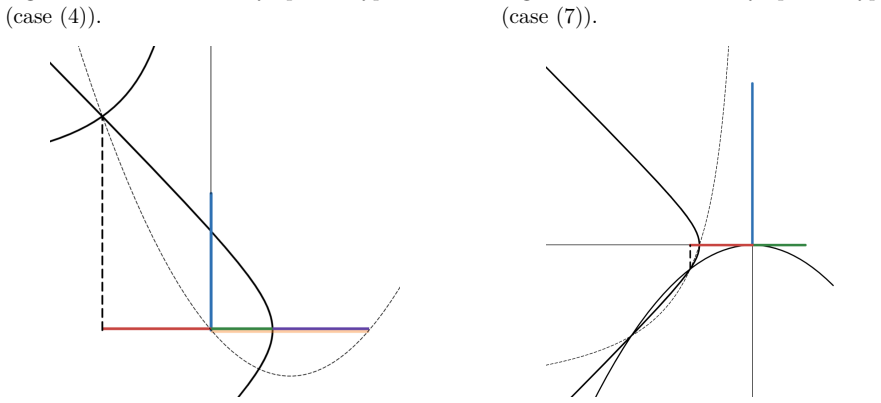
In each of Khayyam's thirteen cubic species the proportional arguments generate local conic relations such that a third algebraically available conic remains geometrically unused; this hidden conic shows algebra and geometry cooperating without merging into a global coordinate system, positioning Khayyam as a geometric algebraist working within Euclid and Apollonius rather than an incomplete precursor to analytic geometry.
What carries the argument
The hidden third conic relation that is algebraically generated by Khayyam's proportional arguments but not used in the geometric construction.
If this is right
- Each of Khayyam's thirteen cubic species contains three algebraically linked conics even though only two appear in the geometric construction.
- Khayyam's algebra and geometry remain tied to specific local intersections rather than a single coordinate plane.
- Khayyam's solutions stay complete within Euclidean and Apollonian geometry and do not require later analytic methods to be understood.
- The unused conic marks the boundary between what Khayyam's proportional arguments make available and what he actually draws.
Where Pith is reading between the lines
- Modern readers may overstate continuity with coordinate geometry because they overlook how strictly local Khayyam's conic relations remain.
- The pattern of the unused third conic could be checked against other medieval geometric algebraists to see whether the same local structure appears.
- If the third conic can be shown to satisfy the same cubic in every species, it supplies a uniform algebraic description that Khayyam himself never states geometrically.
Load-bearing premise
Khayyam's proportional arguments generate local conic relations in which a third conic is always algebraically present yet unused, without requiring modern coordinate concepts.
What would settle it
A detailed reconstruction of any one of the thirteen species in which the given proportions yield no third algebraically available conic relation beyond the two Khayyam constructs.
Figures




read the original abstract
Omar Khayyam's treatment of cubic equations by intersections of conic sections has often been read as an anticipation of analytic or coordinate geometry. This paper argues that such a reading obscures the conceptual structure of Khayyam's own method. Working within the geometric framework of Euclid and Apollonius, it reconstructs Khayyam's thirteen cubic species through the local conic relations generated by his proportional arguments. In each case, the construction yields not merely the two conics Khayyam uses, but a third algebraically available conic relation that remains geometrically unused. This hidden conic reveals the extent to which Khayyam's algebra and geometry cooperate without yet merging into a global coordinate system. From this perspective, Khayyam is not an incomplete analytic geometer, but a complete geometric algebraist working within a different conceptual world.
Editorial analysis
A structured set of objections, weighed in public.
Referee Report
Summary. The paper reconstructs Omar Khayyam's thirteen cubic species through the local conic relations generated by his proportional arguments within the geometric framework of Euclid and Apollonius. It claims that each construction produces not only the two conics Khayyam explicitly uses for intersection but also a third algebraically available conic relation that remains geometrically unused. This hidden conic is presented as revealing the extent to which Khayyam's algebra and geometry cooperate locally without merging into a global coordinate system, positioning him as a complete geometric algebraist rather than an incomplete analytic geometer.
Significance. If the specific reconstructions hold and the third conic can be shown to arise directly from Khayyam's proportional arguments without modern algebraic imposition, the paper would provide a useful corrective to anachronistic interpretations of medieval geometric algebra. It emphasizes conceptual differences between Khayyam's local methods and later coordinate geometry. The absence of concrete examples or verification steps in the provided abstract, however, leaves the central claim difficult to evaluate for soundness.
major comments (2)
- [Abstract] Abstract: the claim that 'in each case, the construction yields not merely the two conics Khayyam uses, but a third algebraically available conic relation' is asserted without any specific reconstruction, example, or verification step for even one of the thirteen cubic species. This omission makes it impossible to assess whether the hidden-conic relation is genuinely present in Khayyam's proportional arguments or only appears after translation into modern equations.
- [Main reconstruction sections] Main reconstruction sections: the argument that the third conic is 'algebraically available yet geometrically unused' within Khayyam's Euclidean-Apollonian toolkit requires demonstration that the relation can be isolated by a distinct geometric construction or proposition available to Khayyam, rather than identified solely by imposing coordinate or algebraic language on the proportions. Without such a demonstration, the claim that this reveals cooperation 'without yet merging' risks circularity with modern concepts.
Simulated Author's Rebuttal
We thank the referee for their thoughtful and constructive report. The comments highlight important issues of clarity and methodological rigor in presenting Khayyam's geometric algebra. We have revised the manuscript to incorporate a concrete example in the abstract and to strengthen the geometric demonstrations in the main sections, ensuring all relations are derived strictly from Khayyam's proportional arguments and classical propositions. Our point-by-point responses follow.
read point-by-point responses
-
Referee: [Abstract] Abstract: the claim that 'in each case, the construction yields not merely the two conics Khayyam uses, but a third algebraically available conic relation' is asserted without any specific reconstruction, example, or verification step for even one of the thirteen cubic species. This omission makes it impossible to assess whether the hidden-conic relation is genuinely present in Khayyam's proportional arguments or only appears after translation into modern equations.
Authors: We accept this criticism of the original abstract. The revised abstract now includes a brief but explicit example drawn from one of Khayyam's species (the equation x³ + a x² = b x + c, reconstructed via the intersection of a hyperbola and a circle as in Khayyam's text). In this case the proportions generate a third parabola as the locus satisfying the same ratio of segments, which is algebraically entailed but not constructed. The full verification for all thirteen species remains in Sections 3–5, where each is derived step-by-step from Khayyam's own wording using only Euclidean and Apollonian propositions. revision: yes
-
Referee: [Main reconstruction sections] Main reconstruction sections: the argument that the third conic is 'algebraically available yet geometrically unused' within Khayyam's Euclidean-Apollonian toolkit requires demonstration that the relation can be isolated by a distinct geometric construction or proposition available to Khayyam, rather than identified solely by imposing coordinate or algebraic language on the proportions. Without such a demonstration, the claim that this reveals cooperation 'without yet merging' risks circularity with modern concepts.
Authors: We agree that the distinction must be shown geometrically rather than imposed algebraically. In the revised Sections 3–5 we now isolate the third conic for each species by exhibiting a separate Apollonian construction (e.g., via the application of areas or the definition of a conic as the locus of points satisfying a constant ratio to a fixed line and point) that could have been performed with Khayyam's tools but is not invoked in his actual diagram. We cite the precise Euclidean propositions (e.g., Elements II.14, VI.29) and Apollonian definitions that license this construction, thereby showing the relation is available within the classical toolkit without requiring coordinate language. A new subsection 2.3 clarifies how this local availability differs from a global coordinate system. revision: yes
Circularity Check
No circularity: historical geometric reconstruction remains self-contained
full rationale
The paper reconstructs Khayyam's thirteen cubic species from proportional arguments within Euclid-Apollonius geometry, identifying a third algebraically present but unused conic relation in each case. No load-bearing step reduces by definition, fitted parameter, or self-citation chain to the paper's own inputs; the derivation draws on external classical sources and does not invoke uniqueness theorems or ansatzes from the author's prior work. The central claim is therefore independent of any self-referential loop and stands as a non-circular interpretive analysis.
Axiom & Free-Parameter Ledger
axioms (1)
- domain assumption Khayyam worked strictly within the geometric framework of Euclid and Apollonius
Lean theorems connected to this paper
-
IndisputableMonolith/Foundation/AlexanderDuality.lean (D=3 forcing via circle linking)alexander_duality_circle_linking unclear?
unclearRelation between the paper passage and the cited Recognition theorem.
the thirteen species fall into five geometric families... local coordinates without global coordinates
What do these tags mean?
- matches
- The paper's claim is directly supported by a theorem in the formal canon.
- supports
- The theorem supports part of the paper's argument, but the paper may add assumptions or extra steps.
- extends
- The paper goes beyond the formal theorem; the theorem is a base layer rather than the whole result.
- uses
- The paper appears to rely on the theorem as machinery.
- contradicts
- The paper's claim conflicts with a theorem or certificate in the canon.
- unclear
- Pith found a possible connection, but the passage is too broad, indirect, or ambiguous to say the theorem truly supports the claim.
Reference graph
Works this paper leans on
-
[1]
Apollonius of Perga, Treatise on Conic Sections, edited by Thomas Little Heath, Cambridge University Press, Cambridge, 1896
-
[2]
C. B. Boyer, The History of the Calculus and Its Conceptual Development, Dover, New York, 1959. MR0124178
work page 1959
-
[3]
T. L. Heath, A History of Greek Mathematics. Vol. I: From Thales to Euclid, Clarendon Press, Oxford, 1921
work page 1921
-
[4]
D. A. Kent and D. J. Muraki, A geometric solution of a cubic by Omar Khayyam \ in which colored diagrams are used instead of letters for the greater ease of learners, Amer. Math. Monthly 123 (2016), no. 2, 149--160. MR3470505, https://doi.org/10.4169/amer.math.monthly.123.2.149
-
[5]
R. Rashed and B. Vahabzadeh, Omar Khayyam, the Mathematician, Bibliotheca Persica Press, New York, 2000
work page 2000
-
[6]
Maq\=alah f\= \ al-jabr wa-al muq\=abalah, Smith Oriental MS 45, Rare Book & Manuscript Library, Columbia University, Lahore, 13th century
-
[7]
F. J. Swetz and V. J. Katz, Mathematical Treasures---Omar Khayyam's Algebra, Convergence, January 2011, Mathematical Association of America, https://old.maa.org/press/periodicals/convergence/mathematical-treasures-omar-khayyam-s-algebra
work page 2011
-
[8]
O. Khayyam, L'alg\`ebre d'Omar Alkhayy\^ami, publi\'ee, traduite et accompagn\'ee d'extraits de manuscrits in\'edits, par F. Woepcke, B. Duprat, Paris, 1851
discussion (0)
Sign in with ORCID, Apple, or X to comment. Anyone can read and Pith papers without signing in.