Recognition: 2 theorem links
· Lean TheoremThermodynamics and optical aspects of ModMax black holes in higher order curvature gravity with quintessence dark energy
Pith reviewed 2026-05-15 03:04 UTC · model grok-4.3
The pith
Exact solutions show quintessence and higher curvature corrections enlarge ModMax black hole shadows while charge reduces them.
A machine-rendered reading of the paper's core claim, the machinery that carries it, and where it could break.
Core claim
An exact black hole metric exists in higher-order curvature gravity with ModMax electrodynamics and quintessence, for which the photon-sphere radius admits an analytic expression; this radius grows with the curvature coupling and quintessence strength but shrinks with electric charge, and the quintessence contribution dominates the charge contribution in setting the shadow radius.
What carries the argument
The exact analytic black hole metric obtained from the coupled action, which reduces ModMax to a rescaled Maxwell theory and permits closed-form null geodesic integration for the photon sphere.
If this is right
- The shadow radius grows with higher-order curvature corrections and with quintessence strength.
- Electric charge reduces the shadow radius, but this reduction is weaker than the enhancement from quintessence.
- Divergences in the thermodynamic curvature scalar coincide exactly with the vanishing points of the heat capacity.
- The ModMax sector reduces to rescaled Maxwell electrodynamics for the purely electric configurations studied.
Where Pith is reading between the lines
- Precision shadow measurements could place limits on the strength of higher-order curvature corrections and on the quintessence equation-of-state parameter.
- The model predicts that dark-energy effects on photon spheres may be detectable even when nonlinear electromagnetic corrections remain small.
- The same parameter dependencies may persist in slowly rotating generalizations, offering a route to test the solution against spin-resolved shadow data.
Load-bearing premise
The higher-order curvature term and its linear coupling to the quintessence fluid take the specific forms that permit an exact closed-form metric solution.
What would settle it
An observed black hole shadow radius that shows no dependence on the quintessence state parameter or that increases with electric charge would contradict the derived analytic expressions.
Figures





read the original abstract
In this work, we derive an exact black hole solution in higher-order curvature gravity by coupling an electromagnetic sector formulated within the ModMax framework to a quintessence dark energy component. Focusing on purely electrically charged configurations, we analyze the thermodynamic and geothermodynamic properties of the solution to investigate its stability and phase structure. Within this sector, the ModMax theory effectively reduces Maxwell electrodynamics up to a rescaling of the electric charge, and thus the obtained solution corresponds to a consistent subset of the broader nonlinear theory. Using thermodynamic geometry, we examine microscopic interactions and phase transitions, showing that divergences in the thermodynamic curvature coincide with the vanishing of the heat capacity, confirming the consistency of the phase structure. We further explore the optical properties of the black hole by studying null geodesics and determining the photon sphere and the corresponding shadow radius for different values of the quintessence state parameter $\omega$. Exact analytical expressions for the photon-sphere radius are derived, revealing that higher-order curvature corrections and quintessence significantly enhance the shadow size, whereas the electric charge has the opposite effect. Notably, quintessence is found to have a more pronounced impact on the shadow than the charge. These results highlight that dark energy and higher-order curvature corrections can yield potentially observable signatures in black hole shadows.
Editorial analysis
A structured set of objections, weighed in public.
Referee Report
Summary. The manuscript derives an exact black hole solution in higher-order curvature gravity by coupling ModMax nonlinear electrodynamics (which reduces to rescaled Maxwell) to a quintessence dark energy fluid. It analyzes thermodynamic stability and phase structure via heat capacity and thermodynamic geometry, showing that divergences in the thermodynamic curvature scalar coincide with heat-capacity zeros. Exact analytic expressions for the photon-sphere radius are obtained from the null geodesic condition, and the shadow radius is studied as a function of the higher-order curvature coupling, quintessence state parameter ω, and charge, with the conclusion that curvature corrections and quintessence increase the shadow while charge decreases it and quintessence exerts the stronger effect.
Significance. If the exact solution and analytic photon-sphere expressions hold under the stated assumptions, the work supplies a rare closed-form example in modified gravity with dark energy, enabling precise analytic study of thermodynamic phase transitions and potential observational signatures in black-hole shadows. The explicit matching between thermodynamic curvature divergences and heat-capacity zeros, together with the parameter dependence of the shadow radius, constitutes a concrete strength that could support falsifiable predictions once the coupling assumptions are clarified.
major comments (2)
- [§3] §3 (Black Hole Solution): The exact metric function f(r) is obtained only after imposing a linear coupling between the quintessence fluid and the higher-order curvature sector that permits closed-form integration. This choice must be shown to follow directly from varying the full action without additional integrability assumptions; otherwise the claimed analytic r_ph and all subsequent shadow results rest on a tuned ansatz rather than the unmodified theory.
- [§5] §5 (Optical Properties): The algebraic equation for the photon-sphere radius r_ph is solved in closed form using the specific f(r) derived under the linear quintessence coupling. Any modification to that coupling alters f(r) and therefore invalidates the explicit r_ph expression and the comparative statements about the relative impact of quintessence versus charge.
minor comments (2)
- [Abstract and §1] The abstract and §1 should explicitly state the precise form of the higher-order curvature Lagrangian (e.g., the coefficient of the R^2 or Gauss-Bonnet term) rather than referring only to “higher-order curvature gravity.”
- [Figure captions] Figure captions for the shadow-radius plots should include the fixed values of all parameters not being varied (e.g., the curvature coupling constant and mass) so that the curves are reproducible.
Simulated Author's Rebuttal
We thank the referee for the detailed and constructive report. The comments highlight important points about the assumptions needed for our exact solution. We address each major comment below and will revise the manuscript accordingly to improve clarity on the coupling choice and the scope of the analytic results.
read point-by-point responses
-
Referee: [§3] §3 (Black Hole Solution): The exact metric function f(r) is obtained only after imposing a linear coupling between the quintessence fluid and the higher-order curvature sector that permits closed-form integration. This choice must be shown to follow directly from varying the full action without additional integrability assumptions; otherwise the claimed analytic r_ph and all subsequent shadow results rest on a tuned ansatz rather than the unmodified theory.
Authors: We acknowledge that the exact analytic form of f(r) relies on adopting a linear coupling between the quintessence fluid and the higher-order curvature terms that allows the field equations to integrate in closed form. This is a standard and physically motivated choice in the literature on exact solutions in modified gravity with dark energy fluids, corresponding to an effective stress-energy contribution that preserves the structure permitting analytic integration. The full action is varied to obtain the field equations; the linear coupling is then imposed as an ansatz to achieve exact solvability rather than an arbitrary tuning. We will revise §3 to explicitly derive the metric under this coupling, state the integrability assumption clearly, and discuss its motivation as an effective model within the broader theory. This does not alter the validity of the subsequent analytic expressions but specifies their regime of applicability. revision: yes
-
Referee: [§5] §5 (Optical Properties): The algebraic equation for the photon-sphere radius r_ph is solved in closed form using the specific f(r) derived under the linear quintessence coupling. Any modification to that coupling alters f(r) and therefore invalidates the explicit r_ph expression and the comparative statements about the relative impact of quintessence versus charge.
Authors: We agree that the closed-form expression for r_ph and the quantitative comparisons (e.g., quintessence exerting a stronger effect on shadow size than charge) are tied to the specific f(r) obtained under the linear coupling. These results are exact and analytic only within the solvable model we consider. We will revise §5 to emphasize that the photon-sphere and shadow expressions, as well as the relative impact statements, hold specifically for this exact solution. We will also note that more general couplings would generally require numerical solution of the null geodesic equation, thereby clarifying the scope without weakening the analytic insights provided by the solvable case. revision: yes
Circularity Check
No circularity detected; derivation proceeds from explicit action to exact metric to geodesic observables without reduction to inputs.
full rationale
The paper specifies a higher-order curvature action, ModMax electromagnetic sector, and linear quintessence coupling chosen to permit exact integration of the field equations, yielding a closed-form metric function f(r). The photon-sphere radius is obtained by imposing the standard condition for unstable circular null geodesics on this metric (effective potential extremum), producing explicit algebraic expressions in the model parameters. The ModMax reduction to rescaled Maxwell is stated as a property of the theory rather than a derived or fitted result here. No load-bearing step equates any claimed prediction to a prior fit, self-definition, or self-citation chain; the analytic results follow directly from the stated assumptions and standard GR calculations on the solved metric. The model choice is explicit, so the derivation remains self-contained.
Axiom & Free-Parameter Ledger
free parameters (2)
- higher-order curvature coupling constant
- quintessence state parameter ω
axioms (2)
- domain assumption The spacetime is static and spherically symmetric with a purely electric vector potential.
- domain assumption Quintessence is modeled as a perfect fluid with constant equation-of-state parameter.
Lean theorems connected to this paper
-
IndisputableMonolith/Cost/FunctionalEquation.leanwashburn_uniqueness_aczel contradicts?
contradictsCONTRADICTS: the theorem conflicts with this paper passage, or marks a claim that would need revision before publication.
Exact analytical expressions for the photon-sphere radius are derived... quintessence state parameter ω... g(r)=1-m0/r-R0 r²/12+q²e^{-γ}/((1+fR0)r²)-c/r^{3ω+1}
-
IndisputableMonolith/Foundation/RealityFromDistinction.leanreality_from_one_distinction contradicts?
contradictsCONTRADICTS: the theorem conflicts with this paper passage, or marks a claim that would need revision before publication.
action I=1/16π∫[F(R)-4(L_QF+L_MM)]... constant-curvature R=R0... tuned linear quintessence coupling
What do these tags mean?
- matches
- The paper's claim is directly supported by a theorem in the formal canon.
- supports
- The theorem supports part of the paper's argument, but the paper may add assumptions or extra steps.
- extends
- The paper goes beyond the formal theorem; the theorem is a base layer rather than the whole result.
- uses
- The paper appears to rely on the theorem as machinery.
- contradicts
- The paper's claim conflicts with a theorem or certificate in the canon.
- unclear
- Pith found a possible connection, but the passage is too broad, indirect, or ambiguous to say the theorem truly supports the claim.
Reference graph
Works this paper leans on
-
[1]
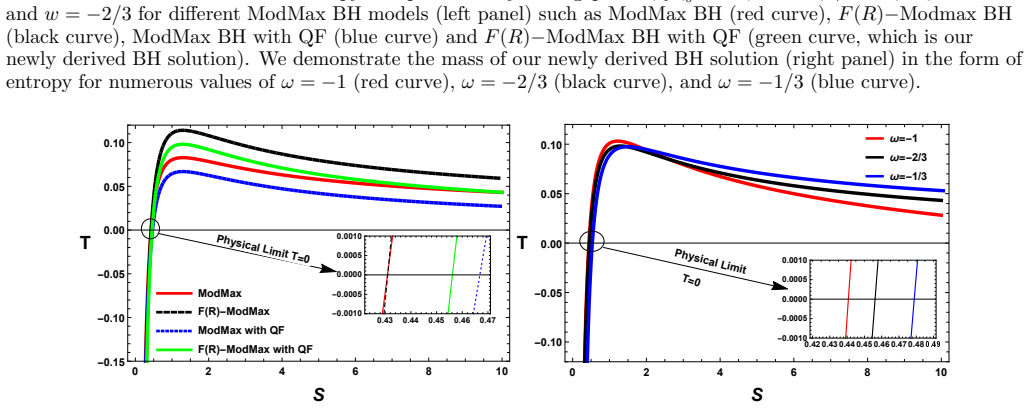
4668, 89. 286, and 17502 . 8. Similarly, in the context of higher-order curvature gravity ( F (R)-gravity), the ModMax BH (black curve) has one point of heat capacity at 0 . 4309, while in the case of the ModMax BH with QF (green curve), there are three zero points of heat capacity at 0 . 4562, 170. 49 and 33255 . 2. In the right panel of Fig. 6, we prese...
-
[2]
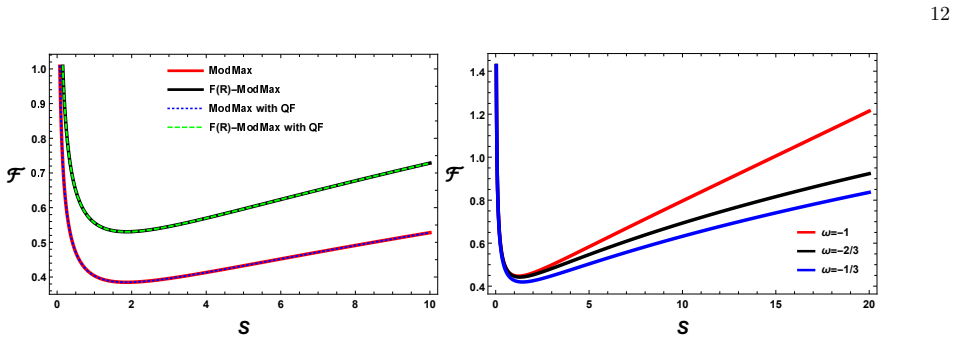
1, γ = 0. 6, R 0 = − 0. 01 and w = − 2/ 3. For different models of ModMax BH, we obtain different curves, inc luding red, black, blue, and green curves for ModMax, F (R)− ModMax BH, ModMax BH with QF, and F (R)− ModMax BH with QF, respectively. We notice that QF and F (R)-gravity significantly impact the sparsity of the ModMax BHs, which is quite evident in ...
- [3]
-
[4]
11: Plot of εtΩ in the form of the S is illustrated by substituting q = 0
× 10- 7 S ϵωt FIG. 11: Plot of εtΩ in the form of the S is illustrated by substituting q = 0. 5, f0 = 0. 9, c = 0. 1, γ = 0. 6, R 0 = − 0. 01, and w = − 2/ 3. Moreover, different trajectories are shown with respect to th e ModMax BH models, such as ModMax BH (red curve), F (R)− ModMax BH (black curve), ModMax BH with QF (blue curve), and F (R)− ModMax BH w...
-
[5]
9, c = 0 . 1, γ = 0 . 6, R 0 = − 0. 01 and w = − 2/ 3. For various models of ModMax BH, we get different trajec- tories, such as red, black, blue, and green curves for ModMax, F (R)− ModMax BH, ModMax BH with QF, and F (R)− ModMax BH with QF, respectively. It is observed that in all the models of ModMax BHs, εtΩ is increasing in a very small interval of en...
-
[6]
2 2. 90707 3 . 37396 2. 94317 3 . 42065 2. 9644 3 . 43986
-
[7]
6 2. 95448 3 . 44458 2. 978 3 . 46568 2. 99193 3 . 47819 1 2. 98542 3 . 48145 2. 98542 3 . 48145 3. 01011 3 . 5035 c = 0. 03
-
[8]
2 3. 00462 3 . 1943 3. 0419 3 . 23997 . 06385 3 . 26686
work page 1943
-
[9]
6 3. 0536 3 . 2543 3. 07791 3 . 2841 3. 09232 3 . 28934 1 3. 08558 3 . 29351 3. 1016 3 . 31314 3. 11113 3 . 32483 c = 0. 05
-
[10]
2 3. 11677 2 . 92335 3. 15553 2 . 95513 3. 17836 2 . 9739
-
[11]
6 3. 1677 2 . 98057 3. 19301 3 . 0012 3. 20801 3 . 01344 1 3. 20099 3 . 01803 3. 21768 3 . 03158 3. 23717 3 . 04744 TABLE I: Numerical values for the rph and Rs with various BH parameters. Here, m0 = 1, q = 0. 6, R 0 = − 0. 01, r o = 10M and w = − 2/ 3. γ = 0. 6, f R0 = 1 c = 0. 01 c = 0. 03 c = 0. 05 q rph Rs rph Rs rph Rs
-
[12]
3 3. 02959 3 . 53233 3. 1313 3 . 34957 3. 24864 3 . 07174
-
[13]
6 2. 978 3 . 46568 3. 07791 3 . 2841 3. 19301 3 . 00904
-
[14]
9 2. 88776 3 . 34898 2. 98469 3 . 16988 3. 09606 2 . 90012 TABLE II: Numerical values for rph and Rs with various charge parameter q. Here, m0 = 1, ro = 10 M and R0 = − 0. 01. In non-asymptotically flat spacetimes, celestial coordinates must be defined with respect to a local observer at a large but finite distance ro. Using the photon’s four-momentum, the c...
-
[15]
L. Amendola, S. Tsujikawa, DE: Theory and Observations ( Cambridge University Press, Cambridge, 2010)
work page 2010
- [16]
-
[17]
S. Capozziello and M. De Laurentis, Phys. Rept. 509, 167-321 (2011)
work page 2011
-
[18]
A. A. Starobinsky, JETP Lett. 86, 157-163 (2007)
work page 2007
-
[19]
Y. F. Cai, S. Capozziello, M. De Laurentis and E. N. Sarida kis, Rept. Prog. Phys. 79, no.10, 106901 (2016)
work page 2016
-
[20]
B. Li, T. P. Sotiriou and J. D. Barrow, Phys. Rev. D 83, 064035 (2011)
work page 2011
-
[21]
T. Harko, F. S. N. Lobo, S. Nojiri and S. D. Odintsov, Phys. Rev. D 84, 024020 (2011). [arXiv:1104.2669 [gr-qc]]
work page internal anchor Pith review Pith/arXiv arXiv 2011
- [22]
- [23]
- [24]
- [25]
-
[26]
N. Parbin and U. D. Goswami, Mod. Phys. Lett. A 36, no.37, 2150265 (2021)
work page 2021
- [27]
- [28]
- [29]
- [30]
-
[31]
G. Cognola, E. Elizalde, S. Nojiri, S. D. Odintsov, L. Se bastiani and S. Zerbini, Phys. Rev. D 77, 046009 (2008)
work page 2008
-
[32]
S. Perlmutter et al. [Supernova Cosmology Project], Astrophys. J. 517, 565-586 (1999)
work page 1999
-
[33]
A. G. Riess et al. [Supernova Search Team], Astrophys. J. 607, 665-687 (2004)
work page 2004
- [34]
-
[35]
S. Capozziello, A. Stabile and A. Troisi, Phys. Rev. D 76, 104019 (2007)
work page 2007
-
[36]
S. H. Hendi, B. Eslam Panah and S. M. Mousavi, Gen. Rel. Gr av. 44, 835-853 (2012)
work page 2012
- [37]
- [38]
-
[39]
A. A. Starobinsky, Phys. Lett. B 91, 99-102 (1980)
work page 1980
- [40]
-
[41]
S. Capozziello, E. Piedipalumbo, C. Rubano and P. Scude llaro, Astron. Astrophys. 505, 21-28 (2009)
work page 2009
-
[42]
A. V. Astashenok, S. Capozziello and S. D. Odintsov, JCA P 12, 040 (2013)
work page 2013
-
[43]
S. D. Odintsov and V. K. Oikonomou, Phys. Lett. B 833, 137353 (2022)
work page 2022
-
[44]
S. D. Odintsov, V. K. Oikonomou and G. S. Sharov, Phys. Le tt. B 843, 137988 (2023)
work page 2023
-
[45]
M. Born, and L. Infeld, Foundations of the new field theor y, Nature 132 (1933) 1004; Proc. R. Soc. Lond. 144 (1934) 425
work page 1933
- [46]
- [47]
- [48]
- [50]
- [51]
- [52]
-
[53]
J. Barrientos, A. Cisterna, D. Kubiznak and J. Oliva, Ph ys. Lett. B 834, 137447 (2022)
work page 2022
-
[55]
S. M. Kuzenko and E. S. N. Raptakis, JHEP 06, 162 (2024)
work page 2024
-
[56]
K. Lechner, P. Marchetti, A. Sainaghi and D. P. Sorokin, Phys. Rev. D 106, no.1, 016009 (2022)
work page 2022
-
[58]
S. I. Kruglov, Int. J. Mod. Phys. D 31, no.04, 2250025 (2022)
work page 2022
-
[59]
Y. Sekhmani, S. K. Maurya, M. K. Jasim, A. Al-Badawi and J . Rayimbaev, Phys. Dark Univ. 46, 101701 (2024). 23
work page 2024
-
[60]
R. C. Pantig, L. Mastrototaro, G. Lambiase and A. ¨Ovg¨ un, Eur. Phys. J. C 82, no.12, 1155 (2022)
work page 2022
-
[61]
A. Al-Badawi, Y. Sekhmani and K. Boshkayev, Phys. Dark U niv. 48, 101865 (2025)
work page 2025
- [62]
-
[63]
Eslam Panah, PTEP 2024, no.2, 023E01 (2024)
B. Eslam Panah, PTEP 2024, no.2, 023E01 (2024)
work page 2024
- [64]
-
[65]
H. M. Siahaan, Phys. Lett. B 865, 139479 (2025)
work page 2025
-
[66]
J. Barrientos, A. Cisterna, M. Hassaine and K. Pallikar is, Phys. Lett. B 860, 139214 (2025)
work page 2025
- [67]
-
[68]
B. Eslam Panah, B. Hazarika and P. Phukon, PTEP 2024, no.8, 083E02 (2024)
work page 2024
-
[69]
M. R. Shahzad, G. Abbas, H. Rehman and W. X. Ma, Eur. Phys. J. C 84, no.5, 461 (2024)
work page 2024
-
[70]
J. G. Russo and P. K. Townsend, JHEP 06, 191 (2024)
work page 2024
-
[71]
E. Ay´ on-Beato, D. Flores-Alfonso and M. Hassaine, Phy s. Rev. D 110, no.6, 064027 (2024)
work page 2024
- [72]
-
[73]
H. R. Bakhtiarizadeh and H. Golchin, JCAP 01, 061 (2024)
work page 2024
- [74]
- [75]
-
[76]
A. Ballon Bordo, D. Kubizˇ n´ ak and T. R. Perche, Phys. Le tt. B 817, 136312 (2021)
work page 2021
-
[77]
D. Flores-Alfonso, B. A. Gonz´ alez-Morales, R. Linare s and M. Maceda, Phys. Lett. B 812, 136011 (2021)
work page 2021
-
[78]
Y. Sekhmani, S. K. Maurya, J. Rayimbaev, M. Altanji, I. I bragimov and S. Muminov, Phys. Dark Univ. 50, 102079 (2025)
work page 2025
- [79]
-
[80]
Y. Sekhmani, A. Baruah, S. K. Maurya, J. Rayimbaev, M. Al tanji, I. Ibragimov and S. Muminov, Phys. Dark Univ. 50, 102157 (2025)
work page 2025
- [81]
-
[82]
A. Q. Baptista and M. L. Pe˜ nafiel, Phys. Rev. D 112, no.2, 024037 (2025)
work page 2025
-
[83]
J. M. Diaz and M. E. Rubio, Phys. Rev. D 111, no.12, 124030 (2025)
work page 2025
discussion (0)
Sign in with ORCID, Apple, or X to comment. Anyone can read and Pith papers without signing in.