Recognition: 2 theorem links
· Lean TheoremSpherical collapse and cluster number counts in DHOST theories that pass the constraints from gravitational waves
Pith reviewed 2026-05-15 02:35 UTC · model grok-4.3
The pith
DHOST theories consistent with gravitational wave constraints predict fewer high-redshift galaxy clusters than the standard ΛCDM model.
A machine-rendered reading of the paper's core claim, the machinery that carries it, and where it could break.
Core claim
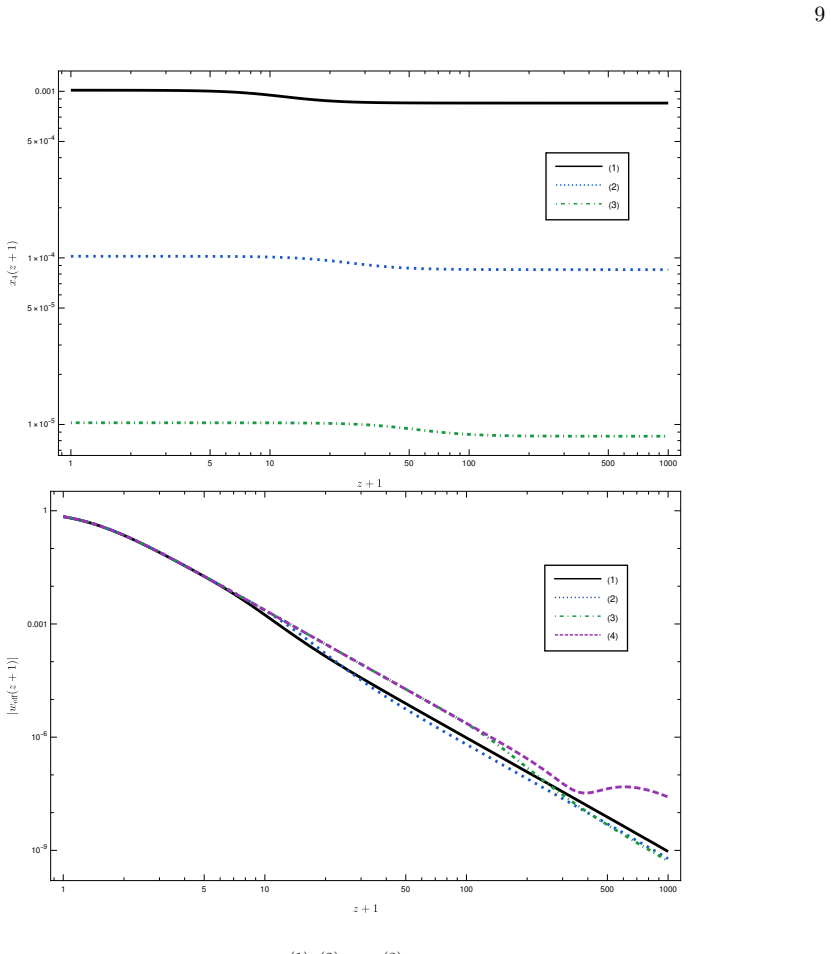
In DHOST theories where gravitational waves propagate at the speed of light without decaying into scalars, deviations from general relativity become appreciable at late times during the matter era. These deviations reduce the growth rate of linear matter perturbations on small scales while increasing the linearly extrapolated density contrast required for spherical collapse. As a result the analytic mass function yields lower galaxy cluster number counts than in ΛCDM; the suppression is strongest in the highest redshift bin even when the present-day deviation parameter is restricted to the upper limit allowed by binary pulsar data.
What carries the argument
Spherical collapse model adapted to DHOST, which supplies a modified collapse threshold δ_c that is inserted into the analytic halo mass function to compute redshift-dependent cluster number counts.
If this is right
- Cluster abundance reaches its maximum in the lowest redshift bin.
- The number of clusters in the highest redshift bin decreases as the deviation from Einstein gravity increases.
- Even at the upper limit set by binary pulsar observations, DHOST cluster counts fall below the ΛCDM values calibrated to eROSITA.
- The minimum mass used in the integration is chosen so that the ΛCDM prediction matches the eROSITA-inferred counts at each redshift.
Where Pith is reading between the lines
- Future high-redshift cluster surveys could tighten bounds on DHOST parameters beyond current pulsar limits if the analytic predictions hold.
- The reported suppression may be testable with weak-lensing or Sunyaev-Zel'dovich cluster catalogs that reach similar redshifts.
- Numerical N-body simulations in DHOST cosmologies would be required to check whether the spherical-collapse threshold remains a reliable proxy for halo formation.
Load-bearing premise
The spherical collapse model and analytic mass function remain accurate when applied to DHOST theories despite the change in gravitational dynamics.
What would settle it
A direct count of galaxy clusters in the highest redshift bin from eROSITA or an equivalent survey that equals or exceeds the ΛCDM prediction would falsify the predicted suppression for the allowed range of DHOST deviations.
Figures



read the original abstract
We investigate the spherical collapse model and the abundance of galaxy clusters in a class of degenerate higher-order scalar--tensor (DHOST) theories in which gravitational waves do not decay into scalar perturbations and which are consistent with current constraints from gravitational-wave observations. We find that deviations from Einstein gravity can become significant at late times when the background universe is close to the scaling regime during the matter-dominated epoch. These deviations suppress the growth of linear matter perturbations on small scales while increasing the extrapolated linear density contrast at collapse, obtained from the spherical collapse model. Using the analytic mass function, we compute the corresponding cluster number counts. The minimum mass threshold in the mass integration for each redshift bin is determined by matching the predicted number counts in the $\Lambda$CDM model with those inferred from the eROSITA survey. We find that the cluster abundance reaches its maximum at low redshift bin, and that the number of clusters in the highest redshift bin is suppressed as the deviation from Einstein gravity becomes larger. The parameters of the theory are chosen such that the deviation from Einstein gravity at present is consistent with the local astrophysical bounds from binary pulsar observations. We find that even under such strict constraints, the upper bound on the deviation leads to lower predicted number counts compared with the $\Lambda$CDM model emulating the eROSITA survey results. However, this may be a consequence of the uncertainties in computing the number counts for the DHOST theories using the spherical collapse model and the analytical mass function.
Editorial analysis
A structured set of objections, weighed in public.
Referee Report
Summary. The manuscript investigates spherical collapse and galaxy cluster number counts in DHOST theories consistent with gravitational wave and binary pulsar constraints. It reports that deviations from GR, even within allowed bounds, suppress linear perturbation growth on small scales, raise the collapse threshold, and result in lower cluster abundances than in ΛCDM when calibrated to eROSITA data, with the effect most pronounced at higher redshifts. The authors caution that the result may arise from uncertainties in extending the spherical collapse model and analytic mass functions to these theories.
Significance. If the extension of the spherical collapse model to DHOST is reliable, the work demonstrates that cluster surveys can probe deviations from GR that are permitted by local constraints, offering a potential observational test via suppressed number counts at high redshift. The use of external constraints to fix parameters and the matching to eROSITA results provide a clear, falsifiable prediction.
major comments (2)
- [Abstract] Abstract: the headline result on suppressed cluster counts (relative to the eROSITA-matched ΛCDM case) is obtained by solving the spherical-collapse ODE for a modified δ_c(z) and inserting it into the standard Press-Schechter/Sheth-Tormen mass function; the abstract itself states that the observed suppression “may be a consequence of the uncertainties in computing the number counts for the DHOST theories using the spherical collapse model and the analytical mass function,” yet no N-body validation, excursion-set re-derivation, or direct comparison of the collapse threshold is reported.
- [Cluster number counts section] Cluster number counts section: the minimum mass threshold for each redshift bin is fixed by matching the ΛCDM prediction to eROSITA-inferred counts, after which the DHOST-modified δ_c is used; no error propagation, sensitivity analysis to the deviation parameter, or robustness checks against variations in the mass-function fitting formula are provided, rendering the quantitative difference from ΛCDM conditional on an untested extrapolation.
minor comments (1)
- [Results] The text should clarify whether the reported suppression is monotonic in the deviation parameter or exhibits any non-linear behavior at the upper bound allowed by binary-pulsar constraints.
Simulated Author's Rebuttal
We thank the referee for the careful and constructive review of our manuscript. We address each major comment point by point below, clarifying our methodology and the scope of the present work. Revisions have been made to strengthen the discussion of limitations and to include additional sensitivity checks.
read point-by-point responses
-
Referee: [Abstract] Abstract: the headline result on suppressed cluster counts (relative to the eROSITA-matched ΛCDM case) is obtained by solving the spherical-collapse ODE for a modified δ_c(z) and inserting it into the standard Press-Schechter/Sheth-Tormen mass function; the abstract itself states that the observed suppression “may be a consequence of the uncertainties in computing the number counts for the DHOST theories using the spherical collapse model and the analytical mass function,” yet no N-body validation, excursion-set re-derivation, or direct comparison of the collapse threshold is reported.
Authors: We agree that our results rely on the spherical collapse model to obtain a modified δ_c(z) and the standard analytic mass function. N-body simulations or a full excursion-set re-derivation for DHOST theories would provide stronger validation, but such computations are computationally demanding and lie outside the scope of this paper, which focuses on the analytic approach. In the revised manuscript we have added an explicit comparison of δ_c(z) between the DHOST models and ΛCDM, expanded the caveats section, and reinforced the cautionary language already present in the abstract regarding uncertainties in the extrapolation. revision: partial
-
Referee: [Cluster number counts section] Cluster number counts section: the minimum mass threshold for each redshift bin is fixed by matching the ΛCDM prediction to eROSITA-inferred counts, after which the DHOST-modified δ_c is used; no error propagation, sensitivity analysis to the deviation parameter, or robustness checks against variations in the mass-function fitting formula are provided, rendering the quantitative difference from ΛCDM conditional on an untested extrapolation.
Authors: We accept that the original submission lacked these quantitative checks. The revised version now includes a sensitivity analysis in which the DHOST deviation parameter is varied within the range allowed by binary-pulsar constraints, showing the resulting impact on cluster counts. We have also added a discussion of robustness with respect to the mass-function parameters used in the matching to eROSITA data and included a simple estimate of the uncertainty arising from that matching procedure. A complete propagation of all systematics and exhaustive variation of fitting formulas remains a more extensive project that we flag as future work. revision: yes
- N-body validation or excursion-set re-derivation of the spherical collapse threshold and mass function in DHOST theories
- Full systematic error propagation that incorporates all eROSITA observational uncertainties and exhaustive variations of mass-function fitting formulas
Circularity Check
No significant circularity; parameters externally constrained and cluster counts computed from independent ODE solution plus standard mass function
full rationale
The derivation sets theory parameters from external GW and binary-pulsar bounds, solves the spherical-collapse ODE in the DHOST background to obtain a new δ_c(z), inserts that threshold into the Press-Schechter/Sheth-Tormen mass function, and calibrates the minimum-mass cut by matching ΛCDM predictions to eROSITA counts. None of these steps reduces to a fitted quantity by construction, a self-definitional loop, or a load-bearing self-citation. The authors explicitly flag uncertainties in extending the analytic machinery, but this is an acknowledged limitation rather than circularity. The central quantitative claim (suppressed counts even at the pulsar-allowed upper bound) therefore remains a genuine prediction conditional on the validity of the spherical-collapse extension.
Axiom & Free-Parameter Ledger
free parameters (1)
- deviation parameter from GR
axioms (2)
- domain assumption Spherical collapse model applies to DHOST theories
- domain assumption Analytic mass function remains valid for cluster abundance in modified gravity
Lean theorems connected to this paper
-
IndisputableMonolith/Foundation/AbsoluteFloorClosure.leanreality_from_one_distinction unclear?
unclearRelation between the paper passage and the cited Recognition theorem.
We solve Eq. (45) numerically... tune the initial value of δm such that δm → ∞ at a given redshift z... compute the corresponding linear density contrast at the collapse redshift, which defines δc.
-
IndisputableMonolith/Cost/FunctionalEquation.leanwashburn_uniqueness_aczel unclear?
unclearRelation between the paper passage and the cited Recognition theorem.
The analytical mass function proposed by Press–Schechter... Sheth–Tormen... fS-T(σ) = A √(2a/π) [1+(σ²/aδc²)^p] δc/σ exp[-aδc²/2σ²]
What do these tags mean?
- matches
- The paper's claim is directly supported by a theorem in the formal canon.
- supports
- The theorem supports part of the paper's argument, but the paper may add assumptions or extra steps.
- extends
- The paper goes beyond the formal theorem; the theorem is a base layer rather than the whole result.
- uses
- The paper appears to rely on the theorem as machinery.
- contradicts
- The paper's claim conflicts with a theorem or certificate in the canon.
- unclear
- Pith found a possible connection, but the passage is too broad, indirect, or ambiguous to say the theorem truly supports the claim.
Reference graph
Works this paper leans on
-
[1]
0.2 0.4 0.6 0.8 1. 1.2 0 200 400 600 800 1000 1200 ● ● ● ● ● ● ● ● ● ● ● ● ● ● ● ● ● ● ● ● ● ● ● ● ●●● PS (1) PS (2) PS (3) Λ( data)
-
[2]
1.2 0 200 400 600 800 1000 1200 FIG
0.2 0.4 0.6 0.8 1. 1.2 0 200 400 600 800 1000 1200 FIG. 5: Number of galaxy clusters N per redshift bin ∆z. The upper panel shows the results obtained using the Sheth–Tormen (ST) mass function, while the lower panel corresponds to the Press–Schechter (PS) mass function. The labels (1)–(3) correspond to the same parameter sets as in Fig. 2, while Λ denotes...
-
[3]
Degenerate higher derivative theories beyond Horndeski: evading the Ostrogradski instability
D. Langlois and K. Noui, JCAP 02, (2016) 034, [arXiv:1510.06930 [gr-qc]]
work page internal anchor Pith review Pith/arXiv arXiv 2016
-
[4]
Extended Scalar-Tensor Theories of Gravity
M. Crisostomi, K. Koyama, and G. Tasinato, JCAP 04, (2016) 044, [arXiv:1602.03119 [hep-th]]
work page internal anchor Pith review Pith/arXiv arXiv 2016
-
[5]
Degenerate higher order scalar-tensor theories beyond Horndeski and disformal transformations
J. Ben Achour, D. Langlois, and K. Noui, Phys. Rev. D 93, (2016) 124005, [arXiv: 1602.08398 [gr-qc]]
work page internal anchor Pith review Pith/arXiv arXiv 2016
-
[6]
J. B. Achour, M. Crisostomi, K. Koyama, D. Langlois, and K. Noui, JHEP 12, (2016) 100, [arXiv:1608.08135 [hep-th]]
work page internal anchor Pith review Pith/arXiv arXiv 2016
-
[7]
Horndeski: beyond, or not beyond?
M. Crisostomi, M. Hull, K. Koyama, and G. Tasinato, JCAP 03, (2016) 038, [arXiv:1601.04658 [hep-th]]
work page internal anchor Pith review Pith/arXiv arXiv 2016
-
[8]
Ostrogradsky in Theories with Multiple Fields
C. de Rham and A. Matas, JCAP 06, (2016) 041, [arXiv:1604.08638 [hep-th]]
work page internal anchor Pith review Pith/arXiv arXiv 2016
-
[9]
B. P. Abbott et al. , Astrophys. J. Lett. 848, (2017) L13, [arXiv:1710.05834 [astro-ph.HE]]
work page internal anchor Pith review Pith/arXiv arXiv 2017
-
[10]
B. P. Abbott et al. , Phys. Rev. Lett. 119, (2017) 161101, [arXiv:1710.05832 [gr-qc]]
work page internal anchor Pith review Pith/arXiv arXiv 2017
-
[11]
Gravitational Wave Decay into Dark Energy
P. Creminelli, M. Lewandowski, G. Tambalo, and F. Vernizzi, JCAP 12, (2018) 025, [arXiv:1809.03484 [astro-ph.CO]]
work page internal anchor Pith review Pith/arXiv arXiv 2018
-
[12]
On the screening mechanism in DHOST theories evading gravitational wave constraints
S. Hirano, T. Kobayashi and D. Yamauchi, Phys. Rev. D 99, 104073 (2019), [arXiv:1903.08399]
work page internal anchor Pith review Pith/arXiv arXiv 2019
-
[13]
T. Hiramatsu and D. Yamauchi, Phys. Rev. D 102, no.8, 083525 (2020) doi:10.1103/PhysRevD.102.083525 [arXiv:2004.09520 [astro-ph.CO]]
-
[14]
C. P. Ma and E. Bertschinger, Astrophys. J. 455 (1995), 7-25 doi:10.1086/176550 [arXiv:astro-ph/9506072 [astro-ph]]
work page internal anchor Pith review Pith/arXiv arXiv doi:10.1086/176550 1995
-
[15]
R. Kimura, T. Kobayashi and K. Yamamoto, Phys. Rev. D 85, 024023 (2012) [arXiv:1111.6749 [astro- ph.CO]]
work page internal anchor Pith review Pith/arXiv arXiv 2012
-
[16]
Effective theory for the Vainshtein mechanism from the Horndeski action
K. Koyama, G. Niz and G. Tasinato, Phys. Rev. D 88, 021502 (2013) [arXiv:1305.0279 [hep-th]]
work page internal anchor Pith review Pith/arXiv arXiv 2013
-
[17]
Vainshtein mechanism after GW170817
M. Crisostomi and K. Koyama, Phys. Rev. D 97, 021301 (2018), [arXiv:1711.06661 [astro-ph.CO]]
work page internal anchor Pith review Pith/arXiv arXiv 2018
-
[18]
Fabian Schmidt, Wayne Hu, and Marcos Lima, Phys. Rev. D 81, 063005 (2010), [arXiv:0911.5178 [astro- ph.CO]]
work page internal anchor Pith review Pith/arXiv arXiv 2010
-
[19]
W. H. Press and P. Schechter, Astrophys. J. 187, 425 (1974)
work page 1974
-
[20]
P. T. P. Viana and A. R. Liddle, Mon. Not. Roy. Astron. Soc. 303, 535 (1999) [astro-ph/9808244]
work page internal anchor Pith review Pith/arXiv arXiv 1999
-
[21]
R. K. Sheth and G. Tormen, Mon. Not. Roy. Astron. Soc. 308, 119 (1999) [astro-ph/9901122]
work page internal anchor Pith review Pith/arXiv arXiv 1999
-
[22]
D. Reed, R. Bower, C. Frenk, A. Jenkins and T. Theuns, Mon. Not. Roy. Astron. Soc. 374, 2 (2007) [astro-ph/0607150]
work page internal anchor Pith review Pith/arXiv arXiv 2007
-
[23]
E. Bulbul et al. , Astron. Astrophys. 685, A106 (2024) [arXiv:2402.08452 [astro-ph.CO]]. 16 Appendix A: Background equations Varying the action in Eq. (15) with respect to n and a, and then setting n = 1, we get the following evolution equations − 3X G4 ( 2 ˙ϕG2 4X ... ϕ + 8G4H 2G4X + 6H ˙ϕG2 4X ¨ϕ − 2G4H ˙ϕG3X + 4G4 ˙HG 4X + G4X ¨ϕ2 ( 2 ˙ϕ2G4XX + G4X )) ...
discussion (0)
Sign in with ORCID, Apple, or X to comment. Anyone can read and Pith papers without signing in.