Recognition: 1 theorem link
· Lean TheoremA New Source of Millicharged Particles: Secondary Showers in the LHC Forward Absorber
Pith reviewed 2026-05-15 05:22 UTC · model grok-4.3
The pith
Secondary production in the LHC TAXN absorber generates a substantial millicharged particle flux that boosts forward detector signals by about 50 percent for light masses.
A machine-rendered reading of the paper's core claim, the machinery that carries it, and where it could break.
Core claim
We identify and quantify secondary production of millicharged particles in the showers initiated by neutral particles in the TAXN absorber. Combining Monte Carlo simulations with Geant4-based modeling reveals a substantial mCP flux that complements primary production, enhancing the signal yield for the proposed FORMOSA detector by approximately 50 percent for masses below 0.1 GeV.
What carries the argument
Secondary cascades in hadronic and electromagnetic showers initiated by neutral particles striking the TAXN absorber, quantified through Monte Carlo simulations combined with Geant4 modeling.
If this is right
- Secondary production must be included in realistic sensitivity projections for High-Luminosity LHC searches.
- The contribution is particularly important for millicharged particles lighter than 0.1 GeV.
- The simulated secondary spectra are made publicly available to support other forward physics studies.
- This source adds to rather than replaces the primary production from the interaction point.
Where Pith is reading between the lines
- Similar secondary production could enhance signals in other LHC forward detectors that rely on the same beamline infrastructure.
- The modeling approach could be applied to estimate yields of other light exotic particles produced in absorber showers.
- Comparing data from FORMOSA with and without the secondary component would test the accuracy of the shower simulations.
- Full modeling of downstream components becomes essential for any far-forward search aiming at percent-level precision.
Load-bearing premise
The Monte Carlo and Geant4 simulations accurately capture the production rates of millicharged particles inside the showers in the absorber.
What would settle it
A measurement of millicharged particle events in the FORMOSA detector that deviates substantially from the predicted rate when secondary production is included would show the modeling of shower yields is incomplete.
Figures

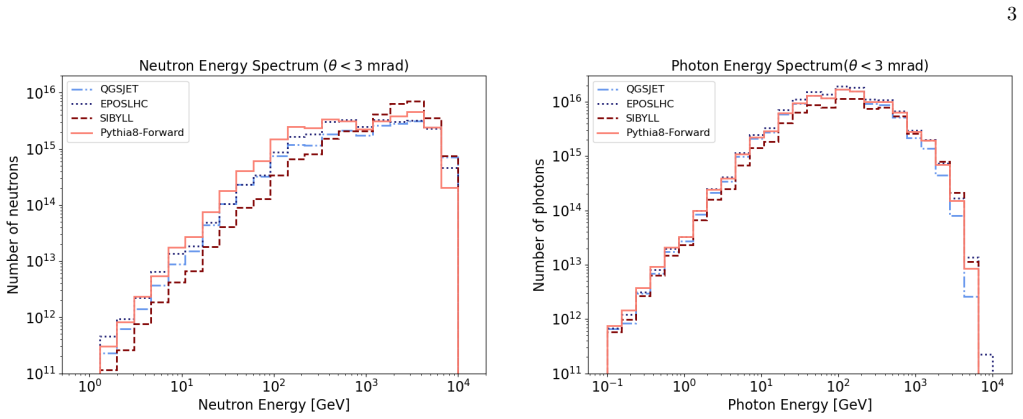


read the original abstract
Millicharged particles (mCPs) are a well-motivated target for far-forward searches at the Large Hadron Collider. We identify and quantify a significant new source of these particles: secondary production in hadronic and electromagnetic showers initiated by energetic neutral particles striking the TAXN absorber. By combining Monte Carlo simulations with \texttt{Geant4}-based modeling, we show that these secondary cascades yield a substantial mCP flux that complements the primary production from the interaction point. For the proposed FORMOSA detector, this contribution can enhance the expected signal yield by approximately $50\%$ for $m_\chi \lesssim 0.1~\textrm{GeV}$. Our results demonstrate that secondary production in downstream infrastructure is an essential ingredient for realistic sensitivity projections and new-physics searches at the High-Luminosity LHC. The simulated secondary spectra are made publicly available to facilitate future forward physics studies.
Editorial analysis
A structured set of objections, weighed in public.
Referee Report
Summary. The manuscript identifies secondary production of millicharged particles (mCPs) in hadronic and electromagnetic showers within the TAXN absorber at the LHC as a new source that can enhance the expected signal in the proposed FORMOSA detector by approximately 50% for masses below 0.1 GeV. This is quantified using Monte Carlo simulations combined with Geant4 modeling of the cascades initiated by neutral particles, and the resulting secondary spectra are made publicly available.
Significance. If the modeling holds, the result is significant for forward mCP searches because it demonstrates that downstream infrastructure contributes a non-negligible flux that must be included in realistic HL-LHC sensitivity projections. The public release of the simulated secondary spectra is a clear strength that supports reproducibility and enables follow-up work by the community.
major comments (1)
- [§3] §3 (Geant4 implementation): the custom mCP cross-sections for pair production, bremsstrahlung, and photonuclear processes (scaled by ε²) are not compared to analytic limits, FLUKA results, or existing mCP literature benchmarks. Because the quoted 50% enhancement for m_χ ≲ 0.1 GeV is driven directly by the secondary yield from these processes, the absence of validation leaves the central numerical claim without independent support.
minor comments (1)
- The abstract states the 50% figure without specifying the range of ε or the precise mCP mass threshold used in the Geant4 runs; adding this would improve clarity.
Simulated Author's Rebuttal
We thank the referee for the positive assessment of our work and for the constructive comment on the Geant4 implementation. We address the major comment below and have revised the manuscript to incorporate additional validation.
read point-by-point responses
-
Referee: [§3] §3 (Geant4 implementation): the custom mCP cross-sections for pair production, bremsstrahlung, and photonuclear processes (scaled by ε²) are not compared to analytic limits, FLUKA results, or existing mCP literature benchmarks. Because the quoted 50% enhancement for m_χ ≲ 0.1 GeV is driven directly by the secondary yield from these processes, the absence of validation leaves the central numerical claim without independent support.
Authors: We appreciate the referee's emphasis on validation. The ε² scaling of the cross sections follows the standard treatment in the mCP literature, and the underlying Geant4 models for pair production, bremsstrahlung, and photonuclear processes are well-established. Nevertheless, we agree that explicit benchmarks strengthen the central claim. In the revised manuscript we have added a new paragraph in §3 that compares the implemented pair-production and bremsstrahlung cross sections to analytic high-energy expressions and to existing mCP results in the literature. For the photonuclear component we have performed dedicated FLUKA cross-checks on the neutral-hadron cascades in the TAXN geometry; the secondary mCP yields agree within 15 %. These additions confirm that the ~50 % enhancement for m_χ ≲ 0.1 GeV is robust. revision: yes
Circularity Check
No circularity: result is direct output of independent Geant4 Monte Carlo modeling
full rationale
The paper's claimed 50% signal enhancement for m_χ ≲ 0.1 GeV is obtained by running Geant4 simulations of secondary mCP production in hadronic and electromagnetic showers within the TAXN absorber. No analytical equations, parameter fits to the target observable, or self-citations are invoked to derive or justify the flux; the result is a numerical output of the simulation chain. The public release of the simulated spectra further allows external checks, confirming the derivation chain is self-contained and non-circular.
Axiom & Free-Parameter Ledger
Reference graph
Works this paper leans on
-
[1]
Observation of a new boson at a mass of 125 GeV with the CMS experiment at the LHC
S. Chatrchyanet al.(CMS), Observation of a New Bo- son at a Mass of 125 GeV with the CMS Experiment at the LHC, Phys. Lett. B716, 30 (2012), arXiv:1207.7235 [hep-ex]
work page internal anchor Pith review Pith/arXiv arXiv 2012
-
[2]
G. Aadet al.(ATLAS), Observation of a new particle in the search for the Standard Model Higgs boson with the ATLAS detector at the LHC, Phys. Lett. B716, 1 (2012), arXiv:1207.7214 [hep-ex]
work page internal anchor Pith review Pith/arXiv arXiv 2012
-
[3]
J. Alimenaet al., Searching for long-lived particles be- yond the Standard Model at the Large Hadron Collider, J. Phys. G47, 090501 (2020), arXiv:1903.04497 [hep-ex]
-
[4]
D. Acostaet al., Review of opportunities for new long- lived particle triggers in Run 3 of the Large Hadron Col- lider, (2021), arXiv:2110.14675 [hep-ex]
-
[5]
Hayrapetyanet al.(CMS), Dark sector searches with the CMS experiment, Phys
A. Hayrapetyanet al.(CMS), Dark sector searches with the CMS experiment, Phys. Rept.1115, 448 (2025), arXiv:2405.13778 [hep-ex]
-
[6]
Letter of Intent for FASER: ForwArd Search ExpeRiment at the LHC
A. Arigaet al.(FASER), Letter of Intent for FASER: ForwArd Search ExpeRiment at the LHC, (2018), arXiv:1811.10243 [physics.ins-det]
work page internal anchor Pith review Pith/arXiv arXiv 2018
-
[7]
FASER's Physics Reach for Long-Lived Particles
A. Arigaet al.(FASER), FASER’s physics reach for long-lived particles, Phys. Rev. D99, 095011 (2019), arXiv:1811.12522 [hep-ph]
work page internal anchor Pith review Pith/arXiv arXiv 2019
-
[8]
J. L. Feng, I. Galon, F. Kling, and S. Trojanowski, For- wArd Search ExpeRiment at the LHC, Phys. Rev. D97, 035001 (2018), arXiv:1708.09389 [hep-ph]
work page internal anchor Pith review Pith/arXiv arXiv 2018
-
[9]
H. Abreuet al.(FASER), Detecting and Studying High- Energy Collider Neutrinos with FASER at the LHC, Eur. Phys. J. C80, 61 (2020), arXiv:1908.02310 [hep-ex]
-
[10]
Ahdidaet al.(SHiP), SND@LHC, (2020), arXiv:2002.08722 [physics.ins-det]
C. Ahdidaet al.(SHiP), SND@LHC, (2020), arXiv:2002.08722 [physics.ins-det]
-
[11]
Abreuet al.(FASER), First Direct Observation of Collider Neutrinos with FASER at the LHC, Phys
H. Abreuet al.(FASER), First Direct Observation of Collider Neutrinos with FASER at the LHC, Phys. Rev. Lett.131, 031801 (2023), arXiv:2303.14185 [hep-ex]
-
[12]
Albaneseet al.(SND@LHC), Observation of Collider Muon Neutrinos with the SND@LHC Experiment, Phys
R. Albaneseet al.(SND@LHC), Observation of Collider Muon Neutrinos with the SND@LHC Experiment, Phys. Rev. Lett.131, 031802 (2023), arXiv:2305.09383 [hep- ex]
-
[13]
J. Boyd and J. L. Feng,Request to run FASER in Run 4, Tech. Rep. (CERN, Geneva, 2023)
work page 2023
-
[14]
R. Mammen Abrahamet al.(FASER), Prospects and Opportunities with an upgraded FASER Neutrino De- tector during the HL-LHC era: Input to the EPPSU, (2025), arXiv:2503.19775 [hep-ex]
-
[15]
SND@LHC Upgrade for the High-Luminosity LHC: Physics Reach and Installation Scenarios
D. Abbaneoet al.(SND@LHC), SND@LHC Upgrade for the High-Luminosity LHC: Physics Reach and Installa- tion Scenarios, (2026), arXiv:2602.21881 [hep-ex]
work page internal anchor Pith review Pith/arXiv arXiv 2026
- [16]
- [17]
- [18]
-
[19]
S. Foroughi-Abari, F. Kling, and Y.-D. Tsai, Looking forward to millicharged dark sectors at the LHC, Phys. Rev. D104, 035014 (2021), arXiv:2010.07941 [hep-ph]
-
[20]
M. Citronet al., Input to the ESPPU 2026 update: Searching for millicharged particles with the FORMOSA experiment at the CERN LHC (2025) arXiv:2504.12973 [hep-ex]
-
[21]
P. Galison and A. Manohar, TWO Z’s OR NOT TWO Z’s?, Phys. Lett. B136, 279 (1984)
work page 1984
-
[22]
Holdom, Two U(1)’s and Epsilon Charge Shifts, Phys
B. Holdom, Two U(1)’s and Epsilon Charge Shifts, Phys. Lett. B166, 196 (1986)
work page 1986
-
[23]
L. B. Okun, M. B. Voloshin, and V. I. Zakharov, ELEC- TRICAL NEUTRALITY OF ATOMS AND GRAND UNIFICATION MODELS, Phys. Lett. B138, 115 (1984)
work page 1984
-
[24]
D. E. Brahm and L. J. Hall, U(1)-prime DARK MAT- TER, Phys. Rev. D41, 1067 (1990)
work page 1990
-
[25]
Direct Detection of Sub-GeV Dark Matter
R. Essig, J. Mardon, and T. Volansky, Direct Detection of Sub-GeV Dark Matter, Phys. Rev. D85, 076007 (2012), arXiv:1108.5383 [hep-ph]
work page internal anchor Pith review Pith/arXiv arXiv 2012
-
[26]
Daily Modulation as a Smoking Gun of Dark Matter with Significant Stopping
C. Kouvaris and I. M. Shoemaker, Daily modulation as a smoking gun of dark matter with significant stopping rate, Phys. Rev. D90, 095011 (2014), arXiv:1405.1729 [hep-ph]
work page internal anchor Pith review Pith/arXiv arXiv 2014
-
[27]
Direct Detection of sub-GeV Dark Matter with Semiconductor Targets
R. Essig, M. Fernandez-Serra, J. Mardon, A. Soto, T. Volansky, and T.-T. Yu, Direct Detection of sub-GeV Dark Matter with Semiconductor Targets, JHEP05, 046, arXiv:1509.01598 [hep-ph]
work page internal anchor Pith review Pith/arXiv arXiv
-
[28]
New Constraints and Prospects for sub-GeV Dark Matter Scattering off Electrons in Xenon
R. Essig, T. Volansky, and T.-T. Yu, New Constraints and Prospects for sub-GeV Dark Matter Scattering off Electrons in Xenon, Phys. Rev. D96, 043017 (2017), arXiv:1703.00910 [hep-ph]
work page internal anchor Pith review Pith/arXiv arXiv 2017
-
[29]
Calorimetric Dark Matter Detection With Galactic Center Gas Clouds
A. Bhoonah, J. Bramante, F. Elahi, and S. Schon, Calorimetric Dark Matter Detection With Galactic Cen- ter Gas Clouds, Phys. Rev. Lett.121, 131101 (2018), arXiv:1806.06857 [hep-ph]
work page internal anchor Pith review Pith/arXiv arXiv 2018
- [30]
- [31]
- [32]
- [33]
-
[34]
Dark Matter Interactions, Helium, and the CMB
R. de Putter, O. Dor´ e, J. Gleyzes, D. Green, and J. Mey- ers, Dark Matter Interactions, Helium, and the Cosmic Microwave Background, Phys. Rev. Lett.122, 041301 (2019), arXiv:1805.11616 [astro-ph.CO]
work page internal anchor Pith review Pith/arXiv arXiv 2019
-
[35]
E. D. Kovetz, V. Poulin, V. Gluscevic, K. K. Boddy, R. Barkana, and M. Kamionkowski, Tighter limits on dark matter explanations of the anomalous EDGES 21 cm signal, Phys. Rev. D98, 103529 (2018), arXiv:1807.11482 [astro-ph.CO]
work page internal anchor Pith review Pith/arXiv arXiv 2018
- [36]
-
[37]
P. Adshead, P. Ralegankar, and J. Shelton, Dark radia- tion constraints on portal interactions with hidden sec- tors, JCAP09, 056, arXiv:2206.13530 [hep-ph]
-
[38]
X. Gan and Y.-D. Tsai, Cosmic millicharge background and reheating probes, JHEP07, 094, arXiv:2308.07951 [hep-ph]
-
[39]
A. Haas, C. S. Hill, E. Izaguirre, and I. Yavin, Looking for milli-charged particles with a new experiment at the LHC, Phys. Lett. B746, 117 (2015), arXiv:1410.6816 [hep-ph]
work page internal anchor Pith review Pith/arXiv arXiv 2015
- [40]
- [41]
-
[42]
S. Choiet al., Letter of Intent: Search for sub-millicharged particles at J-PARC, (2020), arXiv:2007.06329 [physics.ins-det]
- [43]
-
[44]
F. Kling, J.-L. Kuo, S. Trojanowski, and Y.-D. Tsai, FLArE up dark sectors with EM form factors at the LHC forward physics facility, Nucl. Phys. B987, 116103 (2023), arXiv:2205.09137 [hep-ph]
-
[45]
M. Kalliokoski, V. A. Mitsou, M. de Montigny, A. Mukhopadhyay, P.-P. A. Ouimet, J. Pinfold, A. Shaa, and M. Staelens, Searching for minicharged particles at the energy frontier with the MoEDAL-MAPP experiment at the LHC, JHEP04, 137, arXiv:2311.02185 [hep-ph]
-
[46]
R. Mammen Abraham, J. Adhikary, J. L. Feng, M. Fieg, F. Kling, J. Li, J. Pei, T. R. Rabemananjara, J. Rojo, and S. Trojanowski, FPF@FCC: neutrino, QCD, and BSM physics opportunities with far-forward experi- ments at a 100 TeV Proton Collider, JHEP01, 094, arXiv:2409.02163 [hep-ph]
- [47]
-
[48]
H. Eberl, M. Fahrecker, and J. Pradler, Underground Production of Electromagnetic Dark States by MeV- scale Electron Beams and Detection with CCDs, (2025), arXiv:2511.02023 [hep-ph]
work page internal anchor Pith review Pith/arXiv arXiv 2025
-
[49]
A Letter of Intent to Install a milli-charged Particle Detector at LHC P5
A. Ballet al., A Letter of Intent to Install a milli-charged Particle Detector at LHC P5, (2016), arXiv:1607.04669 [physics.ins-det]
work page internal anchor Pith review Pith/arXiv arXiv 2016
-
[50]
R. Aaijet al.(LHCb), First Measurement of Charm Pro- duction in its Fixed-Target Configuration at the LHC, Phys. Rev. Lett.122, 132002 (2019), arXiv:1810.07907 [hep-ex]
-
[51]
Measurement of antiproton production in ${\rm p He}$ collisions at $\sqrt{s_{NN}}=110$ GeV
R. Aaijet al.(LHCb), Measurement of Antiproton Pro- duction in pHe Collisions at √sN N = 110 GeV, Phys. Rev. Lett.121, 222001 (2018), arXiv:1808.06127 [hep- ex]
work page internal anchor Pith review Pith/arXiv arXiv 2018
-
[52]
C. Barschelet al.,LHC fixed target experiments : Report from the LHC Fixed Target Working Group of the CERN 11 Physics Beyond Colliders Forum, CERN Yellow Reports: Monographs, Vol. 4/2020 (CERN, Geneva, 2020)
work page 2020
- [53]
- [54]
- [55]
-
[56]
Wigmans, HIGH RESOLUTION HADRONIC CALORIMETRY, Nucl
R. Wigmans, HIGH RESOLUTION HADRONIC CALORIMETRY, Nucl. Instrum. Meth. A265, 273 (1988)
work page 1988
-
[57]
R. Donaldson and M. G. D. Gilchriese, eds.,Calorimetry for the Supercollider. Proceedings, Workshop, Tuscaloosa, USA, March 13-17, 1989(1990)
work page 1989
-
[58]
K. Akibaet al.(LHC Forward Physics Working Group), LHC Forward Physics, J. Phys. G43, 110201 (2016), arXiv:1611.05079 [hep-ph]
work page internal anchor Pith review Pith/arXiv arXiv 2016
-
[59]
O. Adrianiet al.(LHCf), Transverse-momentum distri- bution and nuclear modification factor for neutral pions in the forward-rapidity region in proton-lead collisions at √sN N = 5.02 TeV, Phys. Rev. C89, 065209 (2014), arXiv:1403.7845 [nucl-ex]
work page internal anchor Pith review Pith/arXiv arXiv 2014
-
[60]
O. Adrianiet al.(LHCf), Measurement of very forward neutron energy spectra for 7 TeV proton–proton colli- sions at the Large Hadron Collider, Phys. Lett. B750, 360 (2015), arXiv:1503.03505 [hep-ex]
work page internal anchor Pith review Pith/arXiv arXiv 2015
-
[61]
O. Adrianiet al.(LHCf), Measurements of longitudinal and transverse momentum distributions for neutral pions in the forward-rapidity region with the LHCf detector, Phys. Rev. D94, 032007 (2016), arXiv:1507.08764 [hep- ex]
work page internal anchor Pith review Pith/arXiv arXiv 2016
-
[62]
O. Adrianiet al.(LHCf), Measurement of forward pho- ton production cross-section in proton–proton collisions at √s= 13 TeV with the LHCf detector, Phys. Lett. B 780, 233 (2018), arXiv:1703.07678 [hep-ex]
work page internal anchor Pith review Pith/arXiv arXiv 2018
-
[63]
O. Adrianiet al.(LHCf), Measurement of inclusive for- ward neutron production cross section in proton-proton collisions at √s= 13 TeV with the LHCf Arm2 detector, JHEP11, 073, arXiv:1808.09877 [hep-ex]
work page internal anchor Pith review Pith/arXiv arXiv
- [64]
-
[65]
G. Piparoet al., Measurement of the forwardηmeson production rate in p-p collisions at √s = 13 TeV with the LHCf-Arm2 detector, JHEP10, 169, arXiv:2305.06633 [hep-ex]
- [66]
-
[67]
F. Kling and L. J. Nevay, Forward neutrino fluxes at the LHC, Phys. Rev. D104, 113008 (2021), arXiv:2105.08270 [hep-ph]
- [68]
- [69]
-
[70]
R. Maciula and A. Szczurek, Far-forward production of charm mesons and neutrinos at forward physics facilities at the LHC and the intrinsic charm in the proton, Phys. Rev. D107, 034002 (2023), arXiv:2210.08890 [hep-ph]
-
[71]
A. Bhattacharya, F. Kling, I. Sarcevic, and A. M. Stasto, Forward neutrinos from charm at the Large Hadron Col- lider, Phys. Rev. D109, 014040 (2024), arXiv:2306.01578 [hep-ph]
-
[72]
L. Buonocore, F. Kling, L. Rottoli, and J. Sominka, Predictions for neutrinos and new physics from forward heavy hadron production at the LHC, Eur. Phys. J. C 84, 363 (2024), arXiv:2309.12793 [hep-ph]
- [73]
-
[74]
Mammen Abrahamet al.(FASER), Neutrino rate pre- dictions for FASER, Phys
R. Mammen Abrahamet al.(FASER), Neutrino rate pre- dictions for FASER, Phys. Rev. D110, 012009 (2024), arXiv:2402.13318 [hep-ex]
-
[75]
R. Mammen Abrahamet al.(FASER), First Measure- ment ofνe andνµInteraction Cross Sections at the LHC with FASER’s Emulsion Detector, Phys. Rev. Lett.133, 021802 (2024), arXiv:2403.12520 [hep-ex]
-
[76]
EPOS LHC : test of collective hadronization with LHC data
T. Pierog, I. Karpenko, J. M. Katzy, E. Yatsenko, and K. Werner, EPOS LHC: Test of collective hadronization with data measured at the CERN Large Hadron Collider, Phys. Rev. C92, 034906 (2015), arXiv:1306.0121 [hep- ph]
work page internal anchor Pith review Pith/arXiv arXiv 2015
-
[77]
Monte Carlo treatment of hadronic interactions in enhanced Pomeron scheme: I. QGSJET-II model
S. Ostapchenko, Monte Carlo treatment of hadronic in- teractions in enhanced Pomeron scheme: I. QGSJET-II model, Phys. Rev. D83, 014018 (2011), arXiv:1010.1869 [hep-ph]
work page internal anchor Pith review Pith/arXiv arXiv 2011
-
[78]
E.-J. Ahn, R. Engel, T. K. Gaisser, P. Lipari, and T. Stanev, Cosmic ray interaction event gener- ator SIBYLL 2.1, Phys. Rev. D80, 094003 (2009), arXiv:0906.4113 [hep-ph]
work page internal anchor Pith review Pith/arXiv arXiv 2009
-
[79]
E.-J. Ahn, R. Engel, T. K. Gaisser, P. Lipari, and T. Stanev, Sibyll with charm, in16th International Sym- posium on Very High Energy Cosmic Ray Interactions (2011) arXiv:1102.5705 [astro-ph.HE]
work page internal anchor Pith review Pith/arXiv arXiv 2011
-
[80]
A new version of the event generator Sibyll
F. Riehn, R. Engel, A. Fedynitch, T. K. Gaisser, and T. Stanev, A new version of the event generator Sibyll, PoSICRC2015, 558 (2016), arXiv:1510.00568 [hep-ph]
work page internal anchor Pith review Pith/arXiv arXiv 2016
discussion (0)
Sign in with ORCID, Apple, or X to comment. Anyone can read and Pith papers without signing in.