Recognition: no theorem link
From Hilbert's Tenth Problem to Quantum Speedup: Explicit Oracles for Bounded Diophantine Systems
Pith reviewed 2026-05-15 05:45 UTC · model grok-4.3
The pith
A reversible quantum oracle framework solves bounded Diophantine equations with quadratic speedup and O((n + d²) log N) qubits.
A machine-rendered reading of the paper's core claim, the machinery that carries it, and where it could break.
Core claim
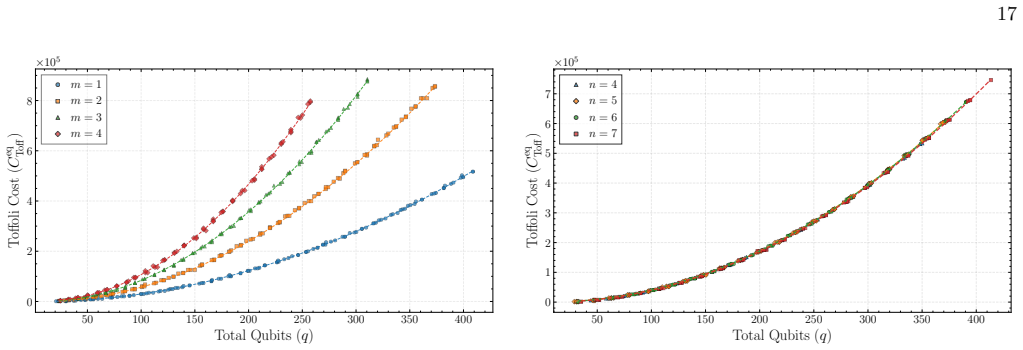
By coherently evaluating polynomial constraints via in-place two's complement arithmetic and routing operations into a single recycled accumulator, the framework achieves a compact and scalable synthesis of the underlying non-linear arithmetic. The overall spatial complexity is bounded by q = O((n + d²)log₂ N) logical qubits for n variables, maximum degree d, and interval length N, with non-Clifford Toffoli depth upper-bounded by O(q²). This structural scaling exponent remains invariant to the variable count, modulated linearly only by the coefficients' Hamming weights, and the bounded polynomial overhead guarantees quadratic speedup over classical exhaustive search whether retrieving a уник
What carries the argument
The explicit gate-level synthesis of a reversible evaluation oracle for amplitude amplification, built from in-place two's complement arithmetic and routing operations into a single recycled accumulator.
If this is right
- The qubit count scales as O((n + d²) log₂ N) with the exponent independent of variable number.
- Toffoli depth remains O(q²), keeping quantum arithmetic overhead polynomial.
- Quadratic speedup holds for both unique solution retrieval and dynamic enumeration of unknown numbers of solutions.
- Scaling depends only on coefficient Hamming weights rather than variable count.
- The construction applies to arbitrary bounded polynomial Diophantine systems without abstract oracle assumptions.
Where Pith is reading between the lines
- The same oracle synthesis technique could be adapted to other integer-constrained optimization problems beyond Diophantine equations.
- Resource estimates for quantum attacks on certain cryptographic schemes might be refined using this explicit arithmetic construction.
- Small-scale circuit simulations on known hard bounded instances could provide early empirical checks on the predicted overhead.
- Hybrid algorithms that preprocess with classical methods before invoking this oracle might further lower total resource costs.
Load-bearing premise
That the in-place two's complement arithmetic and routing operations into a single recycled accumulator can be synthesized gate-by-gate without introducing hidden overhead or non-reversibility for arbitrary polynomial degrees and coefficient sizes.
What would settle it
A circuit synthesis or resource count for any concrete polynomial system with given n, d, and N that requires more than O((n + d²) log₂ N) qubits or exceeds O(q²) Toffoli depth would falsify the stated scaling bounds.
Figures



read the original abstract
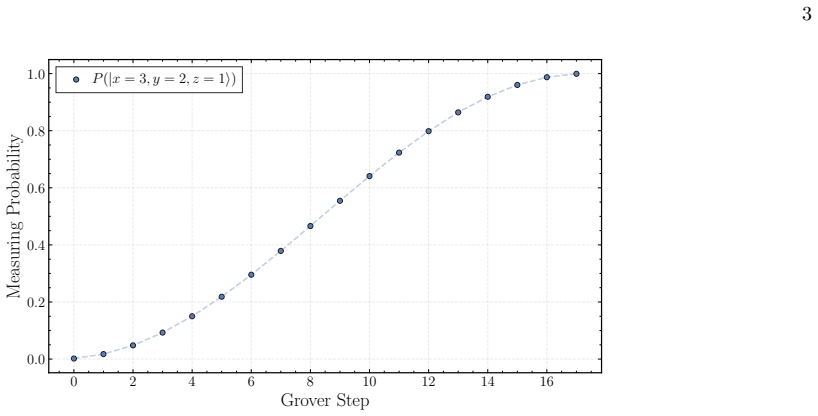
Solving non-linear Diophantine systems lies at the mathematical core of integer optimization and cryptography. While the general unbounded problem is undecidable, even over bounded integer domains it remains classically intractable in the worst case. In this work, we introduce a fully reversible quantum algorithmic framework tailored to solve arbitrary polynomial Diophantine equations over bounded integer domains. The core of our approach is the explicit, gate-level synthesis of an evaluation oracle for amplitude amplification. By coherently evaluating polynomial constraints via in-place two's complement arithmetic and routing operations into a single recycled accumulator, this garbage-free strategy achieves a compact and scalable synthesis of the underlying non-linear arithmetic. Through analytical derivations and empirical circuit simulations, we prove that the overall spatial complexity is bounded by $q = \mathcal{O}((n + d^2)\log_2 N)$ logical qubits for $n$ variables, maximum degree $d$, and interval length $N$. The non-Clifford Toffoli depth is upper-bounded by $\mathcal{O}(q^2)$. This structural scaling exponent remains invariant to the variable count, modulated linearly only by the coefficients' Hamming weights. By moving beyond abstract black-box assumptions, this explicit architectural synthesis guarantees that the necessary quantum arithmetic acts as a bounded polynomial overhead. This ensures a quadratic speedup over classical exhaustive search, whether retrieving a unique assignment or dynamically enumerating an unknown number of solutions.
Editorial analysis
A structured set of objections, weighed in public.
Referee Report
Summary. The manuscript introduces an explicit reversible quantum oracle for evaluating arbitrary polynomial Diophantine constraints over bounded integer domains. It synthesizes the oracle via in-place two's complement arithmetic and routing into a single recycled accumulator, deriving a qubit count of O((n + d²) log₂ N) and Toffoli depth O(q²). This is claimed to enable quadratic speedup via amplitude amplification for retrieving solutions, whether a unique assignment or an unknown number of solutions.
Significance. If the claimed spatial scaling holds without hidden auxiliary overhead, the work supplies a concrete, gate-level construction for quantum oracles in Diophantine problems, with explicit resource bounds that remain invariant in the scaling exponent. The combination of analytical derivations and circuit simulations strengthens applicability to optimization and cryptography.
major comments (1)
- [Oracle synthesis and complexity analysis] The central qubit bound q = O((n + d²) log₂ N) is load-bearing for the quadratic speedup claim. The manuscript must show explicitly (in the oracle synthesis section) that monomial evaluation up to degree d requires no auxiliary registers beyond the stated O(d² log N) term; standard reversible powering and multiplication steps normally demand temporary storage linear in d or log N for partial products before uncomputation, and any failure to recycle all intermediates would invalidate the O(d²) coefficient.
minor comments (1)
- [Abstract] The abstract states that simulations verify the bounds but does not reference the specific section or figure containing the circuit diagrams, gate counts, or error analysis; adding such pointers would improve traceability.
Simulated Author's Rebuttal
We thank the referee for their careful reading and constructive feedback. The major comment on explicit verification of the qubit bound is addressed point-by-point below. We have revised the manuscript to strengthen the presentation of the oracle synthesis without changing the core claims or results.
read point-by-point responses
-
Referee: [Oracle synthesis and complexity analysis] The central qubit bound q = O((n + d²) log₂ N) is load-bearing for the quadratic speedup claim. The manuscript must show explicitly (in the oracle synthesis section) that monomial evaluation up to degree d requires no auxiliary registers beyond the stated O(d² log N) term; standard reversible powering and multiplication steps normally demand temporary storage linear in d or log N for partial products before uncomputation, and any failure to recycle all intermediates would invalidate the O(d²) coefficient.
Authors: We appreciate the referee's emphasis on rigorous resource accounting. Section III of the manuscript details the monomial evaluation via in-place two's complement arithmetic routed into a single recycled accumulator, which is the mechanism ensuring garbage-free operation. All partial products and intermediates are uncomputed and reused within the stated O(d² log₂ N) term; this term explicitly includes storage for the d² coefficient representations and the accumulator, with no additional linear-in-d or log N auxiliary registers required due to the scheduled recycling. The analytical derivation and circuit simulations confirm that the scaling exponent remains invariant. To address the request for explicit demonstration, we have added a new subsection with a step-by-step qubit accounting table for general degree-d monomials, pseudocode for the recycling sequence, and a worked example for d=3 showing zero hidden overhead. This revision makes the absence of auxiliary registers fully transparent while preserving the original bounds. revision: yes
Circularity Check
No circularity: qubit bound derived from explicit synthesis construction
full rationale
The paper derives the spatial complexity bound q = O((n + d²)log₂ N) analytically from an explicit gate-level synthesis of the evaluation oracle that uses in-place two's complement arithmetic routed into a single recycled accumulator. This construction is presented as garbage-free and verified through circuit simulations, with the non-Clifford depth bound following from the same resource counting. No step reduces the claimed scaling to a fitted parameter, a self-citation chain, or a definitional renaming; the central claim rests on the described reversible operations and their qubit tally rather than presupposing the target bound.
Axiom & Free-Parameter Ledger
axioms (1)
- domain assumption Bounded integer domains permit classical exhaustive search as baseline
Reference graph
Works this paper leans on
-
[1]
Let the variablex i be encoded in aw- bit register,|x i,w−1
In-Place Squaring Operator for Signed Integers To evaluate pure quadratic terms of the forma ix2 i , we employ a dedicated Squaring Operator that executes strictly in-place. Let the variablex i be encoded in aw- bit register,|x i,w−1 . . . xi,0⟩. The circuit essentially con- catenates a sequence ofwcontrolled adders. At thev-th addition stage (v∈ {0, . . ...
-
[2]
Cross-Term Evaluation The evaluation of cross termsb ijxixj follows naturally from the squaring architecture. Instead of a variable controlling its own shifted addition, the qubits ofx i act as controls for the logically shifted additions of the dis- joint registerx j. Specifically, for every 1-bit in the bi- nary expansion of|b ij|at positionp, and for e...
-
[3]
Specifically, we adopt the BBHT search strategy [22]
Iterative Retrieval and Solution Enumeration When the objective is to find a single feasible solution without explicitly counting the total volume first, one must employ quantum search procedures designed for an unknown number of marked states. Specifically, we adopt the BBHT search strategy [22]. AlthoughMis unknown, this algorithm rigidly guarantees fin...
-
[4]
Quantum Counting Alternatively, when the primary goal is to deter- mine the exact number of solutions, the operatorGis integrated into a Quantum Counting framework [23]. This framework interpretsGas a unitary transforma- tion whose eigenvaluese ±i2θ encode the ratio of marked states via sin 2(θ) =M/|D|. By applying the Quantum Phase Estimation (QPE) primi...
work page 2024
-
[5]
G. H. Hardy and E. M. Wright,An Introduction to the Theory of Numbers, 4th ed. (Oxford University Press, 1975)
work page 1975
-
[6]
H. Cohen,A Course in Computational Algebraic Num- ber Theory(Springer Publishing Company, Incorporated, 2010)
work page 2010
-
[7]
R. M. Karp, inComplexity of Computer Computations (Springer, 1972) pp. 85–103
work page 1972
-
[8]
M. R. Garey and D. S. Johnson,Computers and In- tractability: A Guide to the Theory of NP-Completeness, first edition ed. (W. H. Freeman, 1979)
work page 1979
-
[9]
Matiyasevich, Enumerable sets are diophantine, in Mathematical Logic in the 20th Century(2003) p
Y. Matiyasevich, Enumerable sets are diophantine, in Mathematical Logic in the 20th Century(2003) p. 269–273
work page 2003
-
[10]
R. Hemmecke, M. K¨ oppe, J. Lee, and R. Weismantel, Nonlinear integer programming, in50 Years of Integer Programming 1958-2008: From the Early Years to the State-of-the-Art(Springer Berlin Heidelberg, Berlin, Hei- delberg, 2010) pp. 561–618
work page 1958
-
[11]
C. Barrett and C. Tinelli, inHandbook of Model Checking (Springer International Publishing, 2018) pp. 305–343
work page 2018
- [12]
-
[13]
J. Ding and B.-Y. Yang, Multivariate public key cryptog- raphy, inPost-Quantum Cryptography, edited by D. J. Bernstein, J. Buchmann, and E. Dahmen (Springer Berlin Heidelberg, Berlin, Heidelberg, 2009) pp. 193–241
work page 2009
-
[14]
K. L. Manders and L. Adleman, Journal of Computer and System Sciences16, 168 (1978)
work page 1978
-
[15]
L. K. Grover, inProceedings of the Twenty-Eighth Annual ACM Symposium on Theory of Computing, STOC ’96 (Association for Computing Machinery, New York, NY, USA, 1996) pp. 212–219
work page 1996
- [16]
-
[17]
I. Borosh and L. B. Treybig, Proceedings of the American Mathematical Society55, 299 (1976)
work page 1976
-
[18]
A. W. Harrow, A. Hassidim, and S. Lloyd, Phys. Rev. Lett.103, 150502 (2009)
work page 2009
- [19]
- [20]
- [21]
-
[22]
S. Wang, X. Li, W. J. B. Lee, S. Deb, E. Lim, and A. Chattopadhyay, Philosophical Transactions of the Royal Society A: Mathematical, Physical and Engineer- ing Sciences383, 10.1098/rsta.2023.0392 (2025)
-
[23]
S. A. Cuccaro, T. G. Draper, S. A. Kutin, and D. P. Moulton, A new quantum ripple-carry addition circuit (2004), arXiv:quant-ph/0410184
work page internal anchor Pith review Pith/arXiv arXiv 2004
-
[24]
C. H. Bennett, IBM J. Res. Dev.17, 525–532 (1973)
work page 1973
- [25]
- [26]
-
[27]
G. Brassard, P. HØyer, and A. Tapp, Quantum count- ing, inAutomata, Languages and Programming(Springer Berlin Heidelberg, 1998) p. 820–831
work page 1998
-
[28]
A. Y. Kitaev, Quantum measurements and the Abelian stabilizer problem (1995), arXiv:quant-ph/9511026
work page internal anchor Pith review Pith/arXiv arXiv 1995
-
[29]
S. Aaronson and P. Rall, Quantum approximate count- ing, simplified, inSymposium on Simplicity in Algorithms (Society for Industrial and Applied Mathematics, 2020) p. 24–32
work page 2020
-
[30]
P. B¨ urgisser, M. Clausen, and M. A. Shokrollahi,Al- gebraic Complexity Theory(Springer Berlin Heidelberg, 1997)
work page 1997
-
[31]
Wegener,The complexity of Boolean functions(John Wiley & Sons, Inc., USA, 1987)
I. Wegener,The complexity of Boolean functions(John Wiley & Sons, Inc., USA, 1987)
work page 1987
-
[32]
A. Javadi-Abhari, M. Treinish, K. Krsulich, C. J. Wood, J. Lishman, J. Gacon, S. Martiel, P. D. Nation, L. S. Bishop, A. W. Cross, B. R. Johnson, and J. M. Gambetta, Quantum computing with Qiskit (2024), arXiv:2405.08810
work page internal anchor Pith review Pith/arXiv arXiv 2024
- [33]
- [34]
-
[35]
D. Nigg, M. M¨ uller, E. A. Martinez, P. Schindler, M. Hennrich, T. Monz, M. A. Martin-Delgado, and R. Blatt, Science345, 302 (2014), https://www.science.org/doi/pdf/10.1126/science.1253742
-
[36]
N. Lacroix, A. Bourassa, F. J. H. Heras, L. M. Zhang, et al., Nature645, 614 (2025)
work page 2025
-
[37]
P. Sales Rodriguez, J. M. Robinson, P. N. Jepsen,et al., Nature645, 620–625 (2025)
work page 2025
-
[38]
S. A. Ortega, P. Fern´ andez, and M. A. Martin-Delgado, Journal of Physics: Complexity6, 025010 (2025)
work page 2025
-
[39]
M. A. Nielsen and I. L. Chuang,Quantum Computa- tion and Quantum Information: 10th Anniversary Edi- tion(Cambridge University Press, 2010)
work page 2010
discussion (0)
Sign in with ORCID, Apple, or X to comment. Anyone can read and Pith papers without signing in.