Recognition: 2 theorem links
· Lean TheoremProperties of natural polynomials for Schwarzschild and Kerr black holes
Pith reviewed 2026-05-15 01:51 UTC · model grok-4.3
The pith
Natural polynomials for black hole quasinormal modes are Pollaczek-Jacobi polynomials with complex parameters
A machine-rendered reading of the paper's core claim, the machinery that carries it, and where it could break.
Core claim
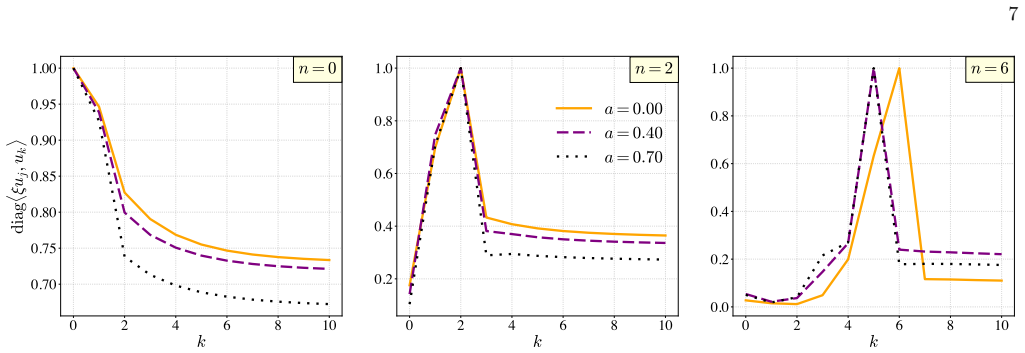
The natural polynomials for Schwarzschild and Kerr black holes are Pollaczek-Jacobi polynomials with complex valued parameters. These polynomials have a three-term recurrence relation, ladder operators, and a governing differential equation. In the Schwarzschild case the recurrence always peaks at the physical overtone index.
What carries the argument
The natural polynomials defined by quasi-normal mode boundary conditions and exact tridiagonalization of Teukolsky's radial equation, which the paper shows coincide with Pollaczek-Jacobi polynomials at complex parameters
If this is right
- The polynomials enable better study of vector space properties of quasi-normal mode solutions.
- Analytic properties like recurrence relations and ladder operators become accessible for these modes.
- The framework supports extension to other black hole spacetimes.
- For Schwarzschild, the recurrence peaks at the physical overtone, revealing a structural feature.
Where Pith is reading between the lines
- Techniques from orthogonal polynomials could be applied to derive new relations among quasinormal mode frequencies.
- This may improve numerical algorithms for solving black hole perturbation problems.
- The complex parameters open the door to studying similar polynomials in other wave equations with complex boundaries.
Load-bearing premise
The polynomials must be exactly those restricted by the quasi-normal mode boundary conditions and that exactly tridiagonalize Teukolsky's radial equation.
What would settle it
Computing the recurrence coefficients for the natural polynomials and finding they do not match the known formula for Pollaczek-Jacobi polynomials with the appropriate complex parameters would disprove the identification.
Figures




read the original abstract
The quasi-normal modes of black holes play various important roles in gravitational wave theory, signal modeling, and data analysis; however, there remain open questions about their mathematical properties. Aspects of classical polynomial theory have been proposed as a framework to investigate quasinormal mode orthogonality and completeness. We have recently presented a class of polynomials that are "natural" to quasi-normal modes in that they are restricted by the quasi-normal mode boundary conditions, and exactly tridiagonalize Teukolsky's radial equation. In turn, these polynomials may be useful for better understanding the vector space properties of quasi-normal mode solutions to that equation. Here, we provide an overview of these polynomials' analytic properties: their 3-term recurrence relation, ladder operators and governing differential equation. We demonstrate that the natural polynomials for Schwarzschild and Kerr black holes are Pollaczek-Jacobi polynomials with complex valued parameters. Along the way, we observe a novel property that is particular to Schwarzschild: the polynomials' 3-term recurrence relation always peaks at the physical overtone index. This work supports the broader application of these polynomials, as well as their extension to black hole spacetimes beyond Schwarzschild and Kerr.
Editorial analysis
A structured set of objections, weighed in public.
Referee Report
Summary. The manuscript introduces 'natural polynomials' for Schwarzschild and Kerr black holes, defined by the requirements that they satisfy quasi-normal mode boundary conditions and exactly tridiagonalize Teukolsky's radial equation. It derives their three-term recurrence relation, ladder operators, and governing differential equation, then demonstrates that these polynomials are identical to Pollaczek-Jacobi polynomials with specific complex-valued parameters. For the Schwarzschild case, it additionally reports that the recurrence coefficients peak at the physical overtone index.
Significance. If the central identification is correct, the work supplies an explicit bridge between black-hole perturbation theory and classical orthogonal-polynomial theory. This link could furnish new tools for establishing orthogonality and completeness relations among quasi-normal-mode solutions, with potential downstream utility in gravitational-wave modeling and data analysis. The provision of closed-form recurrence, ladder, and differential-equation structures, together with the Schwarzschild-specific peak observation, strengthens the case for treating these polynomials as a practical basis for the Teukolsky radial operator.
minor comments (2)
- The explicit values of the complex parameters that map the natural polynomials onto the Pollaczek-Jacobi family are stated in the text but would be more accessible if collected in a short table (e.g., for the first few overtones of Schwarzschild and for representative Kerr spins).
- A brief side-by-side numerical check of the first few recurrence coefficients obtained from the Teukolsky tridiagonalization versus those predicted by the Pollaczek-Jacobi formula would strengthen the identification claim.
Simulated Author's Rebuttal
We thank the referee for their positive assessment of our work and for recommending minor revision. No specific major comments were raised in the report, so we have no point-by-point responses to provide. We will incorporate any minor editorial changes requested by the editor in the revised version.
Circularity Check
No significant circularity; derivation is self-contained
full rationale
The paper starts from the Teukolsky radial equation subject to QNM boundary conditions and the requirement of exact tridiagonalization. From these defining properties it derives the three-term recurrence coefficients, ladder operators, and governing differential equation. The identification of these polynomials as Pollaczek-Jacobi polynomials with complex parameters is performed by direct algebraic comparison of the derived recurrence coefficients against the known closed-form coefficients of the Pollaczek-Jacobi family. This is a classification step, not a redefinition or a statistical fit. The citation to the authors' prior work is used only to recall the definition of the natural polynomials; the analytic properties and the Pollaczek-Jacobi match are obtained independently in the present manuscript. No step reduces the claimed result to its own inputs by construction.
Axiom & Free-Parameter Ledger
axioms (2)
- domain assumption Quasi-normal modes satisfy specific boundary conditions at the horizon and infinity.
- domain assumption Teukolsky's radial equation describes the perturbations of black holes.
Lean theorems connected to this paper
-
IndisputableMonolith/Cost/FunctionalEquation.leanwashburn_uniqueness_aczel unclear?
unclearRelation between the paper passage and the cited Recognition theorem.
We demonstrate that the natural polynomials for Schwarzschild and Kerr black holes are Pollaczek-Jacobi polynomials with complex valued parameters... exactly tridiagonalize Teukolsky's radial equation
-
IndisputableMonolith/Foundation/DimensionForcing.leanreality_from_one_distinction unclear?
unclearRelation between the paper passage and the cited Recognition theorem.
the polynomials' 3-term recurrence relation always peaks at the physical overtone index
What do these tags mean?
- matches
- The paper's claim is directly supported by a theorem in the formal canon.
- supports
- The theorem supports part of the paper's argument, but the paper may add assumptions or extra steps.
- extends
- The paper goes beyond the formal theorem; the theorem is a base layer rather than the whole result.
- uses
- The paper appears to rely on the theorem as machinery.
- contradicts
- The paper's claim conflicts with a theorem or certificate in the canon.
- unclear
- Pith found a possible connection, but the passage is too broad, indirect, or ambiguous to say the theorem truly supports the claim.
Reference graph
Works this paper leans on
-
[1]
R. P. Kerr, Phys. Rev. Lett.11, 237 (1963)
work page 1963
-
[2]
B. P. Abbottet al.(Virgo, LIGO Scientific), Phys. Rev. Lett.116, 221101 (2016), arXiv:1602.03841 [gr-qc]
work page internal anchor Pith review Pith/arXiv arXiv 2016
-
[3]
B. P. Abbottet al.(LIGO Scientific, Virgo), Phys. Rev. D100, 104036 (2019), arXiv:1903.04467 [gr-qc]
work page internal anchor Pith review arXiv 2019
-
[4]
R. Abbottet al.(LIGO Scientific, Virgo), Phys. Rev. D 103, 122002 (2021), arXiv:2010.14529 [gr-qc]
work page internal anchor Pith review arXiv 2021
-
[5]
Tests of General Relativity with GWTC-3
R. Abbottet al.(LIGO Scientific, VIRGO, KAGRA), (2021), arXiv:2112.06861 [gr-qc]
work page internal anchor Pith review Pith/arXiv arXiv 2021
-
[6]
Modeling Ringdown: Beyond the Fundamental Quasi-Normal Modes
L. London, D. Shoemaker, and J. Healy, Phys. Rev. D90, 124032 (2014), arXiv:1404.3197 [gr-qc]
work page internal anchor Pith review Pith/arXiv arXiv 2014
- [7]
-
[8]
A. G. Abacet al.(LIGO Scientific, VIRGO, KAGRA), (2025), arXiv:2508.18082 [gr-qc]
work page internal anchor Pith review Pith/arXiv arXiv 2025
-
[9]
Guptaet al., (2024), 10.21468/SciPostPhysComm- Rep.5, arXiv:2405.02197 [gr-qc]
A. Guptaet al., (2024), 10.21468/SciPostPhysComm- Rep.5, arXiv:2405.02197 [gr-qc]
-
[10]
Empirical tests of the black hole no-hair conjecture using gravitational-wave observations
G. Carulloet al., Phys. Rev. D98, 104020 (2018), arXiv:1805.04760 [gr-qc]
work page internal anchor Pith review Pith/arXiv arXiv 2018
-
[11]
Observational Black Hole Spectroscopy: A time-domain multimode analysis of GW150914
G. Carullo, W. Del Pozzo, and J. Veitch, Phys. Rev. D 99, 123029 (2019), [Erratum: Phys.Rev.D 100, 089903 (2019)], arXiv:1902.07527 [gr-qc]
work page internal anchor Pith review Pith/arXiv arXiv 2019
-
[12]
R. Cotesta, G. Carullo, E. Berti, and V. Cardoso, Phys. Rev. Lett.129, 111102 (2022), arXiv:2201.00822 [gr-qc]
-
[13]
M. Giesler, M. Isi, M. A. Scheel, and S. Teukolsky, Phys. Rev. X9, 041060 (2019), arXiv:1903.08284 [gr-qc]
- [14]
-
[15]
First higher-multipole model of gravitational waves from spinning and coalescing black-hole binaries
L. London, S. Khan, E. Fauchon-Jones, C. Garc ´(i)a, M. Hannam, S. Husa, X. Jim´ enez-Forteza, C. Kalaghatgi, F. Ohme, and F. Pannarale, Phys. Rev. Lett.120, 161102 (2018), arXiv:1708.00404 [gr-qc]
work page internal anchor Pith review Pith/arXiv arXiv 2018
-
[16]
Maga˜ na Zertucheet al., (2021), arXiv:2110.15922 [gr- qc]
L. Maga˜ na Zertucheet al., (2021), arXiv:2110.15922 [gr- qc]
- [17]
-
[18]
M. Giesleret al., Phys. Rev. D111, 084041 (2025), arXiv:2411.11269 [gr-qc]
-
[19]
On gravitational-wave spectroscopy of massive black holes with the space interferometer LISA
E. Berti, V. Cardoso, and C. M. Will, Phys. Rev.D73, 064030 (2006), arXiv:gr-qc/0512160 [gr-qc]
work page internal anchor Pith review Pith/arXiv arXiv 2006
-
[20]
Spectroscopy of Kerr black holes with Earth- and space-based interferometers
E. Berti, A. Sesana, E. Barausse, V. Cardoso, and K. Belczynski, Phys. Rev. Lett.117, 101102 (2016), arXiv:1605.09286 [gr-qc]
work page internal anchor Pith review Pith/arXiv arXiv 2016
-
[21]
Black hole spectroscopy: from theory to experiment
J. Abediet al., (2025), arXiv:2505.23895 [gr-qc]. 12
work page internal anchor Pith review Pith/arXiv arXiv 2025
-
[22]
S. Khan, S. Husa, M. Hannam, F. Ohme, M. P¨ urrer, X. Jim´ enez Forteza, and A. Boh´ e, Phys. Rev.D93, 044007 (2016), arXiv:1508.07253 [gr-qc]
work page internal anchor Pith review Pith/arXiv arXiv 2016
-
[23]
S. Husa, S. Khan, M. Hannam, M. P¨ urrer, F. Ohme, X. Jim´ enez Forteza, and A. Boh´ e, Phys. Rev.D93, 044006 (2016), arXiv:1508.07250 [gr-qc]
work page internal anchor Pith review Pith/arXiv arXiv 2016
-
[24]
H. Estell´ es, A. Ramos-Buades, S. Husa, C. Garc ´(i)a- Quir´ os, M. Colleoni, L. Haegel, and R. Jaume, (2020), arXiv:2004.08302 [gr-qc]
- [25]
-
[26]
Bilinear products and the orthogonality of quasinormal modes on hyperboloidal foliations
M. Minucci, R. Panosso Macedo, C. Pantelidou, and L. Sberna, (2026), arXiv:2604.13182 [gr-qc]
work page internal anchor Pith review Pith/arXiv arXiv 2026
-
[27]
Science with the space-based interferometer eLISA. I: Supermassive black hole binaries
A. Kleinet al., Phys. Rev. D93, 024003 (2016), arXiv:1511.05581 [gr-qc]
work page internal anchor Pith review Pith/arXiv arXiv 2016
-
[28]
The construction and use of LISA sensitivity curves
T. Robson, N. J. Cornish, and C. Liu, Class. Quant. Grav.36, 105011 (2019), arXiv:1803.01944 [astro- ph.HE]
work page internal anchor Pith review Pith/arXiv arXiv 2019
- [29]
-
[30]
Scientific Objectives of Einstein Telescope
B. Sathyaprakashet al.,Gravitational waves. Numeri- cal relativity - data analysis. Proceedings, 9th Edoardo Amaldi Conference, Amaldi 9, and meeting, NRDA 2011, Cardiff, UK, July 10-15, 2011, Class. Quant. Grav.29, 124013 (2012), [Erratum: Class. Quant. Grav.30,079501(2013)], arXiv:1206.0331 [gr-qc]
work page internal anchor Pith review Pith/arXiv arXiv 2011
- [31]
- [32]
- [33]
-
[34]
Y. Chen, G. Filipuk, and L. Zhan, Journal of Mathe- matical Physics60(2019), 10.1063/1.5102102
- [35]
- [36]
-
[37]
T. Chihara,An Introduction to Orthogonal Polynomials, Dover Books on Mathematics (Dover Publications, 2011)
work page 2011
-
[38]
G. B. Arfken, H. J. Weber, and F. E. Harris, inMathe- matical Methods for Physicists (Seventh Edition), edited by G. B. Arfken, H. J. Weber, and F. E. Harris (Aca- demic Press, Boston, 2013) seventh edition ed., pp. 401– 445
work page 2013
-
[39]
Van Assche,Orthogonal Polynomials and Painlev´ e Equations(Cambridge University Press, 2017)
W. Van Assche,Orthogonal Polynomials and Painlev´ e Equations(Cambridge University Press, 2017)
work page 2017
-
[40]
NIST Digital Library of Mathematical Func- tions,
DLMF, “NIST Digital Library of Mathematical Func- tions,”https://dlmf.nist.gov/, Release 1.1.10 of 2023- 06-15, f. W. J. Olver, A. B. Olde Daalhuis, D. W. Lozier, B. I. Schneider, R. F. Boisvert, C. W. Clark, B. R. Miller, B. V. Saunders, H. S. Cohl, and M. A. McClain, eds
work page 2023
-
[41]
C. W. Misner, K. S. Thorne, and J. A. Wheeler,San Francisco: W.H. Freeman and Co., 1973, edited by Mis- ner, C. W., Thorne, K. S., & Wheeler, J. A. (1973)
work page 1973
- [42]
-
[43]
M. Ruiz, R. Takahashi, M. Alcubierre, and D. Nunez, Gen. Rel. Grav.40, 2467 (2008), arXiv:0707.4654 [gr-qc]
work page internal anchor Pith review Pith/arXiv arXiv 2008
-
[44]
S. A. Teukolsky, Astrophys. J.185, 635 (1973)
work page 1973
-
[45]
S. A. Hughes, Phys. Rev. D62, 044029 (2000), [Erratum: Phys.Rev.D 67, 089902 (2003)], arXiv:gr-qc/0002043
work page internal anchor Pith review Pith/arXiv arXiv 2000
-
[46]
Y. Mino, M. Sasaki, M. Shibata, H. Tagoshi, and T. Tanaka, Progress of Theoretical Physics Supplement 128, 1 (1997), http://oup.prod.sis.lan/ptps/article- pdf/doi/10.1143/PTPS.128.1/5438984/128-1.pdf
-
[47]
W. H. Press, Astrophys. J. Lett.170, L105 (1971)
work page 1971
-
[48]
E. D. Fackerell and R. G. Crossman, Jour- nal of Mathematical Physics18, 1849 (2008), https://pubs.aip.org/aip/jmp/article- pdf/18/9/1849/11184786/1849 1 online.pdf
work page 2008
- [49]
- [50]
-
[51]
M. Minucci and R. Panosso Macedo, Gen. Rel. Grav.57, 33 (2025), arXiv:2411.19740 [gr-qc]
-
[52]
Harvey, The Mathematical Gazette39, 719–722 (1955)
R. Harvey, The Mathematical Gazette39, 719–722 (1955)
work page 1955
- [53]
-
[54]
L. London, E. Fauchon, and E. Hamilton, “llon- don6/positive: map,” (2020)
work page 2020
-
[55]
M. Abramowitz and I. A. Stegun,Handbook of Mathe- matical Functions with Formulas, Graphs, and Mathe- matical Tables, ninth dover printing, tenth gpo printing ed. (Dover, New York, 1964)
work page 1964
- [56]
discussion (0)
Sign in with ORCID, Apple, or X to comment. Anyone can read and Pith papers without signing in.