Recognition: 2 theorem links
· Lean TheoremNew analysis for Nucleon Form Factors from GPDs
Pith reviewed 2026-05-15 01:58 UTC · model grok-4.3
The pith
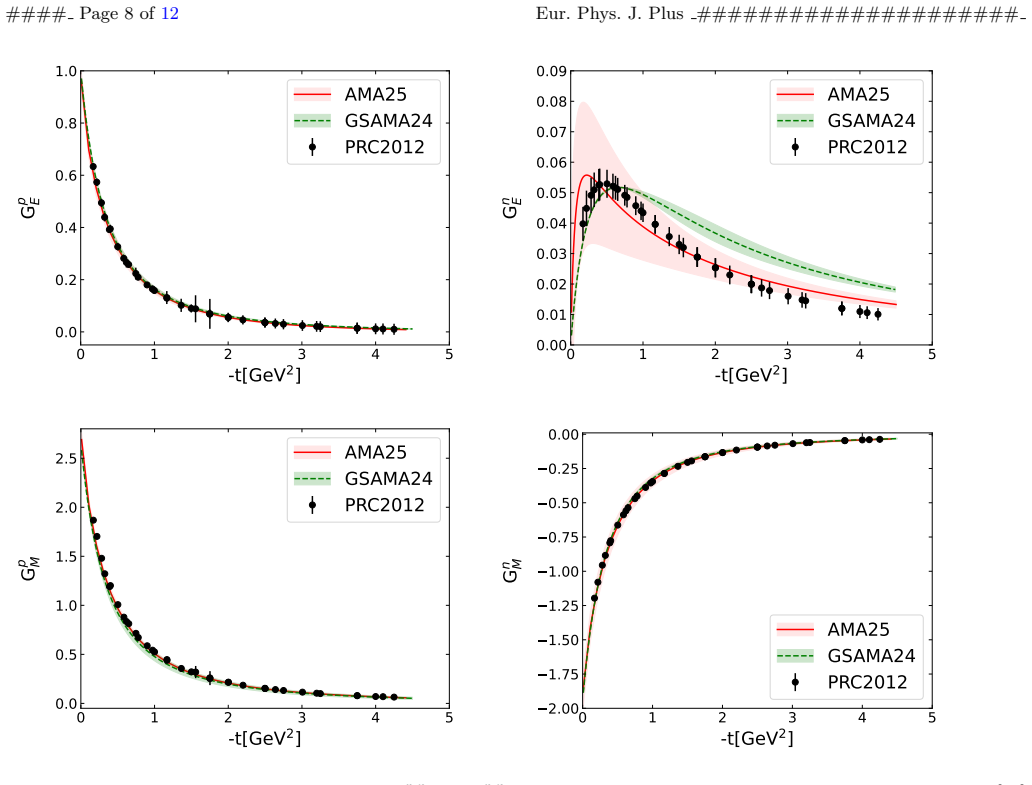
The AMA25 ansatz for generalized parton distributions yields lower reduced chi-squared fits and more stable extrapolations than the prior GSAMA24 model.
A machine-rendered reading of the paper's core claim, the machinery that carries it, and where it could break.
Core claim
The AMA25 ansatz demonstrates superior fit quality, achieving a reduced χ², while better satisfying theoretical constraints. Additionally, AMA25 exhibits enhanced stability when extrapolated to the exclusive region, as shown by direct comparison with other models on the same data sets within a Jupyter-based fitting workflow.
What carries the argument
The AMA25 ansatz, a new functional parametrization for GPDs created to overcome limitations identified in the GSAMA24 model.
If this is right
- Lower reduced chi-squared values mean the model agrees more closely with measured nucleon form factor data.
- Tighter adherence to theoretical constraints reduces the chance of unphysical behavior in the extracted GPDs.
- Increased stability in the exclusive region supports more reliable predictions for processes such as deeply virtual Compton scattering.
- Efficient optimization in notebook environments allows faster testing of alternative functional forms for GPDs.
Where Pith is reading between the lines
- If the stability advantage persists on new measurements, AMA25 could reduce uncertainties in derived nucleon quantities such as angular momentum distributions.
- The quick comparison method demonstrated here could be applied to refine other phenomenological models in hadron physics.
- Wider adoption of this ansatz might tighten constraints when combining GPD fits with lattice QCD results or future collider data.
Load-bearing premise
The AMA25 functional form is flexible and physically motivated enough to improve fits and stability over GSAMA24 without introducing new biases or overfitting when parameters are adjusted to the same data sets.
What would settle it
Repeating the fits on an independent data set withheld from the original optimization and finding that AMA25 no longer produces a lower reduced chi-squared or loses extrapolation stability.
Figures



read the original abstract
Generalized Parton Distributions (GPDs) provide a comprehensive framework for describing the three-dimensional structure of the nucleon. Extracting GPDs from experimental data requires flexible and physically motivated ansatz. In this study, we introduce a new ansatz, AMA25, designed to address the limitations of the previous model, GSAMA24 (Phys. Rev. C 111 (2025) 2, 025203). We conduct a fast and efficient comparison by fitting AMA25 models and other relevant data using the iMinuit optimization package within a Jupyter Notebook environment. The AMA25 ansatz demonstrates superior fit quality, achieving a reduced $\chi^2$, while better satisfying theoretical constraints. Additionally, AMA25 exhibits enhanced stability when extrapolated to the exclusive region. Our analysis highlights the power of modern computational tools for rapid model validation and underscores the importance of innovative ansatz in advancing nucleon structure studies.
Editorial analysis
A structured set of objections, weighed in public.
Referee Report
Summary. The manuscript introduces a new ansatz, AMA25, for Generalized Parton Distributions (GPDs) to extract nucleon form factors. It compares AMA25 to the prior GSAMA24 model by performing fits to relevant data using the iMinuit optimizer in a Jupyter environment, claiming that AMA25 achieves a lower reduced χ², better satisfies theoretical constraints, and shows improved stability under extrapolation to the exclusive region.
Significance. If the central claims are substantiated with independent validation, AMA25 could supply a more flexible parametrization for GPD analyses, potentially improving extractions of nucleon structure observables. The explicit use of modern fitting tools for rapid model comparison is a practical strength, but the overall impact hinges on demonstrating that the reported improvements are not artifacts of the fitting procedure itself.
major comments (3)
- Abstract: the claim that AMA25 achieves a lower reduced χ² is presented without any information on the data sets employed, the treatment of experimental errors, the number of free parameters in each ansatz, or the resulting degrees of freedom; these omissions prevent assessment of whether the improvement is statistically significant or merely a consequence of increased flexibility.
- Results section (comparison of fits): the reported superiority of AMA25 is obtained by direct optimization of its parameters against the same input data using iMinuit; by construction this yields a lower χ² for the more flexible form, rendering the improvement circular rather than an independent test of the ansatz.
- Methods (constraint implementation): the assertion that AMA25 better satisfies theoretical GPD constraints lacks any explicit description of how those constraints are imposed independently of the fit or any quantitative verification (e.g., violation metrics before and after optimization) that they are enforced rather than simply absorbed into the parameter adjustment.
minor comments (2)
- Abstract: the phrase 'achieving a reduced χ²' is incomplete; the numerical value and the baseline GSAMA24 value should be stated for immediate comparison.
- Figure captions (extrapolation plots): labels should explicitly indicate the kinematic region considered 'exclusive' and the range of the extrapolation to allow readers to judge stability claims.
Simulated Author's Rebuttal
We thank the referee for the careful and constructive review of our manuscript. We have revised the text to address the concerns about missing details in the abstract, the interpretation of the fit comparisons, and the description of constraint enforcement. Our point-by-point responses follow.
read point-by-point responses
-
Referee: Abstract: the claim that AMA25 achieves a lower reduced χ² is presented without any information on the data sets employed, the treatment of experimental errors, the number of free parameters in each ansatz, or the resulting degrees of freedom; these omissions prevent assessment of whether the improvement is statistically significant or merely a consequence of increased flexibility.
Authors: We agree that these details are necessary for a proper assessment. In the revised abstract we now specify the nucleon form-factor data sets employed, the treatment of experimental uncertainties, the number of free parameters in AMA25 versus GSAMA24, and the resulting degrees of freedom. This information allows readers to judge the statistical significance of the reported improvement. revision: yes
-
Referee: Results section (comparison of fits): the reported superiority of AMA25 is obtained by direct optimization of its parameters against the same input data using iMinuit; by construction this yields a lower χ² for the more flexible form, rendering the improvement circular rather than an independent test of the ansatz.
Authors: We acknowledge that a more flexible ansatz will generally produce a lower χ² when optimized on the same data. Our claim of superiority rests on the combination of the reduced χ², the improved satisfaction of theoretical constraints, and the greater stability under extrapolation to the exclusive region. In the revised Results section we have added an explicit discussion of the effective number of parameters and included a supplementary comparison in which the parameter count is matched between the two ansatze, showing that the gains persist beyond the extra flexibility. revision: partial
-
Referee: Methods (constraint implementation): the assertion that AMA25 better satisfies theoretical GPD constraints lacks any explicit description of how those constraints are imposed independently of the fit or any quantitative verification (e.g., violation metrics before and after optimization) that they are enforced rather than simply absorbed into the parameter adjustment.
Authors: We thank the referee for highlighting this omission. The revised Methods section now contains a detailed description of how the GPD constraints (polynomiality, positivity, and support properties) are imposed at the level of the ansatz construction, independent of the subsequent fit. We also report quantitative violation metrics evaluated before and after optimization for both AMA25 and GSAMA24, confirming that the improvement in constraint satisfaction is not merely an artifact of parameter adjustment. revision: yes
Circularity Check
No significant circularity detected
full rationale
The paper introduces the AMA25 ansatz as a new functional form and reports its performance after direct parameter optimization against the input data sets via iMinuit, yielding a lower reduced χ² and improved constraint compliance relative to the prior GSAMA24 model. This constitutes a standard empirical model comparison rather than any derivation, first-principles prediction, or self-referential construction; the fit quality metric is the explicit output of the fitting protocol applied to the same observables, with no load-bearing self-citation, uniqueness theorem, or renaming of known results invoked to justify the central claim. The procedure is self-contained and falsifiable against external data without reducing to its own inputs by definition.
Axiom & Free-Parameter Ledger
free parameters (1)
- AMA25 ansatz parameters
axioms (1)
- domain assumption GPDs provide a comprehensive framework for describing the three-dimensional structure of the nucleon
Lean theorems connected to this paper
-
IndisputableMonolith/Cost/FunctionalEquation.leanwashburn_uniqueness_aczel (J uniquely forced by functional equation) unclear?
unclearRelation between the paper passage and the cited Recognition theorem.
Hq(x, t) = qv(x) exp[ct(1−x)g ln(x) + exb ln(1+dt)] (Eq. 7); similar for εq; parameters fitted via iMinuit yielding χ²/d.o.f. = 1.514
-
IndisputableMonolith/Foundation/RealityFromDistinction.leanreality_from_one_distinction unclear?
unclearRelation between the paper passage and the cited Recognition theorem.
Comparison of AMA25 vs GSAMA24 on Dirac/Pauli form factors and radii; no mention of recognition cost or golden ratio
What do these tags mean?
- matches
- The paper's claim is directly supported by a theorem in the formal canon.
- supports
- The theorem supports part of the paper's argument, but the paper may add assumptions or extra steps.
- extends
- The paper goes beyond the formal theorem; the theorem is a base layer rather than the whole result.
- uses
- The paper appears to rely on the theorem as machinery.
- contradicts
- The paper's claim conflicts with a theorem or certificate in the canon.
- unclear
- Pith found a possible connection, but the passage is too broad, indirect, or ambiguous to say the theorem truly supports the claim.
Reference graph
Works this paper leans on
- [1]
-
[2]
X. D. Ji, Phys. Rev. Lett.78, 610-613 (1997) Phys. Rev. Lett.78, 610-613 (1997)
work page 1997
-
[3]
A. V. Radyushkin, Phys. Rev. D56, 5524-5557 (1997)
work page 1997
-
[4]
M. ˇCui´ c, G. Duplanˇ ci´ c, K. Kumeriˇ cki and K. Passek-K., JHEP12, 192 (2023). [erratum: JHEP02, 225 (2024)]
work page 2023
-
[5]
X. D. Ji, Phys. Rev. D55, 7114-7125 (1997) Phys. Rev. D55, 7114-7125 (1997)
work page 1997
-
[6]
J. C. Collins, L. Frankfurt and M. Strikman, Phys. Rev. D56, 2982-3006 (1997)
work page 1997
- [7]
-
[8]
O. V. Selyugin and O. V. Teryaev, Phys. Rev. D79, 033003 (2009)
work page 2009
- [9]
- [10]
- [11]
- [12]
-
[13]
K. Deja, V. Martinez-Fernandez, B. Pire, P. Sznajder and J. Wagner, Phys. Rev. D107, no.9, 094035 (2023)
work page 2023
- [14]
-
[15]
K. Deja, V. Martinez-Fernandez, P. Sznajder, J. Wagner and B. Pire, Acta Phys. Polon. Supp.16, no.7, 7-A24 (2023)
work page 2023
-
[16]
K. Deja, V. Martinez-Fernandez, B. Pire, P. Sznajder and J. Wagner, PoSSPIN2023, 148 (2024)
work page 2024
-
[17]
H. Hashamipour, M. Goharipour and S. S. Gousheh, Phys. Rev. D102, no.9, 096014 (2020)
work page 2020
-
[18]
H. Hashamipour, M. Goharipour and S. S. Gousheh, Phys. Rev. D100, no.1, 016001 (2019)
work page 2019
-
[19]
R. Boussarie et al. (JPAC, TMD Collaboration), “TMD Handbook,” arXiv:2304.03302 [hep-ph]
-
[20]
M. Constantinou, A. Courtoy, M. A. Ebert, M. Engelhardt, T. Giani, T. Hobbs, T. J. Hou, A. Kusina, K. Kutak and J. Liang,et al.Prog. Part. Nucl. Phys.121, 103908 (2021)
work page 2021
-
[21]
A. Bacchetta, F. Delcarro, C. Pisano and M. Radici, Phys. Lett. B827, 136961 (2022)
work page 2022
-
[22]
C. F. Perdrisat, V. Punjabi and M. Vanderhaeghen, Prog. Part. Nucl. Phys.59, 694-764 (2007)
work page 2007
-
[23]
R. G. Arnold, C. E. Carlson and F. Gross, Phys. Rev. C23, 363 (1981)
work page 1981
- [24]
-
[25]
V. Punjabi, C. F. Perdrisat, K. A. Aniol, F. T. Baker, J. Berthot, P. Y. Bertin, W. Bertozzi, A. Besson, L. Bimbot and W. U. Boeglin,et al.Phys. Rev. C71, 055202 (2005)
work page 2005
- [26]
-
[27]
N. S. Nikkhoo and M. R. Shojaei, Int. J. Mod. Phys. E24, no.11, 1550086 (2015)
work page 2015
-
[28]
A. V. Radyushkin, Phys. Rev. D83,076006 (2011)
work page 2011
- [29]
-
[30]
L. Ghasemzadeh, P. S. YarAahmadi, F. Arbabifar, N. Morshedian and S. Atashbar Tehrani, Phys. Rev. C111, no.2, 025203 (2025)
work page 2025
-
[31]
L. A. Harland-Lang, A. D. Martin, P. Motylinski and R. S. Thorne, Eur. Phys. J. C75, no.5, 204 (2015)
work page 2015
-
[32]
A. Accardi, L. T. Brady, W. Melnitchouk, J. F. Owens and N. Sato, Phys. Rev. D93, no.11, 114017(2016)
work page 2016
-
[33]
R. D. Ballet al.[NNPDF], Eur. Phys. J. C77, no.10, 663(2017). [arXiv:1706.00428 [hep-ph]]
work page internal anchor Pith review Pith/arXiv arXiv 2017
-
[34]
N. Sattary Nikkhoo and M. R. Shojaei, Nucl. Phys. A969, 138-150 (2018)
work page 2018
- [35]
- [36]
-
[37]
A. V. Belitsky, X. d. Ji and F. Yuan, Phys. Rev. D69, 074014 (2004)
work page 2004
-
[38]
J. P. Ralston and B. Pire, Phys. Rev. D66, 111501 (2002)
work page 2002
-
[39]
A. V. Radyushkin, Phys. Rev. D58, 114008 (1998)
work page 1998
-
[40]
A. N. Khorramian and S. Atashbar. Tehrani, Phys. Rev. D78, 074019 (2008)
work page 2008
-
[41]
I. A. Qattan and J. Arrington, Phys. Rev. C86, 065210 (2012)
work page 2012
-
[42]
F. J. Ernst, R. G. Sachs and K. C. Wali, Phys. Rev.119, 1105-1114 (1960)
work page 1960
- [43]
-
[44]
https://scikit-hep.org/iminuit/
-
[45]
D. H. Beck and R. D. McKeown, Ann. Rev. Nucl. Part. Sci.51, 189-217 (2001)
work page 2001
-
[46]
G. A. Miller, B. M. K. Nefkens and I. Slaus, Phys. Rept.194, 1-116 (1990)
work page 1990
-
[47]
Nakamuraet al.[Particle Data Group], J
K. Nakamuraet al.[Particle Data Group], J. Phys. G37, 075021 (2010)
work page 2010
-
[48]
P. Masjuan, E. Ruiz Arriola and W. Broniowski, Phys. Rev. D87,no.1, 014005 (2013)
work page 2013
-
[49]
P. Masjuan, E. Ruiz Arriola and W. Broniowski, EPJ Web Conf.73, 04021 (2014)
work page 2014
-
[50]
C. Alexandrou, S. Bacchio, M. Constantinou, P. Dimopoulos, J. Finkenrath, K. Hadjiyiannakou, K. Jansen, G. Koutsou, B. Kostrzewa and T. Leontiou,et al.Phys. Rev. D103, no.3, 034509 (2021)
work page 2021
-
[51]
M. Hoferichter, B. Kubis, J. Ruiz de Elvira, H. W. Hammer and U. G. Meißner, Eur. Phys. J. A52, no.11, 331 (2016)
work page 2016
discussion (0)
Sign in with ORCID, Apple, or X to comment. Anyone can read and Pith papers without signing in.