Recognition: no theorem link
TSAgent: An Agentic Workflow for Autonomous Transition State Search
Pith reviewed 2026-05-15 01:41 UTC · model grok-4.3
The pith
An agentic workflow autonomously locates transition states in catalysis at DFT accuracy with 83% success on benchmarks.
A machine-rendered reading of the paper's core claim, the machinery that carries it, and where it could break.
Core claim
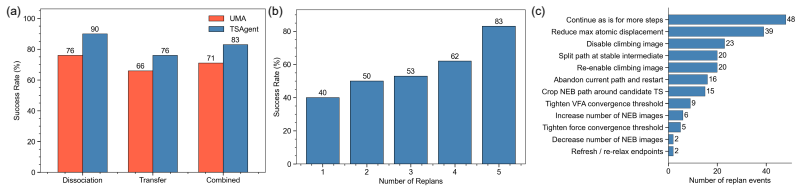
TSAgent automates transition state searches directly at the density functional theory level through a persistent plan-execute-analyze-replan loop that continuously adapts based on convergence diagnostics and geometric feedback. On a diverse 100-example subset of the OC20NEB benchmark it achieves 83% success in locating transition states. On 10 held-out examples it reaches 70% success compared with a human-expert average of 73 +/- 12%. The same workflow independently reproduces Bronsted-Evans-Polanyi scaling relationships for NH3 dissociation on metal and single-atom alloy surfaces from a prior heterogeneous catalysis study.
What carries the argument
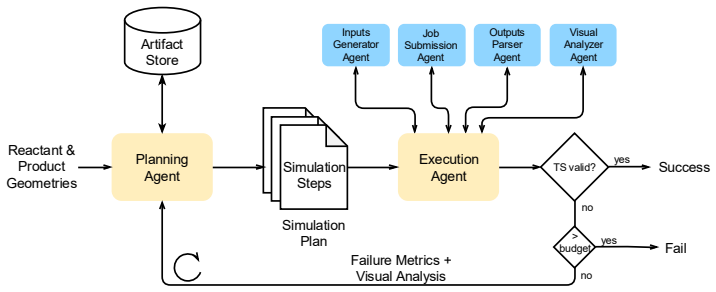
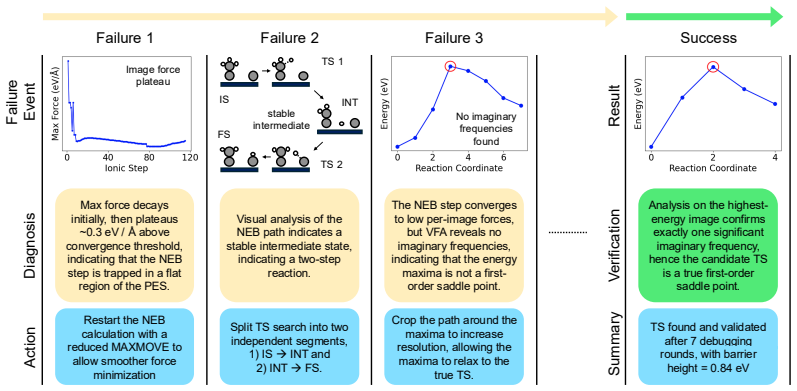
The persistent plan-execute-analyze-replan loop that jointly interprets scalar convergence diagnostics and atomic geometries to adapt the transition state search strategy.
If this is right
- Mechanistic studies of catalytic materials can proceed with substantially less human oversight for transition state identification.
- High-throughput exploration of reaction pathways at DFT accuracy becomes practical for larger numbers of systems.
- Reproducible recovery of established scaling relations demonstrates that the workflow supports genuine scientific discovery beyond benchmark tests.
- The adaptive loop reduces the impact of heterogeneous failure modes that normally interrupt manual transition state searches.
Where Pith is reading between the lines
- The same loop structure could be extended to full reaction mechanism discovery by chaining multiple transition state searches with intermediate minima optimization.
- Failures on particular catalytic systems would highlight specific diagnostic interpretations that need refinement in future agent versions.
- Integration with cheaper surrogate models could lower overall computational cost while preserving DFT-level final accuracy.
- Application to non-catalytic molecular systems would test whether the diagnostic and geometry analysis generalizes beyond heterogeneous catalysis.
Load-bearing premise
The loop can jointly interpret scalar convergence diagnostics and atomic geometries to handle all heterogeneous failure modes without human intervention across catalytic systems.
What would settle it
A set of transition state search cases on the OC20NEB benchmark where TSAgent's success rate falls significantly below the human-expert average because the loop misinterprets specific convergence or geometry signals that humans resolve.
Figures



read the original abstract
Identifying transition states (TSs) on potential energy surfaces is a central computational bottleneck in mechanistic studies of catalytic materials. A TS search is not a single calculation but a long-horizon, multi-step workflow of atomistic simulations with delayed, asynchronous feedback and heterogeneous failure modes that require a joint multimodal analysis of scalar convergence diagnostics and atomic geometries along the reaction path. To address this challenge, we propose TSAgent, an agentic workflow that automates TS search directly at the density functional theory (DFT) level of quantum chemical accuracy. TSAgent operates through a persistent plan-execute-analyze-replan loop, continuously adapting its strategy based on convergence diagnostics and geometric feedback without human intervention. We evaluate TSAgent on a diverse 100-example subset of the OC20NEB heterogeneous catalysis benchmark, where it successfully locates TSs with 83% accuracy. In a direct comparison against expert DFT practitioners on 10 held-out examples, TSAgent achieves a 70% success rate compared to a human-expert average of 73 +/- 12%. Finally, TSAgent independently reproduces Bronsted-Evans-Polanyi scaling relationships for NH3 dissociation on metal and single-atom alloy surfaces from a published heterogeneous catalysis study, demonstrating that its utility extends beyond curated benchmarks to real scientific investigations.
Editorial analysis
A structured set of objections, weighed in public.
Referee Report
Summary. The manuscript presents TSAgent, an agentic workflow for autonomous transition-state searches in heterogeneous catalysis at the DFT level. It uses a persistent plan-execute-analyze-replan loop that interprets scalar convergence diagnostics and atomic geometries to adapt strategies without human intervention. The central empirical claims are an 83% success rate locating TSs on a 100-example subset of the OC20NEB benchmark and a 70% success rate on 10 held-out examples versus a human-expert mean of 73 ± 12%; the workflow is also shown to reproduce published BEP scaling relations for NH3 dissociation on metal and single-atom alloy surfaces.
Significance. If the performance claims are substantiated, TSAgent would address a long-standing computational bottleneck by automating long-horizon, multimodal TS searches that currently require expert oversight. The reproduction of BEP relationships on real catalytic systems indicates utility beyond curated benchmarks. However, the current evidence rests on modest sample sizes and limited methodological transparency, so the work is best viewed as a promising proof-of-concept whose broader impact depends on improved statistical rigor and reproducibility.
major comments (3)
- [expert comparison paragraph] Expert-comparison paragraph: the head-to-head evaluation uses only n=10 examples against a human mean of 73 ± 12%. With this sample size and reported inter-expert variance, the observed 70% agent success rate lies well within sampling noise; no confidence interval on the agent rate, p-value, or power calculation is supplied, rendering the 'comparable to human' claim statistically unsupported.
- [Methods / workflow description] Methods / workflow description: the persistent plan-execute-analyze-replan loop is asserted to jointly interpret scalar diagnostics and atomic geometries across all heterogeneous failure modes, yet no implementation details (prompt templates, decision criteria, multimodal fusion mechanism, or safeguards against post-hoc strategy adjustments) are provided. This absence prevents independent verification of the 83% OC20NEB success rate.
- [Results on OC20NEB subset] Results on OC20NEB subset: the 83% accuracy is reported without a breakdown by reaction class, failure-mode distribution, or error analysis of the cases in which the loop did not converge. Without this stratification it is impossible to assess whether the workflow truly handles the full range of catalytic systems claimed.
minor comments (2)
- [Abstract] The abstract states that TSAgent operates 'directly at the DFT level' but does not specify the functional, basis set, or convergence thresholds used; these parameters should be stated explicitly for reproducibility.
- [Figure 1 or workflow section] A schematic diagram of the plan-execute-analyze-replan loop and its interfaces to the DFT engine would substantially improve clarity of the agent architecture.
Simulated Author's Rebuttal
We thank the referee for the constructive comments. We address each point below and have revised the manuscript accordingly to improve statistical transparency, methodological detail, and result stratification.
read point-by-point responses
-
Referee: Expert-comparison paragraph: the head-to-head evaluation uses only n=10 examples against a human mean of 73 ± 12%. With this sample size and reported inter-expert variance, the observed 70% agent success rate lies well within sampling noise; no confidence interval on the agent rate, p-value, or power calculation is supplied, rendering the 'comparable to human' claim statistically unsupported.
Authors: We agree the n=10 sample is modest and the claim requires qualification. In revision we added a bootstrap 95% CI for the agent success rate (70%, 95% CI 40–90%) and a power analysis in the SI showing that reliable detection of small differences would need substantially larger cohorts. We revised the main text to state that performance is 'comparable within sampling variability of the limited test set' rather than implying equivalence. revision: partial
-
Referee: Methods / workflow description: the persistent plan-execute-analyze-replan loop is asserted to jointly interpret scalar diagnostics and atomic geometries across all heterogeneous failure modes, yet no implementation details (prompt templates, decision criteria, multimodal fusion mechanism, or safeguards against post-hoc strategy adjustments) are provided. This absence prevents independent verification of the 83% OC20NEB success rate.
Authors: We have expanded the Methods section with the complete prompt templates for planning, execution, and analysis agents, explicit decision criteria (force thresholds, imaginary-frequency checks, geometry RMSD cutoffs), the text-based multimodal fusion procedure, and logging safeguards that record every replanning decision. These additions are now in the main text and SI to support independent reproduction. revision: yes
-
Referee: Results on OC20NEB subset: the 83% accuracy is reported without a breakdown by reaction class, failure-mode distribution, or error analysis of the cases in which the loop did not converge. Without this stratification it is impossible to assess whether the workflow truly handles the full range of catalytic systems claimed.
Authors: We added a new results subsection with a table stratifying success rates by reaction class (dissociation, diffusion, coupling, etc.) and failure mode (convergence failure, spurious saddle, etc.). We also include a concise error analysis of the 17 unsuccessful cases, noting recurring issues and how the agent responded. The stratification shows broadly consistent performance across classes. revision: yes
Circularity Check
No significant circularity; empirical results rest on external benchmarks
full rationale
The paper describes an agentic workflow evaluated via direct success-rate measurements on the independent OC20NEB benchmark (100 examples) and reproduction of published BEP scaling relations from an external heterogeneous-catalysis study. No derivation chain, equations, or fitted parameters are presented as predictions; the central claims are statistical performance figures against held-out data and prior literature. The small human-expert comparison (n=10) is an empirical head-to-head rather than a self-referential reduction. No self-citation load-bearing steps, self-definitional constructs, or ansatz smuggling appear in the reported workflow or results.
Axiom & Free-Parameter Ledger
axioms (1)
- domain assumption The plan-execute-analyze-replan loop can adapt to all failure modes in TS searches using convergence diagnostics and geometric feedback
Reference graph
Works this paper leans on
-
[1]
G.N. Simm, A.C. Vaucher, and M. Reiher. Autonomous reaction network exploration in homogeneous and heterogeneous catalysis.Topics in Catalysis, 65:174–183, 2022. doi: 10.1007/s11244-021-01543-9
-
[2]
S.R. Broderick, H.S. Mao, G. Kresse, et al. Deep reaction network exploration at a heterogeneous catalytic interface.Nature Communications, 13:4538, 2022. doi: 10.1038/s41467-022-32514-7
-
[3]
H. Bernhard Schlegel. Geometry optimization.WIREs Computational Molec- ular Science, 1(5):790–809, 2011. ISSN 1759-0884. doi: 10.1002/wcms
-
[4]
_eprint: https://wires.onlinelibrary.wiley.com/doi/pdf/10.1002/wcms.34
URL https://onlinelibrary.wiley.com/doi/abs/10.1002/wcms.34. _eprint: https://wires.onlinelibrary.wiley.com/doi/pdf/10.1002/wcms.34
-
[5]
R. O. Jones. Density functional theory: Its origins, rise to prominence, and future.Rev. Mod. Phys., 87:897–923, Aug 2015. doi: 10.1103/RevModPhys.87.897. URL https://link.aps. org/doi/10.1103/RevModPhys.87.897
-
[6]
Walter Kohn and Lu Jeu Sham. Self-consistent equations including exchange and correlation effects.Physical Review, 140(4A):A1133–A1138, 1965. doi: 10.1103/PhysRev.140.A1133
-
[7]
Brook Wander, Muhammed Shuaibi, John R. Kitchin, Zachary W. Ulissi, and C. Lawrence Zitnick. Cattsunami: Accelerating transition state energy calculations with pre-trained graph neural networks, 2024. URLhttps://arxiv.org/abs/2405.02078
- [8]
-
[9]
Jakob, Karsten Reuter, and Johannes T
David Greten, Konstantin S. Jakob, Karsten Reuter, and Johannes T. Margraf. Benchmarking local geometry optimization algorithms for computational materials discovery, February 2026. URLhttps://doi.org/10.26434/chemrxiv.15000050/v1. Preprint
-
[10]
Santiago Morandi, Oliver Loveday, Tim Renningholtz, Sergio Pablo-García, Rodrigo A. Vargas- Hernández, Ranga Rohit Seemakurthi, Pol Sanz Berman, Rodrigo García-Muelas, Alán Aspuru- Guzik, and Núria López. An end-to-end framework for reactivity in heterogeneous catalysis. Nature Chemical Engineering, 3:169–180, March 2026. doi: 10.1038/s44286-026-00361-8. ...
-
[11]
Sequential co-reduction of nitrate and carbon dioxide enables selective urea electrosynthesis
Yang Li, Shisheng Zheng, Hao Liu, Qi Xiong, Haocong Yi, Haibin Yang, Zongwei Mei, Qinghe Zhao, Zu-Wei Yin, Ming Huang, Yuan Lin, Weihong Lai, Shi-Xue Dou, Feng Pan, and Shunning Li. Sequential co-reduction of nitrate and carbon dioxide enables selective urea electrosynthesis. Nature Communications, 15(176), January 2024. doi: 10.1038/s41467-023-44131-z. U...
-
[12]
Bo Li, Nian Li, Huabin Zhang, Wen-Jing Xiao, and Magnus Rueping. Photochemical, electro- chemical and electrophotochemical C-N bond-forming cross-coupling reactions.Nature Reviews Chemistry, pages 1–18, April 2026. ISSN 2397-3358. doi: 10.1038/s41570-026-00819-6. URL https://www.nature.com/articles/s41570-026-00819-6
-
[13]
Hyunwook Jung, Emanuel Colombi Manzi, Tiago J. Goncalves, Vanessa J. Bukas, Sandip De, Johannes T. Margraf, Karsten Reuter, and Hendrik H. Heenen. From Global Optimization to Transition State Search: An Automated Workflow for Surface Reaction Barriers.ChemRxiv, 2026(0417), 2026. doi: 10.26434/chemrxiv.15002133/v1. URL https://chemrxiv.org/ doi/full/10.264...
-
[14]
Matthew T. Darby, Romain Réocreux, E. Charles. H. Sykes, Angelos Michaelides, and Michail Stamatakis. Elucidating the stability and reactivity of surface intermediates on single-atom alloy catalysts.ACS Catalysis, 8(6):5038–5050, 2018. doi: 10.1021/acscatal.8b00881
-
[15]
arXiv preprint arXiv:2507.14267 , year=
Ziqi Wang, Hongshuo Huang, Hancheng Zhao, Changwen Xu, Shang Zhu, Jan Janssen, and Venkatasubramanian Viswanathan. DREAMS: Density Functional Theory Based Research Engine for Agentic Materials Simulation, July 2025. URL http://arxiv.org/abs/2507. 14267. arXiv:2507.14267 [cs]. 11
-
[16]
Yunheng Zou, Austin H. Cheng, Abdulrahman Aldossary, Jiaru Bai, Shi Xuan Leong, Jorge Arturo Campos-Gonzalez-Angulo, Changhyeok Choi, Cher Tian Ser, Gary Tom, An- drew Wang, Zijian Zhang, Ilya Yakavets, Han Hao, Chris Crebolder, Varinia Bernales, and Alán Aspuru-Guzik. El Agente: An Autonomous Agent for Quantum Chemistry.Mat- ter, 8(7):102263, July 2025. ...
-
[17]
V ASPilot: MCP-Facilitated Multi-Agent Intelligence for Autonomous V ASP Simulations, August 2025
Jiaxuan Liu, Tiannian Zhu, Caiyuan Ye, Zhong Fang, Hongming Weng, and Quansheng Wu. V ASPilot: MCP-Facilitated Multi-Agent Intelligence for Autonomous V ASP Simulations, August 2025. URLhttp://arxiv.org/abs/2508.07035. arXiv:2508.07035 [cond-mat]
-
[18]
Hu, Changshui Zhang, Xingao Gong, Wanli Ouyang, Lei Bai, Dongzhan Zhou, and Mao Su
Zeyu Xia, Jinzhe Ma, Congjie Zheng, Shufei Zhang, Yuqiang Li, Hang Su, P. Hu, Changshui Zhang, Xingao Gong, Wanli Ouyang, Lei Bai, Dongzhan Zhou, and Mao Su. An Agentic Framework for Autonomous Materials Computation, December 2025. URL http://arxiv. org/abs/2512.19458. arXiv:2512.19458 [cs]
-
[19]
Yi-Lun Liao, Brandon Wood, Abhishek Das, and Tess Smidt. EquiformerV2: Improved Equivariant Transformer for Scaling to Higher-Degree Representations, March 2024. URL http://arxiv.org/abs/2306.12059. arXiv:2306.12059 [cs]
-
[20]
Lawrence Zitnick, and Abhishek Das
Johannes Gasteiger, Muhammed Shuaibi, Anuroop Sriram, Stephan Günnemann, Zachary Ulissi, C. Lawrence Zitnick, and Abhishek Das. GemNet-OC: Developing Graph Neural Networks for Large and Diverse Molecular Simulation Datasets, September 2022. URL http://arxiv.org/abs/2204.02782. arXiv:2204.02782 [cs]
-
[21]
Kristof T. Schütt, Oliver T. Unke, and Michael Gastegger. Equivariant message passing for the prediction of tensorial properties and molecular spectra, June 2021. URL http://arxiv. org/abs/2102.03150. arXiv:2102.03150 [cs]
-
[22]
Margraf, and Stephan Günnemann
Johannes Gasteiger, Shankari Giri, Johannes T. Margraf, and Stephan Günnemann. Fast and Uncertainty-Aware Directional Message Passing for Non-Equilibrium Molecules, April 2022. URLhttp://arxiv.org/abs/2011.14115. arXiv:2011.14115 [cs]
-
[23]
Lawrence Zit- nick, and Zachary Ulissi
Lowik Chanussot, Abhishek Das, Siddharth Goyal, Thibaut Lavril, Muhammed Shuaibi, Morgane Riviere, Kevin Tran, Javier Heras-Domingo, Caleb Ho, Weihua Hu, Aini Pal- izhati, Anuroop Sriram, Brandon Wood, Junwoong Yoon, Devi Parikh, C. Lawrence Zit- nick, and Zachary Ulissi. The Open Catalyst 2020 (OC20) Dataset and Community Chal- lenges.ACS Catalysis, 11(1...
-
[24]
Evolving transition-state search with agentic large language models.ChemRxiv, 2026(0127), 2026
Jan A Meissner, Philipp Kuboth, and Jan Meisner. Evolving transition-state search with agentic large language models.ChemRxiv, 2026(0127), 2026. doi: 10.26434/chemrxiv.10001607/v1. URLhttps://chemrxiv.org/doi/full/10.26434/chemrxiv.10001607/v1
-
[25]
Graeme Henkelman, Blas P. Uberuaga, and Hannes Jónsson. A climbing image nudged elastic band method for finding saddle points and minimum energy paths.The Journal of Chemical Physics, 113(22):9901–9904, December 2000. ISSN 0021-9606. doi: 10.1063/1.1329672. URL https://doi.org/10.1063/1.1329672
-
[26]
Graeme Henkelman and Hannes Jónsson. A dimer method for finding saddle points on high dimensional potential surfaces using only first derivatives.The Journal of Chemical Physics, 111(15):7010–7022, October 1999. ISSN 0021-9606. doi: 10.1063/1.480097. URL https: //doi.org/10.1063/1.480097
-
[27]
Shaama Mallikarjun Sharada, Alexis T. Bell, and Martin Head-Gordon. A finite difference Davidson procedure to sidestep full ab initio hessian calculation: Application to characterization of stationary points and transition state searches.The Journal of Chemical Physics, 140(16): 164115, April 2014. ISSN 0021-9606. doi: 10.1063/1.4871660. URL https://doi.o...
-
[28]
Hermes, Khachik Sargsyan, Habib N
Eric D. Hermes, Khachik Sargsyan, Habib N. Najm, and Judit Zádor. Accelerated Saddle Point Refinement through Full Exploitation of Partial Hessian Diagonalization.Journal of Chemical Theory and Computation, 15(11):6536–6549, November 2019. ISSN 1549-9618. doi: 10.1021/acs.jctc.9b00869. URLhttps://doi.org/10.1021/acs.jctc.9b00869
-
[29]
Mina Jafari and Paul M. Zimmerman. Reliable and efficient reaction path and transition state finding for surface reactions with the growing string method.Journal of Computational Chemistry, 38(10):645–658, 2017. doi: https://doi.org/10.1002/jcc.24720. URL https:// onlinelibrary.wiley.com/doi/abs/10.1002/jcc.24720
-
[30]
G. Kresse and J. Furthmüller. Efficient iterative schemes forab initiototal-energy calculations using a plane-wave basis set.Physical Review B, 54(16):11169–11186, October 1996. ISSN 0163-1829, 1095-3795. doi: 10.1103/PhysRevB.54.11169. URL https://link.aps.org/ doi/10.1103/PhysRevB.54.11169
-
[31]
Brandon M. Wood, Misko Dzamba, Xiang Fu, Meng Gao, Muhammed Shuaibi, Luis Barroso- Luque, Kareem Abdelmaqsoud, Vahe Gharakhanyan, John R. Kitchin, Daniel S. Levine, Kyle Michel, Anuroop Sriram, Taco Cohen, Abhishek Das, Ammar Rizvi, Sushree Jagriti Sahoo, Zachary W. Ulissi, and C. Lawrence Zitnick. UMA: A Family of Universal Models for Atoms, March 2026. ...
-
[32]
John Wiley & Sons, Ltd,
Fundamental Concepts in Heterogeneous Catalysis, pages i–ix. John Wiley & Sons, Ltd,
-
[33]
doi: https://doi.org/10.1002/9781118892114.fmatter
ISBN 9781118892114. doi: https://doi.org/10.1002/9781118892114.fmatter. URL https://onlinelibrary.wiley.com/doi/abs/10.1002/9781118892114.fmatter
-
[34]
Mathias Schreiner, Arghya Bhowmik, Tejs Vegge, Jonas Busk, and Ole Winther. Transition1x - a dataset for building generalizable reactive machine learning potentials.Scientific Data, 9(1):779, December 2022. ISSN 2052-4463. doi: 10.1038/s41597-022-01870-w. URL https://www.nature.com/articles/s41597-022-01870-w
-
[35]
Chenru Duan, Yuanqi Du, Haojun Jia, and Heather J. Kulik. Accurate transi- tion state generation with an object-aware equivariant elementary reaction diffusion model.Nature Computational Science, 3(12):1045–1055, December 2023. ISSN 2662-
2023
-
[36]
URL https://www.nature.com/articles/ s43588-023-00563-7
doi: 10.1038/s43588-023-00563-7. URL https://www.nature.com/articles/ s43588-023-00563-7
-
[37]
Chenru Duan, Guan-Horng Liu, Yuanqi Du, Tianrong Chen, Qiyuan Zhao, Haojun Jia, Carla P. Gomes, Evangelos A. Theodorou, and Heather J. Kulik. Optimal transport for generating transition states in chemical reactions.Nature Machine Intelligence, 7(4):615–626, April 2025. ISSN 2522-5839. doi: 10.1038/s42256-025-01010-0. URL https://www.nature.com/ articles/s...
-
[38]
G. Kresse and J. Furthmüller. Efficiency of ab-initio total energy calculations for metals and semiconductors using a plane-wave basis set.Computational Materials Science, 6(1): 15–50, July 1996. ISSN 09270256. doi: 10.1016/0927-0256(96)00008-0. URL https: //linkinghub.elsevier.com/retrieve/pii/0927025696000080
-
[39]
G. Kresse and D. Joubert. From ultrasoft pseudopotentials to the projector augmented-wave method.Physical Review B, 59(3):1758–1775, January 1999. ISSN 0163-1829, 1095-3795. doi: 10.1103/PhysRevB.59.1758. URL https://link.aps.org/doi/10.1103/PhysRevB. 59.1758
-
[40]
B. Hammer, L. B. Hansen, and J. K. Nørskov. Improved adsorption energetics within density- functional theory using revised Perdew-Burke-Ernzerhof functionals.Physical Review B, 59 (11):7413–7421, March 1999. doi: 10.1103/PhysRevB.59.7413. URL https://link.aps. org/doi/10.1103/PhysRevB.59.7413
-
[41]
Stefan Grimme, Jens Antony, Stephan Ehrlich, and Helge Krieg. A consistent and accurate ab initio parametrization of density functional dispersion correction (DFT-D) for the 94 elements H-Pu.The Journal of Chemical Physics, 132(15):154104, April 2010. ISSN 0021-9606. doi: 10.1063/1.3382344. URLhttps://doi.org/10.1063/1.3382344. 13
-
[42]
Effect of the damping function in dispersion corrected density functional theory.Journal of Computational Chemistry, 32(7):1456–1465,
Stefan Grimme, Stephan Ehrlich, and Lars Goerigk. Effect of the damping function in dispersion corrected density functional theory.Journal of Computational Chemistry, 32(7):1456–1465,
-
[43]
URL https://onlinelibrary.wiley.com/ doi/abs/10.1002/jcc.21759
doi: https://doi.org/10.1002/jcc.21759. URL https://onlinelibrary.wiley.com/ doi/abs/10.1002/jcc.21759
-
[44]
Søren Smidstrup, Andreas Pedersen, Kurt Stokbro, and Hannes Jónsson. Improved initial guess for minimum energy path calculations.The Journal of Chemical Physics, 140(21):214106, June 2014. ISSN 0021-9606. doi: 10.1063/1.4878664. URL https://doi.org/10.1063/1. 4878664
-
[45]
Nikolai A. Zarkevich and Duane D. Johnson. Nudged-elastic band method with two climbing images: Finding transition states in complex energy landscapes a).The Journal of Chemical Physics, 142(2):024106, January 2015. ISSN 0021-9606. doi: 10.1063/1.4905209. URL https://doi.org/10.1063/1.4905209
-
[46]
GeometryOptimization
Christoph Dellago, Peter G. Bolhuis, and Phillip L. Geissler.Transition Path Sampling, chapter 1, pages 1–78. John Wiley & Sons, Ltd, 2002. ISBN 9780471231509. doi: https://doi.org/10. 1002/0471231509.ch1. URL https://onlinelibrary.wiley.com/doi/abs/10.1002/ 0471231509.ch1. 14 Appendix A Software Stack and LLM Backbone All agents in the system use OpenAI’...
2002
discussion (0)
Sign in with ORCID, Apple, or X to comment. Anyone can read and Pith papers without signing in.