Uncovering Trajectory and Topological Signatures in Multimodal Pediatric Sleep Embeddings
Pith reviewed 2026-05-15 04:43 UTC · model grok-4.3
The pith
Augmenting multimodal pediatric sleep embeddings with geometric, topological, and clinical features yields complementary gains in predicting breathing events and arousals.
A machine-rendered reading of the paper's core claim, the machinery that carries it, and where it could break.
Core claim
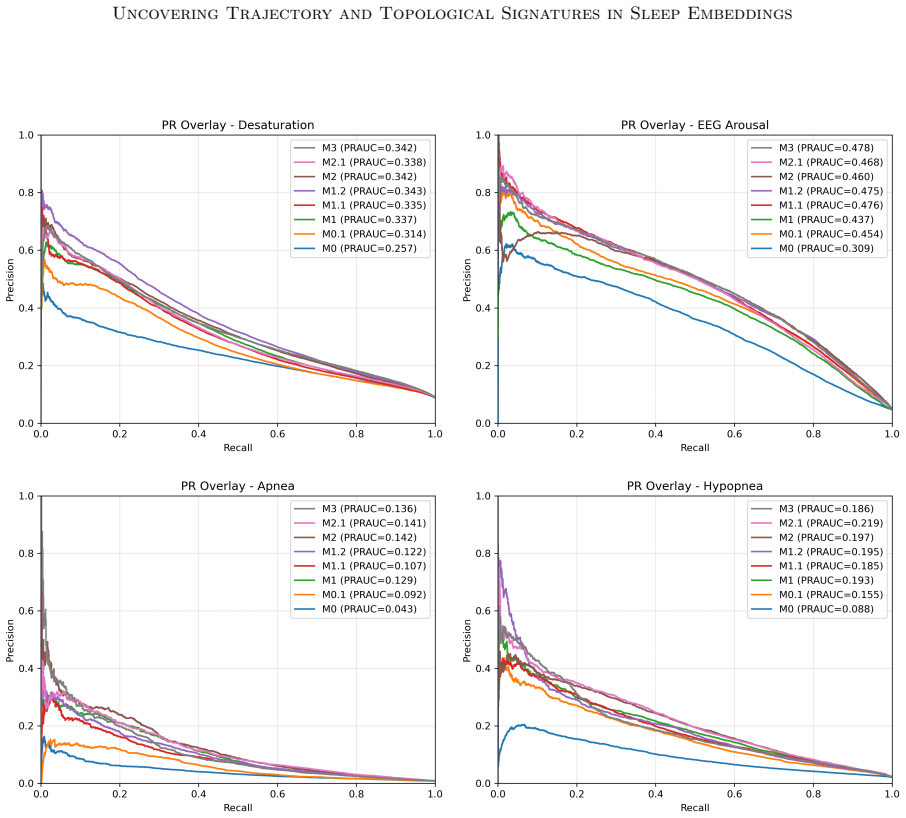
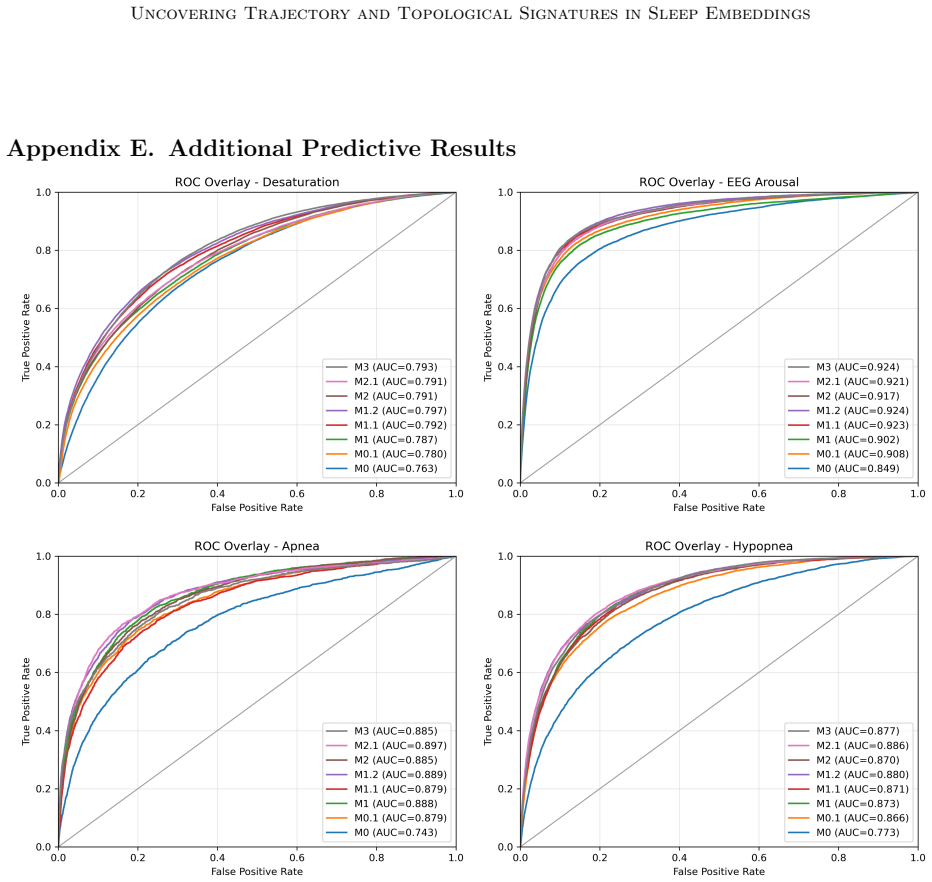
The authors claim that latent geometry from PHATE, topological summaries via persistent homology, and EHR features supply complementary, interpretable signals to the multimodal embeddings, resulting in higher AUPRC and better calibration for predicting desaturation (0.26 to 0.34), EEG arousal (0.31 to 0.48), hypopnea (0.09 to 0.22), and apnea (0.05 to 0.14) using linear and MLP classifiers.
What carries the argument
The central mechanism is the fusion of per-epoch embeddings with PHATE coordinates, whole-night movement descriptors, persistent homology summaries of the embedding point cloud, and EHR variables, evaluated through interpretable linear and MLP models on four binary classification tasks.
If this is right
- More expressive late-fusion models outperform simpler ones across tasks.
- Feature importance is task-dependent, with different signals mattering for different events.
- The full fusion model achieves the best calibration as measured by Brier score and Expected Calibration Error.
- These signals improve robustness under extreme class imbalance in pediatric PSG data.
Where Pith is reading between the lines
- If correct, similar geometric and topological augmentations might improve embedding-based models in other time-series medical domains such as EEG or ECG analysis.
- This suggests that masked autoencoder embeddings primarily capture local epoch information, leaving global trajectory and shape properties to be added explicitly.
- Future work could test whether these gains persist when using more advanced deep learning classifiers instead of linear and MLP models.
- The task-dependence of feature importance points to the need for event-specific feature selection in sleep diagnostics.
Load-bearing premise
The reported performance improvements stem from truly complementary information in the added geometric, topological, and clinical features rather than from overfitting or artifacts specific to the imbalanced pediatric PSG dataset.
What would settle it
Retraining the linear and MLP models on an independent pediatric sleep dataset and observing no AUPRC gains or calibration improvements when adding the PHATE, persistent homology, and EHR features would falsify the central claim.
Figures




read the original abstract
While generative models have shown promise in pediatric sleep analysis, the latent structure of their multimodal embeddings remains poorly understood. This work investigates session-wide diagnostic information contained in the sequences of 30-second pediatric PSG epochs embedded by a multimodal masked autoencoder. We test whether augmenting embeddings with PHATE-derived per-epoch coordinates and whole-night movement descriptors, persistent homology summaries of the embedding cloud, and EHR yields task-relevant signals. Simple linear and MLP models, chosen for interpretability rather than state-of-the-art performance, show that geometric, topological, and clinical features each provide complementary gains. For binary predictions, feature importance is task-dependent, and more expressive late-fusion models generally perform better, with AUPRC improving from 0.26 to 0.34 for desaturation, 0.31 to 0.48 for EEG arousal, 0.09 to 0.22 for hypopnea, and 0.05 to 0.14 for apnea. We also report Brier score and Expected Calibration Error, where the full fusion model yields the best calibration across all four binary tasks. Our study reveals that latent geometry/topology and EHR offer complementary, interpretable signals beyond embeddings, improving calibration and robustness under extreme imbalance.
Editorial analysis
A structured set of objections, weighed in public.
Referee Report
Summary. The manuscript investigates session-wide diagnostic information in 30-second epoch embeddings from a multimodal masked autoencoder applied to pediatric PSG data. It tests whether augmenting these embeddings with PHATE-derived geometric coordinates, persistent homology summaries of the embedding cloud, whole-night movement descriptors, and EHR features yields complementary signals for binary prediction of desaturation, EEG arousal, hypopnea, and apnea events. Simple linear and MLP models demonstrate AUPRC gains (0.26→0.34, 0.31→0.48, 0.09→0.22, 0.05→0.14 respectively) and improved calibration with late fusion, attributing the gains to task-dependent feature importance from geometry, topology, and clinical data.
Significance. If the performance deltas are shown to arise from truly orthogonal signals under leakage-free evaluation, the work would establish that latent geometric and topological structure in multimodal sleep embeddings supplies interpretable, complementary information beyond the base representations, with particular value for calibration in severely imbalanced pediatric PSG tasks. The deliberate use of linear/MLP heads for interpretability and the reporting of Brier scores plus ECE are positive design choices.
major comments (2)
- [Methods] Methods section: the pipeline description does not specify whether PHATE coordinates, persistent homology summaries, and whole-night movement descriptors were computed on the full session embedding cloud before any train/test split or inside each training fold only. Because these features are derived from the same point cloud used for downstream prediction, any global computation would introduce leakage and directly undermine the complementarity claim for the reported AUPRC deltas.
- [Results] Results section (and abstract): no dataset size (patients or epochs), patient-level cross-validation details, nested CV procedure, or statistical testing (e.g., DeLong tests or bootstrap CIs on AUPRC) is provided. Without these, it is impossible to determine whether the gains from 0.26 to 0.34 (desaturation) and 0.05 to 0.14 (apnea) exceed what would be expected from post-hoc feature selection or imbalance artifacts alone.
minor comments (2)
- [Abstract] Abstract: the positive-class prevalences for the four binary tasks are not stated, making the reported AUPRC values difficult to interpret in context of 'extreme imbalance'.
- [Results] Figure captions and text: clarify whether feature importance rankings are derived from the linear models or the MLP heads, and whether they are averaged across folds.
Simulated Author's Rebuttal
We thank the referee for the constructive and detailed comments, which highlight important aspects of methodological transparency and statistical rigor. We address each major comment below and will revise the manuscript to incorporate the requested clarifications and additions.
read point-by-point responses
-
Referee: [Methods] Methods section: the pipeline description does not specify whether PHATE coordinates, persistent homology summaries, and whole-night movement descriptors were computed on the full session embedding cloud before any train/test split or inside each training fold only. Because these features are derived from the same point cloud used for downstream prediction, any global computation would introduce leakage and directly undermine the complementarity claim for the reported AUPRC deltas.
Authors: We agree that the current Methods section lacks explicit detail on this critical point. All PHATE coordinates, persistent homology summaries, and movement descriptors were in fact computed strictly inside each training fold of the patient-level cross-validation, using only training-patient embeddings to derive the geometric and topological features before applying them to held-out test folds. No global computation across the full dataset occurred. We will revise the Methods section to explicitly describe this fold-wise procedure, including the nested CV structure used for feature extraction, to eliminate any ambiguity regarding leakage. revision: yes
-
Referee: [Results] Results section (and abstract): no dataset size (patients or epochs), patient-level cross-validation details, nested CV procedure, or statistical testing (e.g., DeLong tests or bootstrap CIs on AUPRC) is provided. Without these, it is impossible to determine whether the gains from 0.26 to 0.34 (desaturation) and 0.05 to 0.14 (apnea) exceed what would be expected from post-hoc feature selection or imbalance artifacts alone.
Authors: We acknowledge that the Results section and abstract currently omit these essential details. The revised manuscript will report the full dataset size (number of patients and total epochs), a complete description of the patient-level cross-validation scheme, confirmation that nested CV was used for both hyperparameter selection and feature computation, and appropriate statistical analyses including bootstrap confidence intervals on AUPRC differences and DeLong tests for paired model comparisons. These additions will allow readers to properly evaluate the significance of the observed gains relative to potential artifacts. revision: yes
Circularity Check
No significant circularity in the empirical feature augmentation pipeline
full rationale
The paper presents an empirical analysis of multimodal pediatric sleep embeddings from a masked autoencoder, augmented with independently computed geometric (PHATE), topological (persistent homology), movement descriptors, and EHR features. These are fed into simple linear and MLP models for downstream binary prediction tasks, with reported AUPRC gains evaluated on the data. No equations, self-definitional steps, fitted inputs renamed as predictions, or load-bearing self-citations reduce the complementarity claims to quantities defined by the same parameters. Feature extraction and evaluation follow standard ML pipelines that are self-contained and falsifiable against external benchmarks, with no ansatzes or uniqueness theorems imported from prior author work.
Axiom & Free-Parameter Ledger
free parameters (1)
- MLP and linear model hyperparameters
axioms (1)
- domain assumption Multimodal masked autoencoder embeddings contain latent session-wide diagnostic information in pediatric PSG sequences.
Lean theorems connected to this paper
-
IndisputableMonolith/Foundation/AlexanderDuality.leanalexander_duality_circle_linking echoes?
echoesECHOES: this paper passage has the same mathematical shape or conceptual pattern as the Recognition theorem, but is not a direct formal dependency.
We compute persistent homology directly on the original 7,680-D embedding cloud and summarize H0 and H1 characteristics
-
IndisputableMonolith/Foundation/ArithmeticFromLogic.leanembed_strictMono_of_one_lt unclear?
unclearRelation between the paper passage and the cited Recognition theorem.
PHATE-derived per-epoch coordinates and whole-night movement descriptors
What do these tags mean?
- matches
- The paper's claim is directly supported by a theorem in the formal canon.
- supports
- The theorem supports part of the paper's argument, but the paper may add assumptions or extra steps.
- extends
- The paper goes beyond the formal theorem; the theorem is a base layer rather than the whole result.
- uses
- The paper appears to rely on the theorem as machinery.
- contradicts
- The paper's claim conflicts with a theorem or certificate in the canon.
- unclear
- Pith found a possible connection, but the passage is too broad, indirect, or ambiguous to say the theorem truly supports the claim.
Reference graph
Works this paper leans on
-
[1]
Guillaume Tauzin and Umberto Lupo and Lewis Tunstall and Julian Burella Pérez and Matteo Caorsi and Anibal Medina-Mardones and Alberto Dassatti and Kathryn Hess , year=. giotto-tda:. 2004.02551 , archivePrefix=
-
[2]
Goldberger, Ary L and Amaral, Luis AN and Glass, Leon and Hausdorff, Jeffrey M and Ivanov, Plamen Ch and Mark, Roger G and Mietus, Joseph E and Moody, George B and Peng, Chung-Kang and Stanley, H Eugene , journal=. 2000 , publisher=
work page 2000
-
[3]
Zhang, Guo-Qiang and Cui, Licong and Mueller, Remo and Tao, Shiqiang and Kim, Matthew and Rueschman, Michael and Mariani, Sara and Mobley, Daniel and Redline, Susan , journal=. 2018 , publisher=
work page 2018
-
[4]
Thapa, Rahul and He, Bryan and Kjaer, Magnus Ruud and Iv, Hyatt Moore and Ganjoo, Gauri and Mignot, Emmanuel and Zou, James , booktitle =. 2024 , volume =
work page 2024
-
[5]
Proceedings of the IEEE/CVF Conference on Computer Vision and Pattern Recognition (CVPR) , month =
He, Kaiming and Chen, Xinlei and Xie, Saining and Li, Yanghao and Doll\'ar, Piotr and Girshick, Ross , title =. Proceedings of the IEEE/CVF Conference on Computer Vision and Pattern Recognition (CVPR) , month =. 2022 , pages =
work page 2022
-
[6]
Journal of the American Academy of Child & Adolescent Psychiatry , volume =. 1997 , issn =. doi:https://doi.org/10.1097/00004583-199701000-00012 , author =
-
[7]
and Huang, Yungui and Chi, Yuejie and Linwood, Simon L
Lee, Harlin and Li, Boyue and DeForte, Shelly and Splaingard, Mark L. and Huang, Yungui and Chi, Yuejie and Linwood, Simon L. , title =. Scientific Data , volume =. 2022 , month =
work page 2022
-
[8]
The AASM Manual for the Scoring of Sleep and Associated Events: Rules, Terminology and Technical Specifications , author =. 2007 , publisher =
work page 2007
-
[9]
Pandey, Saurav Raj and Saeed, Aaqib and Lee, Harlin , booktitle=. 2024 , volume=
work page 2024
-
[10]
Sleep and Breathing , volume =
Karamanli, Harun and Yalcinoz, Tankut and Yalcinoz, Mehmet Akif and Yalcinoz, Tuba , title =. Sleep and Breathing , volume =. 2016 , month =. doi:10.1007/s11325-015-1218-7 , url =
-
[11]
Becht, Etienne and McInnes, Leland and Healy, John and Dutertre, Charles-Antoine and Kwok, Immanuel W. H. and Ng, Lai Guan and Ginhoux, Florent and Newell, Evan W. , title =. Nature Biotechnology , volume =. 2019 , month =
work page 2019
-
[12]
and van Dijk, David and Wang, Zheng and Gigante, Scott and Burkhardt, Daniel B
Moon, Kevin R. and van Dijk, David and Wang, Zheng and Gigante, Scott and Burkhardt, Daniel B. and Chen, William S. and Yim, Kristina and. Visualizing structure and transitions in high-dimensional biological data , journal =. 2019 , month =
work page 2019
-
[13]
Kuchroo, Manik and Huang, Jessie and Wong, Patrick and Grenier, Jean-Christophe and Shung, Dennis and Tong, Alexander and Lucas, Carolina and Klein, Jon and Burkhardt, Daniel B and Gigante, Scott and others , journal=. Multiscale. 2022 , publisher=
work page 2022
-
[14]
Feng, Zishun and Sivak, Joseph A. and Krishnamurthy, Ashok K. , title =. 2024 , isbn =. doi:10.1007/978-3-031-66535-6_25 , booktitle =
-
[15]
Multi-layered deep learning perceptron approach for health risk prediction , author=. Journal of Big Data , volume=. 2020 , publisher=
work page 2020
-
[16]
Journal of the American Medical Informatics Association , volume =
Xiao, Cao and Choi, Edward and Sun, Jimeng , title =. Journal of the American Medical Informatics Association , volume =. 2018 , month =
work page 2018
-
[17]
Optimal-transport analysis of single-cell gene expression identifies developmental trajectories in reprogramming , author=. Cell , volume=. 2019 , publisher=
work page 2019
-
[18]
Selective review of offline change point detection methods , author=. Signal Processing , volume=. 2020 , publisher=
work page 2020
-
[19]
Focal Loss for Dense Object Detection , year=
Lin, Tsung-Yi and Goyal, Priya and Girshick, Ross and He, Kaiming and Dollár, Piotr , journal=. Focal Loss for Dense Object Detection , year=
-
[20]
arXiv preprint arXiv:2207.06921 , year=
Automatic sleep scoring from large-scale multi-channel pediatric eeg , author=. arXiv preprint arXiv:2207.06921 , year=
-
[21]
Multimodal fusion with deep neural networks for leveraging
Huang, Shih-Cheng and Pareek, Anuj and Zamanian, Roham and Banerjee, Imon and Lungren, Matthew P , journal=. Multimodal fusion with deep neural networks for leveraging. 2020 , publisher=
work page 2020
-
[22]
The precision-recall plot is more informative than the
Saito, Takaya and Rehmsmeier, Marc , journal=. The precision-recall plot is more informative than the. 2015 , publisher=
work page 2015
-
[23]
IEEE Transactions on Pattern Analysis and Machine Intelligence , volume=
Multimodal machine learning: A survey and taxonomy , author=. IEEE Transactions on Pattern Analysis and Machine Intelligence , volume=. 2018 , publisher=
work page 2018
-
[24]
IEEE Transactions on Biomedical Engineering , volume=
Phan, Huy and Mikkelsen, Kaare and Ch. IEEE Transactions on Biomedical Engineering , volume=. 2022 , publisher=
work page 2022
-
[25]
Journal of Sleep Research , pages=
Topological Data Analysis Based Characteristics of Electroencephalogram Signals in Children With Sleep Apnea , author=. Journal of Sleep Research , pages=. 2025 , publisher=
work page 2025
-
[26]
Journal of Machine Learning Research , month = jan, pages =
Bubenik, Peter , title =. Journal of Machine Learning Research , month = jan, pages =. 2015 , volume =
work page 2015
-
[27]
Adams, Henry and Emerson, Tegan and Kirby, Michael and Neville, Rachel and Peterson, Chris and Shipman, Patrick and Chepushtanova, Sofya and Hanson, Eric and Motta, Francis and Ziegelmeier, Lori , journal=
-
[28]
Pattern Recognition , volume =. 2020 , issn =. doi:https://doi.org/10.1016/j.patcog.2020.107509 , author =
-
[29]
Marcus, Carole L and Brooks, Lee J and Ward, Sally Davidson and Draper, Kari A and Gozal, David and Halbower, Ann C and Jones, Jacqueline and Lehmann, Christopher and Schechter, Michael S and Sheldon, Stephen and others , journal=. 2012 , publisher=
work page 2012
-
[30]
Kruskal, William H and Wallis, W Allen , journal=. 1952 , publisher=
work page 1952
- [31]
- [32]
-
[33]
Cliff, Norman , year=
-
[34]
Killick, Rebecca and Fearnhead, Paul and Eckley, Idris A , journal=. 2012 , publisher=
work page 2012
-
[35]
Davis, Jesse and Goadrich, Mark , booktitle=
-
[36]
Berry, Richard B and Budhiraja, Rohit and Gottlieb, Daniel J and Gozal, David and Iber, Conrad and Kapur, Vishesh K and Marcus, Carole L and Mehra, Reena and Parthasarathy, Sairam and Quan, Stuart F and others , journal=. 2012 , publisher=
work page 2012
-
[37]
Supratak, Akara and Dong, Hao and Wu, Chao and Guo, Yike , journal=. 2017 , publisher=
work page 2017
-
[38]
Journal of Neural Engineering , volume=
Banville, Hubert and Chehab, Omar and Hyv. Journal of Neural Engineering , volume=. 2021 , publisher=
work page 2021
-
[39]
IEEE Transactions on Pattern Analysis and Machine Intelligence , volume=
XSleepNet: Multi-view sequential model for automatic sleep staging , author=. IEEE Transactions on Pattern Analysis and Machine Intelligence , volume=. 2021 , publisher=
work page 2021
- [40]
-
[41]
Proceedings of the AAAI Conference on Artificial Intelligence , author=. 2015 , month=. doi:10.1609/aaai.v29i1.9602 , number=
discussion (0)
Sign in with ORCID, Apple, or X to comment. Anyone can read and Pith papers without signing in.