Recognition: no theorem link
Paraphrasing Attack Resilience of Various AI-Generated Text Detection Methods
Pith reviewed 2026-05-15 01:31 UTC · model grok-4.3
The pith
Binoculars-inclusive ensembles detect AI text most accurately but lose the largest share of that accuracy when text is paraphrased.
A machine-rendered reading of the paper's core claim, the machinery that carries it, and where it could break.
Core claim
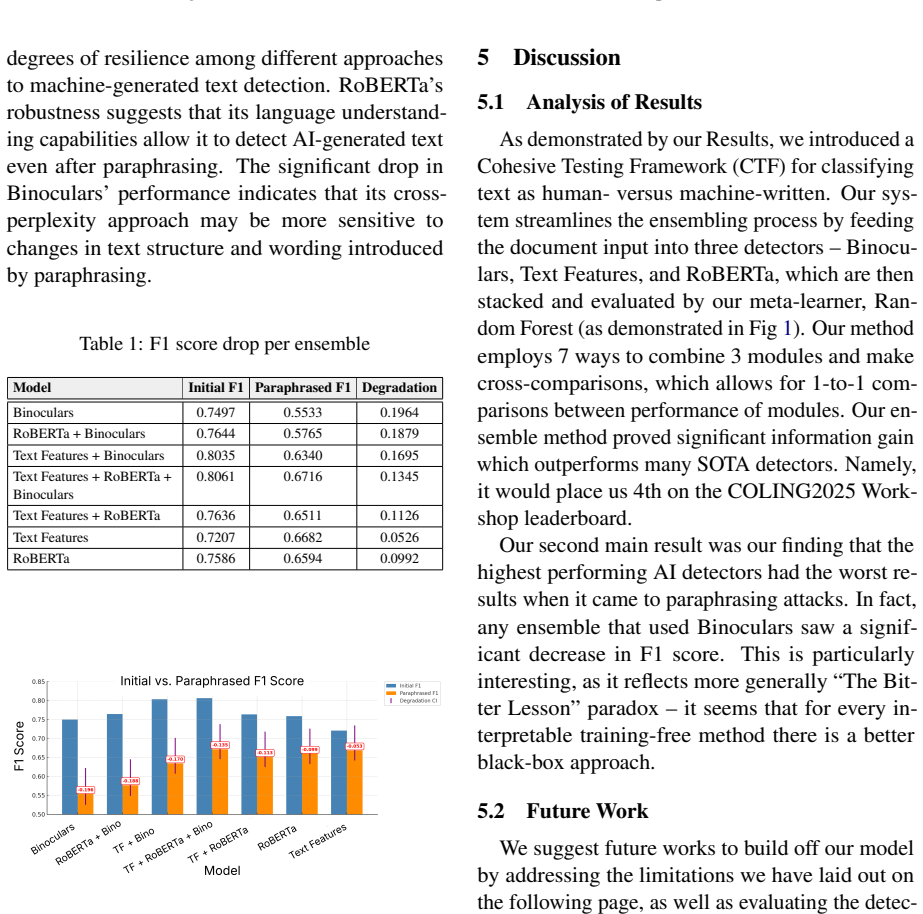
Binoculars-inclusive ensembles yield the strongest detection results but also suffer the most significant losses during attacks, illustrating a dichotomy of performance versus resilience among state-of-the-art AI text detection techniques.
What carries the argument
Comparison of standalone detectors (fine-tuned RoBERTa, Binoculars, text feature analysis) and their Random Forest ensembles under controlled paraphrasing attacks.
If this is right
- Higher-accuracy detectors are more vulnerable to simple rewriting attacks and may require extra defenses.
- Practical systems must choose between peak detection rates and consistent behavior under evasion.
- Ensemble construction improves baseline performance but passes through the same attack weaknesses of its strongest component.
Where Pith is reading between the lines
- Adversarial training focused on paraphrases could narrow the observed resilience gap for Binoculars-based methods.
- Detection pipelines might benefit from runtime selection among models depending on detected rewriting patterns.
- The trade-off may extend to other evasion techniques such as translation or style transfer.
Load-bearing premise
The paraphrasing attacks and evaluation datasets used are representative of real-world evasion attempts and the reported performance differences generalize beyond the specific test conditions.
What would settle it
A follow-up test on a fresh dataset using different paraphrasing tools in which Binoculars-inclusive ensembles no longer show the largest accuracy drops.
Figures





read the original abstract
The recent large-scale emergence of LLMs has left an open space for dealing with their consequences, such as plagiarism or the spread of false information on the Internet. Coupling this with the rise of AI detector bypassing tools, reliable machine-generated text detection is in increasingly high demand. We investigate the paraphrasing attack resilience of various machine-generated text detection methods, evaluating three approaches: fine-tuned RoBERTa, Binoculars, and text feature analysis, along with their ensembles using Random Forest classifiers. We discovered that Binoculars-inclusive ensembles yield the strongest results, but they also suffer the most significant losses during attacks. In this paper, we present the dichotomy of performance versus resilience in the world of AI text detection, which complicates the current perception of reliability among state-of-the-art techniques.
Editorial analysis
A structured set of objections, weighed in public.
Referee Report
Summary. The manuscript evaluates the paraphrasing attack resilience of three AI-generated text detection approaches—fine-tuned RoBERTa, Binoculars, and text feature analysis—along with their Random Forest ensembles. It claims that Binoculars-inclusive ensembles deliver the strongest detection performance but suffer the largest drops under paraphrasing attacks, revealing a performance-resilience trade-off.
Significance. If the empirical comparisons are rigorously supported, the identification of a performance-resilience dichotomy in Binoculars-inclusive ensembles would be a useful practical observation for the design of AI text detectors. It could help the community avoid over-reliance on high-performing but brittle methods when facing real evasion attempts.
major comments (3)
- Abstract: the key discovery is stated but supplies no quantitative results, dataset descriptions, attack implementation details, or error analysis to support the claimed performance-resilience dichotomy. This omission leaves the magnitude of the reported losses unanchored.
- Evaluation section: the representativeness of the paraphrasing attacks (paraphraser models, prompt strategies, lexical diversity) and evaluation datasets is not justified with concrete details on domain coverage or attack strength, which is load-bearing for the generalizability of the trade-off claim.
- Results section: performance differences and loss magnitudes under attacks are presented without statistical significance tests, confidence intervals, or ablation on ensemble feature importance, making it impossible to confirm that Binoculars-inclusive ensembles incur reliably larger drops.
minor comments (2)
- Add explicit descriptions of the Random Forest hyperparameters and feature sets used in the ensembles to improve reproducibility.
- Ensure all tables reporting accuracy or F1 scores include standard deviations across multiple runs or folds.
Simulated Author's Rebuttal
We thank the referee for the constructive feedback on our manuscript. The comments highlight important areas for strengthening the presentation of our empirical findings on the performance-resilience trade-off in AI-generated text detectors. We address each major comment below.
read point-by-point responses
-
Referee: Abstract: the key discovery is stated but supplies no quantitative results, dataset descriptions, attack implementation details, or error analysis to support the claimed performance-resilience dichotomy. This omission leaves the magnitude of the reported losses unanchored.
Authors: We agree that the abstract would be strengthened by including quantitative anchors for the claimed dichotomy. We have revised the abstract to report specific metrics (e.g., pre- and post-attack F1 scores for the top-performing ensembles), along with concise references to the datasets and paraphrasing attack setups used in the study. revision: yes
-
Referee: Evaluation section: the representativeness of the paraphrasing attacks (paraphraser models, prompt strategies, lexical diversity) and evaluation datasets is not justified with concrete details on domain coverage or attack strength, which is load-bearing for the generalizability of the trade-off claim.
Authors: We have expanded the Evaluation section to include explicit details on the paraphraser models (e.g., T5-based and GPT variants), prompt strategies, lexical diversity controls, and the multi-domain datasets (news, academic, and web text). We added a justification subsection explaining their selection based on coverage of real-world evasion scenarios and domain diversity to support the generalizability of the observed trade-off. revision: yes
-
Referee: Results section: performance differences and loss magnitudes under attacks are presented without statistical significance tests, confidence intervals, or ablation on ensemble feature importance, making it impossible to confirm that Binoculars-inclusive ensembles incur reliably larger drops.
Authors: We acknowledge the value of statistical rigor for validating the larger drops. We have updated the Results section to include paired t-tests with reported p-values, 95% confidence intervals on the performance losses, and an ablation study on Random Forest feature importance. These additions confirm that Binoculars features drive both the high baseline performance and the statistically significant larger drops under attack. revision: yes
Circularity Check
No circularity: purely empirical evaluation of existing detectors
full rationale
The paper conducts an empirical comparison of three pre-existing detection methods (fine-tuned RoBERTa, Binoculars, text feature analysis) and their Random Forest ensembles on paraphrased text. No equations, derivations, fitted parameters, or self-citations are used to derive or justify any result by construction. All claims rest on experimental outcomes that can be independently reproduced or falsified on external datasets. This matches the default case of a self-contained empirical study with no load-bearing reductions to prior inputs.
Axiom & Free-Parameter Ledger
Reference graph
Works this paper leans on
-
[1]
https:// www.gptinf.com/
Gptinf: Ai content detection bypass tool. https:// www.gptinf.com/. Accessed: 2025-01-31. Harika Abburi, Michael Suesserman, Nirmala Pudota, Balaji Veeramani, Edward Bowen, and Sanmitra Bhattacharya
2025
-
[2]
Souradip Chakraborty, Amrit Singh Bedi, Sicheng Zhu, Bang An, Dinesh Manocha, and Furong Huang
Generative ai text classifi- cation using ensemble llm approaches.Preprint, arXiv:2309.07755. Souradip Chakraborty, Amrit Singh Bedi, Sicheng Zhu, Bang An, Dinesh Manocha, and Furong Huang
-
[3]
On the possibilities of ai-generated text detection. Preprint, arXiv:2304.04736. Roberto Corizzo and Sebastian Leal-Arenas
-
[4]
Epub 2023 Jun
Distinguish- ing academic science writing from humans or chat- gpt with over 99% accuracy using off-the-shelf ma- chine learning tools.Cell Reports Physical Science, 4(6):101426. Epub 2023 Jun
2023
-
[5]
Xiaomeng Hu, Pin-Yu Chen, and Tsung-Yi Ho
Spotting llms with binoculars: Zero-shot detection of machine-generated text.Preprint, arXiv:2401.12070. Xiaomeng Hu, Pin-Yu Chen, and Tsung-Yi Ho
-
[6]
Kalpesh Krishna, Yixiao Song, Marzena Karpinska, John Wieting, and Mohit Iyyer
Radar: Robust ai-text detection via adversarial learn- ing.Preprint, arXiv:2307.03838. Kalpesh Krishna, Yixiao Song, Marzena Karpinska, John Wieting, and Mohit Iyyer
-
[7]
Rahul Kumar and Michael Mindzak
Paraphras- ing evades detectors of ai-generated text, but retrieval is an effective defense.Preprint, arXiv:2303.13408. Rahul Kumar and Michael Mindzak
-
[8]
RoBERTa: A Robustly Optimized BERT Pretraining Approach
Roberta: A robustly optimized BERT pretraining approach.CoRR, abs/1907.11692. Arthur I. Miller
work page internal anchor Pith review Pith/arXiv arXiv 1907
-
[9]
Alberto Muñoz-Ortiz, Carlos Gómez-Rodríguez, and David Vilares
Luxveri at genai detection task 1: Inverse perplex- ity weighted ensemble for robust detection of ai- generated text across english and multilingual con- texts.Preprint, arXiv:2501.11914. Alberto Muñoz-Ortiz, Carlos Gómez-Rodríguez, and David Vilares
-
[10]
Copyright © 2023 Journal of International Society of Preventive and Community Dentistry
Misconduct in biomedical re- search: A meta-analysis and systematic review.Jour- nal of International Society of Preventive & Commu- nity Dentistry, 13(3):185–193. Copyright © 2023 Journal of International Society of Preventive and Community Dentistry. Diana Trandab˘at, and Daniela Gifu
2023
-
[11]
27th International Conference on Knowledge Based and Intelligent Information and Engineering Sytems (KES 2023)
Discriminat- ing ai-generated fake news.Procedia Computer Sci- ence, 225:3822–3831. 27th International Conference on Knowledge Based and Intelligent Information and Engineering Sytems (KES 2023). Vivek Verma, Eve Fleisig, Nicholas Tomlin, and Dan Klein
2023
-
[12]
Ghostbuster: Detecting text ghostwrit- ten by large language models. InProceedings of the 2024 Conference of the North American Chap- ter of the Association for Computational Linguistics: Human Language Technologies (Volume 1: Long Papers), pages 1702–1717, Mexico City, Mexico. As- sociation for Computational Linguistics. Yuxia Wang, Artem Shelmanov, Joni...
2024
-
[13]
human.arXiv preprint arXiv:2501.11012
Genai content de- tection task 1: English and multilingual machine- generated text detection: Ai vs. human.arXiv preprint arXiv:2501.11012. Junchao Wu, Shu Yang, Runzhe Zhan, Yulin Yuan, Derek F. Wong, and Lidia S. Chao
-
[14]
A survey on llm-generated text detection: Necessity, methods, and future directions.Preprint, arXiv:2310.14724. A Appendix A.0.1 Dataset The training dataset contained a total of 610k entries from HC3, M4GT, and MAGE. The test dataset contained a total of 74k entries from CU- DRT, IELTS, NLPeer, PeerSum, and MixSet. We replicated 3 methods as well as thei...
discussion (0)
Sign in with ORCID, Apple, or X to comment. Anyone can read and Pith papers without signing in.