Recognition: 2 theorem links
· Lean TheoremPower sensitivity of broadband radiofrequency detectors based on quantum diamond spins
Pith reviewed 2026-05-15 02:45 UTC · model grok-4.3
The pith
RF power sensitivity of NV diamond detectors improves as the spin interface shrinks.
A machine-rendered reading of the paper's core claim, the machinery that carries it, and where it could break.
Core claim
The power sensitivity scales inversely with the characteristic physical dimension of the RF-spin interface for both slope-detection and variance-detection protocols in most noise regimes. Photon-shot-noise-limited values of 10^{-20} W Hz^{-1} for slope detection and 10^{-12} W Hz^{-1/2} for variance detection are achievable when the interface is made smaller.
What carries the argument
The RF-spin interface geometry, such as coplanar-waveguide width or loop-antenna diameter, which sets how input RF power translates into the local magnetic field strength at the NV spins.
Load-bearing premise
Ideal spin-RF coupling and specified noise regimes hold without degradation from fabrication imperfections or extra decoherence in small volumes.
What would settle it
Fabricate NV detectors with coplanar waveguides of several different widths, measure their input-power sensitivities under controlled conditions, and check whether sensitivity improves exactly as the inverse of width.
Figures




read the original abstract
Nitrogen-vacancy (NV) centres in diamond can be used to detect radiofrequency (RF) signals through coupling of the RF magnetic field with the NV spins, combined with optical readout of the spin state. The sensitivity of such RF detectors has so far been mainly studied in terms of magnetic field sensitivity, which is relevant when the RF signal is generated by a near-field source. However, for applications where the RF input is delivered externally, a more relevant quantity is the sensitivity in terms of the input RF power. Here we theoretically analyse the power sensitivity of NV-based RF detectors as a function of the RF-spin interface geometry. We derive scaling laws of the power sensitivity for both slope-detection and variance-detection RF sensing protocols, and for various noise regimes. We find that, in most scenarios, the power sensitivity scales inversely with the characteristic physical dimension of the RF-spin interface, for instance the width of a coplanar waveguide or the diameter of a loop antenna. In other words, the smaller the structure and the probed NV volume, the better the power sensitivity, which is contrary to the case of magnetic field sensitivity. Lastly, we numerically estimate that photon shot noise limited sensitivities of 10^{-20} W Hz^{-1} (slope) and 10^{-12} W Hz^{-1/2} (variance) are achievable. This work lays the groundwork for further optimisation of NV-based RF detectors.
Editorial analysis
A structured set of objections, weighed in public.
Referee Report
Summary. The paper theoretically analyzes power sensitivity (rather than magnetic-field sensitivity) of NV-center-based RF detectors for externally delivered signals. It derives scaling laws for slope-detection and variance-detection protocols across noise regimes, concluding that power sensitivity improves as 1/d (d = characteristic RF-spin interface dimension such as coplanar-waveguide width or loop-antenna diameter). Numerical estimates are given for photon-shot-noise-limited performance of 10^{-20} W Hz^{-1} (slope) and 10^{-12} W Hz^{-1/2} (variance).
Significance. If the scaling laws hold under realistic conditions, the work supplies a concrete design rule for miniaturizing NV-RF interfaces to improve power sensitivity, which is the relevant figure of merit for many RF-metrology and sensing applications. The distinction between power and field sensitivity is clearly drawn and the numerical estimates provide a useful benchmark. The derivations rest on standard spin-coupling and noise expressions rather than ad-hoc parameters.
major comments (2)
- [Scaling-law derivation] Scaling-law derivation (main text, following the abstract statement): the inverse scaling with d assumes spin-RF coupling strength, T2*, and optical collection efficiency are independent of d. No quantitative treatment of surface-induced decoherence or reduced collection efficiency at small d is provided, yet these effects are expected to grow with surface-to-volume ratio and could flatten or reverse the claimed scaling.
- [Noise-regime analysis] Noise-regime analysis (slope- and variance-detection sections): the transition between photon-shot-noise and spin-projection-noise limits is stated without explicit d-dependent terms for optical losses or increased surface noise; the numerical sensitivity estimates therefore rest on the ideal-coupling assumption that the skeptic note identifies as load-bearing.
minor comments (2)
- [Abstract and numerical estimates] The abstract and numerical-estimate paragraph would benefit from a short table listing the key parameters (NV density, optical collection efficiency, T2* value) used to obtain the 10^{-20} W Hz^{-1} and 10^{-12} W Hz^{-1/2} figures.
- [Introduction and scaling-laws section] Notation for the characteristic dimension d should be defined once at first use and used consistently when referring to waveguide width versus antenna diameter.
Simulated Author's Rebuttal
We thank the referee for their careful reading of the manuscript and for highlighting the importance of clearly stating the assumptions underlying our scaling laws. We address each major comment below. Where the comments identify gaps in the presentation of limitations, we will revise the manuscript to improve clarity and add discussion of potential deviations from the ideal scaling.
read point-by-point responses
-
Referee: [Scaling-law derivation] Scaling-law derivation (main text, following the abstract statement): the inverse scaling with d assumes spin-RF coupling strength, T2*, and optical collection efficiency are independent of d. No quantitative treatment of surface-induced decoherence or reduced collection efficiency at small d is provided, yet these effects are expected to grow with surface-to-volume ratio and could flatten or reverse the claimed scaling.
Authors: We agree that the derived inverse scaling with d rests on the assumption that spin-RF coupling strength, T2*, and optical collection efficiency are independent of d. This assumption is appropriate for the regime of current experimental devices (d ~ 1-100 μm) where bulk-like NV properties dominate. In the revised manuscript we will (i) explicitly list these assumptions at the start of the scaling derivation, (ii) add a dedicated paragraph discussing how surface-induced decoherence and reduced collection efficiency are expected to scale with surface-to-volume ratio, and (iii) note that the 1/d improvement represents the ideal-case scaling that may saturate or reverse at sufficiently small d. We will cite relevant literature on NV surface effects. This is a partial revision. revision: partial
-
Referee: [Noise-regime analysis] Noise-regime analysis (slope- and variance-detection sections): the transition between photon-shot-noise and spin-projection-noise limits is stated without explicit d-dependent terms for optical losses or increased surface noise; the numerical sensitivity estimates therefore rest on the ideal-coupling assumption that the skeptic note identifies as load-bearing.
Authors: We acknowledge that the noise-regime transitions and the quoted numerical estimates (10^{-20} W Hz^{-1} and 10^{-12} W Hz^{-1/2}) are derived under photon-shot-noise-limited conditions with ideal coupling and collection. In the revision we will introduce explicit d-dependent factors for optical collection efficiency (scaling with the probed area) and briefly discuss how surface noise could shift the crossover between regimes. The numerical estimates will be qualified as benchmarks for the ideal photon-shot-noise case. This is a partial revision. revision: partial
Circularity Check
No circularity: scaling laws derived from independent standard spin-coupling and noise expressions
full rationale
The paper derives the claimed 1/d scaling of power sensitivity directly from standard NV spin physics: RF B-field per unit power scales as ~1/d for the interface geometry, while noise is taken from fixed regimes (photon shot noise or spin-projection noise) whose expressions do not reference the target sensitivity. No parameters are fitted to the result, no self-citation chain is load-bearing for the central claim, and the derivation does not reduce to a self-definition or renaming of known results. The scaling is a straightforward consequence of the input physical relations rather than being forced by construction.
Axiom & Free-Parameter Ledger
axioms (1)
- standard math Standard quantum-mechanical description of NV spin dynamics under RF magnetic field and optical readout
Lean theorems connected to this paper
-
IndisputableMonolith/Cost/FunctionalEquation.leanwashburn_uniqueness_aczel unclear?
unclearRelation between the paper passage and the cited Recognition theorem.
the power sensitivity scales inversely with the characteristic physical dimension of the RF-spin interface... BRF ≈ μ0 IRF / (2w) ... ηCPW ∝ w^{2−4(1−κnoise)/κprot} L^{−2(1−κnoise)/κprot}
-
IndisputableMonolith/Foundation/AlexanderDuality.leanalexander_duality_circle_linking unclear?
unclearRelation between the paper passage and the cited Recognition theorem.
We derive scaling laws of the power sensitivity for both slope-detection and variance-detection RF sensing protocols
What do these tags mean?
- matches
- The paper's claim is directly supported by a theorem in the formal canon.
- supports
- The theorem supports part of the paper's argument, but the paper may add assumptions or extra steps.
- extends
- The paper goes beyond the formal theorem; the theorem is a base layer rather than the whole result.
- uses
- The paper appears to rely on the theorem as machinery.
- contradicts
- The paper's claim conflicts with a theorem or certificate in the canon.
- unclear
- Pith found a possible connection, but the passage is too broad, indirect, or ambiguous to say the theorem truly supports the claim.
Reference graph
Works this paper leans on
-
[1]
Moreover, it allows the field-to-power ratio (i.e
Model The coplanar waveguide (CPW) provides an easy to fabricate, broadband solution for the local delivery of RF signals to the NV spins. Moreover, it allows the field-to-power ratio (i.e. the factorα conc) to be increased by simply reducing the transverse size of the CPW by tapering from a wider source [26]. The CPW can be approximately characterised by...
-
[2]
Scaling laws From Eq. 13, we can derive scaling laws for the sensitivity as a function of the geometrical parameters wandL, in the saturated PL regime and in the linear regime. Two different laser beam geometries are considered, either parallel to the CPW (Fig. 2(a)) or perpendicular to it (Fig. 2(b)). In the saturated regime, we assume there is sufficien...
-
[3]
PL-dependent noise regime We now discuss these scaling laws and their implications for optimising the power sensitivity. We focus on the PL-dependent noise regime (κ noise = 1/2) as this is the most interesting scenario encompassing the photon shot noise limit. In Fig. 2(c-f), we plotη CPW from Eq. 13 as a function of the track widthwwhen substituting the...
-
[4]
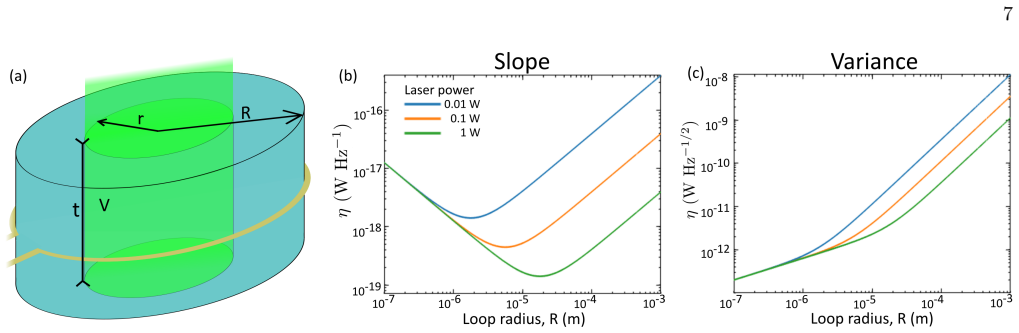
Model Alternate to the CPW, the loop antenna is another common broadband solution for concentrating RF fields from kHz to GHz frequencies [14, 17]. By loop antenna here, we refer to a coaxial cable or planar waveguide terminated in a single-turn omega loop, see Fig. 3(a). Such systems can be modelled as a shorted transmission line where the current flowin...
-
[5]
19 we can derive scaling laws here as a function of the loop radiusR
Scaling laws Similar to the CPW case, from Eq. 19 we can derive scaling laws here as a function of the loop radiusR. In the saturated PL regime, we obtain ηloop ∝R 2−6 1−κnoise κprot .(20) In the linear regime and considering a laser beam perpendicular to the plane of the loop as shown in Fig. 3(a), we obtain ηloop ∝R 2−2 1−κnoise κprot .(21) The explicit...
-
[6]
PL-dependent noise regime We now discuss theRdependence of the sensitivity in the PL-dependent noise regime (κnoise = 1/2). Fig. 3(b)- (c) plotsη loop calculated from Eq. 19 when substituting the general saturation law forρ PL in Eq. 7 for both the slope and variance detection cases. Similarly to the CPW, largeRcorresponds to the linear PL regime, whereas...
-
[7]
R. Rizzato, N. R. von Grafenstein, and D. B. Bucher, Quantum sensors in diamonds for magnetic resonance spectroscopy: Current applications and future prospects, Applied Physics Letters123, 260502 (2023)
work page 2023
-
[8]
J. Du, F. Shi, X. Kong, F. Jelezko, and J. Wrachtrup, Single-molecule scale magnetic resonance spectroscopy using quantum diamond sensors, Rev. Mod. Phys.96, 025001 (2024)
work page 2024
-
[9]
X.-D. Chen, E.-H. Wang, L.-K. Shan, S.-C. Zhang, C. Feng, Y. Zheng, Y. Dong, G.-C. Guo, and F.-W. Sun, Quantum enhanced radio detection and ranging with solid spins, Nature Communications14, 1288 (2023), publisher: Nature Publishing Group
work page 2023
-
[10]
L. Shao, M. Zhang, M. Markham, A. M. Edmonds, and M. Lonˇ car, Diamond radio receiver: Nitrogen-vacancy centers as fluorescent transducers of microwave signals, Phys. Rev. Appl.6, 064008 (2016)
work page 2016
-
[11]
S. Magaletti, L. Mayer, J.-F. Roch, and T. Debuisschert, A quantum radio frequency signal analyzer based on nitrogen vacancy centers in diamond, Communications Engineering1, 19 (2022), publisher: Nature Publishing Group
work page 2022
-
[12]
M. Chipaux, L. Toraille, C. Larat, L. Morvan, S. Pezzagna, J. Meijer, and T. Debuisschert, Wide bandwidth instantaneous radio frequency spectrum analyzer based on nitrogen vacancy centers in diamond, Applied Physics Letters107, 233502 (2015)
work page 2015
-
[13]
J. Meinel, V. Vorobyov, B. Yavkin, D. Dasari, H. Sumiya, S. Onoda, J. Isoya, and J. Wrachtrup, Heterodyne sensing of microwaves with a quantum sensor, Nature Communications12, 10.1038/s41467-021- 22714-y (2021), arXiv: 2008.10068 Publisher: Nature Research
-
[14]
Z. Wang, F. Kong, P. Zhao, Z. Huang, P. Yu, Y. Wang, F. Shi, and J. Du, Picotesla magnetometry of microwave fields with diamond sensors, Science Advances 8, eabq8158 (2022)
work page 2022
- [15]
-
[16]
X.-D. Chen, H.-X. Zang, Y. Dong, Z.-W. Liu, M.-Q. Ma, S.-C. Zhang, Y. Zheng, G.-C. Guo, and F.-W. Sun, Microwave remote sensing with hybrid quantum receiver, ACS Nano18, 27393 (2024)
work page 2024
-
[17]
T. Wolf, P. Neumann, K. Nakamura, H. Sumiya, T. Ohshima, J. Isoya, and J. Wrachtrup, Subpicotesla diamond magnetometry, Phys. Rev. X5, 041001 (2015)
work page 2015
-
[18]
J. F. Barry, M. H. Steinecker, S. T. Alsid, J. Majumder, L. M. Pham, M. F. O’Keeffe, and D. A. Braje, Sensitive ac and dc magnetometry with nitrogen-vacancy-center ensembles in diamond, Phys. Rev. Appl.22, 044069 (2024)
work page 2024
-
[19]
G. de Lange, D. Rist` e, V. V. Dobrovitski, and R. Hanson, Single-spin magnetometry with multipulse sensing sequences, Phys. Rev. Lett.106, 080802 (2011)
work page 2011
-
[20]
D. R. Glenn, D. B. Bucher, J. Lee, M. D. Lukin, H. Park, and R. L. Walsworth, High-resolution magnetic resonance spectroscopy using a solid-state spin sensor, Nature555, 351 (2018)
work page 2018
- [21]
- [22]
-
[23]
J. C. Hermann, R. Rizzato, F. Bruckmaier, R. D. Allert, A. Blank, and D. B. Bucher, Extending radiowave fre- quency detection range with dressed states of solid- state spin ensembles, npj Quantum Information10, 103 (2024), publisher: Nature Publishing Group. 10
work page 2024
- [24]
-
[25]
G. Wang, Y.-X. Liu, J. M. Schloss, S. T. Alsid, D. A. Braje, and P. Cappellaro, Sensing of arbitrary-frequency fields using a quantum mixer, Phys. Rev. X12, 021061 (2022)
work page 2022
-
[26]
Z. Yin, J. J. Welter, C. A. Hart, P. V. Petruzzi, and R. L. Walsworth, High-resolution and wide-frequency- range magnetic spectroscopy with solid-state spin ensem- bles, npj Quantum Information11, 190 (2025)
work page 2025
- [27]
-
[28]
C. L. Degen, F. Reinhard, and P. Cappellaro, Quantum sensing, Rev. Mod. Phys.89, 035002 (2017)
work page 2017
-
[29]
A. Laraoui, J. S. Hodges, C. A. Ryan, and C. A. Meriles, Diamond nitrogen-vacancy center as a probe of random fluctuations in a nuclear spin ensemble, Phys. Rev. B84, 104301 (2011)
work page 2011
-
[30]
R. Rizzato, M. Schalk, S. Mohr, J. C. Hermann, J. P. Leibold, F. Bruckmaier, G. Salvitti, C. Qian, P. Ji, G. V. Astakhov, U. Kentsch, M. Helm, A. V. Stier, J. J. Finley, and D. B. Bucher, Extending the coherence of spin de- fects in hBN enables advanced qubit control and quan- tum sensing, Nature Communications14, 5089 (2023), publisher: Nature Publishing Group
work page 2023
-
[31]
N. B. Manson, J. P. Harrison, and M. J. Sellars, Nitrogen- vacancy center in diamond: Model of the electronic structure and associated dynamics, Phys. Rev. B74, 104303 (2006)
work page 2006
-
[32]
W. Jia, Z. Shi, X. Qin, X. Rong, and J. Du, Ultra- broadband coplanar waveguide for optically detected magnetic resonance of nitrogen-vacancy centers in diamond, Review of Scientific Instruments89, 064705 (2018)
work page 2018
-
[33]
J.-P. Tetienne, N. Dontschuk, D. A. Broadway, S. E. Lillie, T. Teraji, D. A. Simpson, A. Stacey, and L. C. L. Hollenberg, Apparent delocalization of the current density in metallic wires observed with diamond nitrogen-vacancy magnetometry, Phys. Rev. B99, 014436 (2019)
work page 2019
-
[34]
F. Lenzini, N. Gruhler, N. Walter, and W. H. P. Pernice, Diamond as a platform for integrated quantum photonics, Advanced Quantum Technologies1, 1800061 (2018)
work page 2018
-
[35]
J. F. Barry, J. M. Schloss, E. Bauch, M. J. Turner, C. A. Hart, L. M. Pham, and R. L. Walsworth, Sensitivity optimization for nv-diamond magnetometry, Rev. Mod. Phys.92, 015004 (2020)
work page 2020
-
[36]
S. H. Mousavi, I. A. D. Williamson, and Z. Wang, Kinetic inductance driven nanoscale 2D and 3D THz transmis- sion lines, Scientific Reports6, 25303 (2016)
work page 2016
-
[37]
O. R. Opaluch, N. Oshnik, R. Nelz, and E. Neu, Optimized planar microwave antenna for nitrogen vacancy center based sensing applications, Nanomaterials 11, 10.3390/nano11082108 (2021)
-
[38]
Z. Li, Z. Li, Z. Shi, H. Zhang, Y. Liang, and J. Tang, Design of a high-bandwidth uniform radiation antenna for wide-field imaging with ensemble nv color centers in diamond, Micromachines13, 10.3390/mi13071007 (2022)
- [39]
-
[40]
E. R. Eisenach, J. F. Barry, L. M. Pham, R. G. Rojas, D. R. Englund, and D. A. Braje, Broadband loop gap resonator for nitrogen vacancy centers in diamond, Review of Scientific Instruments89, 094705 (2018)
work page 2018
-
[41]
H. H. Vallabhapurapu, J. P. Slack-Smith, V. K. Sewani, C. Adambukulam, A. Morello, J. J. Pla, and A. Laucht, Fast Coherent Control of a Nitrogen-Vacancy-Center Spin Ensemble Using a KTaO 3 Dielectric Resonator at Cryogenic Temperatures, Physical Review Applied16, 044051 (2021), publisher: American Physical Society. Appendix A: CPW: Numerical simulations I...
work page 2021
discussion (0)
Sign in with ORCID, Apple, or X to comment. Anyone can read and Pith papers without signing in.