Recognition: 2 theorem links
· Lean TheoremOpen Quantum Theory of Shot Noise in Dissipative Chiral Transport
Pith reviewed 2026-05-15 02:31 UTC · model grok-4.3
The pith
Current noise in dissipative chiral transport arises from the competition between average occupancy and particle-number fluctuations.
A machine-rendered reading of the paper's core claim, the machinery that carries it, and where it could break.
Core claim
Mapping the open dissipative chiral transport problem onto a quantum circuit yields an exact decomposition of current noise into occupancy-distribution and particle-number-fluctuation contributions; complete energy relaxation suppresses all but the U(1)-protected residual noise.
What carries the argument
Quantum-circuit mapping that decomposes noise into separate occupancy-distribution and particle-number-fluctuation terms.
If this is right
- Shot noise is strongly suppressed once energy relaxation is complete.
- Inter-channel noise correlations reverse sign under selective source heating.
- The occupancy distribution can be reconstructed from measured noise cumulants via the proposed inversion scheme.
- Only the component of noise protected by particle-number conservation survives full relaxation.
Where Pith is reading between the lines
- The same circuit decomposition may apply to other open quantum transport geometries with chiral edges.
- The residual U(1)-protected noise could serve as a stable reference signal in experiments where thermal noise dominates.
- Varying the bath coupling strength offers a direct experimental knob to tune between the two noise contributions.
Load-bearing premise
The open-system dynamics of the dissipative chiral transport can be captured exactly by the quantum-circuit representation without further uncontrolled approximations.
What would settle it
Failure to observe a sign reversal in inter-channel correlation noise when the source is selectively heated while the bath remains cold would contradict the claimed decomposition.
Figures


read the original abstract
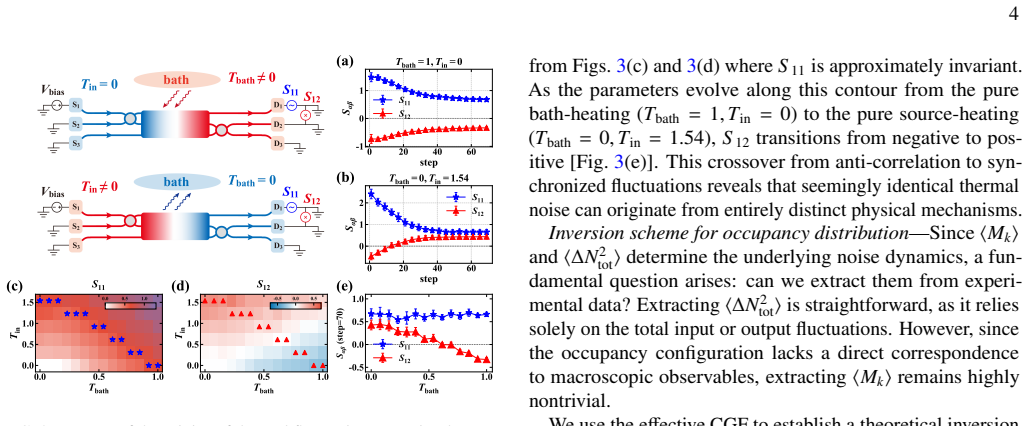
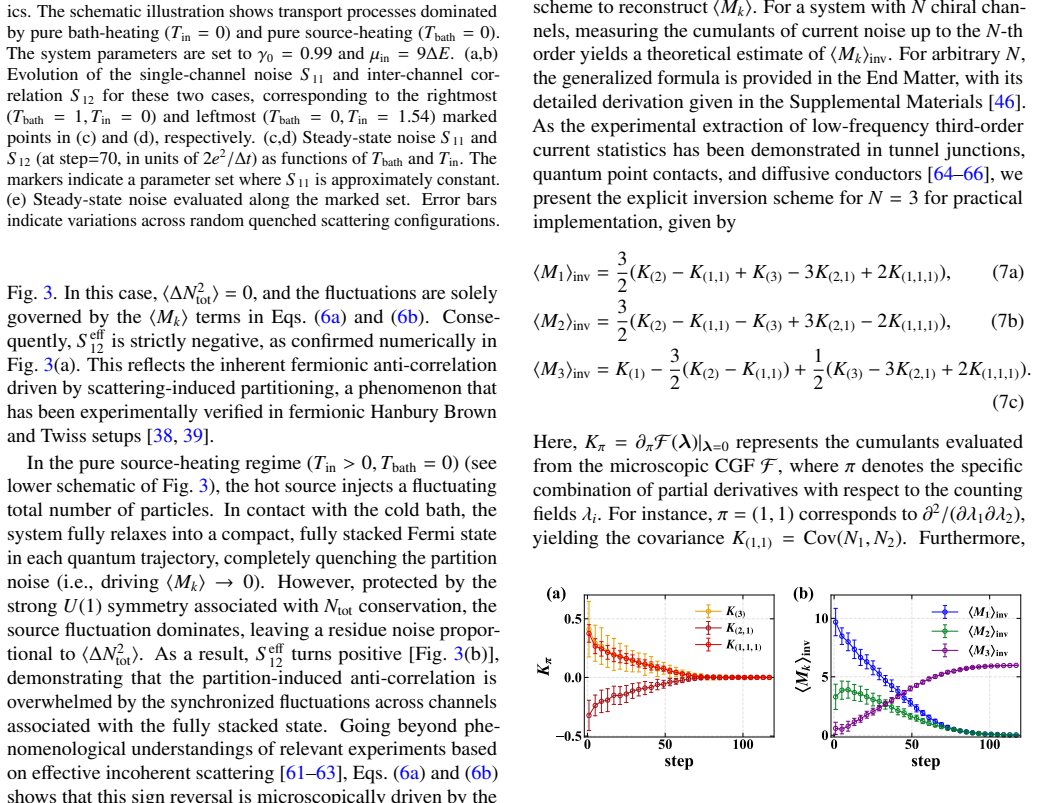
We develop an open quantum theory for shot-noise dynamics in dissipative chiral transport. By mapping a system under consideration onto a quantum circuit, we show that current noise is governed by two competing factors: the average occupancy distribution and particle-number fluctuations. With energy fully relaxed, shot noise is strongly suppressed, reflecting the stacking of electrons into lower energy states due to dissipation. This process quenches the partition noise from partially occupied levels, and finally isolates the residual noise protected by strong $U(1)$ symmetry. Moreover, selectively heating the source against the bath uncovers the underlying competition between the noise contributions from the occupancy distribution and those from the particle-number fluctuations. It triggers a sign reversal in inter-channel correlation noise, a signature masked by seemingly identical single-channel thermal noises. We propose an inversion scheme to experimentally reconstruct the hidden occupancy distribution directly from measurable noise cumulants.
Editorial analysis
A structured set of objections, weighed in public.
Referee Report
Summary. The manuscript develops an open quantum theory of shot noise in dissipative chiral transport. By mapping the system onto a quantum circuit, it decomposes current noise into competing contributions from the average occupancy distribution and particle-number fluctuations. Full energy relaxation is shown to strongly suppress shot noise via electron stacking into lower states, quenching partition noise and isolating only the residual component protected by U(1) symmetry. Selective heating of the source is used to expose the competition, producing a sign reversal in inter-channel correlation noise, and an inversion scheme is proposed to reconstruct the hidden occupancy distribution from measurable noise cumulants.
Significance. If the quantum-circuit mapping is shown to be exact and free of hidden approximations, the work would supply a useful framework for noise analysis in open dissipative systems, clarifying how dissipation suppresses partition noise while preserving symmetry-protected residuals. The proposed inversion from cumulants to occupancy could enable new experimental probes of non-equilibrium distributions in mesoscopic chiral devices.
major comments (2)
- [Quantum-circuit mapping section (likely §III)] The central claim of exact noise decomposition and strong suppression rests on the quantum-circuit mapping of the dissipative chiral system. The manuscript must demonstrate explicitly (with the relevant Lindblad equation and circuit construction) that this mapping reproduces the full steady-state noise spectrum without additional Markovian, weak-coupling, or perturbative assumptions; any uncontrolled approximation here would render the suppression result and the isolation of U(1)-protected noise non-exact.
- [Results on energy relaxation and selective heating (likely §IV)] The suppression result and the sign-reversal prediction require validation against known limits. Direct comparison of the derived noise expressions to the equilibrium thermal-noise limit and to the non-dissipative chiral case (with explicit equations) is needed to confirm that the quenching of partition noise is not an artifact of the mapping.
minor comments (2)
- [Inversion scheme paragraph] Define all noise cumulants and the precise form of the inversion scheme with explicit formulas so that the reconstruction procedure can be reproduced from the text alone.
- [Figure captions and associated text] Add uncertainty estimates or parameter-sensitivity analysis to the plots showing sign reversal in inter-channel correlations.
Simulated Author's Rebuttal
We thank the referee for the careful reading of our manuscript and the constructive comments. We address each major comment below and will revise the manuscript to provide the requested explicit demonstrations and validations.
read point-by-point responses
-
Referee: [Quantum-circuit mapping section (likely §III)] The central claim of exact noise decomposition and strong suppression rests on the quantum-circuit mapping of the dissipative chiral system. The manuscript must demonstrate explicitly (with the relevant Lindblad equation and circuit construction) that this mapping reproduces the full steady-state noise spectrum without additional Markovian, weak-coupling, or perturbative assumptions; any uncontrolled approximation here would render the suppression result and the isolation of U(1)-protected noise non-exact.
Authors: We agree that the quantum-circuit mapping requires a fully explicit presentation to establish its validity. In the revised manuscript we will add a dedicated subsection that states the Lindblad master equation for the dissipative chiral system, details the circuit construction, and derives the steady-state noise spectrum directly from it. Within the standard Lindblad framework (which assumes Markovian dynamics and weak system-bath coupling by construction), no further perturbative or uncontrolled approximations are introduced; the noise decomposition follows exactly from the mapping. We will emphasize these points to confirm that the suppression of partition noise and the isolation of the U(1)-protected residual are exact results inside the model. revision: yes
-
Referee: [Results on energy relaxation and selective heating (likely §IV)] The suppression result and the sign-reversal prediction require validation against known limits. Direct comparison of the derived noise expressions to the equilibrium thermal-noise limit and to the non-dissipative chiral case (with explicit equations) is needed to confirm that the quenching of partition noise is not an artifact of the mapping.
Authors: We concur that direct validation against known limits is necessary. In the revised manuscript we will insert explicit comparisons in §IV: (i) the equilibrium limit (zero bias voltage, finite temperature) will be shown to recover the Johnson-Nyquist thermal noise with the corresponding equation; (ii) the non-dissipative limit (vanishing relaxation rate) will be shown to reproduce the standard partition-noise formula for chiral transport. These reductions will be derived step-by-step from the general noise expressions, demonstrating that the quenching of partition noise is a physical consequence of energy relaxation rather than an artifact of the mapping. revision: yes
Circularity Check
No significant circularity detected in derivation chain
full rationale
The abstract and provided context describe a mapping of the dissipative chiral system onto a quantum circuit that permits decomposition of noise into occupancy and fluctuation terms. No equations, self-definitions, fitted parameters renamed as predictions, or load-bearing self-citations are quoted that would reduce the central claims to their own inputs by construction. The derivation is presented as an independent construction within the open-system Lindblad framework and remains self-contained against external benchmarks such as the master equation itself.
Axiom & Free-Parameter Ledger
Lean theorems connected to this paper
-
IndisputableMonolith/Cost/FunctionalEquation.leanwashburn_uniqueness_aczel unclear?
unclearRelation between the paper passage and the cited Recognition theorem.
We map this transport process onto a fermionic quantum circuit... intra-layer random unitary gates U(m) and inter-layer dissipative jump operators Kα... both commute with Ntot, strictly enforcing a strong U(1) symmetry
-
IndisputableMonolith/Foundation/ArrowOfTime.leanz_monotone_absolute echoes?
echoesECHOES: this paper passage has the same mathematical shape or conceptual pattern as the Recognition theorem, but is not a direct formal dependency.
dissipation forces electrons to pack into lower energy states... quenches the partition noise... isolates the residual noise protected by strong U(1) symmetry
What do these tags mean?
- matches
- The paper's claim is directly supported by a theorem in the formal canon.
- supports
- The theorem supports part of the paper's argument, but the paper may add assumptions or extra steps.
- extends
- The paper goes beyond the formal theorem; the theorem is a base layer rather than the whole result.
- uses
- The paper appears to rely on the theorem as machinery.
- contradicts
- The paper's claim conflicts with a theorem or certificate in the canon.
- unclear
- Pith found a possible connection, but the passage is too broad, indirect, or ambiguous to say the theorem truly supports the claim.
Reference graph
Works this paper leans on
-
[1]
J. B. Johnson, Thermal agitation of electricity in conductors, Phys. Rev.32, 97 (1928)
work page 1928
-
[2]
Nyquist, Thermal agitation of electric charge in conductors, Phys
H. Nyquist, Thermal agitation of electric charge in conductors, Phys. Rev.32, 110 (1928)
work page 1928
-
[3]
Brillouin, Fluctuations de courant dans un conducteur, Helv
L. Brillouin, Fluctuations de courant dans un conducteur, Helv. Phys. Acta7, 47 (1934)
work page 1934
-
[4]
Y . M. Blanter and M. Büttiker, Shot noise in mesoscopic con- ductors, Phys. Rep.336, 1 (2000)
work page 2000
-
[5]
C. W. J. Beenakker and H. van Houten, Semiclassical theory of shot noise and its suppression in a conductor with deterministic scattering, Phys. Rev. B43, 12066 (1991)
work page 1991
-
[6]
A. Shimizu and M. Ueda, Effects of dephasing and dissipation on quantum noise in conductors, Phys. Rev. Lett.69, 1403 (1992)
work page 1992
-
[7]
C. W. J. Beenakker, Suppression of shot noise in metallic diffu- sive conductors, Phys. Rev. B46, 1889 (1992)
work page 1992
-
[8]
R. C. Liu and Y . Yamamoto, Suppression of quantum partition noise in mesoscopic electron branching circuits, Phys. Rev. B 49, 10520 (1994)
work page 1994
-
[9]
R. C. Liu and Y . Yamamoto, Nyquist noise in the transition from mesoscopic to macroscopic transport, Phys. Rev. B50, 17411 (1994)
work page 1994
-
[10]
M. J. M. de Jong and C. W. J. Beenakker, Semiclassical theory of shot-noise suppression, Phys. Rev. B51, 16867 (1995)
work page 1995
-
[11]
A. H. Steinbach, J. M. Martinis, and M. H. Devoret, Observation of hot-electron shot noise in a metallic resistor, Phys. Rev. Lett. 76, 3806 (1996)
work page 1996
-
[12]
Y . V . Nazarov, ed.,Quantum Noise in Mesoscopic Physics, NATO Science Series II: Mathematics, Physics and Chemistry No. 97 (Springer Netherlands, 2003)
work page 2003
-
[13]
M. G. Pala and G. Iannaccone, Effect of dephasing on the current statistics of mesoscopic devices, Phys. Rev. Lett.93, 256803 (2004)
work page 2004
- [14]
-
[15]
C. W. J. Beenakker, Pure dephasing increases partition noise in the quantum Hall effect, Phys. Rev. B113, 075416 (2026)
work page 2026
-
[16]
C.-Z. Chang, J. Zhang, X. Feng, J. Shen, Z. Zhang, M. Guo, K. Li, Y . Ou, P. Wei, L.-L. Wang, Z.-Q. Ji, Y . Feng, S. Ji, X. Chen, J. Jia, X. Dai, Z. Fang, S.-C. Zhang, K. He, Y . Wang, L. Lu, X.-C. Ma, and Q.-K. Xue, Experimental observation of the quan- tum anomalous Hall effect in a magnetic topological insulator, Science340, 167 (2013)
work page 2013
-
[17]
X. Kou, S.-T. Guo, Y . Fan, L. Pan, M. Lang, Y . Jiang, Q. Shao, T. Nie, K. Murata, J. Tang, Y . Wang, L. He, T.-K. Lee, W.-L. Lee, and K. L. Wang, Scale-invariant quantum anomalous Hall effect in magnetic topological insulators beyond the two-dimensional limit, Phys. Rev. Lett.113, 137201 (2014)
work page 2014
- [18]
- [19]
-
[20]
A. Marguerite, J. Birkbeck, A. Aharon-Steinberg, D. Halbertal, K. Bagani, Y . Myasoedov, A. K. Geim, D. J. Perello, and E. Zel- dov, Imaging work and dissipation in the quantum Hall state in graphene, Nature575, 628 (2019)
work page 2019
-
[21]
Y .-F. Zhao, R. Zhang, R. Mei, L.-J. Zhou, H. Yi, Y .-Q. Zhang, J. Yu, R. Xiao, K. Wang, N. Samarth, M. H. W. Chan, C.-X. Liu, and C.-Z. Chang, Tuning the Chern number in quantum anomalous Hall insulators, Nature588, 419 (2020)
work page 2020
-
[22]
C.-Z. Chang, C.-X. Liu, and A. H. MacDonald, Colloquium: Quantum anomalous Hall effect, Rev. Mod. Phys.95, 011002 (2023)
work page 2023
-
[23]
H. Li, H. Jiang, Q.-F. Sun, and X. C. Xie, Emergent energy dissipation in quantum limit, Science Bulletin69, 1221 (2024)
work page 2024
-
[24]
Q. Yan, H. Li, H. Jiang, Q.-F. Sun, and X. C. Xie, Rules for dissi- pationless topotronics, Science Advances10, eado4756 (2024)
work page 2024
-
[25]
K. M. Fijalkowski, N. Liu, M. Klement, S. Schreyeck, K. Brun- ner, C. Gould, and L. W. Molenkamp, A balanced quantum Hall resistor, Nat. Electron.7, 438 (2024)
work page 2024
-
[26]
X.-L. Qi, T. L. Hughes, and S.-C. Zhang, Chiral topological superconductor from the quantum Hall state, Phys. Rev. B82, 184516 (2010)
work page 2010
-
[27]
C. W. J. Beenakker, Search for Majorana fermions in supercon- ductors, Annu. Rev. Condens. Matter Phys.4, 113 (2013)
work page 2013
-
[28]
M. Sato and Y . Ando, Topological superconductors: a review, Rep. Prog. Phys.80, 076501 (2017). 6
work page 2017
-
[29]
B. Lian, X.-Q. Sun, A. Vaezi, X.-L. Qi, and S.-C. Zhang, Topo- logical quantum computation based on chiral Majorana fermions, Proc. Natl. Acad. Sci. USA115, 10938 (2018)
work page 2018
-
[30]
Büttiker, Absence of backscattering in the quantum Hall effect in multiprobe conductors, Phys
M. Büttiker, Absence of backscattering in the quantum Hall effect in multiprobe conductors, Phys. Rev. B38, 9375 (1988)
work page 1988
-
[31]
C. W. J. Beenakker, Random-matrix theory of quantum transport, Rev. Mod. Phys.69, 731 (1997)
work page 1997
-
[32]
Q. Ma, F. D. Parmentier, P. Roulleau, and G. Fleury, Graphene n−p junctions in the quantum Hall regime: Numerical study of incoherent scattering effects, Phys. Rev. B97, 205445 (2018)
work page 2018
-
[33]
C. W. J. Beenakker and J.-F. Chen, Monitored quantum trans- port: full counting statistics of a quantum Hall interferometer, Quantum9, 1874 (2025)
work page 2025
-
[34]
C. W. J. Beenakker, Shot noise from which-path detection in a chiral Majorana interferometer, Phys. Rev. B112, L081402 (2025)
work page 2025
-
[35]
S. Datta,Electronic Transport in Mesoscopic Systems, Cam- bridge Studies in Semiconductor Physics and Microelectronic Engineering (Cambridge University Press, Cambridge, 1995)
work page 1995
-
[36]
H. Haug and A.-P. Jauho,Quantum Kinetics in Transport and Optics of Semiconductors, 2nd ed., Solid-State Sciences No. 123 (Springer, Berlin, Heidelberg, 2008)
work page 2008
-
[37]
Y . V . Nazarov and Y . M. Blanter,Quantum Transport: Introduc- tion to Nanoscience(Cambridge University Press, Cambridge, 2009)
work page 2009
- [38]
-
[39]
W. D. Oliver, J. Kim, R. C. Liu, and Y . Yamamoto, Hanbury Brown and Twiss-type experiment with electrons, Science284, 299 (1999)
work page 1999
-
[40]
B. Buˇca and T. Prosen, A note on symmetry reductions of the Lindblad equation: transport in constrained open spin chains, New J. Phys.14, 073007 (2012)
work page 2012
-
[41]
V . V . Albert and L. Jiang, Symmetries and conserved quantities in lindblad master equations, Phys. Rev. A89, 022118 (2014)
work page 2014
-
[42]
D. A. Abanin and L. S. Levitov, Quantized transport in graphene p−njunctions in a magnetic field, Science317, 641 (2007)
work page 2007
-
[43]
J. R. Williams, L. DiCarlo, and C. M. Marcus, Quantum Hall effect in a gate-controlledp−n junction of graphene, Science 317, 638 (2007)
work page 2007
-
[44]
S. Oberholzer, E. V . Sukhorukov, C. Strunk, and C. Schönen- berger, Shot noise of series quantum point contacts intercalating chaotic cavities, Phys. Rev. B66, 233304 (2002)
work page 2002
-
[45]
J. Li and S.-Q. Shen, Disorder effects in the quantum Hall effect of graphenep−njunctions, Phys. Rev. B78, 205308 (2008)
work page 2008
-
[46]
See Supplemental Materials for details
-
[47]
H.-P. Breuer and F. Petruccione,The Theory of Open Quantum Systems(Oxford University Press, Oxford, 2007)
work page 2007
-
[48]
M. A. Nielsen and I. L. Chuang,Quantum Computation and Quantum Information: 10th Anniversary Edition(Cambridge University Press, 2010)
work page 2010
-
[49]
F. Verstraete, M. M. Wolf, and J. I. Cirac, Quantum computation and quantum-state engineering driven by dissipation, Nat. Phys. 5, 633 (2009)
work page 2009
-
[50]
Schollwöck, The density-matrix renormalization group in the age of matrix product states, Ann
U. Schollwöck, The density-matrix renormalization group in the age of matrix product states, Ann. Phys. January 2011 Special Issue,326, 96 (2011)
work page 2011
-
[51]
S. Paeckel, T. Köhler, A. Swoboda, S. R. Manmana, U. Scholl- wöck, and C. Hubig, Time-evolution methods for matrix-product states, Ann. Phys.411, 167998 (2019)
work page 2019
- [52]
-
[53]
T. Xiang,Density Matrix and Tensor Network Renormalization (Cambridge University Press, Cambridge, 2023)
work page 2023
- [54]
-
[55]
M. Fishman, S. R. White, and E. M. Stoudenmire, The ITensor Software Library for Tensor Network Calculations, SciPost Phys. Codebases , 4 (2022)
work page 2022
-
[56]
L. S. Levitov and G. B. Lesovik, Charge distribution in quantum shot noise, JETP Lett.58, 230 (1993)
work page 1993
-
[57]
Y . V . Nazarov, Circuit theory for full counting statistics in multi- terminal circuits, Phys. Rev. Lett.88, 196801 (2002)
work page 2002
-
[58]
S. Pilgram, P. Samuelsson, H. Förster, and M. Büttiker, Full- counting statistics for voltage and dephasing probes, Phys. Rev. Lett.97, 066801 (2006)
work page 2006
-
[59]
H. Förster, P. Samuelsson, S. Pilgram, and M. Büttiker, V oltage and dephasing probes in mesoscopic conductors: A study of full-counting statistics, Phys. Rev. B75, 035340 (2007)
work page 2007
-
[60]
Both formalisms are equivalent for extracting the cumulants of the fluctuations
In contrast to the conventional characteristic function with a complex phase eiλ ˆN widely used in quantum transport, we define the generating function using a real parameter λ for algebraic simplicity. Both formalisms are equivalent for extracting the cumulants of the fluctuations
-
[61]
C. Texier and M. Büttiker, Effect of incoherent scattering on shot noise correlations in the quantum Hall regime, Phys. Rev. B62, 7454 (2000)
work page 2000
-
[62]
S. Oberholzer, E. Bieri, C. Schönenberger, M. Giovannini, and J. Faist, Positive cross correlations in a normal-conducting fermionic beam splitter, Phys. Rev. Lett.96, 046804 (2006)
work page 2006
-
[63]
T. Ota, M. Hashisaka, K. Muraki, and T. Fujisawa, Negative and positive cross-correlations of current noises in quantum Hall edge channels at bulk filling factor ν =1, J. Phys.: Condens. Matter29, 225302 (2017)
work page 2017
- [64]
-
[65]
G. Gershon, Y . Bomze, E. V . Sukhorukov, and M. Reznikov, De- tection of non-Gaussian fluctuations in a quantum point contact, Phys. Rev. Lett.101, 016803 (2008)
work page 2008
-
[66]
Open Quantum Theory of Shot Noise in Dissipative Chiral Transport
E. Pinsolle, S. Houle, C. Lupien, and B. Reulet, Non-Gaussian current fluctuations in a short diffusive conductor, Phys. Rev. Lett.121, 027702 (2018). End Matter Inversion Scheme for the Occupancy Distribution—To ob- tain the inverted average occupancy distribution ⟨Mk⟩inv from the measurable joint cumulants Kπ = ∂π ˜F |λ=0, we employ a three-step inversi...
work page 2018
-
[67]
Unitary Scattering S2
-
[68]
Dissipative Kraus Operators S2 C. Average of Observables S3 D. Momentum and Cumulant Generating Function S3 S3. Derivation of the Inversion Scheme S3 A. Definitions of the Effective CGF and the Filter Cumulants and Operators S3
-
[69]
The Effective CGF S3
-
[70]
Effect of the Filter Operator S4 C
The Filter Cumulant S4 B. Effect of the Filter Operator S4 C. Determining the CoefficientsWm(k) S5 S4. Simulation Parameters S6 S1. CONSTRUCTION OF THE QUANTUM CIRCUIT MODEL A. Kraus Operators for Dissipation For a given channel n between adjacent layers m and m +1, the explicit forms of these Kraus operators ˆK↑, ˆK↓, and ˆK0 are ˆK(m,m+1) ↑,n = √γ↑ˆc† m...
-
[71]
Unitary Scattering SVD U1 U2 U3 FIG. S2. Schematic of the unitary scattering and the subsequent MPS update. The rectangular blocks spanning three adjacent sites (illustrated for N =3) represent the application of the Haar-random unitary operators defined in Eq. (S10). SVD is then employed to factorize the multi-site tensors back into the standard M×N sing...
-
[72]
Dissipative Kraus Operators As established in Sec. S1 C, each step of the dissipative evolution entails applying a specific Kraus operator ˆK to the system. Since we consider jumps between the first channels of adjacent energy levels, the corresponding operator spans across all intermediate lattice sites between the two target sites, as schematically illu...
-
[73]
The Effective CGF Let λ :=( λ1, . . . , λN) be the counting field. The effective CGF is defined as ˜F(λ)=ln⟨e Ψ(λ)⟩M.(S14) Here,M:=( M0,M 1, . . . ,M N). The microscopic generating function is given by Ψ(λ)= NX k=1 Mk ln " S k(λ)/ N k !# ,(S15) where S k(λ)= P i1<···<ik eλi1 +···+λik . The bracket ⟨· · · ⟩M denotes the statistical average over the configu...
-
[74]
The Filter Cumulant We define the m-th order filter cumulant Qm as a linear combination of cumulants Qm = X π⊢m C(π)K π.(S17) The sum runs over all integer partitions π of m with the coeffi- cients C(π)=(−1) |π|−1(|π| −1)! m! Q|π| j=1 p j!Q v cv! .(S18) Here, |π| denotes the total number of parts in the partition π, p j represents the value of the j-th pa...
discussion (0)
Sign in with ORCID, Apple, or X to comment. Anyone can read and Pith papers without signing in.