Recognition: 2 theorem links
· Lean TheoremA quantum chemistry dataset containing ground-state and conical-intersection structures of 260k molecules
Pith reviewed 2026-05-15 02:31 UTC · model grok-4.3
The pith
A dataset supplies ground-state and conical-intersection structures for 260,000 small molecules computed at the OM2/MRCI level.
A machine-rendered reading of the paper's core claim, the machinery that carries it, and where it could break.
Core claim
We constructed a quantum chemistry dataset containing ground-state and conical-intersection structures of small molecules (up to ten heavy atoms: C, N, O, F). Ground-state geometries were optimized at the semi-empirical OM2 level, with single-point energies calculated at the OM2/MRCI level. Conical-intersection geometries and energies were also computed at the OM2/MRCI level. This dataset is designed to enable a deep integration of photochemistry with machine learning, bridging the gap between photochemical insight and data-driven approaches.
What carries the argument
The OM2/MRCI semi-empirical calculations that produce optimized ground-state structures and conical-intersection structures plus energies for each of the 260,000 molecules.
If this is right
- Machine learning models can be trained directly on the conical-intersection examples to predict locations and energy gaps in photoinduced reactions.
- Large-scale screening of photochemical pathways becomes feasible for thousands of small organic molecules without repeated quantum chemistry runs.
- Data-driven methods can now incorporate both ground-state and excited-state features from a single consistent source.
- The dataset supports development of surrogate models that accelerate excited-state dynamics simulations.
Where Pith is reading between the lines
- The data could be combined with existing ground-state property datasets to train models that jointly predict ground- and excited-state behavior.
- A validation campaign that recomputes a few thousand entries at CASSCF or higher levels would quantify the accuracy limits of the semi-empirical approximation.
- Models trained on this set might generalize to slightly larger molecules if the conical-intersection features prove transferable beyond ten heavy atoms.
Load-bearing premise
The OM2/MRCI semi-empirical level supplies sufficiently accurate geometries and relative energies for conical intersections across the full chemical space of the 260,000 molecules.
What would settle it
Direct comparison of conical-intersection geometries and energy gaps from a representative subset of the dataset against reference values from higher-level multireference methods such as CASPT2 or MRCI with expanded basis sets would show large systematic deviations if the assumption fails.
Figures


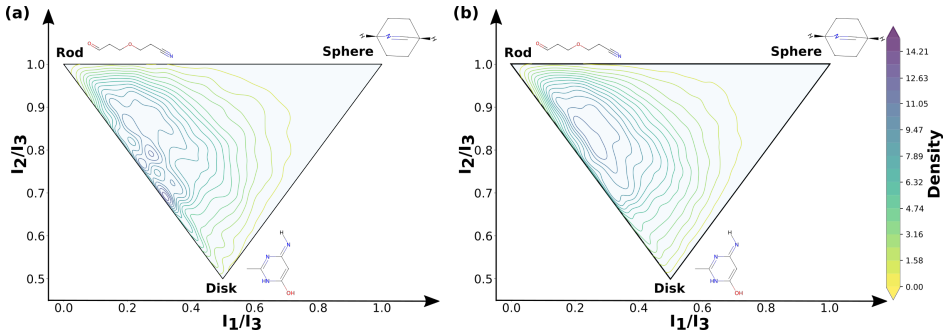


read the original abstract
Conical intersections play central roles in photoinduced reactions. However, comprehensive conical-intersection datasets that could advance our understanding of excited-state reaction processes remain scarce. To address this gap, we constructed a quantum chemistry dataset containing ground-state and conical-intersection structures of small molecules (up to ten heavy atoms: C, N, O, F). Ground-state geometries were optimized at the semi-empirical OM2 level, with single-point energies calculated at the OM2/MRCI level. Conical-intersection geometries and energies were also computed at the OM2/MRCI level. This dataset is designed to enable a deep integration of photochemistry with machine learning, bridging the gap between photochemical insight and data-driven approaches.
Editorial analysis
A structured set of objections, weighed in public.
Referee Report
Summary. The manuscript presents a quantum chemistry dataset containing ground-state and conical-intersection structures for 260k small molecules (up to ten heavy atoms: C, N, O, F). Ground-state geometries were optimized at the semi-empirical OM2 level with single-point energies at OM2/MRCI; conical-intersection geometries and energies were computed at the OM2/MRCI level. The work is framed as enabling machine-learning integration with photochemistry.
Significance. If the dataset is released with complete metadata and access instructions, it would address a genuine scarcity of large-scale conical-intersection data. This resource could support data-driven studies of photoinduced processes, provided users understand the semi-empirical accuracy limits.
minor comments (3)
- Add an explicit data-availability statement with repository DOI, file formats, and any usage license.
- Specify the exact sampling procedure used to generate the 260k molecules so that the chemical-space coverage can be assessed.
- Report the software version, convergence thresholds, and any filtering criteria applied during the OM2/MRCI conical-intersection searches.
Simulated Author's Rebuttal
We thank the referee for the positive assessment of our manuscript and for recommending minor revision. We appreciate the recognition that the dataset addresses a genuine scarcity of large-scale conical-intersection data and will ensure it is released with complete metadata and access instructions.
Circularity Check
No significant circularity; dataset generation is direct computation
full rationale
The manuscript describes the direct application of established semi-empirical methods (OM2 for ground-state geometry optimization and OM2/MRCI for single-point energies and conical-intersection searches) to generate structures and energies for 260k molecules. No equations, fitted parameters, predictions, or self-citations are invoked that reduce any claim to the inputs by construction. The central claim is simply that the dataset was produced and released using the stated protocol, which holds by explicit computation without internal reduction or circularity.
Axiom & Free-Parameter Ledger
axioms (1)
- domain assumption The OM2/MRCI semi-empirical method yields usable ground-state geometries and conical-intersection locations for small organic molecules containing C, N, O, F.
Lean theorems connected to this paper
-
IndisputableMonolith/Cost/FunctionalEquation.leanwashburn_uniqueness_aczel unclear?
unclearRelation between the paper passage and the cited Recognition theorem.
Ground-state geometries were optimized at the semi-empirical OM2 level, with single-point energies calculated at the OM2/MRCI level. Conical-intersection geometries and energies were also computed at the OM2/MRCI level.
-
IndisputableMonolith/Foundation/RealityFromDistinction.leanreality_from_one_distinction unclear?
unclearRelation between the paper passage and the cited Recognition theorem.
This dataset is designed to enable a deep integration of photochemistry with machine learning
What do these tags mean?
- matches
- The paper's claim is directly supported by a theorem in the formal canon.
- supports
- The theorem supports part of the paper's argument, but the paper may add assumptions or extra steps.
- extends
- The paper goes beyond the formal theorem; the theorem is a base layer rather than the whole result.
- uses
- The paper appears to rely on the theorem as machinery.
- contradicts
- The paper's claim conflicts with a theorem or certificate in the canon.
- unclear
- Pith found a possible connection, but the passage is too broad, indirect, or ambiguous to say the theorem truly supports the claim.
Reference graph
Works this paper leans on
-
[1]
Domcke, W. and Yarkony, D. and K\". Conical Intersections: Electronic Structure, Dynamics & Spectroscopy , publisher =. 2004 , volume =
work page 2004
-
[2]
Domcke, W. and Yarkony, D. R. and K\". Conical Intersections: Theory, Computation, and Experiment , publisher =. 2011 , volume =
work page 2011
- [3]
- [4]
- [5]
-
[6]
Curchod, B. F. and Mart\'. Ab Initio Nonadiabatic Quantum Molecular Dynamics , journal =. 2018 , volume =
work page 2018
- [7]
-
[8]
Segatta, F. and Cupellini, L. and Garavelli, M. and Mennucci, B. , title =. Chem. Rev. , year =
- [9]
- [10]
-
[11]
Leach, A. R. , title =
- [12]
-
[13]
Exciton-Vibrational Coupling in the Dynamics and Spectroscopy of
Schr\". Exciton-Vibrational Coupling in the Dynamics and Spectroscopy of. Phys. Rep. , year =
- [14]
- [15]
- [16]
-
[17]
Aldossary, A. and Campos-Gonzalez-Angulo, J. A. and Pablo-Garc\'. In Silico Chemical Experiments in the Age of. Adv. Mater. , year =
-
[18]
Wang, H. and Fu, T. and Du, Y. and Gao, W. and Huang, K. and Liu, Z. and Chandak, P. and Liu, S. and Van Katwyk, P. and Deac, A. and Anandkumar, A. and Bergen, K. and Gomes, C. P. and Ho, S. and Kohli, P. and Lasenby, J. and Leskovec, J. and Liu, T. Y. and Manrai, A. and Marks, D. and Ramsundar, B. and Song, L. and Sun, J. and Tang, J. and Veli. Scientifi...
work page 2023
-
[19]
Shao, C. and Shi, Z. and Xu, J. and Wang, L. , title =. J. Phys. Chem. Lett. , year =
- [20]
-
[21]
Glielmo, A. and Husic, B. E. and Rodriguez, A. and Clementi, C. and No\'. Unsupervised Learning Methods for Molecular Simulation Data , journal =. 2021 , volume =
work page 2021
-
[22]
Bannigan, P. and Aldeghi, M. and Bao, Z. and H\". Machine Learning Directed Drug Formulation Development , journal =. 2021 , volume =
work page 2021
-
[23]
Dral, P. O. and Barbatti, M. , title =. Nat. Rev. Chem. , year =
- [24]
- [25]
-
[26]
Pereira, F. and Xiao, K. and Latino, D. A. R. S. and Wu, C. and Zhang, Q. and Aires-de-Sousa, J. , title =. J. Chem. Inf. Model. , year =
- [27]
-
[28]
Fast and Accurate Excited States Predictions: Machine Learning and Diabatization , journal =
Sr. Fast and Accurate Excited States Predictions: Machine Learning and Diabatization , journal =. 2024 , volume =
work page 2024
-
[29]
Yuan, M. and Zou, Z. and Luo, Y. and Jiang, J. and Hu, W. , title =. J. Phys. Chem. Lett. , year =
-
[30]
Xiao, D. and Wang, S.-R. and Liu, X.-Y. and Fang, W.-H. and Cui, G. , title =. J. Phys. Chem. Lett. , year =
-
[31]
Coxson, A. and Omar, \"O. H. and del Cueto, M. and Troisi, A. , title =. J. Chem. Theory Comput. , year =
-
[32]
Hu, D. and Xie, Y. and Li, X. and Li, L. and Lan, Z. , title =. J. Phys. Chem. Lett. , year =
-
[33]
Chen, W.-K. and Liu, X.-Y. and Fang, W.-H. and Dral, P. O. and Cui, G. , title =. J. Phys. Chem. Lett. , year =
-
[34]
Dral, P. O. and Barbatti, M. and Thiel, W. , title =. J. Phys. Chem. Lett. , year =
-
[35]
Li, J. and Stein, R. and Adrion, D. M. and Lopez, S. A. , title =. J. Am. Chem. Soc. , year =
-
[36]
Lin, K. and Peng, J. and Xu, C. and Gu, F. L. and Lan, Z. , title =. J. Phys. Chem. Lett. , year =
-
[37]
Tang, D. and Jia, L. and Shen, L. and Fang, W.-H. , title =. J. Phys. Chem. Lett. , year =
-
[38]
Ramakrishnan, R. and Dral, P. O. and Rupp, M. and von Lilienfeld, O. A. , title =. Sci. Data , year =
- [39]
- [40]
-
[41]
Koslowski, A. and Beck, M. E. and Thiel, W. , title =. J. Comput. Chem. , year =
-
[42]
Neutral and Charged Biradicals, Zwitterions, Funnels in
Bona. Neutral and Charged Biradicals, Zwitterions, Funnels in. Angew. Chem. Int. Ed. Engl. , year =
-
[43]
Thiel, W. and Beck, M. and Billeter, S. and others , title =. 2019 , note =
work page 2019
-
[44]
doi:10.5281/zenodo.7671152 , note =
Open-source cheminformatics , year =. doi:10.5281/zenodo.7671152 , note =
-
[45]
Nikiforov, A. and Gamez, J. A. and Thiel, W. and Huix-Rotllant, M. and Filatov, M. , title =. J. Chem. Phys. , year =
-
[46]
Malmqvist, P.-. The. Chem. Phys. Lett. , year =
- [47]
-
[48]
Keal, T. W. and Koslowski, A. and Thiel, W. , title =. Theor. Chem. Acc. , year =
-
[49]
Sauer, W. H. B. and Schwarz, M. K. , title =. J. Chem. Inf. Comput. Sci. , year =
- [50]
-
[51]
Anatole , year = 2015, month = aug, journal =
Ramakrishnan, Raghunathan and Hartmann, Mia and Tapavicza, Enrico and Von Lilienfeld, O. Anatole , year = 2015, month = aug, journal =. Electronic Spectra from
work page 2015
-
[52]
A Deep Learning Model for Predicting Selected Organic Molecular Spectra , author =. Nat. Comput. Sci. , volume =
-
[53]
doi:10.1021/acs.jpclett.5c00839 , copyright =
Yuan, Mingzhi and Zou, Zihan and Luo, Yi and Jiang, Jun and Hu, Wei , year = 2025, month = apr, journal =. doi:10.1021/acs.jpclett.5c00839 , copyright =
-
[54]
Liang, Jiechun and Ye, Shuqian and Dai, Tianshu and Zha, Ziyue and Gao, Yuechen and Zhu, Xi , year = 2020, month = nov, journal =
work page 2020
-
[55]
Nakata, Maho and Shimazaki, Tomomi , year = 2017, month = jun, journal =
work page 2017
-
[56]
Molecular Quantum Chemical Data Sets and Databases for Machine Learning Potentials , author =. Mach. Learn.: Sci. Technol. , volume =
-
[57]
Machine Learning of Molecular Electronic Properties in Chemical Compound Space , author =. New J. Phys. , volume =
-
[58]
Fast and Accurate Modeling of Molecular Atomization Energies with Machine Learning , author =. Phys. Rev. Lett. , volume =
-
[59]
Axelrod, Simon and. Sci. Data , volume =
-
[60]
Smith, J. S. and Isayev, O. and Roitberg, A. E. , year = 2017, journal =
work page 2017
-
[61]
and Conte, Chen Qu Riccardo and Nandi, Apurba and Houston, Paul L
Bowman, Joel M. and Conte, Chen Qu Riccardo and Nandi, Apurba and Houston, Paul L. and Yu, Qi , year = 2022, month = jun, journal =. The. doi:10.1063/5.0089200 , archiveprefix =. 2205.11663 , primaryclass =
-
[62]
and Barbatti, Mario , year = 2023, month = feb, journal =
Pinheiro Jr, Max and Zhang, Shuang and Dral, Pavlo O. and Barbatti, Mario , year = 2023, month = feb, journal =
work page 2023
-
[63]
Zhang, Lina and Zhang, Shuang and Owens, Alec and Yurchenko, Sergei N. and Dral, Pavlo O. , year = 2022, month = mar, journal =
work page 2022
-
[64]
Pengmei, Zihan and Liu, Junyu and Shu, Yinan , year = 2024, month = feb, journal =. Beyond
work page 2024
-
[65]
Computational and Data Driven Molecular Material Design Assisted by Low Scaling Quantum Mechanics Calculations and Machine Learning , author=. Chem. Sci. , volume=. 2021 , publisher=
work page 2021
-
[66]
Designing Promising Thermally Activated Delayed Fluorescence Emitters via Machine Learning-Assisted High-Throughput Virtual Screening , author=. J. Phys. Chem. C , volume=. 2023 , publisher=
work page 2023
-
[67]
A Unified Active Learning Framework for Photosensitizer Design , author=. Chem. Sci. , volume=. 2026 , publisher=
work page 2026
-
[68]
Development and Implementation of in Silico Molecule Fragmentation Algorithms for the Cheminformatics Analysis of Natural Product Spaces , author=. 2023 , doi=
work page 2023
-
[69]
Nonadiabatic dynamics: The SHARC approach , author=. WIRES. COMPUT. MOL. SCI. , volume=. 2018 , publisher=
work page 2018
-
[70]
Effect of the damping function in dispersion corrected density functional theory , author=. J. Comput. Chem. , volume=. 2011 , publisher=
work page 2011
-
[71]
InChI, the IUPAC International Chemical Identifier , author=. J. Cheminf. , volume=. 2015 , publisher=
work page 2015
-
[72]
The properties of known drugs. 1. Molecular frameworks , author=. J. Med. Chem. , volume=. 1996 , publisher=
work page 1996
-
[73]
Reactants, Products, and Transition States of Elementary Chemical Reactions Based on Quantum Chemistry , author =. Sci. Data , volume =
-
[74]
Two Excited-State Datasets for Quantum Chemical
Lupo Pasini, Massimiliano and Mehta, Kshitij and Yoo, Pilsun and Irle, Stephan , year = 2023, month = aug, journal =. Two Excited-State Datasets for Quantum Chemical
work page 2023
-
[75]
Pybel: a Python Wrapper for the OpenBabel Cheminformatics Toolkit , author=. Chem. Cent. J. , volume=. 2008 , publisher=
work page 2008
-
[76]
Open Babel: An Open Chemical Toolbox , author=. J. Cheminf. , volume=. 2011 , publisher=
work page 2011
-
[77]
The Atomic Simulation Environment---a Python Library for Working with Atoms , author=. J. Phys. Condens. Matter , volume=. 2017 , publisher=
work page 2017
- [78]
-
[79]
Excited State Non-Adiabatic Dynamics of Large Photoswitchable Molecules Using a Chemically Transferable Machine Learning Potential , author =. Nat. Commun. , volume =
-
[80]
Machine Learning Enables Long Time Scale Molecular Photodynamics Simulations , author=. Chem. Sci. , volume=. 2019 , publisher=
work page 2019
discussion (0)
Sign in with ORCID, Apple, or X to comment. Anyone can read and Pith papers without signing in.