Recognition: no theorem link
Machine-learning-identified two-dimensional van der Waals multiferroics for four-state nonvolatile memory
Pith reviewed 2026-05-15 02:39 UTC · model grok-4.3
The pith
The AuCrP2S6 monolayer combines ferromagnetism and out-of-plane ferroelectricity with bulk photovoltaic readout to support four-state nonvolatile memory in one atomic layer.
A machine-rendered reading of the paper's core claim, the machinery that carries it, and where it could break.
Core claim
Screening the ABC2X6 family identifies AuCrP2S6 monolayer as a representative 2D multiferroic with a ferromagnetic ground state and sizable out-of-plane polarization of 7.46 pC/m together with a moderate ferroelectric switching barrier of roughly 130 meV per formula unit. The bulk photovoltaic effect supplies a nonlinear optical response in which the polarization direction controls the photocurrent sign and the magnetic order selects the spin channel through robust exchange splitting, thereby enabling non-destructive readout of four distinct logic states within one atomic layer.
What carries the argument
The bulk photovoltaic effect inside the AuCrP2S6 monolayer, which converts the coupled ferroelectric and ferromagnetic orders into a dual-channel optical signal for four-state readout.
Load-bearing premise
The machine-learning model trained on the ABC2X6 family correctly ranks synthesizable multiferroic candidates and the subsequent calculations accurately capture both the ground-state orders and the bulk photovoltaic response.
What would settle it
An experiment that measures the photocurrent sign after controlled polarization reversal and finds no reversal, or measures no spin-selective splitting tied to the magnetic order.
Figures


read the original abstract
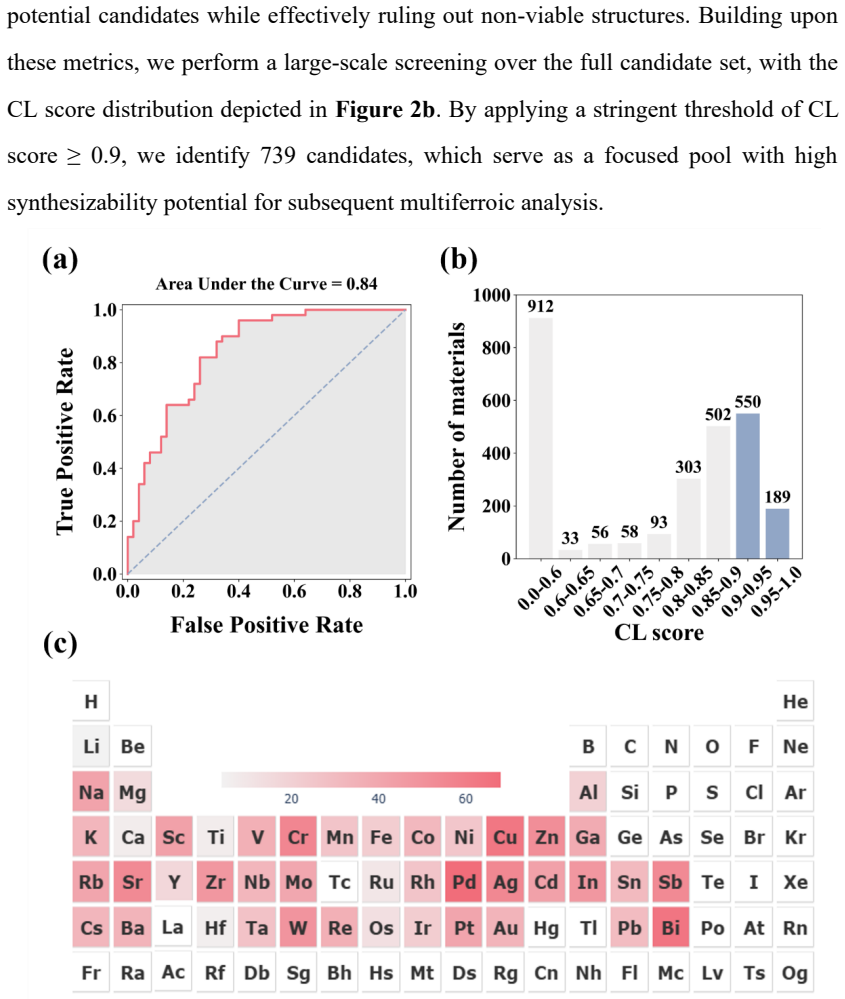
Two-dimensional (2D) van der Waals (vdW) multiferroics offer an attractive platform for four-state nonvolatile memory by combining switchable ferroelectric polarization and magnetization within a single material system. However, their development is hindered by the scarcity of synthesizable candidates and the lack of non-destructive readout schemes. Here, we combine machine-learning screening with first-principles calculations to explore the 2D vdW ABC$_2$X$_6$ family and identify a set of high-confidence multiferroic candidates. Among them, AuCrP$_2$S$_6$ monolayer emerges as a representative system with a ferromagnetic ground state, a sizable out-of-plane polarization of 7.46 pC/m, and a moderate ferroelectric switching barrier of $\sim$130 meV/f.u. Moreover, the nonlinear optical response mediated by the bulk photovoltaic effect (BPVE) in AuCrP$_2$S$_6$ provides a dual-channel probe of the ferroic orders, in which the polarization direction governs the photocurrent sign while the magnetic order selects the spin channel via robust exchange splitting. This intrinsic coupling enables the non-destructive readout of four logic states within a single atomic layer, thereby providing a practical blueprint for next-generation multistate optoelectronic memory.
Editorial analysis
A structured set of objections, weighed in public.
Referee Report
Summary. The manuscript describes a machine-learning screening of the 2D van der Waals ABC2X6 family to identify multiferroic candidates for four-state nonvolatile memory. It identifies AuCrP2S6 monolayer as a representative system exhibiting a ferromagnetic ground state, an out-of-plane polarization of 7.46 pC/m, a ferroelectric switching barrier of approximately 130 meV per formula unit, and a bulk photovoltaic effect that allows dual-channel probing of the ferroic orders for non-destructive readout.
Significance. If the machine-learning model is properly validated and the first-principles results are robust, this work would be significant as it proposes a concrete material candidate with coupled ferroic orders and an optical readout mechanism, addressing the scarcity of 2D multiferroics suitable for multistate memory applications. The approach combines data-driven screening with detailed calculations, which is a positive aspect.
major comments (2)
- [Machine Learning Screening] The abstract and results claim that the ML model accurately ranks synthesizable multiferroic candidates, but no validation metrics such as cross-validation scores, precision-recall on held-out known multiferroics, or feature importance analysis are reported. This is critical because the central claim relies on the reliability of this ranking step to identify AuCrP2S6.
- [First-Principles Calculations] Specific numerical values are given for the polarization (7.46 pC/m) and switching barrier (~130 meV/f.u.), yet the manuscript provides no details on the DFT functional, Hubbard U values if used, k-point sampling, or convergence tests. Without these, the ground-state orders and BPVE response cannot be independently verified.
minor comments (2)
- [Abstract] The polarization unit is given as pC/m; confirm if this is the standard 2D polarization unit (pC/m) or if it should be specified as surface polarization.
- [Discussion] Add more references to prior work on BPVE in 2D materials to contextualize the nonlinear optical response.
Simulated Author's Rebuttal
We thank the referee for the constructive comments and positive assessment of the work's potential significance. We address each major comment below and will revise the manuscript accordingly to improve verifiability and transparency.
read point-by-point responses
-
Referee: [Machine Learning Screening] The abstract and results claim that the ML model accurately ranks synthesizable multiferroic candidates, but no validation metrics such as cross-validation scores, precision-recall on held-out known multiferroics, or feature importance analysis are reported. This is critical because the central claim relies on the reliability of this ranking step to identify AuCrP2S6.
Authors: We agree that explicit validation metrics are necessary to substantiate the ML screening. The current manuscript does not report cross-validation scores, precision-recall on held-out sets, or feature importance. In the revised version, we will add a dedicated subsection detailing the model training, 5-fold cross-validation performance, precision-recall analysis on a held-out test set including known multiferroics, and SHAP feature importance to confirm the robustness of the ranking that identified AuCrP2S6 as a high-confidence candidate. revision: yes
-
Referee: [First-Principles Calculations] Specific numerical values are given for the polarization (7.46 pC/m) and switching barrier (~130 meV/f.u.), yet the manuscript provides no details on the DFT functional, Hubbard U values if used, k-point sampling, or convergence tests. Without these, the ground-state orders and BPVE response cannot be independently verified.
Authors: We acknowledge that the computational details were omitted, which hinders independent verification. The calculations used the PBE functional with Hubbard U=3.5 eV applied to Cr d-orbitals, a 12x12x1 k-point mesh for relaxations (15x15x1 for electronic and BPVE properties), and energy convergence to 10^{-6} eV. Convergence tests for k-points, plane-wave cutoff, and vacuum thickness were performed. In the revised manuscript, we will include a comprehensive 'Computational Methods' section with all parameters, convergence data, and specifics for the BPVE calculations. revision: yes
Circularity Check
No significant circularity in ML screening plus DFT verification chain
full rationale
The paper's derivation proceeds by training an ML model on the ABC2X6 family to rank candidates, followed by independent first-principles calculations that compute ground-state magnetic order, out-of-plane polarization (7.46 pC/m), switching barrier (~130 meV/f.u.), and BPVE response for AuCrP2S6. These DFT outputs are not defined in terms of the ML descriptors or fitted parameters by construction; they are standard electronic-structure results applied to the screened structures. No self-definitional equations, fitted-input predictions, load-bearing self-citations, imported uniqueness theorems, smuggled ansatzes, or renamings of known results appear in the abstract or described workflow. The central claims therefore remain independent of the input data and do not reduce to tautology.
Axiom & Free-Parameter Ledger
axioms (1)
- standard math Standard density-functional-theory approximations (exchange-correlation functional, pseudopotentials, k-point sampling) are sufficient to predict ground-state magnetic order, polarization, and bulk photovoltaic effect.
Reference graph
Works this paper leans on
-
[1]
1 P. Singh, S. Baek, H. H. Yoo, J. Niu, J. H. Park, and S. Lee, “Two-dimensional CIPS-InSe van der Waals heterostructure ferroelectric field effect transistor for nonvolatile memory applications,” ACS Nano 16, 5418-5426 (2022). 2 S. Lin, G. Zhang, Q. Lai, J. Fu, W. Zhu, and H. Zeng, “Recent advances in layered two‐ dimensional ferroelectrics from material...
work page 2022
-
[2]
2D ferroic materials for nonvolatile memory applications,
Liu, C. Shan, and J. He, “2D ferroic materials for nonvolatile memory applications,” Adv. Mater. 37, 2305044 (2025). 4 X. Liu, Z. Pan, Z. Xia, L. Li, Q. Deng, Y . Pan, J. Li, and N. Huo, “Memristors based on 2D materials: bridging device theory and potential applications,” Adv. Funct. Mater., e20816 (2025). 5 X. Wang, Z. Shang, C. Zhang, J. Kang, T. Liu, ...
work page 2025
-
[3]
Electrical and magnetic anisotropies in van der Waals multiferroic CuCrP2S6,
Deng, J. Hong, and J. Zhao, “Electrical and magnetic anisotropies in van der Waals multiferroic CuCrP2S6,” Nat. Commun. 14, 840 (2023). 6 Y . Wu, Z. Zeng, H. Lu, X. Han, C. Yang, N. Liu, X. Zhao, L. Qiao, W. Ji, R. Che, L. Deng, P. Yan, and B. Peng, “Coexistence of ferroelectricity and antiferroelectricity in 2D van der Waals multiferroic,” Nat. Commun. 1...
work page 2023
-
[4]
Evidence for a single-layer van der Waals multiferroic,
Watanabe, T. Taniguchi, A. S. Botana, S. Picozzi, N. Gedik, and R. Comin, “Evidence for a single-layer van der Waals multiferroic,” Nature 602, 601-605 (2022). 10 M. Amini, A. O. Fumega, H. González‐Herrero, V . Vaňo, S. Kezilebieke, J. L. Lado, and P. Liljeroth, “Atomic-scale visualization of multiferroicity in monolayer NiI 2,” Adv. Mater. 36, 2311342 (...
work page 2022
-
[5]
Evidence for multiferroicity in single -layer CuCrSe2,
Chen, K. Wu, X. Tian, C. Wu, and B. Feng, “Evidence for multiferroicity in single -layer CuCrSe2,” Nat. Commun. 15, 4252 (2024). 14 N. A. Hill, “Why are there so few magnetic ferroelectrics?,” J. Phys. Chem. B 104, 6694-6709 (2000). 15 R. Ramesh, and N. A. Spaldin, “Multiferroics: progress and prospects in thin films,” Nat. Mater. 6, 21-29 (2007). 16 N. A...
work page 2024
-
[6]
Revival of ferroelectric memories based on emerging fluorite‐structured ferroelectrics,
Jo, B. J. Kuh, D. Ha, Y . Kim, J. Heo, and M. H. Park, “Revival of ferroelectric memories based on emerging fluorite‐structured ferroelectrics,” Adv. Mater. 35, 2204904 (2023). 25 Y . Su, X. Li, M. Zhu, J. Zhang, L. You, and E. Y . Tsymbal, “Van der Waals multiferroic tunnel junctions,” Nano Lett. 21, 175-181 (2021). 26 Y . Cheng, T. Xu, D. Tian, X. He, Y...
work page 2023
-
[7]
Room -temperature magnetoelectric switching and magnetoelectric memory driven by gate voltage,
Valvidares, P. Yu, and W. Jiang, “Room -temperature magnetoelectric switching and magnetoelectric memory driven by gate voltage,” Phys. Rev. X 15, 011060 (2025). 27 C. Huang, J. Han, J. Wang, J. Jiang, Z. Qu, F. Wu, A. Li, Y . Wan, K. Wang, and E. Kan, “Electric-field switching of interlayer magnetic order in a van der Waals heterobilayer via spin- electr...
work page 2025
-
[8]
When machine learning meets 2D materials: a review,
Wiel, W. Zhang, and P. K. J. Wong, “When machine learning meets 2D materials: a review,” Adv. Sci. 11, 2305277 (2024). 33 A. Jain, S. P. Ong, G. Hautier, W. Chen, W. D. Richards, S. Dacek, S. Cholia, D. Gunter, D
work page 2024
-
[9]
Commentary: the materials project: a materials genome approach to accelerating materials innovation,
Skinner, G. Ceder, and K. A. Persson, “Commentary: the materials project: a materials genome approach to accelerating materials innovation,” APL Mater. 1, 011002 (2013). 34 A. Belsky, M. Hellenbrandt, V . L. Karen, and P. Luksch, “New developments in the inorganic crystal structure database (ICSD): accessibility in support of materials research and design...
work page 2013
-
[10]
CuInP2S6 room temperature layered ferroelectric,
Morozovska, J. Banys, Y . Vysochanskii, and S. V . Kalinin, “CuInP2S6 room temperature layered ferroelectric,” Nano Lett. 15, 3808-3814 (2015). 45 F. Liu, L. You, K. L. Seyler, X. Li, P. Y u, J. Lin, X. Wang, J. Zhou, H. Wang, H. He, S. T
work page 2015
-
[11]
Room-temperature ferroelectricity in CuInP2S6 ultrathin flakes,
Pantelides, W. Zhou, P. Sharma, X. Xu, P . M. Ajayan, J. Wang, and Z. Liu, “Room-temperature ferroelectricity in CuInP2S6 ultrathin flakes,” Nat. Commun. 7, 12357 (2016). 46 S. Huang, Z. Shuai, and D. Wang, “Ferroelectricity in 2D metal phosphorus trichalcogenides and van der Waals heterostructures for photocatalytic water splitting,” J. Mater. Chem. A 9,...
work page 2016
-
[12]
Spatially tunable interfacial ferroelectricity in low-symmetric WTe2,
Tien, C. Chen, Y . Y . Lai, H. Deng, C. S. Chang, H. Lin, T. R. Chang, S. F. Lee, and Y . H. Lee, “Spatially tunable interfacial ferroelectricity in low-symmetric WTe2,” Nano Lett. 26, 864-870 (2026). 50 J. E. Sipe, and A. I. Shkrebtii, “Second-order optical response in semiconductors,” Phys. Rev. B 61, 5337-5352 (2000). 51 J. Ahn, G. Y . Guo, N. Nagaosa,...
work page 2026
discussion (0)
Sign in with ORCID, Apple, or X to comment. Anyone can read and Pith papers without signing in.